Every morning, hundreds of millions of people do something no marketer can buy: they check the weather. They open an app, glance at a number, and quietly decide what to wear, what to eat, where to go, and what to buy. It is the most widely consulted forecast in human life — and for most brands, it is the least consulted dataset in the building.
That is the strange gap at the heart of weather-driven marketing. The signal is public. The science is published. The ad tech has existed for over a decade. And yet, walk into most marketing teams and ask when their creative last changed because it started raining, and you will get a blank stare. This piece is about why that gap exists, what the evidence actually says, and how to close it without buying anything expensive.
The Most Predictable Signal You Already Ignore
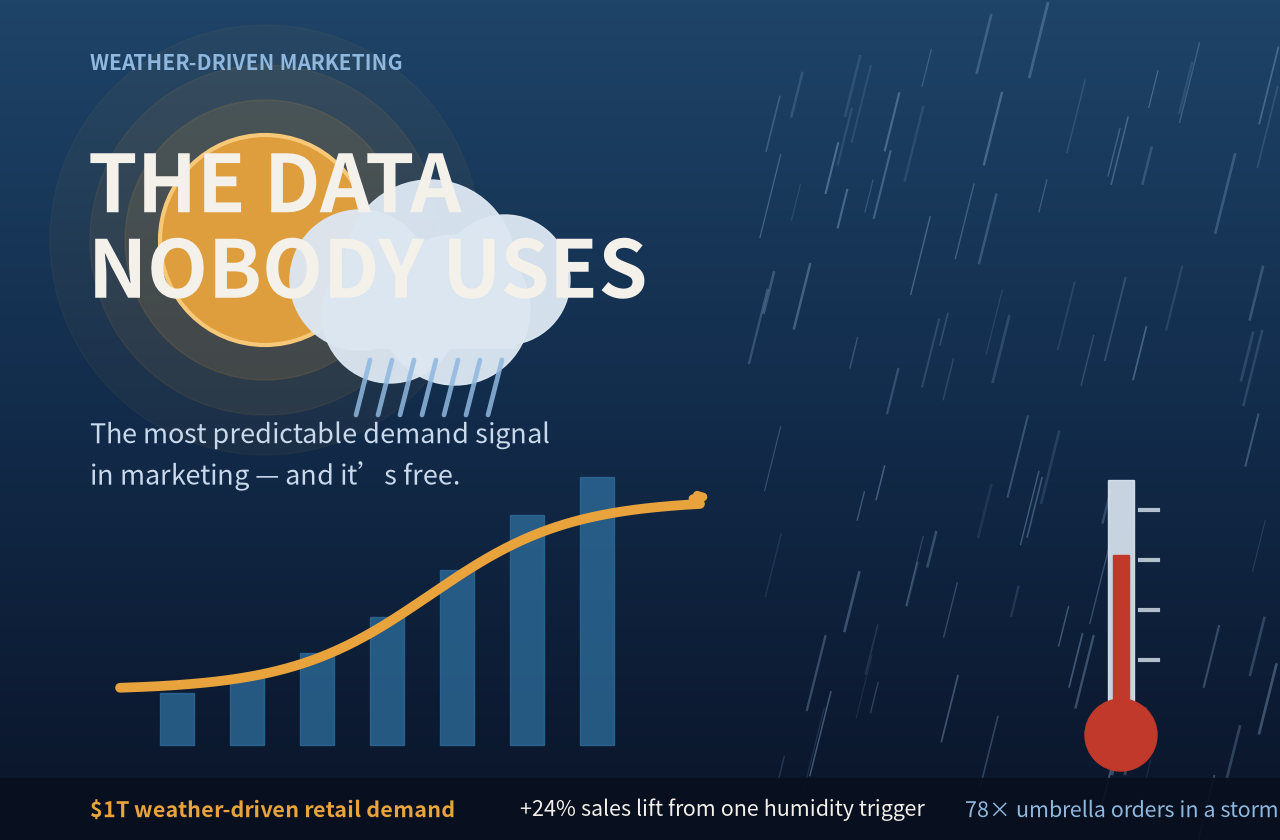
Let us start with scale. The American Meteorological Society estimates that roughly 3.4% of retail sales are directly influenced by weather. The National Retail Federation translates that into about $1 trillion in global retail sales shifting with the weather every year. Not extreme events — the weather. Tuesday being colder than Monday.
Now compare that with how marketing budgets work. Teams pay premiums for audience segments inferred from browsing behavior, modeled lookalikes, and probabilistic intent scores. Meanwhile, the one external variable that moves demand more frequently and more directly than almost anything else sits in a free government API, unused.
Here is the reframe worth keeping: weather is not small talk. It is a forecast of your customers’ needs, published daily, for free, with accuracy no intent model can match.
What the Research Actually Shows
This is not folk wisdom dressed up as strategy. The weather-and-demand relationship has a serious academic paper trail, and it is more interesting than “cold days sell soup.”
Sunshine moves markets — literally
In a classic study published in the Journal of Finance in 2003, David Hirshleifer and Tyler Shumway examined morning sunshine in 26 countries between 1982 and 1997. Sunshine was strongly correlated with daily stock returns; once you controlled for sunshine, rain and snow had no relationship at all. Professional investors, pricing billions of dollars, were nudged by whether the sun was out. If weather tilts trained professionals in high-stakes markets, what do you think it does to a shopper deciding between cooking and ordering in?
The Federal Reserve took weather seriously — twice
Martha Starr-McCluer’s 2000 Federal Reserve Board study found that unusual weather has a modest but significant effect on monthly retail sales — though at quarterly frequency, the effects tended to wash out as shoppers shifted timing. Case closed? Not quite.
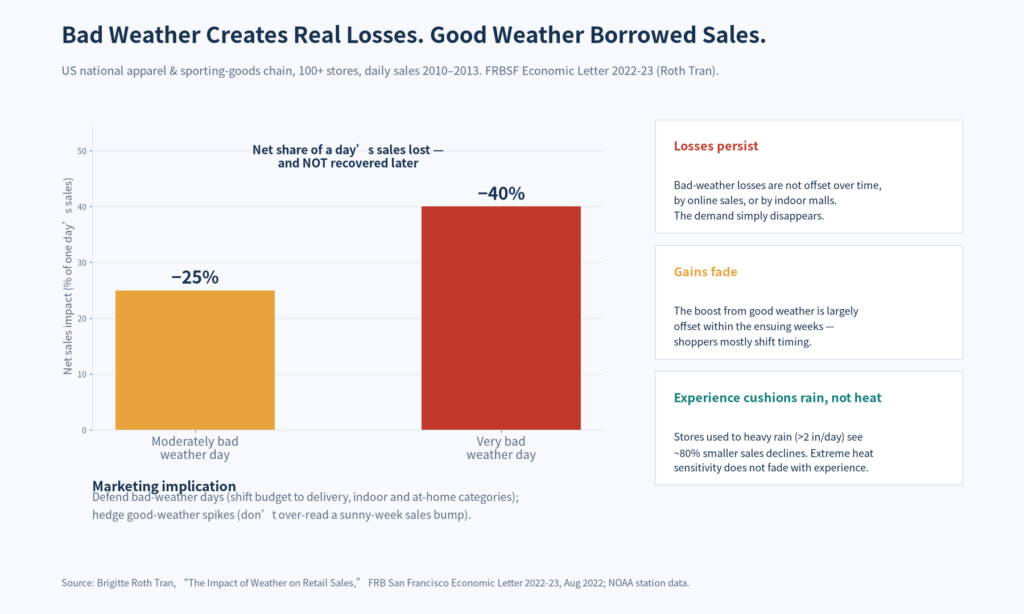
More than two decades later, Brigitte Roth Tran of the San Francisco Fed reopened the question with daily store-level data from over 100 stores of a national apparel and sporting-goods chain. Her finding, published in a 2022 Economic Letter, overturns the comfortable assumption: bad-weather losses are real and persistent. A moderately bad weather day produced a net loss of about one-quarter of a day’s sales; a very bad day, about 40% — losses not recovered later, not rescued by the website, not offset by shoppers switching to indoor malls. Good-weather gains, by contrast, largely faded within the ensuing weeks. The asymmetry matters: rain does not postpone demand. It destroys some of it — and creates demand elsewhere.
Extreme temperatures move whole stores
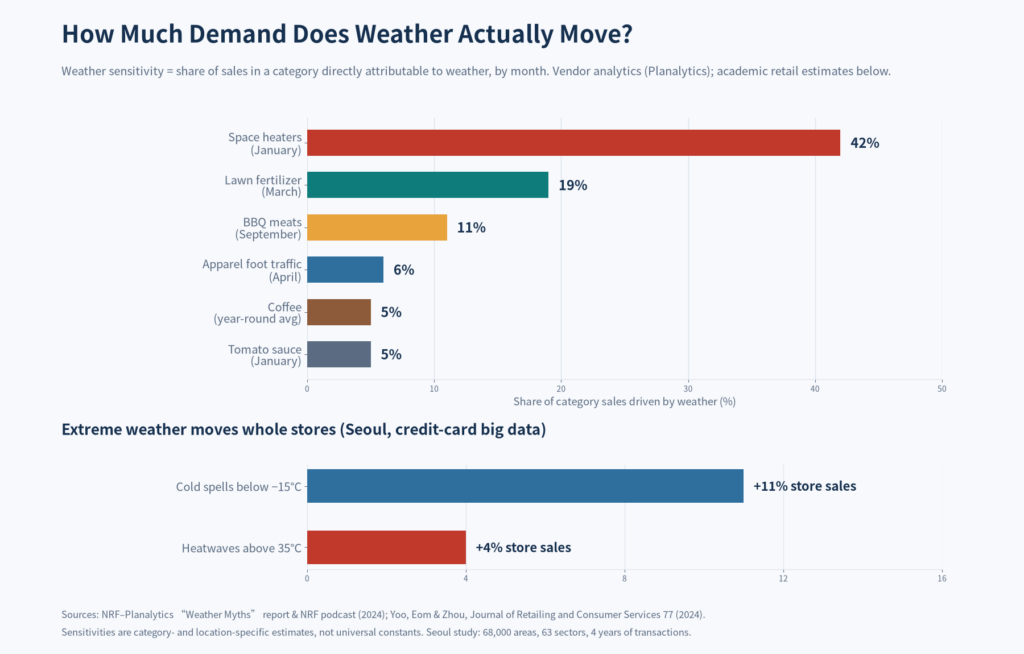
A 2024 study in the Journal of Retailing and Consumer Services used credit-card big data covering roughly 68,000 areas and 63 sectors in Seoul. During heatwaves above 35°C, brick-and-mortar retail sales rose about 4%; during cold spells below −15°C, about 11%. The mechanism is thermal comfort: people flee into temperature-controlled stores and buy things that extend the comfort — hot drinks, cold drinks. The store becomes shelter, and shelter sells.
Weather even biases big-ticket decisions
Behavioral economists have shown the effect goes deeper than comfort. Busse, Pope, Pope and Silva-Risso, studying over 40 million vehicle transactions for the Quarterly Journal of Economics (2015), found that warm, sunny weather pushes buyers toward convertibles, and a ten-inch snowstorm lifts the share of four-wheel-drive sales by about 6%. The kicker: convertibles bought during warm spells were traded in sooner — buyer’s remorse, measurable in depreciation. In Management Science (2017), Buchheim and Kolaska found outdoor-movie ticket buyers were heavily swayed by the weather on the day they purchased, even though reliable forecasts made today’s weather irrelevant to the future movie night. Weather does not just change what people need. It changes how they predict what they will want.
The Four Triggers: How Weather Becomes Demand
Pull the evidence together and four distinct mechanisms emerge. Each maps to a different marketing action.
- The threshold trigger (temperature). Categories flip at specific temperatures — hot drinks below a line, cold drinks and sunscreen above it. This is rule-based and automatable.
- The context trigger (rain). Rain rewrites the day’s logistics: delivery over dine-in, indoor over outdoor, streaming over strolling. A 2021 study of a Chinese convenience-store chain found rainy weather significantly raised both sales and items per basket; a peer-reviewed Kybernetes study (2022) of Meituan order data confirmed temperature, rainfall and air quality move most takeaway categories.
- The calendar trigger (season). Seasonal demand is weather you can schedule. Solar-term and seasonal-calendar marketing in China works on exactly this logic: the ritual date is a proxy for a predictable weather state.
- The psychological trigger (mood and projection). Sunshine lifts mood and risk appetite; today’s weather biases forecasts of tomorrow’s desires. This is why weather-matched creative feels uncannily relevant — it speaks to a state the customer is already in.
And here is the detail most teams miss: according to the NRF–Planalytics “Weather Myths” report, over 90% of a business’s weather-driven sales swings come from ordinary day-to-day temperature and precipitation changes — not storms, not disasters. You do not need a hurricane plan. You need a Tuesday plan.
The Proof It Converts: Pantene’s Haircast
The cleanest documented case is over a decade old, which tells you something about the activation gap. In 2013, Pantene had no new product, fading shelf presence, and sales at Walgreens down 7% year over year. Its insight: bad hair days are weather events. Humidity spikes cause frizz; dry heat causes flatness.
So Pantene partnered with The Weather Channel to deliver a “Haircast” — a hyper-local hair forecast inside the weather app people already checked every morning. Humid Chicago got the anti-frizz serum. Dry Phoenix got the moisturizing line. Every ad carried a $2 Walgreens coupon and pointed to the nearest store.
The result, documented in the MMA SMARTIES award case: Pantene sales at Walgreens rose 24% year over year in July and August, against a 10% goal — and the entire haircare category at Walgreens rose 4%. The campaign earned incremental displays in 5,500 stores. No new product. No celebrity. Just the right message, triggered by the right humidity reading, in the right zip code.
China Runs This Playbook at Platform Scale
If Pantene proves the concept, China proves the industrial version. Moji Weather, the country’s dominant weather app, reports roughly 160 million monthly active users in QuestMobile’s 2025 rankings — and at its 2025 partner conference it disclosed that weather-scenario marketing revenue grew 165% year over year in Q1 2025, against 15% growth for its overall ad business. The weather-triggered slice is growing ten times faster than the rest. As far back as 2015, Moji ran a “35°C Plan” with McDonald’s and Sprite: when the thermometer crossed the line, the offers went live.
The demand side is just as vivid. Since August 2018, Moji has supplied minute-level, kilometer-level forecasts to Meituan, Ele.me and Dianping — weather data wired directly into delivery dispatch. And when Beijing was hit by a freak rainstorm on July 24, 2018, Meituan’s instant-retail arm saw rain-gear orders jump 78-fold versus a dry comparison day, with slippers, towels, socks and even hair dryers riding the wave. Umbrellas were only the first purchase of a whole weather-driven basket.
Notice what China’s version adds: the trigger is not just an ad swap. It is inventory positioning, courier staffing, delivery-time promises, and category merchandising — the marketing message and the operations move together.
Why Everyone Still Gets This Wrong
Three objections come up in every planning meeting. Each is half-right, which is what makes it dangerous.
“Weather data is hard to operationalize.” The data was never the bottleneck. The US National Weather Service offers a free public API; commercial forecast feeds cost a rounding error against the demand they predict. What is missing is an owner: someone whose job includes turning a forecast into a rule. The gap is organizational, not technical.
“It only works for umbrellas and air conditioners.” The Seoul data covered 63 sectors. The NRF sensitivity tables include tomato sauce, pet food and jewelry. Coffee — a habit product — swings about 5% with the weather on average, and Northeast coffee demand can run 10% above normal when cool weather lingers into spring. Weather touches mood, mobility and appetite, which is to say it touches almost everything.
“It’s a gimmick.” A gimmick is an untriggered umbrella ad in July. A humidity-triggered serum ad with a coupon and a store locator, measured at +24% year over year against a 10% goal, is performance marketing. The gimmick is not using the signal — it is pretending your audience’s context does not exist.
The Counterargument, Taken Seriously
Two honest caveats keep this playbook credible.
First, correlation is not always causation, and some weather effects are timing shifts rather than net demand. Starr-McCluer found effects washing out quarterly; Roth Tran found good-weather gains fading within weeks. The practical answer is not skepticism but measurement: run weather-triggered campaigns against held-out control regions, and count net lift, not spike-day vanity metrics. Also expect location to matter — Roth Tran found stores experienced in heavy rain suffered about 80% smaller declines than inexperienced stores. A two-inch rain day in Seattle is not a two-inch rain day in Phoenix. Triggers must be local, and thresholds must be learned from your own sales history, not copied from a blog post.
Second, there is an ethical edge. The car-purchase research shows weather-driven buying can produce regret — convertibles traded in early. Selling harder into a psychological bias is possible; whether you should is a brand decision. The defensible version of weather marketing serves a real need the weather created (frizz, cold, a stranded commute), rather than exploiting a mood swing to push irrelevant inventory.
The privacy story, by contrast, is genuinely favorable. Weather targeting is contextual, not personal: it segments by the conditions around a person, not by tracking the person. In a world tightening rules on behavioral data, a signal that needs no cookies and no identity graph is not just cheap — it is durable.
The Playbook: Four Steps, One Quarter
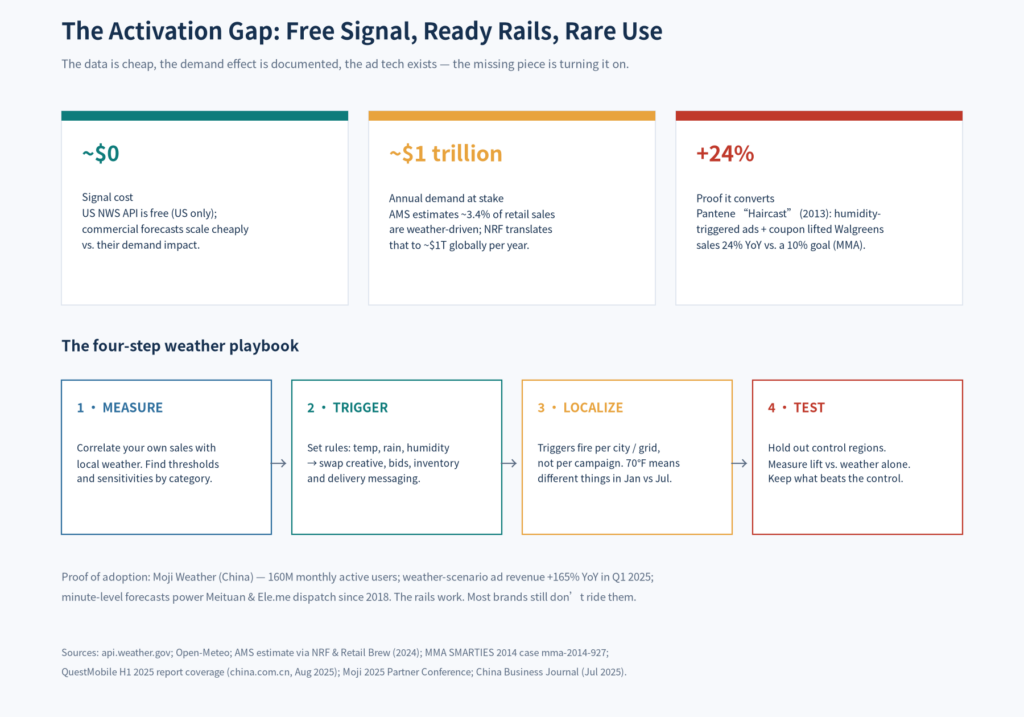
Step 1 — Measure your own sensitivity. Join two years of daily sales by location with local weather history. Find the categories that move, the thresholds where they flip, and the lag between weather and purchase. This is a spreadsheet project before it is a software project.
Step 2 — Write trigger rules. Below X degrees, hot-drink creative and bids up. Rain forecast, delivery messaging on, dine-in promotions paused. Humidity above Y, frizz SKUs featured. Keep the rule set small — five rules that run beats fifty that wait for approval.
Step 3 — Localize ruthlessly. Triggers fire per city or grid, never nationally. Seventy degrees means beach in January and sweater weather in July. The Weather Company built its advertising business on this granularity; its consumer apps still reach more than 360 million people monthly, and the asset changed hands from IBM to Francisco Partners in 2024 precisely because weather-driven decisioning is a growth market.
Step 4 — Test against a control. Hold out matched regions. Measure net incremental sales, not weather-day spikes. Keep what beats control; kill what does not. The brands that win here treat weather like any other performance channel — with the same discipline and none of the mysticism.
The Takeaway
Weather is the rare marketing signal that is free, forecastable, scientifically validated and commercially proven — and still mostly unused. The research says ordinary Tuesdays move more demand than storms. The Fed says bad-weather losses are real and permanent. Pantene says a humidity trigger can beat a product launch. China says the whole operation — ads, inventory, couriers — can run on the forecast. The gap was never data. It was activation. The forecast for tomorrow is already published. The only question is whether your marketing will have read it.