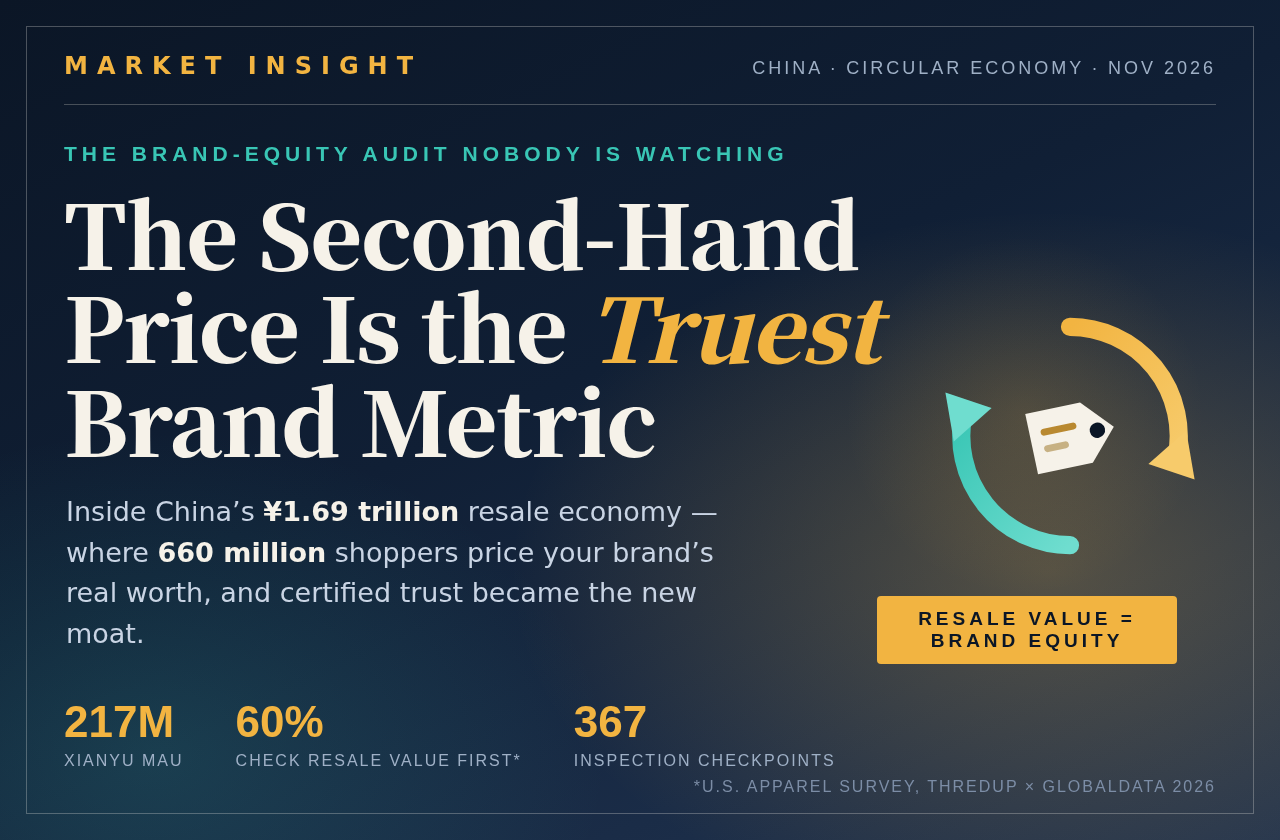
Somewhere on Xianyu right now, a stranger is listing your product at 40% of what you sold it for. Or 90%. Or — if you’re Apple, certain luxury houses, or a hot designer-toy IP — above retail. That listing is not noise. It’s a verdict. It’s the market telling you, in public and in cash, what your brand is actually worth once the campaign budget stops talking.
Most marketing teams treat resale as somebody else’s problem: a disposal channel, a sustainability footnote, at worst a gray-market threat. China’s second-hand economy has quietly become something else entirely — a live, liquid, brutally honest brand-equity audit, running every single day, with 660 million participants. And the brands that learn to read it (and feed it) are starting to win the first-hand sale before it even begins.
Let’s walk through what’s actually happening, what the verified numbers say, and what you should do about it on Monday morning.
A Trillion-Yuan Market Hiding in Plain Sight
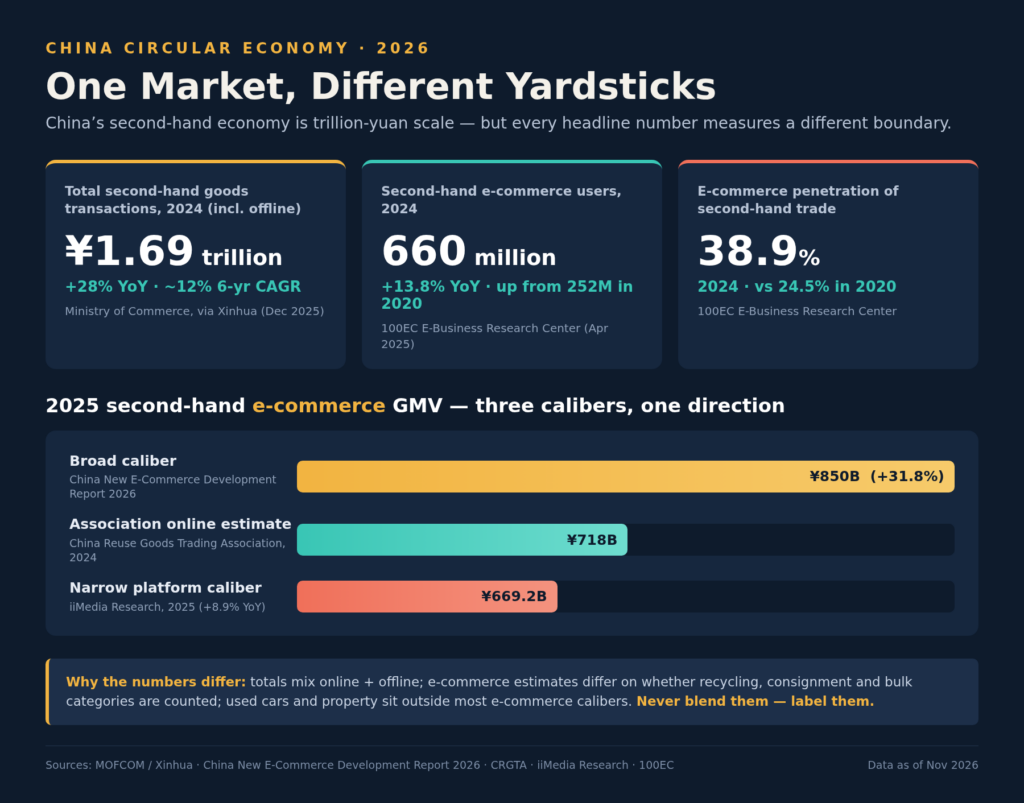
Start with scale. According to China’s Ministry of Commerce, second-hand goods transactions reached RMB 1.69 trillion in 2024 — up 28% year over year, with a six-year compound growth rate around 12%. That’s not a niche. That’s a consumer economy the size of a mid-sized national retail sector, and it grew faster than almost anything else in Chinese consumption.
The user base tells the same story. The 100EC E-Business Research Center counted 660 million second-hand e-commerce users in 2024, up from 252 million in 2020 — roughly two and a half times in four years. Penetration of online channels into second-hand trade climbed from 24.5% to 38.9% over the same window. An industry-association survey found 78.3% of people have transacted second-hand and 97.2% of households own items they could sell. Read that again: almost every household in China is sitting on inventory.
Policy is pouring fuel on it. In April 2025, the Ministry of Commerce designated the first ten pilot cities and 28 pilot enterprises for second-hand goods circulation, alongside national trade-in programs that moved over 129 million home appliances in 2025 alone. The government has decided the circular economy is infrastructure, not charity. When Beijing treats your “disposal channel” as strategic policy, it’s time to update the org chart.
Three Numbers, Three Yardsticks: Label Your Calibers
Here’s where most articles about this market fall apart, so let’s be the exception. You’ll see three different “2025 second-hand e-commerce” numbers circulating, and they’re all real — they just measure different things.
The China New E-Commerce Development Report 2026, released by the China Federation of Network Social Organizations, puts 2025 second-hand e-commerce at RMB 850 billion, up 31.77%. iiMedia Research’s narrower platform-based count says RMB 669.2 billion, up 8.9%, heading toward RMB 911.4 billion by 2030. The China Reuse Goods Trading Association’s own online-channel series reached RMB 718 billion in 2024. There’s even a year-labeling inconsistency in the headline totals: the association restated the RMB 1.69 trillion figure for 2025 with 12.4% growth, while the Ministry of Commerce attributes the same figure to 2024 with 28% growth. Same number, two years — somebody’s boundary moved.
Does this undermine the story? No. Every source, on every caliber, points the same direction: bigger, more mainstream, more institutional. But it teaches the discipline this whole topic demands. Never blend calibers. Label them. If you can’t be precise about how a market is measured, you have no business being precise about what it means — and precision is exactly what the second-hand market forces on brands.
Xianyu: The Flea Market That Became a Fandom
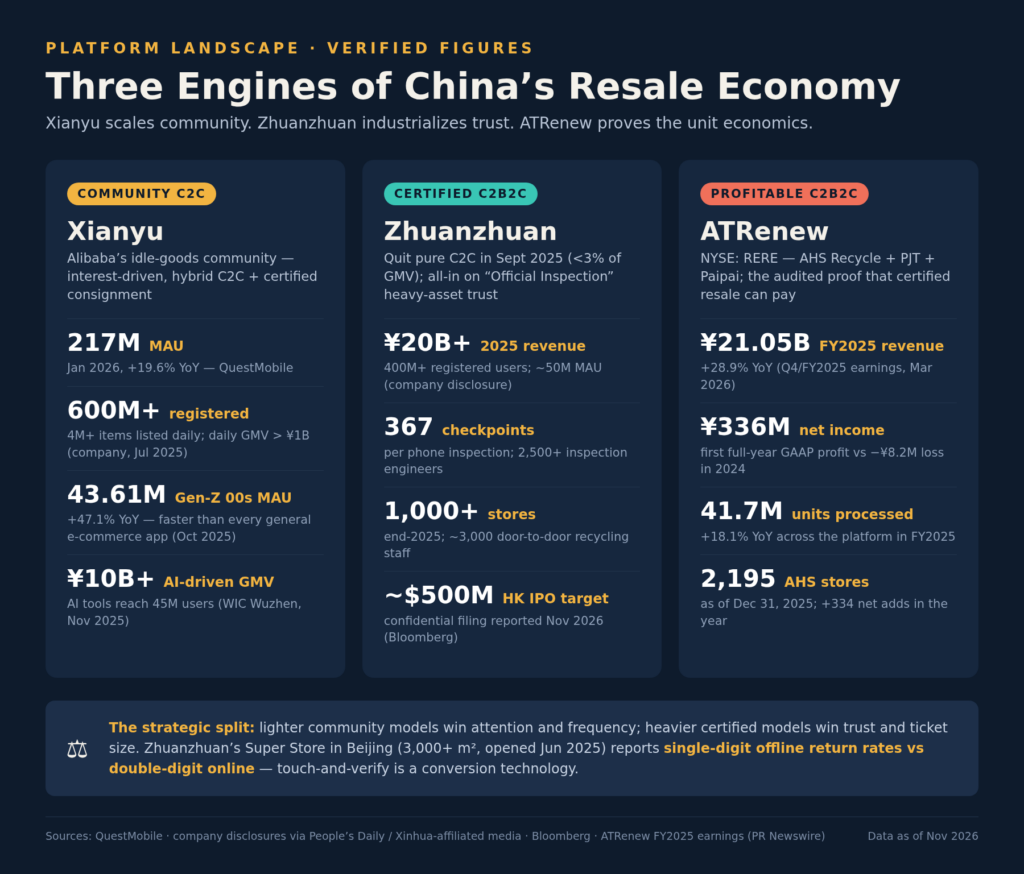
Xianyu, Alibaba’s idle-goods platform, is the scale anchor. QuestMobile measured 217 million monthly active users in January 2026, up 19.6% year over year — the fastest MAU growth among major e-commerce apps. The company itself reports over 600 million registered users, more than 4 million items listed daily, and daily GMV above RMB 1 billion. That’s not a garage sale. That’s a stock exchange for stuff.
But the raw scale misses the interesting part. Xianyu’s growth engine is young people treating second-hand as identity commerce, not frugality. QuestMobile’s post-00s report found 43.61 million Gen-Z users born after 2000 active monthly on Xianyu — growing 47.1% year over year, faster than every general e-commerce platform in China. Post-95 users make up 43% of actives; post-00s another 22%.
What are they trading? Anime merchandise (“guzi”), idol photo cards, designer toys, blind-box figures. In Q1 2025, sales of Chinese-style guzi jumped 167%; in Q2, designer-toy transaction volume rose over 300%, with average spend of RMB 218 per purchase. In January 2026, Xianyu launched a dedicated interest-community homepage, Yuli Ciyuan, complete with official-warehouse authentication for collectibles and a “dimension cabinet” tool that tracks your collection’s market value — literal profit-and-loss statements for fandom. When a platform builds portfolio analytics for anime pins, the second-hand market has stopped being about saving money. It’s about belonging, and about assets.
The Trust Turn: Zhuanzhuan Burns Its C2C Bridge
If Xianyu proves the demand, Zhuanzhuan proves what it takes to serve it. In September 2025, Zhuanzhuan announced it was shutting down the peer-to-peer “free market” it was founded on — a business that had shrunk to under 3% of GMV — and going all-in on C2B2C: the platform buys your item, inspects it, prices it, resells it, and stands behind it.
The infrastructure behind that pivot is startlingly physical. Each used phone passes 367 inspection checkpoints. The company employs more than 2,500 inspection engineers and luxury authenticators, nearly 3,000 door-to-door recycling staff, and ran over 1,000 branded stores by the end of 2025. Revenue passed RMB 20 billion in 2025, with more than 400 million registered users. In November 2026, Bloomberg reported a confidential Hong Kong IPO filing targeting roughly US$500 million.
Why does a marketing person care about inspection checkpoints? Because Zhuanzhuan’s founder essentially said the quiet part out loud: users could replace C2C with Xianyu tomorrow, but certified, guaranteed second-hand has no substitute. Trust is the product. And trust, it turns out, has a physical conversion effect — Zhuanzhuan’s 3,000-square-meter Beijing “Super Store” reports single-digit return rates offline versus double-digit online. Letting people touch and verify a used product is a conversion technology.
ATRenew Proves the Math Works
Skeptics will say heavy-asset trust is a money pit. The audited answer arrived in March 2026. ATRenew — the NYSE-listed parent of AHS Recycle, operating 2,195 stores across China — reported FY2025 revenue of RMB 21.05 billion, up 28.9%, and its first full-year GAAP profit: RMB 336 million, against a small loss the year before. It processed 41.7 million used devices, up 18.1%.
Sit with that. A company whose entire business is buying used phones from consumers and reselling them with verification just crossed into sustained profitability at scale. Certified second-hand is not a subsidy story or a ESG press release. It’s a business model with functioning unit economics — which means the trust infrastructure your brand might partner with is here to stay.
Resale Value Is Brand Equity — Literally
Now the marketing thesis. A second-hand price is the only brand valuation with no marketing inflation in it. Nobody runs ads on Xianyu listings to prop up a residual price. The number is what a real buyer pays a real seller for your product after the honeymoon ends. It aggregates durability, desirability, authenticity and cultural heat into one brutally clean figure.
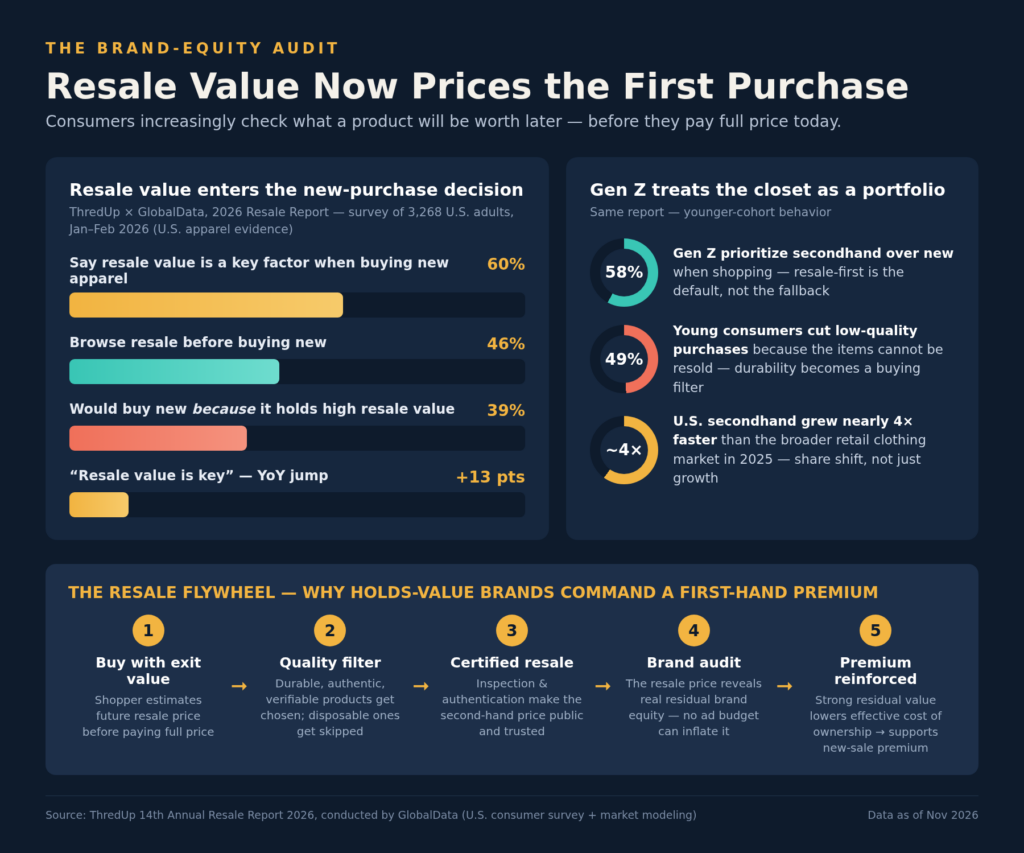
And buyers have started using that figure before they buy new. ThredUp’s 2026 Resale Report, conducted by GlobalData with a survey of 3,268 U.S. adults, found 60% of consumers now say resale value is a key factor when buying new apparel — up 13 percentage points in a single year. Another 39% say they’d buy a new item specifically because it holds value. And 46% browse resale before buying new, rising to 58% among Gen Z. That’s U.S. apparel data, not Chinese data — but it’s the cleanest available measurement of a psychology that Xianyu’s guzi traders were practicing years earlier.
The mechanism deserves a name: the resale flywheel. Shoppers estimate the exit value, which filters them toward durable, authentic products, which trade actively on certified platforms, which publishes a trusted residual price, which lowers the effective cost of ownership — and justifies the first-hand premium. Hold-value brands get to charge more because buying them is cheaper. Read that sentence twice; it’s the whole game.
What Everyone Gets Wrong
Three errors keep showing up in brand strategy decks.
“Second-hand is outside marketing.” It isn’t anymore. It’s where your brand equity gets marked to market daily. If your CFO can read a bond yield, your CMO can read a residual-price trend.
“Second-hand means cheap.” The fastest-growing cohorts on Xianyu are buying identity goods — collectibles that sometimes trade above retail — and paying premiums for certified condition. Cheap is one lane. Trust and fandom are the growth lanes.
“C2C is the model.” China’s number-two platform deliberately killed its C2C business because unmediated trust doesn’t scale in non-standard goods. Even Xianyu now runs official-warehouse authenticated consignment for collectibles. The center of gravity moved from matching buyers to guaranteeing outcomes.
The Counterargument: Doesn’t Resale Cannibalize New Sales?
Partly, yes — and pretending otherwise is dishonest. A used iPhone sold is sometimes a new iPhone not sold. But the aggregate evidence points the other way. In the ThredUp/GlobalData survey, 49% of young consumers said they’ve reduced purchases of low-quality apparel precisely because it can’t be resold. Resale didn’t shrink their spending; it reallocated it toward brands that hold value. U.S. secondhand grew nearly four times faster than the broader clothing market in 2025 — and the brands with strong residual prices are the ones capturing that redirected budget, plus trade-in cycles that pull owners back into the new-product funnel. Cannibalization is real for weak brands. For strong ones, resale is a loyalty program that pays the customer.
The honest limits: certified doesn’t mean perfect. Zhuanzhuan faces six-figure complaint volumes on consumer platforms, and regulators flagged its unreachable human customer service in 2025 — trust infrastructure at scale is hard, and its profit line remains undisclosed. And the caliber chaos in market data means anyone quoting a single confident number is selling something.
The Playbook: Four Moves for Monday Morning
1. Put residual price on the brand dashboard. Track your products’ certified second-hand prices quarterly, by category and vintage, next to awareness and NPS. A falling residual curve is a brand-equity leak your survey data will catch two years late.
2. Design for the second life. Durability, repairability, authenticity markers, transferable warranties — these are no longer sustainability nice-to-haves. They’re inputs to the price that future buyers will pay, which current buyers increasingly check first.
3. Partner with the trust layer. Trade-in credit, certified pre-owned programs, official authentication. The platforms have already built the inspection centers, stores and logistics. Zhuanzhuan and ATRenew turned certification into moats; brands can rent that moat instead of digging their own.
4. Show up in the interest communities. The guzi and designer-toy economies on Xianyu are fandom infrastructure with portfolio tools attached. Limited editions, collectible lines, IP collaborations — products designed to circulate become permanent brand touchpoints instead of one-time transactions.
Conclusion: The Audit Is Already Running
China’s circular economy has crossed from frugal fringe to institutional mainstream: RMB 1.69 trillion in transactions, 660 million users, a Gen-Z fandom engine growing 47% a year, a certified-trust industrial base, and — finally — audited profits proving the model pays. The second-hand price is the truest brand metric because it’s the only one no marketer can inflate. Your brand is already being priced on these platforms, every day, with or without your participation. The only strategic choice left is whether you read the verdict — and start earning a better one.