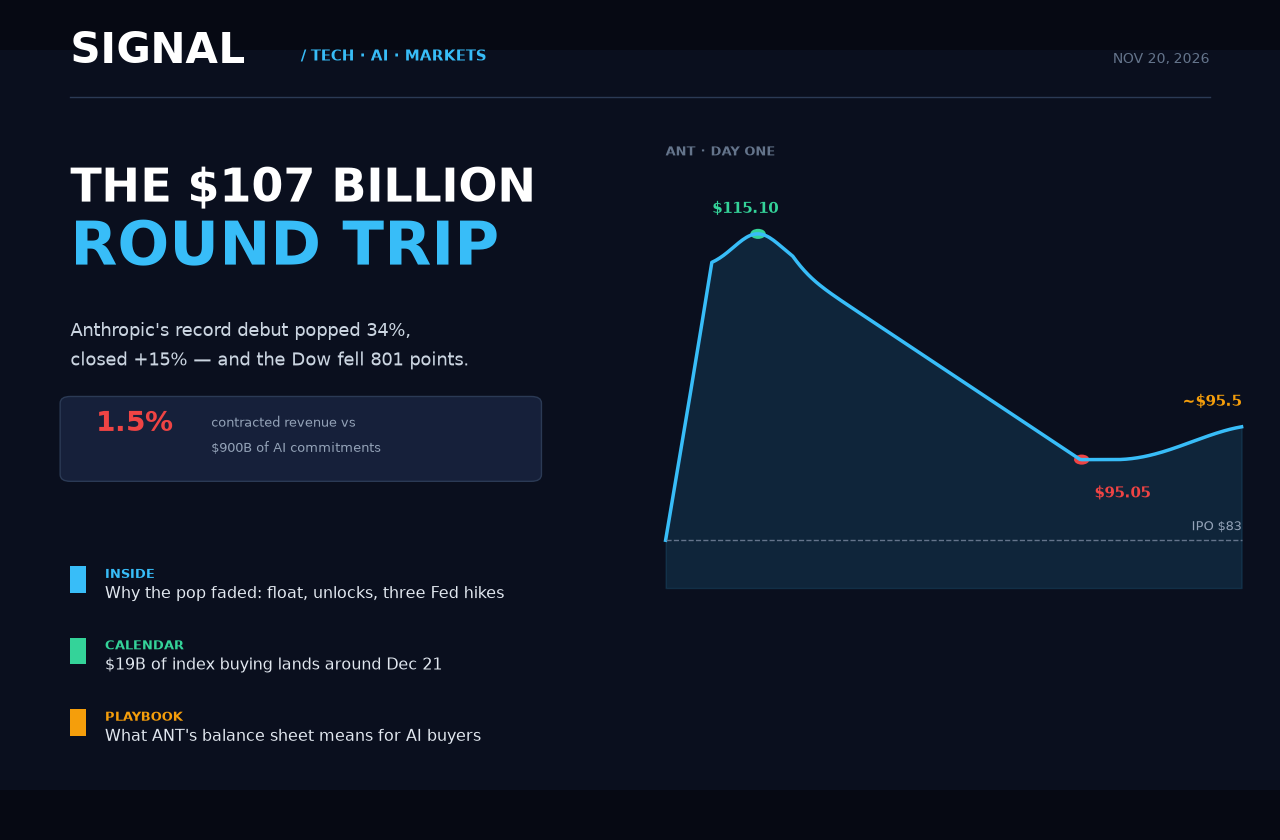
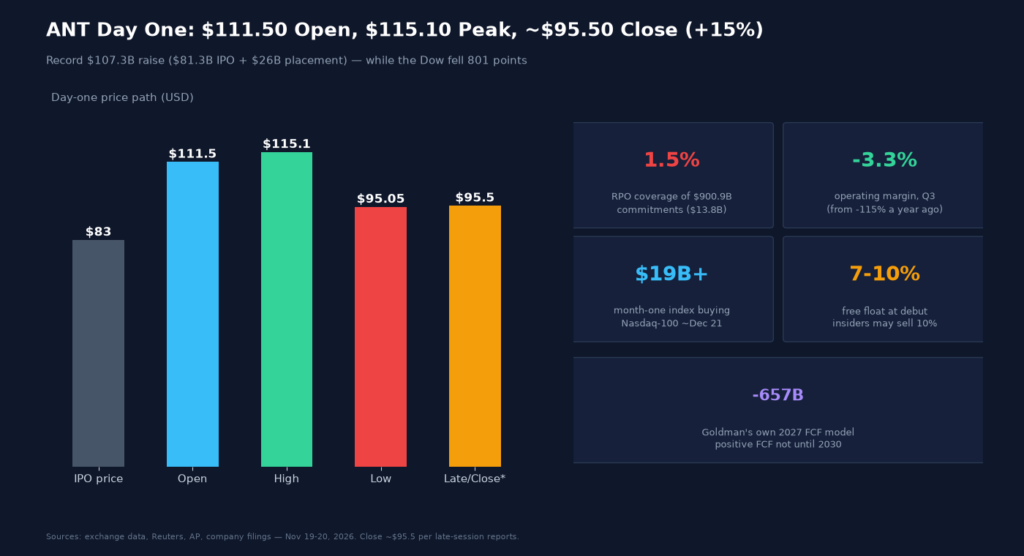
Anthropic’s first day as a public company contained the entire AI debate in a single trading session. Shares of the Claude maker, priced Wednesday night at $83 — above the marketed $70–78 range — opened Thursday at $111.50, spiked to $115.10, and briefly valued the company above $2 trillion on a fully diluted basis, richer than Meta, Tesla or Walmart. Then gravity arrived. The stock slid through $100, touched $95.05, and finished the session around $95.50, up roughly 15% — a respectable IPO pop by historical standards, and a 17% round-trip loss for anyone who bought the open. Meanwhile the rest of the market, which had rallied into the debut, collapsed: the Dow fell 801 points (-1.6%), the S&P 500 dropped 1.29% to extend its losing streak to six sessions, the Nasdaq lost 1.29%, and the VIX fear gauge pushed toward 29, its highest since March. The largest IPO in history — $81.3 billion raised, $107.3 billion including the concurrent private placement — succeeded, and the market it was supposed to rescue failed anyway.
Why the pop faded: three forces, one tape
The first force was mechanical. A listing this size vacuums capital: investors sold Nvidia, Broadcom, Micron and the neoclouds to fund ANT allocations, and the “oxygen-sucking” effect that market strategists had warned about showed up within minutes of the first trade. The second was supply. Unlike a conventional IPO, Anthropic’s prospectus lets non-founder employees, directors and consultants sell up to 10% of their holdings — roughly 315 million shares — from day one, with another 35% unlockable after the first full-year results. Against a free float of just 7–10%, that is enormous potential supply meeting a price set by euphoria. The third force was macro: JPMorgan published a call for three Fed hikes (December, January, March) taking rates to 4.5–4.75%, hawkish minutes were still echoing, and risk appetite drained out of everything with a duration-sensitive valuation. A 15% close in that environment is, arguably, strength.
The two numbers that define the argument
Buried in the filings are the sharpest arguments on both sides. For the bears: Anthropic has committed $900.9 billion to compute and infrastructure through 2045 — $451.6 billion due before 2031, $70.7 billion in the next twelve months — while remaining performance obligations, the revenue actually contracted, stand at just $13.8 billion. That is 1.5% coverage. Roughly 79% of revenue is consumption-based and can evaporate with usage; the commitments largely cannot. About $186 billion carries termination rights or conditions, and the SpaceX contract can be cancelled with 90 days’ notice after early 2027 — escape hatches, but partial ones. Goldman Sachs, a lead underwriter, models 2027 revenue of $136 billion against a $40.4 billion operating loss and negative free cash flow of $65.7 billion, with positive FCF not arriving until 2030. The underwriter’s own model says this company must keep raising money for years.
For the bulls: operating margin improved from -115.0% to -3.3% in a single year. Revenue for the nine months hit $33.24 billion, up roughly 1,200%, with an $81 billion run-rate by end-October, net revenue retention reported at levels traditional SaaS never sees, and each dollar of compute reportedly producing over two dollars of revenue. Melius Research’s Ben Reitzes argues mature margins could exceed the hyperscalers’. If the margin trajectory holds even half as well as the last twelve months, the commitments stop looking like a noose and start looking like secured supply for a demand curve that keeps steepening. NYU’s Aswath Damodaran values the stock at $76.98 — below the IPO price — while some analysts see $155. Thursday’s $95–115 range was, quite literally, the market trading inside that disagreement.
The calendar matters more than the close
What happens next is unusually schedulable. MSCI, FTSE Russell and the Nasdaq-100 are expected to add ANT between late November and late December, with the Nasdaq-100 fast-entry landing around December 21; Berenberg estimates more than $19 billion of price-insensitive index buying in the first month, roughly 29% of the IPO share count. The S&P 500 is off the table — it requires a year of seasoning and GAAP profitability. But the cautionary precedent is fresh: SpaceX entered the Nasdaq-100 after its June IPO, fell about 15% in six sessions, and remains below its opening price months later. Index demand is a bid, not a floor. The real supply cliff sits 180 days out for employees and 365 for founders. Anyone forming a view on ANT should be looking at that calendar, not at Thursday’s candle.
What this means if you buy AI, not stock
Three practical readings for marketing and technology buyers. First, the split-screen day — ANT up, the AI sector down — marks the moment the market stopped buying “AI” as a basket and started discriminating between assets. Your vendor evaluations should do the same: the funded, revenue-compounding leaders now have visible balance sheets, and the gap between them and the subsidised tail will widen. Second, the mismatch between Anthropic’s rigid commitments and elastic revenue means its pricing will be managed toward consumption growth — expect aggressive enterprise commit incentives, and negotiate multi-year price protection while the vendor needs your committed spend to justify its own. Third, service-continuity clauses belong in every AI contract now: a vendor whose underwriter models negative cash flow through 2029 is a vendor whose roadmap depends on capital markets staying open. The IPO answered whether investors believe in AI. It did not answer whether the economics close — and your contracts should be written for both outcomes.