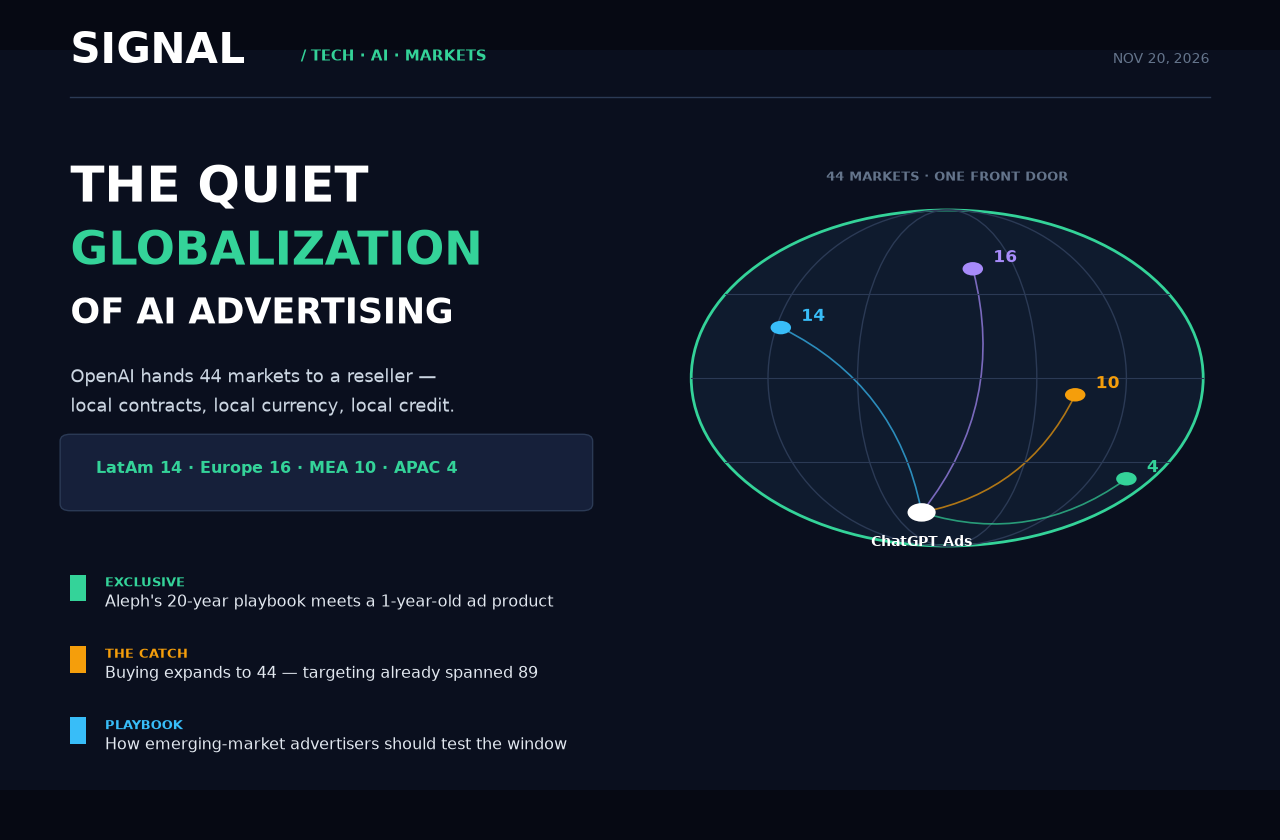
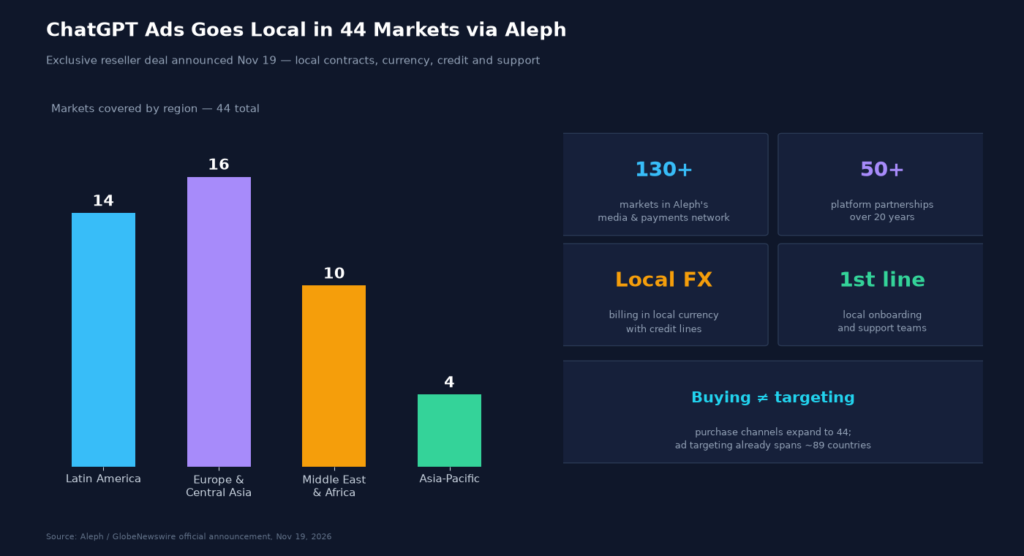
The most consequential advertising infrastructure announcement of the week did not come from Google or Meta. On November 19, OpenAI confirmed an exclusive reseller partnership with Aleph, the Miami-founded media and payments group, extending ChatGPT Ads purchasing into 44 markets across Latin America, Europe and Central Asia, the Middle East and Africa, and Asia-Pacific. The distinction that matters: this expands where advertisers can buy, not where ads can target — ChatGPT ad targeting already spans roughly 89 countries. What changes is the plumbing. Brands and agencies in the 44 markets can now contract locally, get invoiced in local currency, access credit lines, and receive onboarding and first-line support from Aleph teams on the ground. For a product barely a year into its advertising life, OpenAI has just outsourced its emerging-market go-to-market to a company with 20 years of practice doing exactly this for more than 50 platforms across 130-plus markets.
Why resellers, and why now
Every global ad platform eventually faces the same wall: the demand exists everywhere, but the ability to transact does not. A performance agency in Bogotá or a retailer in Riyadh may want ChatGPT inventory, but cross-border contracts, dollar invoicing, wire transfers and English-only support turn a media buy into a procurement project. Google and Meta solved this decades ago with local entities, reseller networks and credit programs; OpenAI, whose ads business launched at scale only in 2026, has neither the time nor the appetite to build 44 country operations. Aleph’s pitch, in founder-CEO Gastón Taratuta’s words, is “turning global technology into local growth” — a local team that speaks the language, bills the currency and extends the credit. The exclusive structure is notable: OpenAI is not running an open partner marketplace in these markets but routing them through a single counterparty, trading margin and control for speed and compliance coverage.
The market list rewards a close read. Saudi Arabia, the UAE, Qatar, Kuwait, Egypt, Nigeria, Kenya, Turkey, Morocco and South Africa give ChatGPT Ads a formal commercial channel across the Gulf and Africa’s largest economies — regions where conversational AI usage is disproportionately high but ad-platform monetisation infrastructure is thin. The Latin American list is effectively the entire Spanish- and Portuguese-speaking commercial map. Central Asia — Kazakhstan, Uzbekistan, Azerbaijan — appears in a major ad platform’s channel strategy almost for the first time. These are not the markets where OpenAI’s direct sales team was ever going to land; they are precisely the markets where a reseller with local payment rails converts latent demand into revenue.
The strategic subtext: distribution economics
There is a second reading. Reseller exclusivity implies OpenAI is optimising its ads business for reach-per-dollar rather than margin-per-impression — consistent with a company that has publicly prioritised scale while its ad products mature. Third-party estimates of ChatGPT Ads performance vary widely, and the honest position is that retention and ROI data remain immature; buying through a reseller does not change the underlying auction or the measurement gaps. What it changes is who bears the friction of market development. Aleph takes on local credit risk, compliance and support; OpenAI takes volume. For comparison, Anthropic chose the opposite path entirely — Claude carries no advertising at all, a founding decision its president re-emphasised on IPO day. Two frontier labs, two theories of the business: one monetises attention through the oldest model in media, the other refuses to. The reseller deal makes that experiment global.
A practical playbook for advertisers in the 44 markets
If you operate in these regions, four moves follow. First, treat this as an access window, not a performance guarantee: early ChatGPT ad inventory in newly opened commercial markets will be thin, formats limited, and measurement evolving — budget it as a structured test with explicit learning goals, not a performance channel with quota expectations. Second, use the credit layer deliberately: local-currency billing with credit lines changes the cash-flow math for agencies managing multi-market campaigns; negotiate terms with Aleph the way you would with any platform rep, including rebates and payment windows. Third, mind the targeting distinction: your campaigns can already reach users in ~89 countries; what’s new is your ability to transact from your own market — do not confuse the announcement with new audience inventory in your country. Fourth, prepare the creative and compliance side for conversational contexts: ads inside AI answers face different user intent than feed ads, and the brands that win early are those whose offers and landing experiences answer questions rather than interrupt them.
The quiet lesson of this announcement is about how AI-era media actually scales. The models get the headlines, but distribution — contracts, currency, credit, support — decides who gets paid. OpenAI just admitted, in the most practical way possible, that it cannot build that layer alone. Forty-four markets now have a front door to the AI ad economy. Whether the rooms behind it are worth the rent is the test that starts now.