Everyone can recite the numbers. More than 500 million Chinese people now participate in outdoor activities. The industry is worth roughly RMB 3.17 trillion. And yet Mobi Garden — the tent champion of the boom years — just posted its first annual loss since going public, while softshell jackets grew over 130% on Tmall during Double-11 2026’s first wave. Same market, same consumers, opposite directions. Why?
The answer isn’t taste. It’s arithmetic.
Consumers Don’t Buy Gear. They Buy Use-Days.
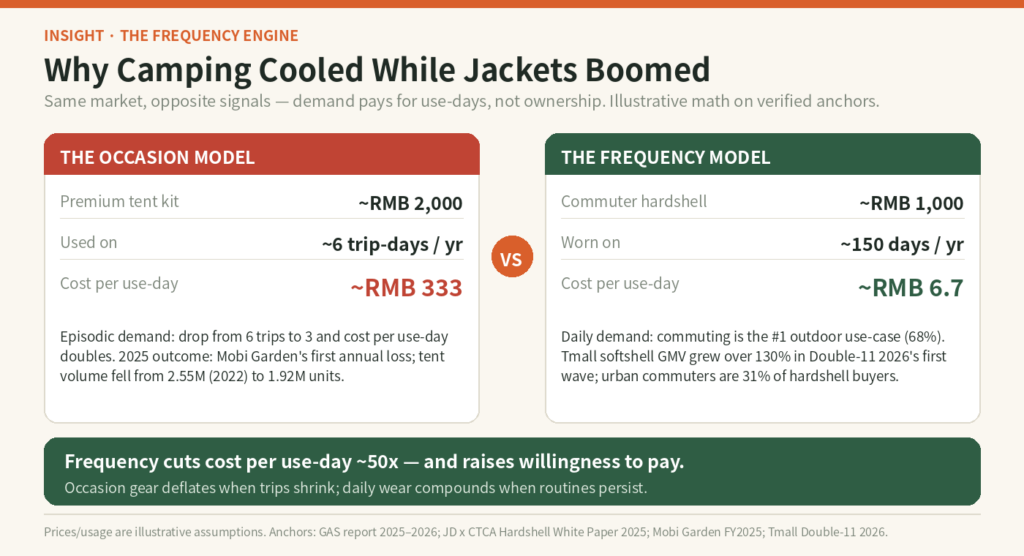
Strip away the branding and every outdoor purchase is a bet on future usage. A RMB 2,000 tent kit used on six trip-days a year costs about RMB 333 per use-day. A RMB 1,000 hardshell worn 150 days a year — commuting, raining, weekend-walking — costs under RMB 7. These are illustrative assumptions, not survey data, but the order of magnitude is the whole story: frequency divides price by roughly fifty.
This is why the two segments diverged without contradicting each other. Glamping was an occasion purchase: its value depended on trips actually happening, several weekends a year, with photo-worthy staging. When the ritual faded — when camping stopped being a performance and became, at most, a casual habit — the denominator collapsed. Fewer trips meant a higher cost per use-day, which meant the next tent purchase got postponed. Mobi Garden’s tent volume fell from 2.55 million units in 2022 to 1.92 million in 2025, and inventory now takes about nine months to turn. The occasion model deflates from the denominator.
The jacket runs the opposite machine. The General Administration of Sport’s 2025–2026 report found city commuting and everyday outfits are the #1 consumption use-case for outdoor goods at 68% — camping ranks fourth at 45%. JD’s hardshell white paper puts urban commuters at 31% of buyers, the largest segment, with spending up 45% in 2024. Once a jacket enters the daily routine, its denominator is the calendar itself. Routines don’t fizzle like fads; they persist through fashion cycles. That’s why the same consumer who stopped upgrading tents kept upgrading jackets — the jacket’s cost per wear kept falling, and its social visibility (every colleague sees it, every day) kept paying dividends the tent in the garage never could.
The Strategic Corollary
If frequency is the engine, the marketer’s job is to move products into routines, not occasions. Sell the jacket to the commute, the shoe to the school run, the flask to the desk. Rent out the tent — access models rescue occasion gear precisely by pooling denominators across many users. And treat the camping slowdown not as demand destruction but as denominator repair: lighter kits, more trips, lower cost per outing. The brands that understood this stopped selling weekends and started selling weekdays. That is the entire shift, in one sentence.



