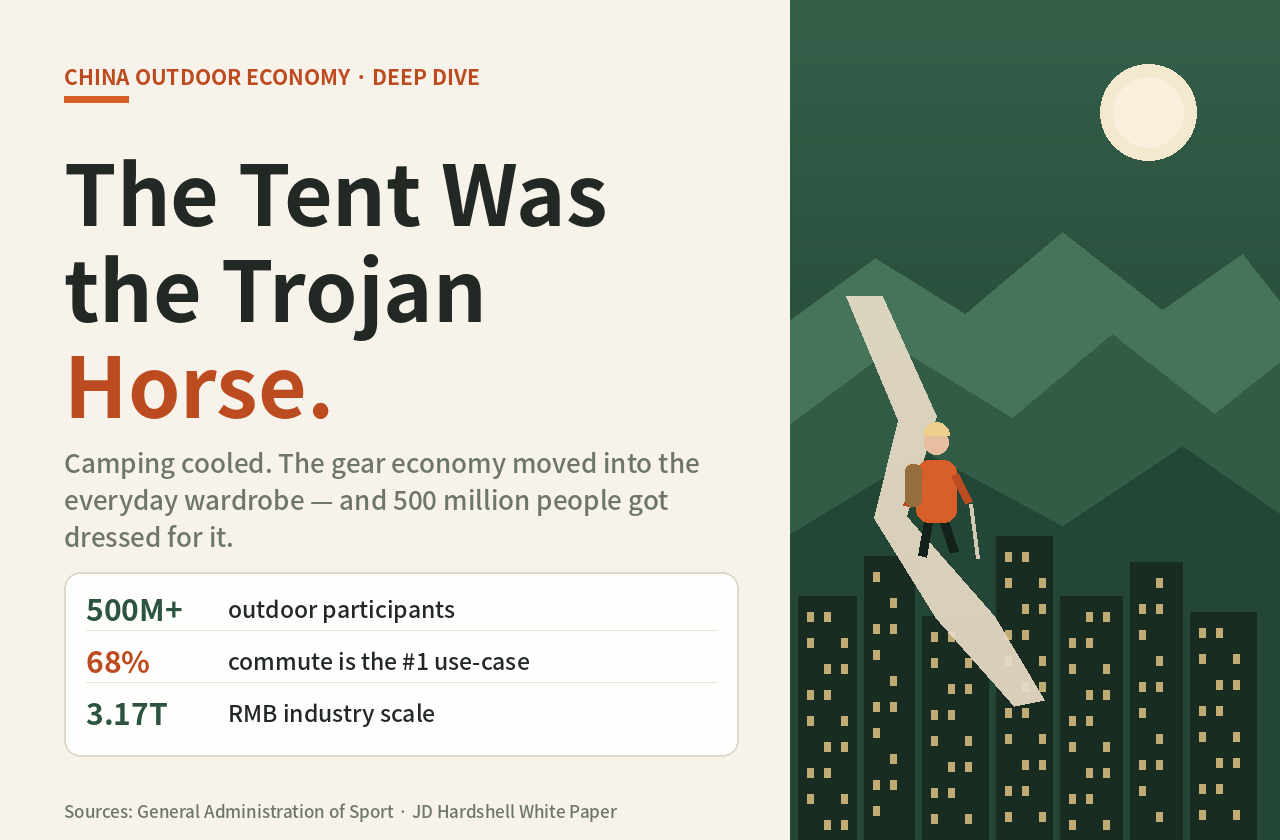
China’s outdoor story is usually told as a camping craze that cooled. That framing misses the structural turn. By end-2025, more than 500 million people participated in outdoor activities, and the outdoor-related industry reached roughly RMB 3.17 trillion, according to the General Administration of Sport. The decisive number is quieter: city commuting and everyday outfits are now the #1 consumption use-case for outdoor goods at 68% — ahead of light hiking (60%), cycling (55%) and camping (45%). The hardshell jacket became office wear; the trail shoe became the commute shoe. The gear economy did not shrink when glamping deflated — it changed engines, from episodic trip occasions to daily-wear frequency. This deep dive maps the four-layer structure of the post-craze gear economy, separates verified data from caliber traps, and lays out what brands should do next.
1. The Number Everyone Quotes — and the Number Everyone Misses
When the General Administration of Sport released its China Outdoor Sports Industry Development Report (2025–2026) in October 2026, headlines fixated on two figures: 500 million-plus participants and an industry scale of about RMB 3.17 trillion. Both are real. Wang Yuxiong, director of the sports economics research center at Central University of Finance and Economics, noted on CCTV that the participant count was 400 million just a year earlier — a 100-million jump in twelve months.
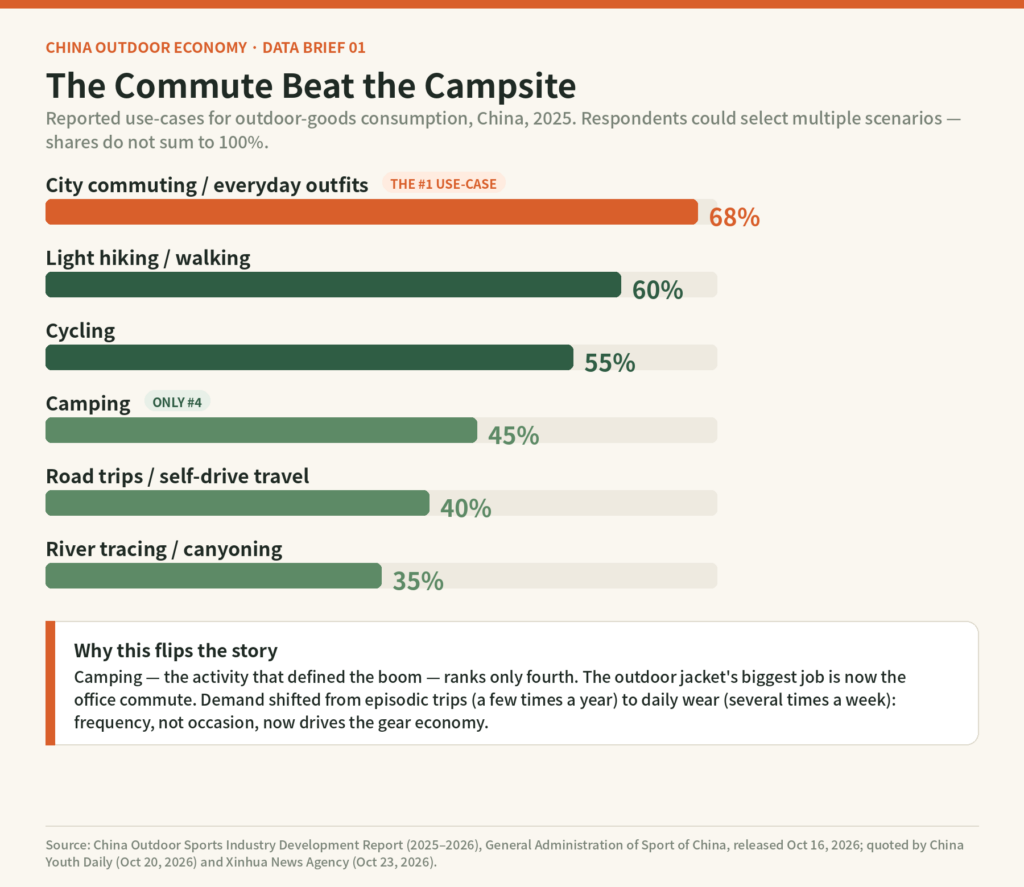
But the report’s most consequential line was buried further down: among consumption use-cases for outdoor goods, city commuting and everyday outfits ranked first at 68%, followed by light hiking at 60%, cycling at 55%, camping at 45%, road trips at 40% and canyoning at 35%. Read that ranking again. Camping — the activity that defined the entire boom narrative — is fourth. The market’s biggest job for outdoor gear is getting people to work.
That single ranking flips the story. A category whose primary use happens several times a week behaves very differently from one whose primary use happens several times a year. Frequency changes purchase cadence, price sensitivity, design priorities and channel logic. Everything below follows from this flip.
2. How Big Is the Outdoor Economy, Really? A Caliber Map
Before any strategy conversation, get the boundaries straight — Chinese outdoor statistics nest like matryoshka dolls, and blending them produces nonsense.
- RMB 3.17 trillion — the broadest caliber: the entire outdoor-related industry, including tourism, services, venues and events, per the General Administration of Sport report.
- Over RMB 1 trillion in consumption, across 800 million-plus consumption trips in 2025 — a demand-side caliber from the joint report by Beijing Sport University’s School of Leisure Sports and Tourism, the China Sports Development Research Institute, the National Fitness Research Institute and Meituan Research Institute, released at the China International Camping Congress in May 2026.
- RMB 142.37 billion — outdoor, mountaineering and camping goods sold on JD, Taobao, Tmall and Douyin in 2025, up 22.22% year-on-year and equal to 31.68% of all sporting-goods sales on those four platforms. This figure originates from the China Sporting Goods Federation’s annual industry report (May 2026, based on Moojing e-commerce monitoring); the sports administration’s report re-cites it.
- RMB 248.32 billion — the core camping economy in 2025 per iiMedia Research, with roughly RMB 1.44 trillion in induced upstream-downstream activity. This is a camping-specific caliber, not an outdoor-goods caliber.
Four numbers, four boundaries. The honest sentence is: outdoor participation went mainstream, online gear sales grew above 22%, and camping — one segment inside the story — decelerated hard. None of these facts contradicts the others.
3. The Camping Cooling Was Real — Just Not Where You Think
Let’s not gaslight the tent makers. The glamping deflation is documented in audited financials.
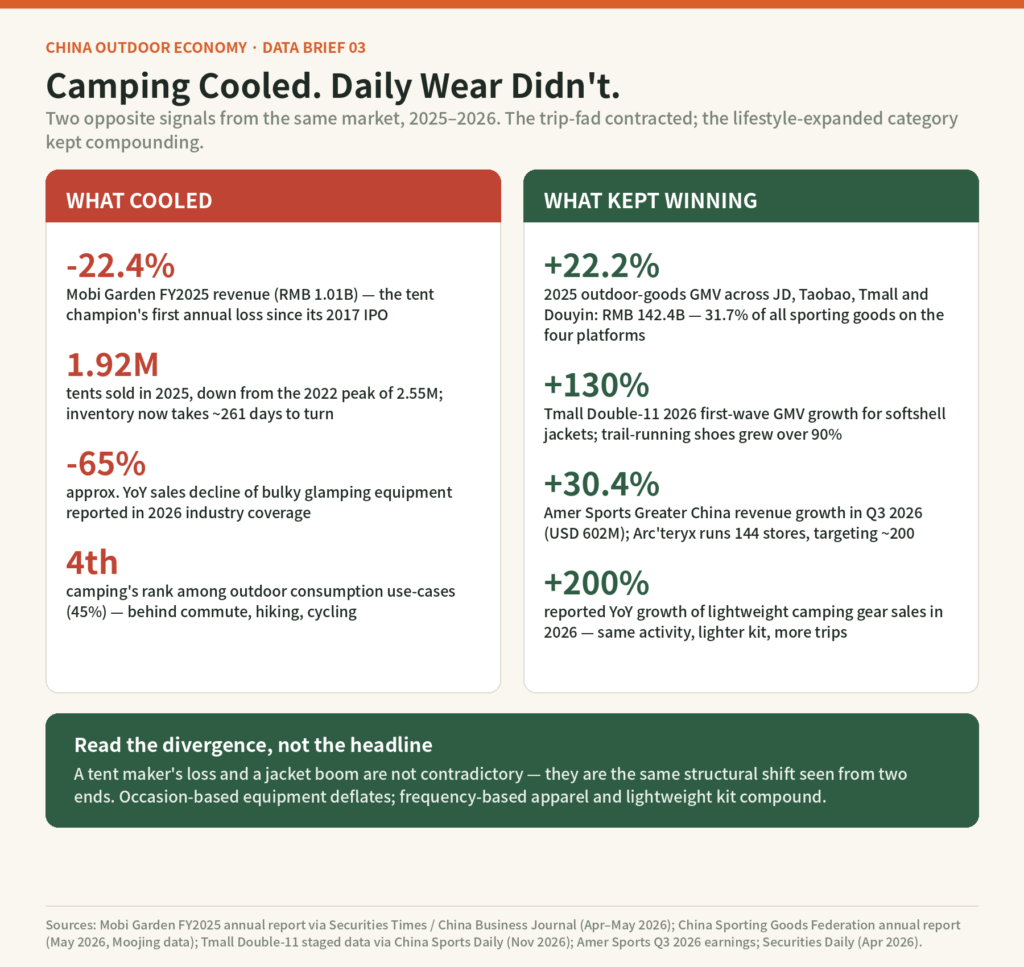
Mobi Garden — the listed tent champion once nicknamed the Moutai of tents — reported FY2025 revenue of RMB 1.01 billion, down 22.40%, and a net loss of RMB 34.19 million: its first annual loss since the 2017 IPO. Tent volume fell from a 2022 peak of 2.55 million units to 1.92 million in 2025, and inventory turnover stretched to roughly 261 days — nearly nine months to sell a tent. Toread’s outdoor equipment revenue fell 29.09% in the same year.
What cooled was a specific consumption ritual: the moving-truck glamping trip, with its tarps, vintage lanterns, pour-over coffee kits and photo staging. Industry reporting in 2026 put lightweight camping gear sales up more than 200% year-on-year while bulky glamping equipment fell about 65% — a holiday-window signal, not an annual statistic, but directionally consistent with everything else. Securities Daily’s field reporting during the 2026 Qingming holiday found campsites around Beijing, the Yangtze Delta and the Pearl River Delta fully booked. People did not stop camping. They stopped performing camping.
iiMedia’s own data tells the same story in slow motion: the core camping market’s growth ran above 50% during 2021–2024, then decelerated to 16.1% in 2025. Still growing — just no longer a frenzy. The trip fad deflated; the activity normalized.
4. Meanwhile, the Wardrobe Kept Compounding
Now look at the other end of the same market.
The JD x China Textile Commerce Association hardshell jacket white paper (November 2025) sized China’s hardshell market at RMB 28.7 billion, growing around 18.5% annually — the world’s third-largest market for the category. More than 60% of hardshell buyers wear them in daily scenarios, not just on mountains. Sales of products marketed as lightweight grew 83%. Domestic brands now hold 58% of the mid-to-high-end segment.
The consumer segmentation in that white paper is the cleanest evidence of the lifestyle turn: urban outdoor commuters are the largest group at 31% — and their spending grew 45% in 2024 — while hardcore outdoor enthusiasts, the parameter-obsessed buyers, account for 23%. The biggest and fastest group is not the mountaineer. It’s the office worker who wants one jacket for the subway, the rain and the weekend trail.
Platform data confirms the momentum continued into late 2026. Tmall’s first-wave Double-11 data showed softshell jacket GMV up more than 130% year-on-year, trail-running shoes up more than 90%, and outdoor casual clothing and shoes up more than 70% and 50% respectively. Amer Sports — Arc’teryx’s parent — grew Q3 2026 revenue 24% globally, with Greater China up 30.4% to USD 602 million; Arc’teryx operates 144 stores in Greater China and sees room for roughly 200.
A tent maker’s first-ever loss and a jacket boom are not contradictory headlines. They are the same structural shift, seen from two ends.
5. Who Are These 500 Million People? Not Who You Picture
The stereotype — the bearded male adventurer with a rooftop tent — is statistically obsolete.
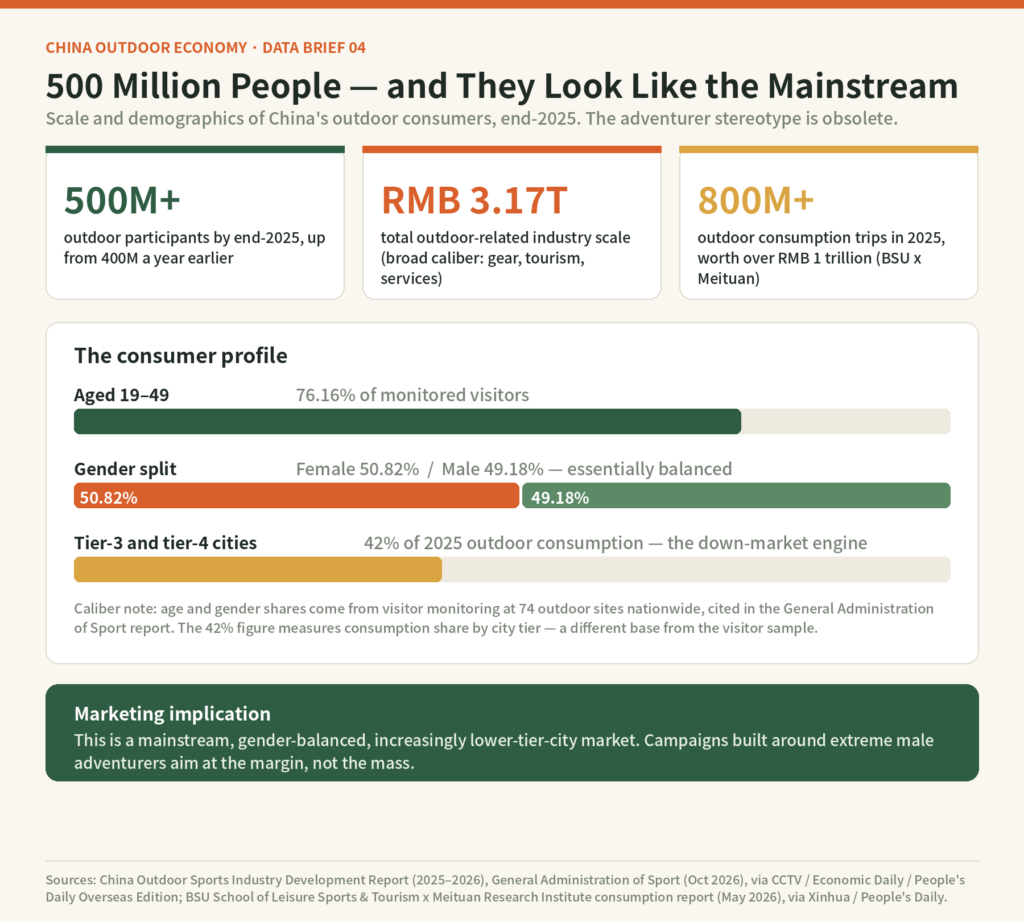
Monitoring at 74 outdoor sites nationwide, cited in the sports administration’s report, shows visitors aged 19–49 make up 76.16% of the crowd, and the gender split is essentially even: 50.82% female, 49.18% male. Meanwhile, tier-3 and tier-4 cities accounted for 42% of outdoor consumption in 2025 — note this is a consumption-share caliber, a different base from the visitor sample, and it marks the market’s center of gravity moving down-market.
The demand-side report from Beijing Sport University and Meituan adds texture: consumption is fragmenting into beginner, regular and professional tiers, and the conversion path now runs from online discovery to offline experience to platform booking to content sharing. Cycling alone counts roughly 40 million participants, about 10 million of them active, with 3,248 events held over three years, per the China Cycling Association.
Mainstream age structure, gender balance, lower-tier-city growth: this is a mass consumer market wearing outdoor clothing, not a niche expedition community buying provisions.
6. The Gear Economy’s Four Engines
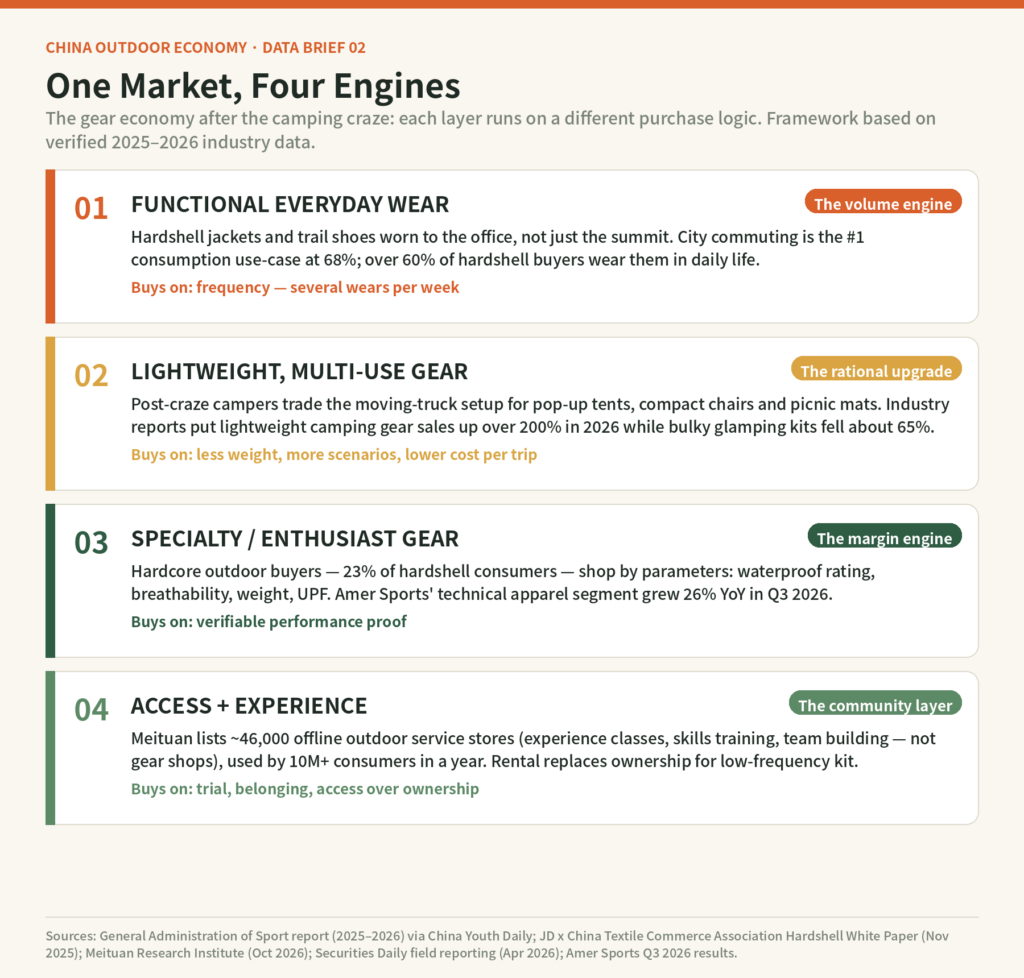
Put the verified data together and a four-layer structure emerges. Each layer runs on a different purchase logic — and conflating them is the most common strategic error in this market.
Layer 1: Functional everyday wear — the volume engine. Hardshells, trail shoes and technical pants bought for the commute. The 68% use-case and the 31% commuter segment live here. Purchase logic: frequency. Several wears a week justify a wardrobe staple, and the product must pass office aesthetics as well as weather tests.
Layer 2: Lightweight, multi-use gear — the rational upgrade. The post-craze camper wants less, lighter, more versatile: pop-up tents, compact chairs, one stove for three scenarios. Purchase logic: lower cost per trip, more trips per year. This is not consumption downgrading; it is frequency liberation — the same budget spread across more outings.
Layer 3: Specialty and enthusiast gear — the margin engine. The 23% hardcore segment shops by waterproof rating, breathability, grams and UPF. They demand verifiable proof, and they pay for it — Amer Sports’ technical apparel segment grew 26% in Q3 2026 while its margins expanded. Purchase logic: evidence.
Layer 4: Access and experience — the community layer. Meituan lists roughly 46,000 offline outdoor service stores — experience classes, skills training, team building, explicitly not gear shops — used by more than 10 million consumers in a year. Rental is the quiet sibling: a national survey found 77.3% of young respondents have rented instead of bought, with outdoor gear the second most-rented category. Purchase logic: trial and belonging before ownership.
7. What Everyone Misunderstands
Mistake one: camping cooled, therefore outdoor cooled. Camping is the fourth use-case. The category expanded its job description from trip to daily life — that is a more durable demand base, not a smaller one.
Mistake two: selling expedition gear to a commute-wear majority. If 68% of use is urban, a product line optimized only for extreme environments is aimed at the margin, not the mass. The volume wants office-to-trail versatility.
Mistake three: the male-adventurer creative brief. With a near-even gender split and 42% of consumption in lower-tier cities, campaigns built on extreme masculinity and tier-1 aspiration both miss the statistical center.
Mistake four: ownership-only business models. The fastest on-ramps into this market are a rented kit, a skills class and a weekend group — access and community are demand infrastructure, not side businesses.
8. The Playbook for Brands and Marketers
- Lead with functional everyday wear. Design and merchandise for the commute first: clean silhouettes, office-appropriate colors, all-day comfort — then prove the trail credentials. The daily-frequency engine is where volume compounds.
- Serve the rational upgrade. Build lightweight, multi-scenario lines and price on cost-per-use, not sticker shock. Communicate weight, pack size and setup time as headline specs — they are the new purchase drivers.
- Earn the enthusiast premium with evidence. Publish the parameters, invite third-party tests, and let the 23% verify. This segment is small, loud and disproportionately influential in category credibility — their approval sells to everyone else.
- Build access and community as acquisition. Rental partnerships, beginner classes, local activity groups. Nearly 40% of outdoor consumption happens away from home, per Meituan — the travel-triggered trial is a real funnel, and the local community is the retention loop.
- Let domestic identity work for you. With local brands at 58% of the mid-to-high-end hardshell segment, the made-in-China performance story is no longer a discount argument — it is a quality argument.
9. Risks and Honest Caveats
- Caliber sprawl. RMB 3.17T (whole industry), RMB 142B (four-platform goods), RMB 248B (camping core) measure different things. Any deck that adds or compares them without labels is unreliable.
- The camping-fad residue is real. Campsite homogenization and overcapacity persist; camping-specific brands face genuine headwinds even as the broader category grows. Mobi Garden’s nine-month inventory cycle is the cautionary tale.
- Fashion-cycle risk. The gorpcore aesthetic is trend-sensitive. Functional demand is durable; the fashion premium is cyclical. Anchor products on function so the trend’s exit does not take the business with it.
- Down-market price pressure. As tier-3/4 consumption rises, value transparency intensifies. Premiums must be justified by verifiable function, not brand alone.
- Forecast discipline. Published camping forecasts for 2026 and 2030 conflict across report versions; this analysis deliberately uses only 2025 actuals and documented growth rates. Treat any single-source forward number with suspicion.
Conclusion
The tent was the Trojan horse. It carried outdoor culture into the mainstream during the craze years — and when the glamping ritual deflated, what remained inside the walls was far bigger than camping: a 500-million-person market whose #1 outdoor use-case is the daily commute, whose fastest-growing hardshell segment is office workers, and whose gear economy now compounds on frequency rather than occasion. Brands still selling expedition equipment to this market are guarding an empty campsite. Brands selling functional everyday versatility, lightweight rationality, evidence-backed performance and access-plus-community inherit the kingdom. Camping cooled. The uniform won.