Somewhere in a conference room right now, a creative team is storyboarding a campaign for China’s middle class. You know the one. Soft golden light. A woman in her thirties opens the door of a new apartment. A slow pan across a kitchen island. The tagline lands: “You’ve earned this.”
It’s a beautiful ad. It may also be selling to a person who doesn’t exist.
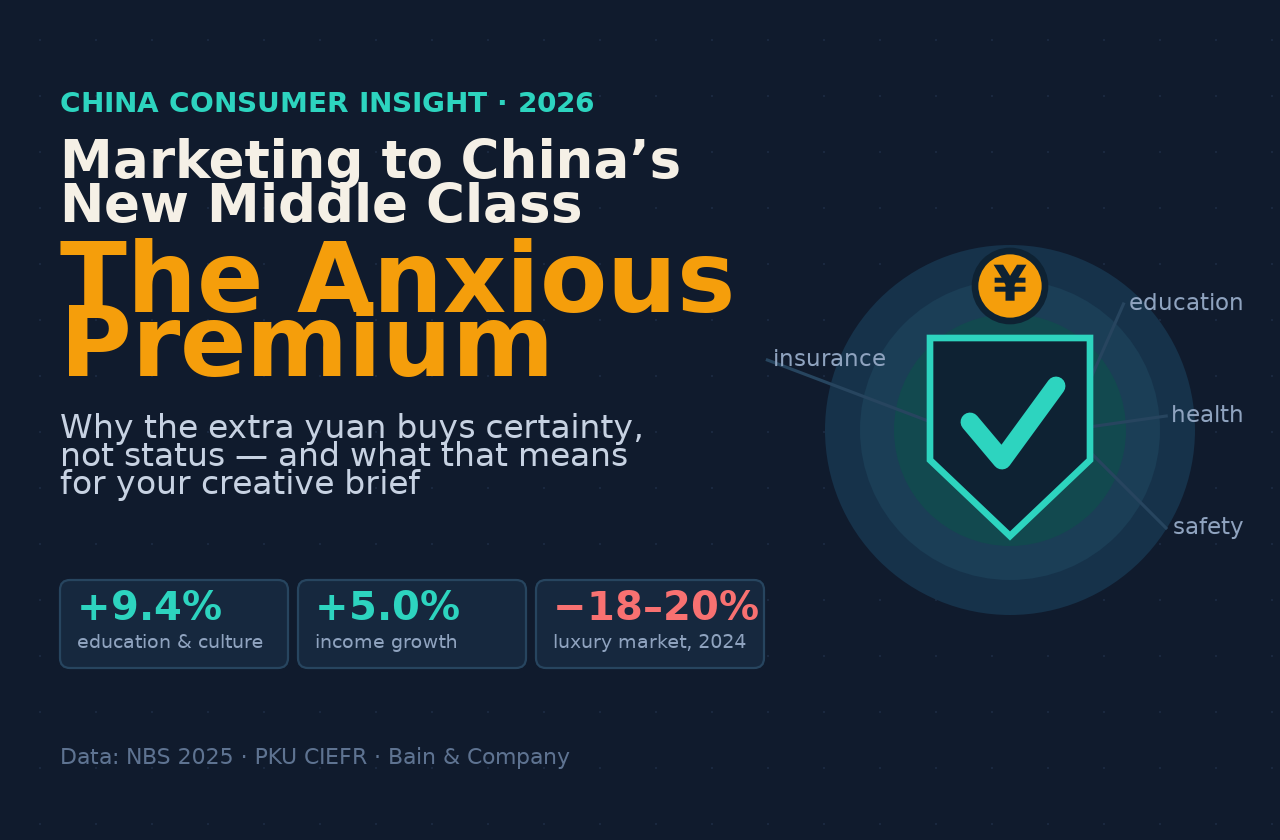
The standard playbook treats China’s new middle class as aspirational upgraders — people climbing, confident, ready to reward themselves with premium goods. But sit with the spending data for an hour and a different portrait emerges. This is a cohort whose income grew 5.0% in 2025 while its education-and-culture spending grew 9.4%. A cohort that parked ¥14.64 trillion of fresh cash into bank deposits in a single year. A cohort where 87% of parents, in one massive survey, said the word that luxury briefs never use: anxious.
The premium this class pays is real. But it isn’t a victory lap. It’s an insurance policy. And once you see that, almost every line of the standard brief needs rewriting.
Who We Mean by the “New Middle Class”
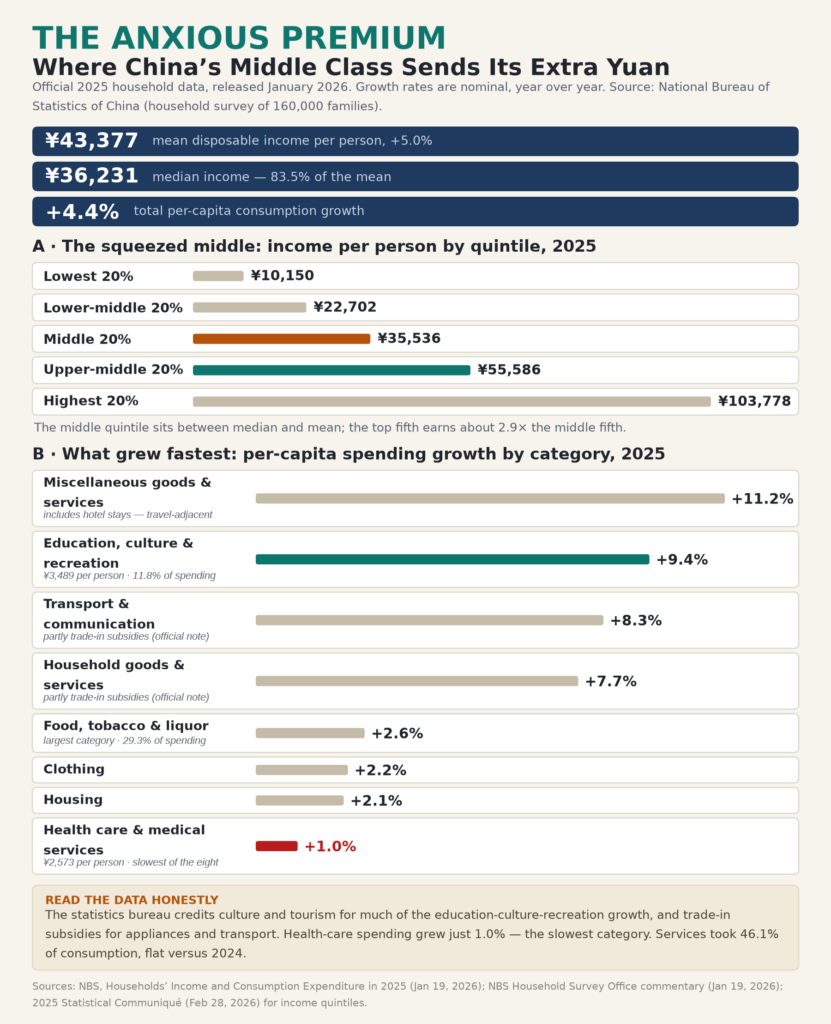
Let’s pin the term down before we build on it. China’s statistical system doesn’t publish a “middle class” category, so the honest approach is to use the official income quintiles as scaffolding. In 2025, according to the National Bureau of Statistics, per-capita disposable income averaged ¥43,377. The middle quintile earned ¥35,536; the upper-middle quintile, ¥55,586. The top fifth took in ¥103,778 — nearly three times the middle.
The more revealing number is the median: ¥36,231, or 83.5% of the mean. When the median sits that far below the average, the distribution has a long right tail — a lot of households clustered below the “average” lifestyle that advertising portrays. The typical family isn’t living the mean. It’s living slightly beneath it, watching the mean from below.
That gap is the emotional weather of this entire piece. The new middle class — younger, urban, digitally fluent, mostly one generation removed from much leaner circumstances — occupies the territory between the median and the mean. Far enough above the bottom to have something to lose. Far enough below the top to know how easily it could be lost.
The Spending Signature: What Grew, What Didn’t
Here is where the story gets interesting — and where we have to be more careful than most commentary is.
In 2025, per-capita consumption rose 4.4% overall. Within that, education, culture and recreation spending grew 9.4% to ¥3,489 per person — the second-fastest of the eight official categories. Transport and communication grew 8.3%. Household goods and services, 7.7%. Meanwhile food, tobacco and liquor grew 2.6%, clothing 2.2%, housing 2.1%. And health care? Just 1.0% — the slowest category of all.
Before we rush to call all of this anxiety money, two honesty checks. First, the fastest-growing category was actually “miscellaneous goods and services” at 11.2% — and the NBS Household Survey Office explicitly notes it includes hotel stays. Second, the bureau’s own commentary credits the education-culture-recreation jump partly to the cultivation of “culture and tourism consumption,” and the appliance and transport growth partly to government trade-in subsidies. This is a blended category. Concert tickets and family trips live in the same bucket as school fees.
The tourism boom confirms the mix: 6.52 billion domestic trips in 2025, up 16.2%, with total spending up 9.5% — but average spend per trip fell to roughly ¥966 from ¥1,024. People traveled more and spent less each time. That’s not swagger. That’s a household finding cheaper ways to feel normal.
So no, the headline category number alone doesn’t prove anxiety. To find the anxious premium, you have to open the education line item specifically — and that’s where the academic data gets loud.
Open the Education Line: The Fear Is Priced In
The best dataset on what Chinese families actually spend on schooling comes from Peking University’s China Institute for Educational Finance Research, which has run a national household tracking survey since 2017. The 2023 round covered 26,804 families, and its findings, published in late 2025, are striking.
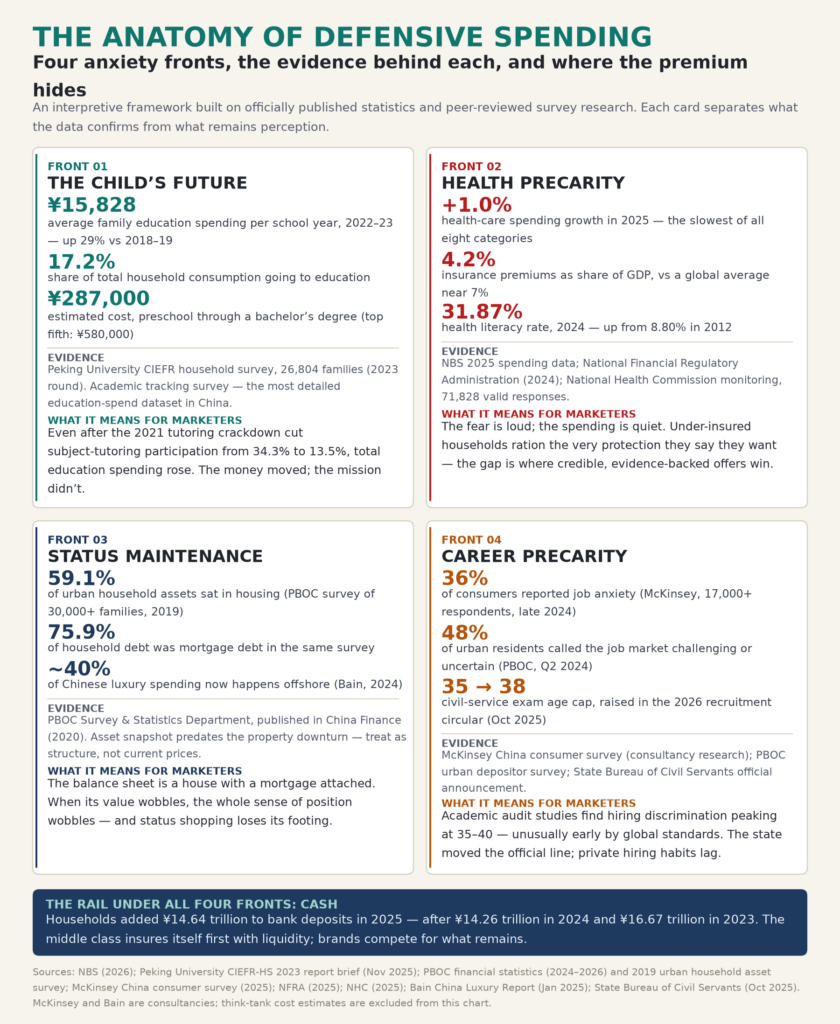
Average family education spending hit ¥15,828 per school year in 2022–23 — up 29% from the 2018–19 round. That’s 17.2% of total household consumption going to education. Per child: ¥11,086 a year. Roll it up from preschool through a bachelor’s degree and the average family is looking at roughly ¥287,000. The top fifth of families spend about ¥580,000; the bottom fifth, ¥160,000.
Now the part that kills the “it’s just affluence” explanation: this 29% increase happened straight through the 2021 “double reduction” crackdown, which dismantled the commercial tutoring industry. Subject-tutoring participation collapsed from 34.3% of students in 2016–17 to 13.5% in 2022–23. And total education spending still rose. The policy deleted the channel; it couldn’t delete the demand. Money migrated — to non-subject enrichment, to school-adjacent services, to anything that still smelled like an edge.
The PKU data also shows who absorbed the policy shock: families in the middle 40–80% of the consumption distribution. The poorest quintile couldn’t afford much tutoring before or after; the richest barely noticed the ban. The squeeze landed, precisely, on the middle. By 2023, the top quarter of families were outspending the bottom quarter on tutoring by six to one.
And the parents themselves know what’s happening. A 2021 survey by the Communist Youth League’s publicity department and the China Youth Daily social survey center — an online, self-selected sample, but an enormous one at 511,043 parents — found 87.0% reporting education anxiety. The top stated source, at 73.2%, was their own inability to coach their child well enough. The third, at 53.1%, was the tutoring industry itself: marketing, they said, that manufactured “fall behind” panic. Read that again. The customers diagnosed the anxiety funnel better than most marketers do.
Four Fronts of the Anxious Premium
Pull the threads together and the defensive spending resolves into four fronts. Each has hard evidence behind it — and each carries a caveat worth respecting.
Front one: the child’s future
This is the strongest front, with the cleanest data. The ¥287,000 lifecycle cost, the 29% growth through a crackdown, the 6:1 spending gap between rich and poor — education is where the fear of the child falling behind gets priced, year after year, regardless of policy weather. For marketers, the operative insight is that education spending behaves less like a discretionary category and more like a fixed obligation with a luxury price tag.
Front two: health precarity — the underinsured fear
Here the naive story breaks, and the real one is more useful. If anxiety were simply converting into health spending, the category would be booming. It grew 1.0% in 2025 — dead last. Meanwhile insurance penetration remains thin: premiums equal about 4.2% of GDP against a global average near 7%, as the financial regulator’s own officials noted in 2025. Per-person premiums run around $568 versus a world average of $883.
So the health front isn’t a spending boom. It’s a protection gap. Households report deep precarity — one serious illness is the canonical middle-class ruin story — yet they ration the very products that address it. Health literacy, to be fair, is climbing fast: 31.87% in 2024, up from 8.80% in 2012, per the National Health Commission’s monitoring of nearly 72,000 respondents. People are learning what protection looks like faster than they’re buying it. For brands with genuine, verifiable health value, that gap is the opportunity — but it converts on evidence, not on fear.
Front three: status maintenance — the balance sheet is a house
The People’s Bank of China’s landmark survey of more than 30,000 urban households, published in 2020, found 59.1% of family assets sitting in housing, with mortgages making up 75.9% of household debt. That’s a 2019 snapshot — the property downturn since has changed the values, not the structure. The middle-class balance sheet is still, overwhelmingly, one leveraged asset.
When that asset’s value wobbles, the entire sense of position wobbles with it. McKinsey’s late-2024 survey of over 17,000 consumers found confidence among affluent urban elderly — once the most optimistic segment — down roughly 20%, driven by asset depreciation. And the visible-premium market told the same story: Bain’s China luxury report estimated the mainland personal luxury market fell 18–20% in 2024, with watches down 28–33%, as spending rotated toward “value-preserving assets and experiences.” Status display was the first thing cut. Defensive value was what remained.
Front four: career precarity — the 35-year wall
In that same McKinsey survey, 36% of respondents reported experiencing “job anxiety”; a PBOC urban survey in mid-2024 found 48% calling the job market challenging or uncertain. Academic work using the Chinese Academy of Social Sciences’ national survey data finds something unusual by global standards: hiring age discrimination in China peaks at 35–40, not in the fifties. The famous “35-year-old threshold” isn’t folklore; it’s measurable, and it raises unemployment risk and lowers incomes for those it touches.
The state has started moving the line — the 2026 civil-service recruitment circular raised the general age cap from 35 to 38, and to 43 for fresh master’s and PhD graduates. That’s a real signal. But private hiring habits lag official circulars by years, and every thirty-something professional knows it. Income risk is the front that funds all the others: you buy the child’s edge and the family’s protection precisely because your own paycheck feels conditional.
What Everyone Misunderstands
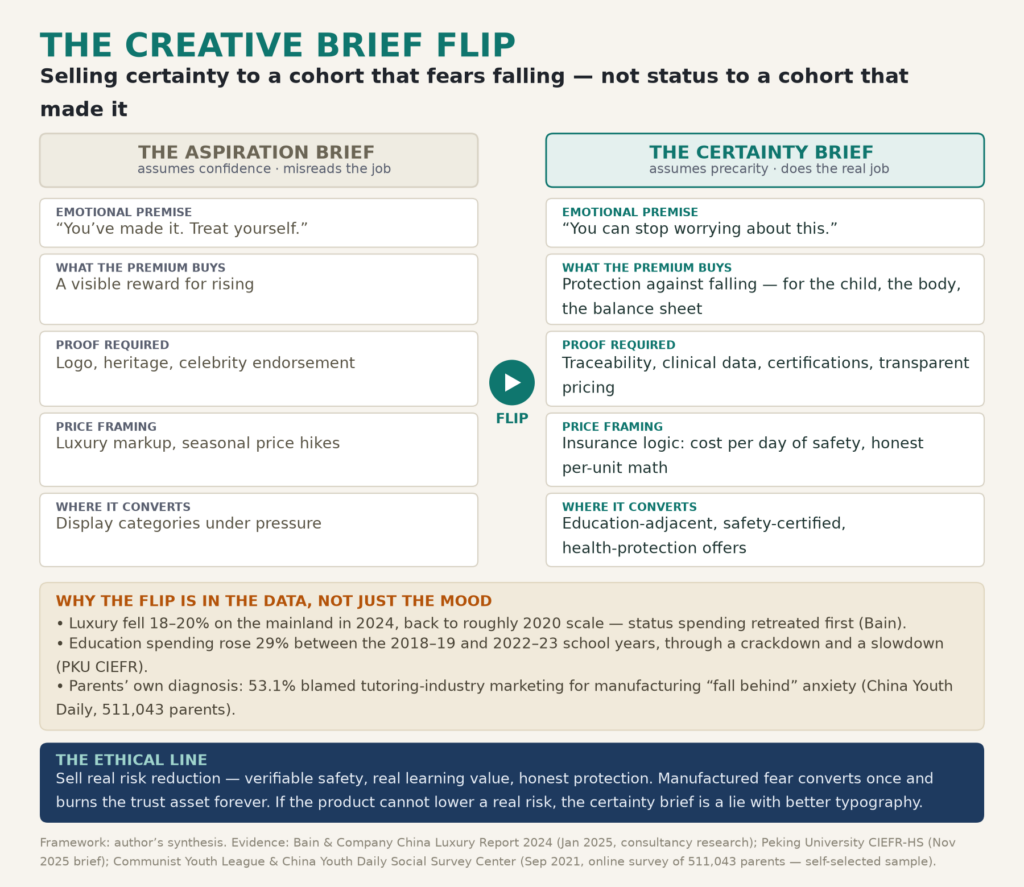
Misread one: premium equals luxury. The visible premium — bags, watches, badges — is the one that photographs well. The anxious premium is bigger and quieter: school fees, enrichment, safety-certified goods, the “correct” choice. In 2024 the loud premium shrank 18–20% while the quiet one compounded. If your category map only includes display goods, you’re watching the wrong meter.
Misread two: this is irrational spending. It isn’t. It’s loss aversion doing exactly what loss aversion does. Kahneman and Tversky’s foundational work showed losses loom roughly twice as large as equivalent gains. A cohort one generation out of scarcity, holding one leveraged asset, facing a 35-year hiring wall, is not miscalculating when it overpays for certainty. It’s calculating a different function than the one your pricing model assumes: minimize the probability of falling, not maximize the pleasure of rising.
Misread three: aspiration copy is neutral. “Treat yourself” isn’t a harmless default. To a precarity-minded buyer it can read as tone-deaf — or worse, as a trap, the kind of spend that erodes the buffer they’re desperately building. The emotion your copy assumes is itself a targeting decision. Get it wrong and the media spend just delivers the wrong feeling to the right demographic.
Misread four: the cohort is a monolith. The PKU data shows the top quarter outspending the bottom six to one on tutoring; McKinsey segments confidence across 108 demographic cells, with rural consumers improving while urban millennials sour. “The middle class” is a distribution, not a person. The anxious premium is strongest precisely in the middle bands — the families with enough to protect and not enough to feel safe.
The Counterarguments, Taken Seriously
“But they still travel, dine out, buy experiences — that’s pleasure, not fear.” True, and the data says so: the tourism boom is real, and the NBS credits it inside that 9.4% category. The claim here was never that every yuan is defensive. It’s about where the marginal premium goes — and the marginal education yuan, up 29% through a crackdown, is the cleanest signal in the dataset. Pleasure is the base. Certainty is the premium. Both can be true; only one is mispriced by most briefs.
“Anxiety marketing is manipulation.” Sometimes, yes — and remember, 53.1% of parents in that half-million-parent survey blamed industry marketing for manufacturing the panic in the first place. The ethical line is bright and practical: sell real risk reduction, or don’t sell certainty at all. A traceable food supply chain, a screening service with clinical validation, an education product with honest outcome data — those lower actual risk. A countdown timer on a “don’t let your child fall behind” headline lowers nothing except the customer’s defenses. The first builds a trust asset; the second burns one that took a generation to deposit.
“Maybe the middle class is just shrinking, and this is decline, not strategy.” Partly fair — income expectations are grim (McKinsey’s respondents expected just 1.4% household income growth for 2025, down from 2.5% a year earlier), and the deposit mountain suggests fear, not confidence. But a squeezed middle doesn’t stop allocating; it reallocates. The 29% education increase amid a slowdown is precisely the evidence: when the pie stops growing fast, the defensive slice grows anyway. That’s not decline. That’s priority, revealed under pressure.
Rewriting the Brief: From Status to Certainty
So what does a certainty brief actually look like? Not softer copy. Different physics.
Lead with the loss you prevent, not the status you confer. The job-to-be-done is downside protection: the child who doesn’t fall behind, the illness caught early, the product that won’t fail. Frame the benefit as a floor, not a ceiling.
Bring evidence to a fear fight. This cohort overpays for verifiable certainty — traceability, certifications, clinical data, transparent per-unit pricing — and discounts unverifiable claims to zero. The anxious buyer is not a naive buyer. They are, if anything, the most skeptical premium buyer in the market, because they cannot afford to be wrong twice.
Price like insurance, not like luxury. A per-day cost of protection converts where a Veblen markup repels. “¥3 a day for a screened, traceable supply chain” speaks the cohort’s actual language. Frequent luxury-style price hikes do the opposite: Bain’s report explicitly flags Chinese consumers’ refusal to accept increases without justified value.
Choose your categories by fear map, not by glamor map. The compounding defensive categories — education-adjacent services, safety-certified goods, credible health protection — are where the premium lives. The health protection gap in particular is a rare thing: documented demand, thin supply of trusted offers, and a buyer who has learned what good looks like faster than the market has delivered it.
And audit the fear in your funnel. If a touchpoint amplifies anxiety without reducing risk, cut it. Not just because it’s wrong — because this cohort has already told a half-million-person survey that it notices, resents, and remembers.
The Takeaway
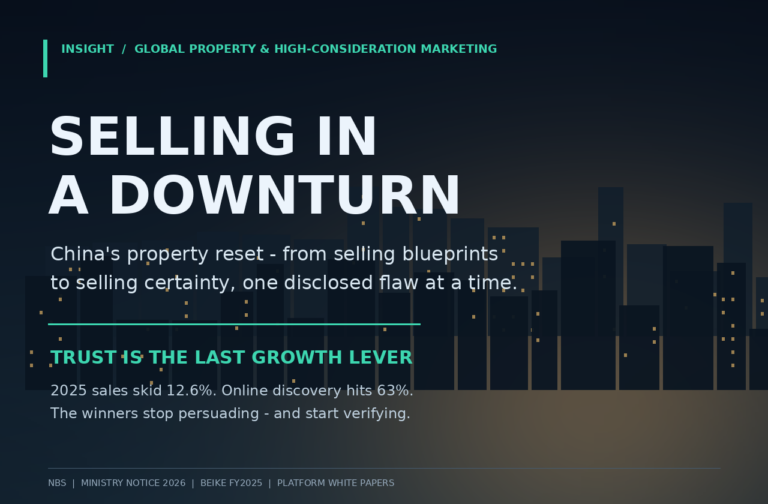
China’s new middle class is not treating itself. It’s hedging itself — against the child’s fall, the body’s failure, the asset’s slide, the paycheck’s end. The official data shows the squeeze (a median at 83.5% of the mean), the academic data shows the priority (education up 29% through a crackdown), and the market data shows the consequence (luxury down 18–20% while defensive spending compounds).
The brands that inherit this premium won’t be the ones with the best golden-hour cinematography. They’ll be the ones that understood the assignment: this is not a cohort buying its way up. It’s a cohort paying not to fall. Sell the floor. Prove the floor. And the margin you’re chasing — the anxious premium — was never a reward for status. It was always the price of certainty.