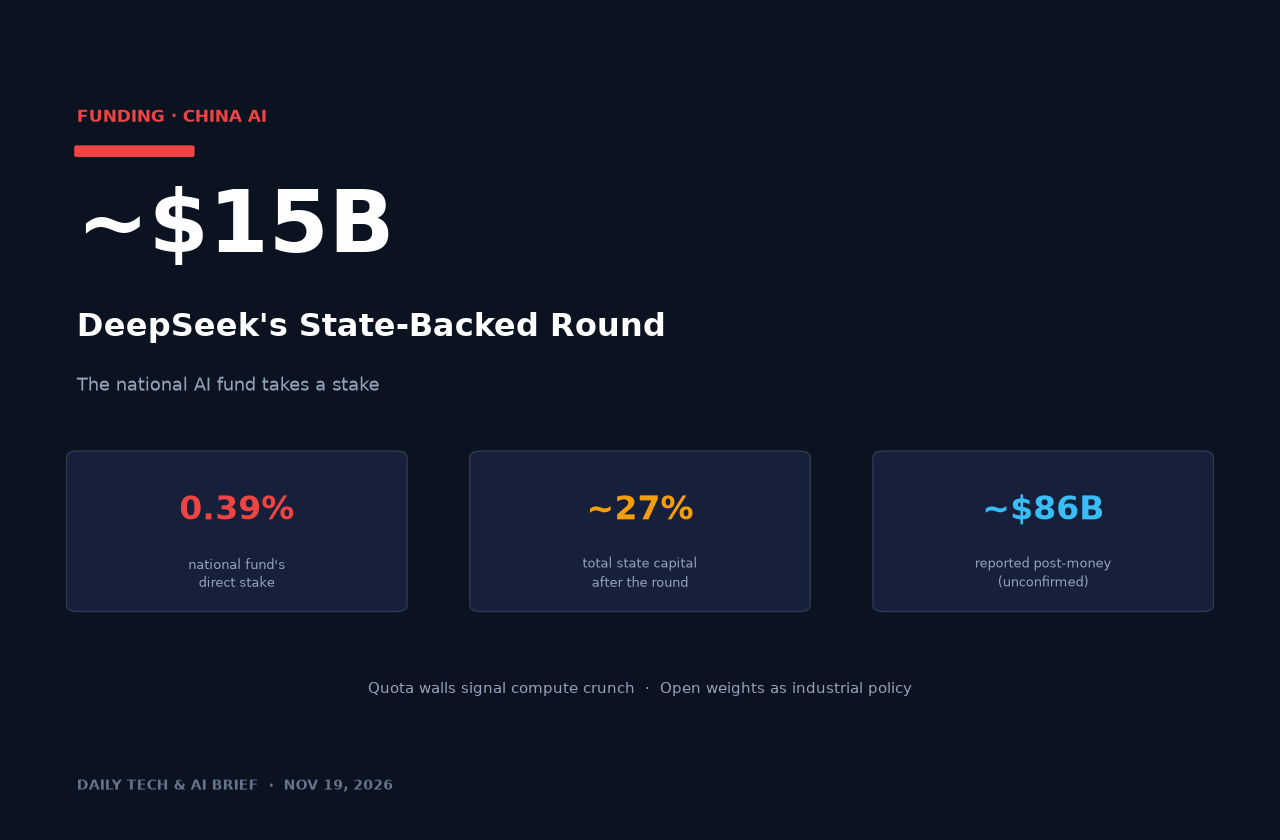
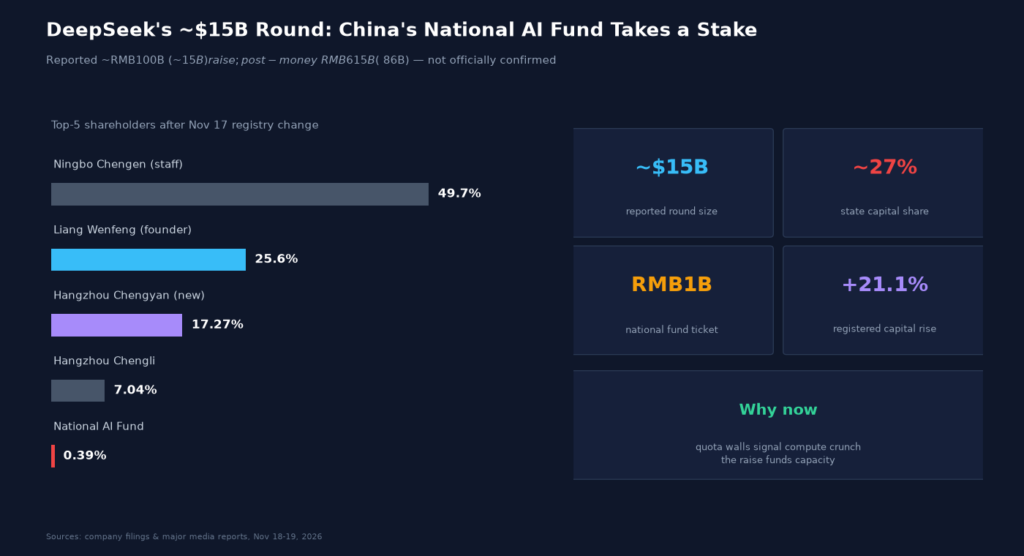
The quietest mega-round of the year closed in a business registry. Corporate filings updated November 17 show DeepSeek’s core operating entity, Hangzhou DeepSeek Artificial Intelligence Fundamental Technology Research, raising registered capital 21.1% to RMB19.92 million and adding a shareholder that changes the company’s political geometry: China’s National Artificial Intelligence Industry Investment Fund. The state fund’s direct stake is small — 0.3925%, making it the fifth-largest shareholder — but reporting from Reuters, Bloomberg and The Information puts the broader second round at roughly RMB100 billion (about $15 billion), with total state-linked capital rising to around 27% of the company from roughly 2% after the first round. Chinese financial media, citing people familiar, put the range at RMB100–105.5 billion at a post-money valuation near RMB615 billion (~$86 billion). None of the figures are officially confirmed by DeepSeek, which remains one of the most disclosure-averse companies in technology. What is confirmed is the direction: the lab that embarrassed Silicon Valley with cheap, open-weight reasoning models is now, formally, part of China’s national AI infrastructure.
Why the money is arriving now
The timing connects to a consumer-visible symptom. For days, DeepSeek’s free tier has been throttling users — some exhausting quotas within an hour — with no announced paid plan, while industry analysts describe a structural compute shortage expected to persist for years. A lab whose models are distilled into thousands of downstream products, whose API pricing undercuts everyone, and whose consumer app remains free, has a demand problem of the best kind and a capacity problem of the worst. A ~$15 billion raise is not a growth-marketing war chest; it is a procurement budget for accelerators, power, and data centers in a market where US export rules have closed the H200 channel and tightened remote-compute access. Domestic supply is ramping — IDC data this week showed Chinese vendors above 50% of domestic AI-accelerator shipments — but usable capacity, as the same reporting stressed, lags shipment counts badly. DeepSeek’s round is the financial expression of that gap.
The state fund’s participation prices in something money alone cannot buy: priority. In a compute-rationed economy, allocation follows policy, and a national-fund cap table is the strongest allocation signal available. It also formalizes what was already functionally true — DeepSeek’s open-weight releases serve as the substrate for a domestic ecosystem the state wants built on non-US foundations.
The strategic read: open weights as industrial policy
Set this beside the week’s other model news and a bifurcation sharpens. In the US, Anthropic went public at $83 with founder super-voting control and take-or-pay commitments north of $300 billion; OpenAI cut prices and confirmed IPO plans; the frontier consolidates into a few closed, capital-devouring platforms. In China, the leading edge is deliberately open: DeepSeek’s weights are free to download, Alibaba open-sourced its chip software stack this week, and Tencent’s Hy4 flash topped OpenRouter’s daily usage chart on release. Two systems are optimizing for different things — the American one for margin on intelligence, the Chinese one for diffusion of intelligence. For the rest of the world’s businesses, the Chinese system is effectively an export subsidy of capability: frontier-adjacent models, no license fees, deployable on your own hardware.
That is the fact global marketing organizations should sit with. The cost floor for AI capability worldwide is increasingly set by labs whose business model is not selling you a subscription. Any vendor pricing AI services purely on “our model is smart” is competing against a free alternative that is good enough for most workflows and improving monthly.
Practical implications for buyers and builders
Three moves follow. First, re-benchmark against open weights annually, if not quarterly: the tasks where a paid frontier model earns its premium are shrinking, and your eval suite should identify them precisely rather than defaulting everything to the most expensive API. Second, treat DeepSeek’s monetization turn as a scheduled event: a compute-hungry lab with state backing and throttled free users will introduce paid tiers — budget for the transition and for the API pricing volatility around it. Third, watch the compliance perimeter: a national-fund-backed Chinese lab will face growing scrutiny in Western procurement contexts, even as its open weights remain legally downloadable in many jurisdictions. Decide your posture on open-weight deployment — self-hosted models sidestep some data-transfer concerns while raising others — before policy decides it for you.
The registry filing is two paragraphs long. The round it confirms reorganizes the economics of global AI. Both things are true, and only one of them made headlines.






