Most coverage of Heytea’s retreat reads it as a mood: a brand that lost its nerve, got tired of the price war, decided to be small again. That reading is comforting and wrong. What happened between 2022 and 2025 was not a change of heart. It was a profit-and-loss statement finally being read out loud.
Two Ledgers That Were Never Reconciled
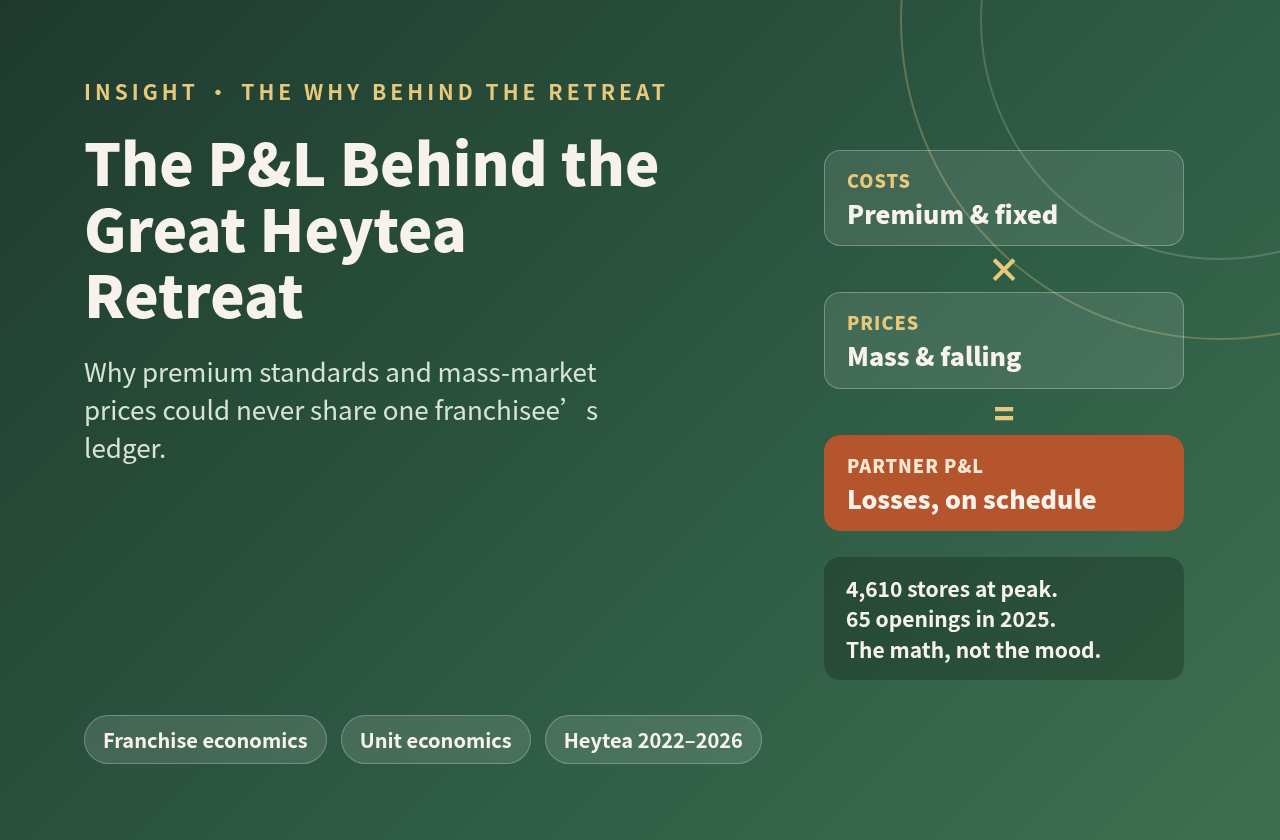
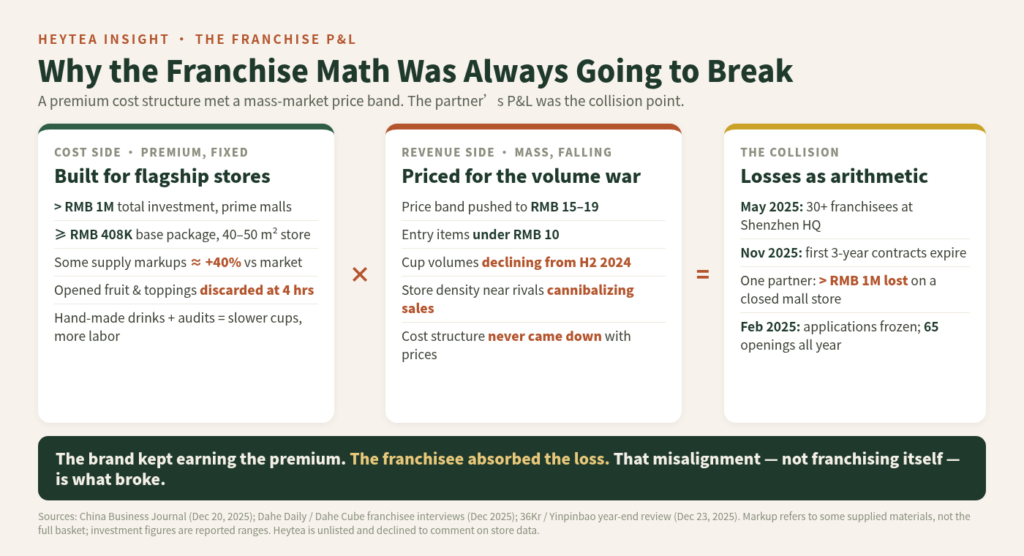
Start with what a Heytea partner actually signed up for. According to franchisee interviews published by Dahe Daily in December 2025, a store in a prime mall often demanded more than RMB 1 million in total investment; even the base package for a 40-to-50-square-meter shop started at RMB 408,000. Some supplied materials carried markups of roughly 40 percent above market prices — note the word “some,” because the distinction matters. Opened fruit and toppings had to be discarded after four hours. Drinks were hand-made, which slowed throughput. Monitoring systems added labor. Every one of these costs was a premium-brand cost, designed for company-run flagships selling at RMB 30.
Now look at the revenue side. To win in lower-tier cities, Heytea pushed its price band down to RMB 15 to 19, with some items under RMB 10. From the second half of 2024, partners reported cup volumes sliding as store density rose — the brand had even encouraged clustering near rivals’ best locations, which cannibalized sales. Prices fell. Volume fell. Costs did neither.
Why the Losses Were Arithmetic, Not Bad Luck
Here is the mechanism most retellings skip. In a franchise system, the brand and the partner keep separate ledgers. Heytea’s headquarters earned on supply-chain markups and brand fees regardless of whether any individual store profited. The partner earned only on the gap between cup revenue and cup cost — a gap the brand itself was compressing from both ends: premium inputs on one side, discounted prices on the other. When volumes were rising fast, as in 2023’s 280-percent expansion, the gap stayed positive and nobody audited the structure. When volumes turned, the same structure produced losses with mechanical certainty. One early partner told Dahe Daily he closed a mall store after losing more than RMB 1 million. In May 2025, more than 30 franchisees went to Shenzhen headquarters to ask for support. The first three-year contracts were reaching expiry. This was not a sentiment problem. It was double-entry bookkeeping.
What the Retreat Actually Fixed
Seen this way, the February 2025 internal letter — no more numbers games, return to users and the brand — was not surrender. It was the only move that repaired the ledger: stop adding partners whose economics cannot work, let the price band recover through premium formats, and rebuild the willingness to pay that makes premium costs survivable. Craft stores pricing up to RMB 39, the zero-residue kale program, two deep collabs instead of fourteen — each is an attempt to widen the partner’s revenue gap again, from the demand side. And the September 2026 reopening, with its business-plan requirement and explicit risk warnings, is an admission that the gate, not the slogan, is where alignment gets enforced. The triangle was never solved by feeling differently about scale. It gets solved only when both ledgers can show a profit at the same time.