In February 2017, a tea shop inside a Shanghai shopping mall did something no beverage chain had done before: it made people wait seven hours. The line at Raffles City snaked through the atrium in six switchback lanes. Scalpers flipped RMB 25 cups for RMB 80, sometimes more. The store pushed out nearly 4,000 cups a day. The brand was Heytea, and for a moment it looked like the future of Chinese retail — young, design-obsessed, premium, and impossible to ignore.
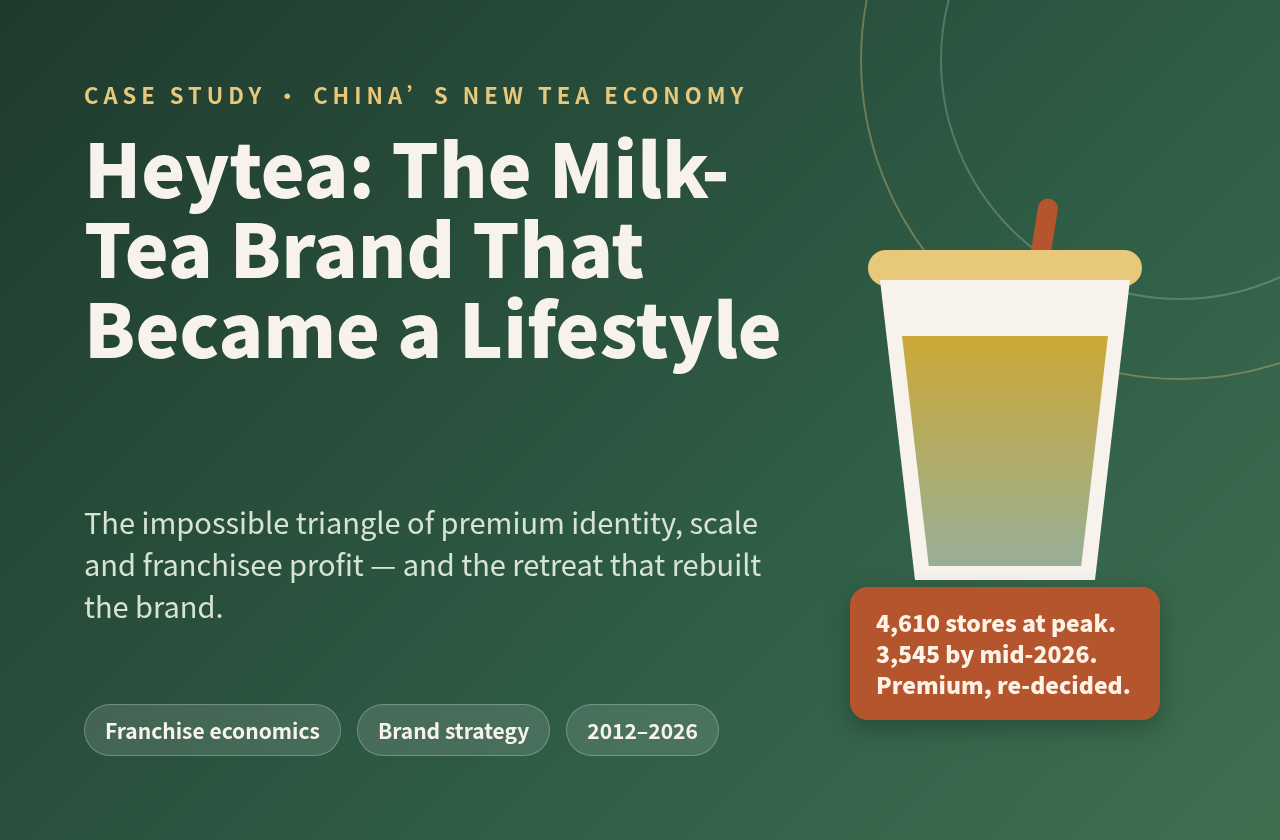
Nine years later, Heytea is doing something stranger than making people queue. It is shrinking on purpose. Its store count fell from a peak of 4,610 in October 2024 to 3,545 by July 2026, according to third-party monitors. It froze franchise applications, walked away from a price war it had helped start, and told the entire industry — in an internal letter that leaked immediately — that the numbers game was over.
Here is the twist most obituaries miss: the retreat was not the failure. The retreat was the correction. This case study is about what happens when a premium brand tries to buy scale with someone else’s money, breaks the promise that made it premium, and then pays the price to put the promise back together.
Executive Summary
Heytea invented China’s premium new-tea category, then spent 2022 to 2025 discovering that premium identity, rapid scale and franchisee profitability form an impossible triangle. After ten years of direct-only operation, it opened franchising in November 2022 and quintupled its footprint in two years — but premium standards, marked-up supply costs and a sliding price band squeezed partners into losses. A February 2025 internal letter halted the expansion; roughly 680 stores vanished in a year. What followed was a lifestyle rebuild: craft stores with prices back above RMB 20, an industry-first zero-residue kale program, two deeply executed IP collaborations instead of fourteen shallow ones, and an overseas network that kept compounding. In September 2026, the franchise portal quietly reopened — this time with a business plan requirement and explicit risk warnings. The lesson for any premium brand: premium is a decision you enforce system-wide, not a price tag you defend. Scale that dilutes the decision destroys the asset.
Inventing the Category: Cheese Tea, Designed Stores, and a Seven-Hour Queue
The origin story is almost too clean. In May 2012, a young founder named Nie Yunchen opened a tiny shop called Royal Tea on Jiuzhong Street in Jiangmen, a third-tier city in Guangdong. While the rest of the market was mixing powder and creamer, he was brewing real tea, adding real fruit, and topping it with a salted cheese foam. The product was genuinely different. The trademark was not even registrable — copycats multiplied faster than he could open stores — so in early 2016 he bought the name Heytea and rebranded everything overnight.
Then came Shanghai. The February 2017 opening at Raffles City turned waiting itself into a marketing channel. Contemporary reporting recorded queues of up to six or seven hours, purchase limits, and a scalper economy selling cups at two to three times face value. Heytea did not just sell a drink; it sold proof that you were the kind of person who drank Heytea. At roughly RMB 30 a cup, in a market accustomed to single digits, it became the pricing anchor for an entire category that analysts would later call new tea.
The Direct-Only Decade and the RMB 60 Billion Peak
For ten years, Heytea refused to franchise. Nie’s public reasoning was consistent: if store growth outruns what the brand can carry, the brand’s energy dilutes. Every store was company-run, designed like a small gallery, and monitored like a lab. The collab machine — double-digit partnerships a year with fashion houses, games and artists — kept the brand in feeds without paid media.
Capital rewarded the discipline. A 2016 round from IDG and investor He Boquan exceeded RMB 100 million; Meituan’s Dragonball fund led RMB 400 million in 2018; Tencent and Sequoia followed; and by July 2021, media reported a round at a post-money valuation of RMB 60 billion — roughly USD 8 billion at the time — with only existing shareholders allowed in. Note the caveat that matters later: Heytea never officially confirmed that figure, and it remains media-reported to this day.
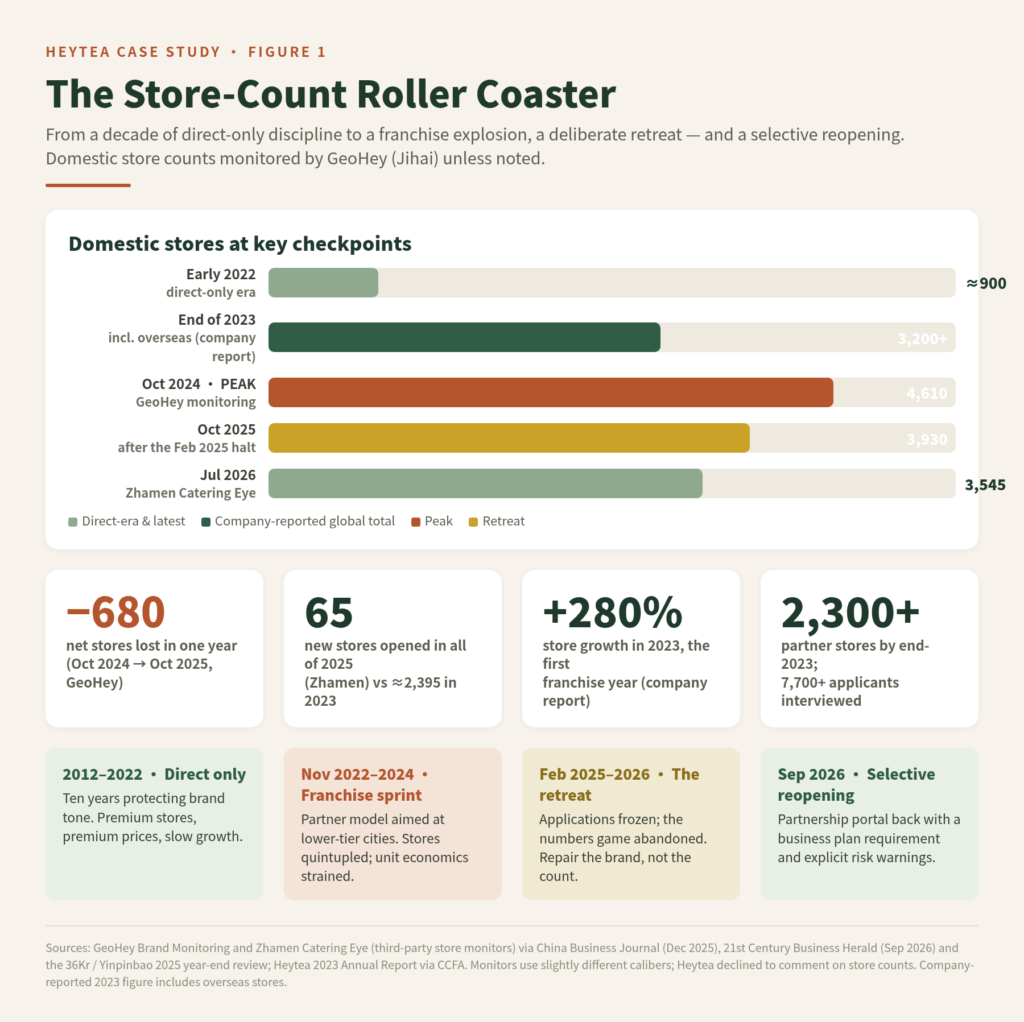
Meanwhile, the ground was shifting. Mixue Bingcheng franchised its way past 20,000 stores. GoodMe and ChaBaiDao were locking up the best mall corners in lower-tier cities. Heytea’s direct model was beautiful, profitable per store, and slow. By early 2022 it had around 900 stores while rivals counted in the tens of thousands. Franchise expert Li Weihua later described what happened next as a competitive response rather than a chosen strategy: Heytea opened franchising because the scale race was leaving it behind.
The Franchise Pivot: From 900 Stores to 4,610
The descent started before the pivot. In February 2022, Heytea cut prices across its menu by RMB 1 to 10 and pledged no new products above RMB 29 that year. In November 2022, it launched its business partnership program — franchising by another name — aimed squarely at non-first-tier cities, with standardized small stores of 40 to 50 square meters instead of the designed flagship spaces.
The response was explosive. Heytea’s own 2023 annual report says it interviewed more than 7,700 potential partners, opened over 2,300 partner stores, and ended the year with more than 3,200 stores worldwide — growth of 280 percent. Third-party monitor Zhamen counted roughly 2,395 openings that year alone. By October 2024, GeoHey Brand Monitoring put the domestic network at its peak: 4,610 stores.
On paper, it worked. Under the skin, three forces were pulling against each other.
The Impossible Triangle
Here is the framework that explains everything that followed. A premium brand that franchises into down-market cities faces a three-way conflict:
Premium identity versus rapid scale. Heytea’s promise was hand-prepped fresh fruit, made-to-order drinks, designed spaces and strict audits. Replicating that promise across thousands of partner-run stores in county-level cities multiplies cost and variance at the same time.
Premium standards versus franchisee profit. Partners fronted the capital and carried the risk, but the cost structure they inherited was built for direct-operated flagships. According to franchisee interviews published by Dahe Daily in December 2025, some supplied materials were marked up around 40 percent above market prices. Fruit and toppings had to be discarded four hours after opening. Hand-making drinks slowed throughput. Online monitoring systems added labor. A store in a prime mall often required more than RMB 1 million in total investment; even the base package for a small store started at RMB 408,000, with fit-out alone from RMB 100,000.
Premium price versus down-market acceptance. To compete where it was expanding, Heytea pushed its price band down to RMB 15 to 19, with some items under RMB 10 — straight into GoodMe and ChaBaiDao territory. But costs never came down with the prices. Partners were selling at mass-market prices with premium-market economics. And customers got a cognitive split: a brand that still looked premium, at prices that said it was not.
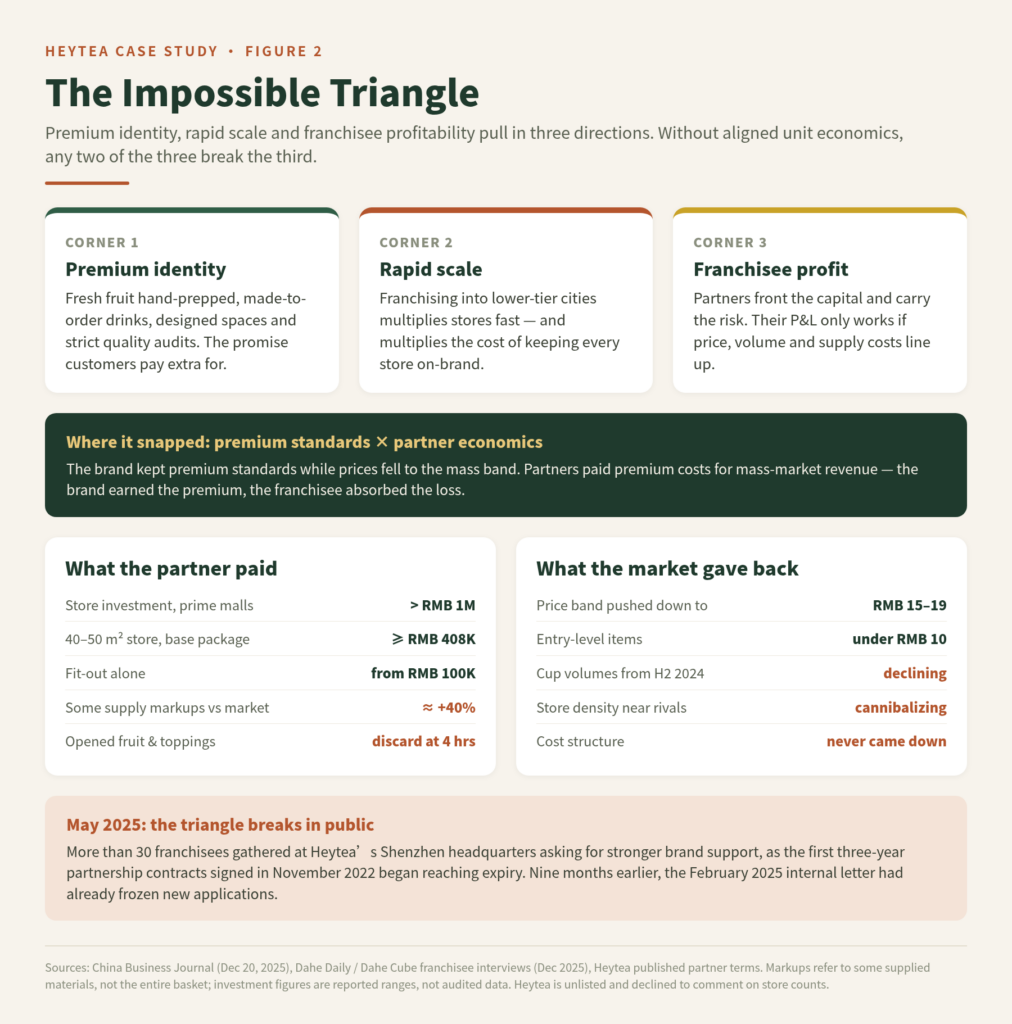
The brand earned the premium. The franchisee absorbed the loss. That sentence is the whole case.
When the Triangle Snapped
From the second half of 2024, partners told reporters their cup volumes were sliding as store density rose — Heytea had even instructed partners to cluster near rival brands’ best locations, which intensified cannibalization. One early partner interviewed by Dahe Daily closed a mall store after losing more than RMB 1 million. In May 2025, more than 30 franchisees traveled to Heytea’s Shenzhen headquarters to demand stronger brand support. The first three-year contracts, signed in November 2022, were reaching expiry, and renewal terms were unclear.
China Business Journal’s December 2025 investigation captured the structural problem precisely: a cost system designed for premium direct stores had been installed, unchanged, inside a franchise model chasing volume in price-sensitive cities. When cups fell, losses were not bad luck. They were arithmetic.
The February 2025 Letter: Walking Away From the Numbers Game
On February 10, 2025, Heytea sent an all-staff email whose title became an industry slogan: no more numbers games or scale involution — return to users and the brand. It suspended new partner applications, refused the low-price war, and argued that years of capital-driven price cuts and blind expansion had produced homogenized products, excess stores and exhausted customers. (The letter’s own words, translated: the numbers game of new tea had reached its end.)
The follow-through was real. Zhamen recorded just 65 new stores in all of 2025, against roughly 2,395 in 2023. GeoHey counted 3,930 stores in October 2025 — a net loss of 680 in twelve months. By January 2026, Zhamen had 3,846; by July 2026, 3,545, tenth place in the milk-tea category. This was not a brand quietly bleeding out. It was a brand amputating on schedule.
The Lifestyle Rebuild: Craft, Proof, Scarcity
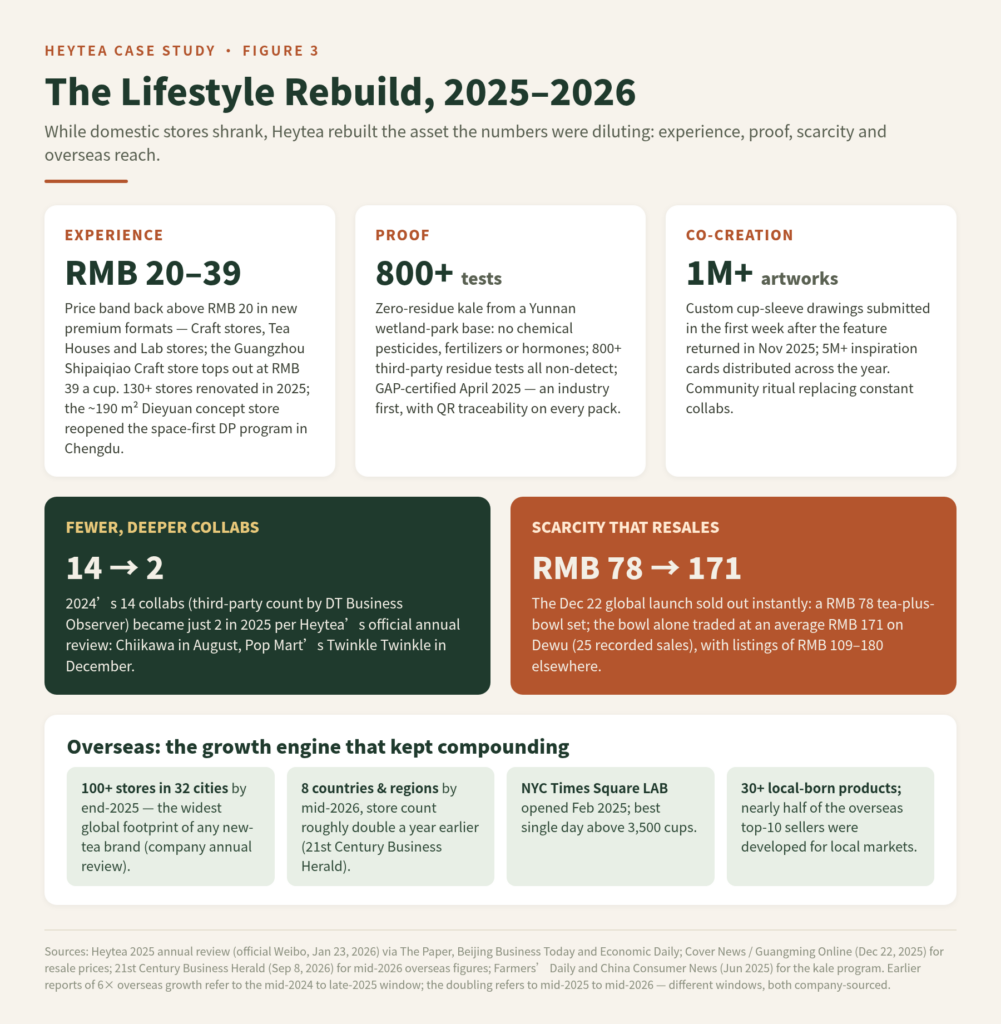
What did Heytea do with the space the retreat created? It rebuilt the asset the numbers had been diluting.
Experience went back up. New premium formats — Craft stores, Tea Houses, Lab stores — pushed prices back above RMB 20, with the Guangzhou Shipaiqiao Craft store topping out at RMB 39 a cup. The company renovated more than 130 stores in 2025 and relaunched its space-first DP program with the roughly 190-square-meter Dieyuan concept store in Chengdu. The small, seatless franchise box was no longer the brand’s only face.
Proof replaced claims. Through its traceability program, Heytea grew kale in a base inside Yilong Lake National Wetland Park in Yunnan without chemical pesticides, fertilizers or hormones, then ran more than 800 third-party residue tests — all non-detect — and earned GAP certification in April 2025. Farmers’ Daily covered it as an industry first. The kale drink that had sold 3.5 million cups in its first month in 2024 now had a supply-chain story competitors could not copy with a press release.
Scarcity replaced frequency. In 2024, Heytea ran 14 collaborations by one third-party count. In 2025, its official annual review says it ran exactly two: Chiikawa in August, and Pop Mart’s Twinkle Twinkle in December. (Broader third-party counts put the year at five; the official number is two. Either way, the direction is the point.) The December 22 launch — Heytea’s first globally synchronized collab — sold out instantly. A RMB 78 tea-and-bowl set became a resale market: the bowl alone traded at an average of RMB 171 on Dewu, with 25 recorded sales, and listings of RMB 109 to 180 elsewhere. Fans turned the cups into lamps. That is not discount-driven volume. That is ritual.
Users became co-creators. When the custom cup-sleeve drawing feature returned in November 2025, users submitted more than a million artworks in the first week. Over the year, Heytea distributed more than five million inspiration cards. Community participation replaced the collab treadmill at a fraction of the cost.
Overseas: The Engine That Kept Compounding
While domestic stores shrank, the overseas network did the opposite. By the end of 2025, Heytea’s official review counted more than 100 stores in 32 cities — the widest global footprint of any new-tea brand. The first overseas Lab store opened in Times Square in February 2025 and recorded days above 3,500 cups. More than 30 products were developed for local markets, and nearly half of the overseas top-ten sellers were local-born, not menu exports.
One caliber note, because the numbers travel badly: reports of overseas stores growing more than sixfold refer to the window from roughly mid-2024 to late 2025; the September 2026 report of a network doubled year-on-year, across eight countries and regions, refers to mid-2025 to mid-2026. Different windows, both company-sourced. The honest summary is that overseas kept compounding from a small base while the domestic network rationalized — growth, but not yet a cure.
The September 2026 Reopening: Select, Don’t Recruit
On September 7, 2026 — nineteen months after the freeze — the partner application portal quietly reappeared in the Heytea GO mini-program. The differences from 2022 are the story. Applicants now file a business partnership plan explaining how they would run the store and what team strengths they bring. The application notice warns, in plain language, that new tea is not a windfall industry and that people chasing short-term returns should not apply. Submitting does not create a partnership; Heytea reserves the right to reject at any review stage.
The first expansion recruited anyone with capital. The second selects operators with a plan. Whether that fixes the triangle is an open question — the economics still have to align — but the design of the gate has changed.
What Everyone Misunderstands
“Heytea is declining.” Store count fell; the brand’s premium machinery was repaired. Overseas doubled. Prices recovered in the new formats. And the valuation obituaries need a fact-check of their own: the only recent third-party mark, Hurun’s Global Unicorn Index 2026, values Heytea at RMB 26 billion — well below the 2021 peak, but hardly zero. A widely circulated claim that a July 2026 financing restored the RMB 60 billion valuation does not survive scrutiny: it appears as a single unsourced line in one report, no major outlet independently confirmed a round in that window, and earlier in 2026 the founder publicly told Huxiu there was no confirmed completed financing. Treat the 60 billion revival as rumor, not fact.
“Franchising failed.” Franchising did not fail; misaligned franchising failed. Mixue ended 2025 with 59,823 stores globally and RMB 5.9 billion in net profit. GoodMe reached 13,554. The model works when supply costs, price band and partner economics are designed together from day one. Heytea’s error was exporting a flagship cost structure into a volume game.
“Premium means expensive.” The rebuild shows premium is experience, craft and ritual — the RMB 39 craft cup, the 800-test kale, the bowl that resells at 171. Price descent eroded the identity without lowering costs; experience ascent is what rebuilds it.
“This is a Heytea story.” It is an industry story. The China Chain Store & Association says market growth slowed to 15 to 20 percent in 2024, down from 30-plus. Zhamen counted over 100,000 openings in the year to December 15, 2025 — and a net loss of nearly 30,000 stores. Heytea’s retreat happened inside a sector-wide rationalization, not in a vacuum.
The Reusable Methodology
Four rules travel beyond tea:
- Enforce the premium decision system-wide. Standards, supply pricing and partner economics must all express the same promise. If the brand earns the premium while partners eat the cost, the triangle snaps — on schedule.
- Never descend the price band to chase scale. Lower prices without lower costs is the worst of both worlds. If you must grow down-market, build a different cost structure — or a different brand.
- Treat retreat as strategy. Shrinking to repair an asset beats scaling to dilute it. Heytea’s 65 openings in 2025 bought the room for craft stores, traceability and overseas depth.
- Reopen with selection, not recruitment. The 2026 gate — business plan, risk warnings, rejection rights — is what aligned franchising looks like on paper. The test is whether partner P&Ls finally work.
Risks and Honest Caveats
Heytea is unlisted. Store counts come from third-party monitors (GeoHey, Zhamen) with slightly different calibers; the company declined to comment. Financing and valuation figures across its history are media-reported, never company-confirmed — including the 2021 peak. The 40 percent markup is franchisee-reported and applies to some materials, not the whole basket. The triangle is re-attempted, not solved: partner economics remain the test. Competitors are enormous — Mixue near 60,000 stores, GoodMe past 13,500, Chagee globalizing with 345 overseas stores — and even Chagee’s adjusted profit fell about 24 percent in 2025, a reminder that scale alone no longer guarantees margin. Nayuki, the listed premium peer, saw revenue fall 12 percent to RMB 4.33 billion and ended 2025 with 1,646 stores. The premium niche is defensible, but it is small, and it must hold. And collab scarcity works until it doesn’t: two deep hits a year is a discipline, not a guarantee. In late March 2026, Nie publicly denied any listing plans for the year — this remains a private company’s bet on its own brand, without an exit clock.
Conclusion: Premium Is a Decision
Heytea invented premium new tea, then learned — expensively — that premium identity, rapid scale and franchisee profit cannot coexist without aligned economics. The 2022 pivot bought scale and broke the promise. The 2025 retreat stopped the bleeding and rebuilt the asset: craft, proof, scarcity, community, overseas. The 2026 reopening is the disciplined second attempt, and its outcome is genuinely undetermined.
For anyone running a premium brand, the takeaway is uncomfortable and simple. Premium is not a price you defend. It is a decision you enforce — in every store, every supplier invoice, every partner contract. Scale that dilutes the decision destroys the asset. Heytea stopped playing the numbers game and went back to defending the decision. That is why this retreat reads less like a decline and more like a brand remembering what it was for.