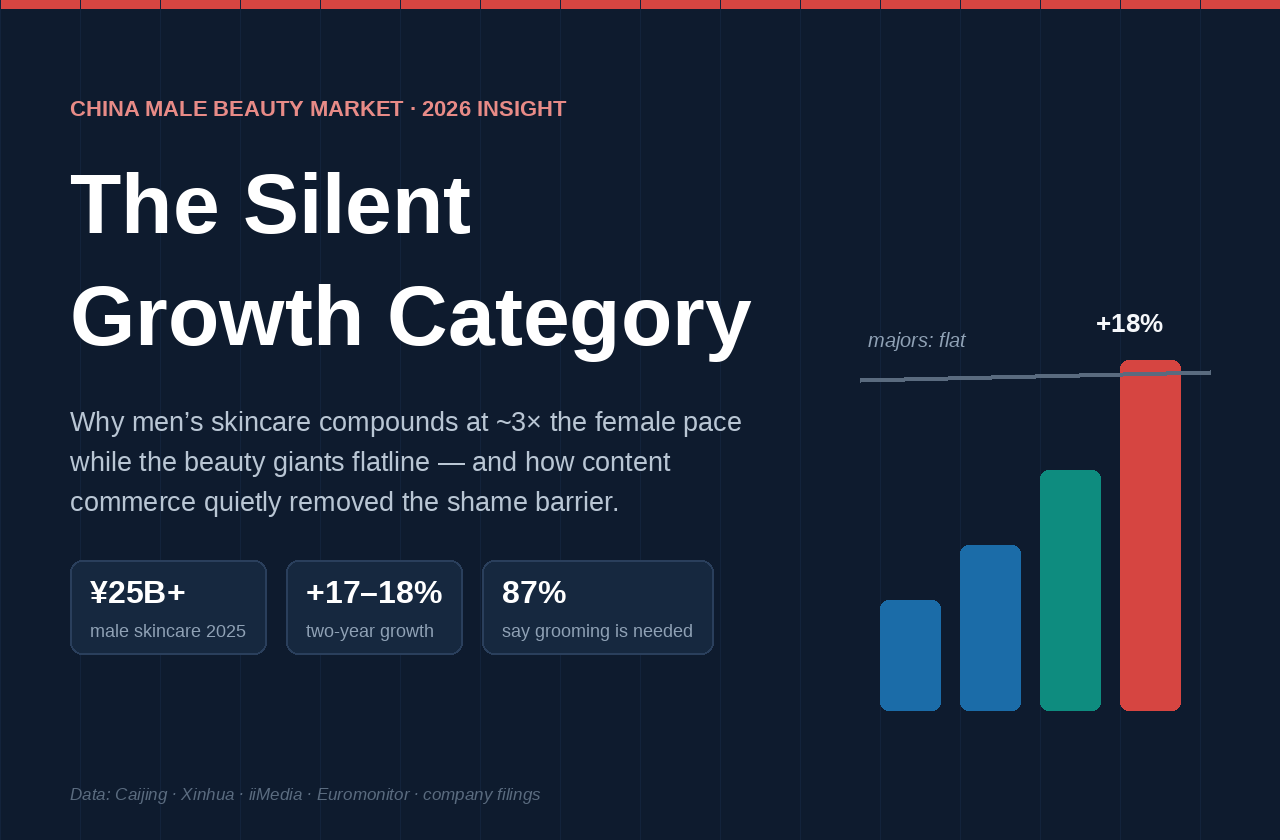
Walk through any Chinese beauty hall and you’ll see the same scene: counters staffed for women, campaigns voiced for women, livestreams that open with “all the girls.” Now look at the receipts. While L’Oréal, Estée Lauder, Shiseido and Proya all posted flat or shrinking years, Chinese men quietly bought more than ¥25 billion worth of skincare in 2025 — a category that grew 17% and 18% in the two prior years, according to LeadLeo and iiMedia figures compiled by Caijing magazine. That’s roughly three times the female category’s pace, off a base that is still only about 4% of iiMedia’s ¥579.1 billion cosmetics market.
Small base, big velocity, almost no noise. This is the silent growth category — and its silence is not an accident. It’s the product of a social tax that content-commerce finally learned to remove.
The Divergence: Majors Flatline, Men’s Aisle Compounds
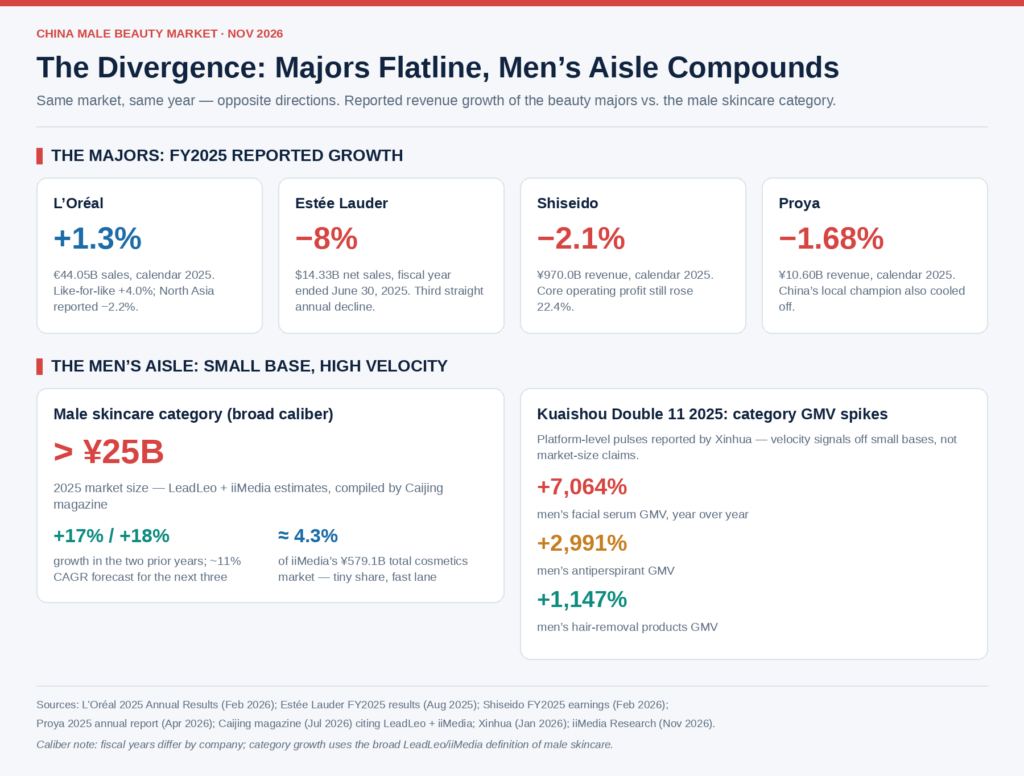
Start with the giants, because their year explains why everyone suddenly cares about men’s faces. L’Oréal closed calendar 2025 at €44.05 billion in sales, up just 1.3% as reported (a healthier 4.0% like-for-like, with North Asia down 2.2% reported). Estée Lauder’s fiscal year ended June 2025 brought net sales of $14.33 billion, down 8% — its third straight annual decline. Shiseido’s 2025 revenue fell 2.1% to ¥970 billion, though core operating profit rose 22.4% on cost discipline. Even Proya, the local champion that spent years outgrowing everyone, saw 2025 revenue slip 1.68% to ¥10.60 billion. All four figures come from the companies’ own filings and results releases.
Against that backdrop, the male category’s 17–18% growth looks like a typo. It isn’t. But it also isn’t a market-size claim yet — it’s a velocity signal, and the most violent pulses came from content platforms, not shelves.
The Spikes That Look Like Typos
During Double 11 in 2025, Xinhua reported that men’s facial serum GMV on Kuaishou jumped 7,064% year over year. Antiperspirant rose 2,991%; hair-removal products 1,147%. The state news agency’s January 2026 feature on the “¥25 billion new blue ocean” carried the numbers alongside a Kuaishou bestseller chart, and Economic Information Daily’s November coverage described the same serum surge as “more than 70-fold.” Read those numbers honestly: they are category-level pulses off tiny bases on one platform. They tell you where demand is being unlocked, not how big the market is.
By the 2026 mid-year 618 festival, the pattern had spread to the shelf giant too: Caijing reported that men’s tone-up cream and men’s lip essence on Taobao each grew over 200% in transaction value. The aisle is no longer just a content-platform curiosity.
The Livestream That Changed Its Greeting
The most telling detail sits inside Meione, the agency behind Li Jiaqi’s livestream — China’s most famous beauty salesroom. During a 2024 lipstick festival, a viewer kept asking in the comments whether there was anything suitable for men. The questions multiplied. Men who had come to grab deals for their partners started lingering for themselves, asking which serum suits oily skin, whether there’s a lipstick or fragrance for guys. Meione added male SKUs and changed its iconic opening call from “all the girls” to “all the girls and boys.”
The agency’s own 618 data, shared with Securities Daily in June 2026: male users’ average order value and repurchase rate both rose clearly year over year; sales of men’s tone-up cream, oil-control serum, antiperspirant and sunscreen each grew more than 150%; and under-25 Gen Z men became the main force among new buyers. Their search terms migrated from “men’s cleanser” and “razor” to “anti-ageing” and “repair mask.” Treat these as agency-reported figures, but notice what they describe: not a stunt, a habit forming.
The Shame Barrier: The Tax Nobody Priced
Why did demand this real stay invisible for so long? Because buying beauty carried a social cost for men that no spreadsheet captured. Caijing’s interviews put it plainly: men with regular skincare routines said they avoided makeup because they feared the looks around them — the sense that the environment still wasn’t tolerant enough. One skincare loyalist never touched color cosmetics at all. The barrier wasn’t desire. It was the audience.
Call it the shame discount: men wanted the product but not the performance of buying it. Standing at a “men’s makeup” counter is a public statement. Being addressed as “girls” in a livestream is a misaddress that stings. So men searched privately, checked out anonymously, and bought products that didn’t look like makeup. Shelf-commerce, built around visible browsing and public counters, could never remove that audience. Content-commerce could — and did.
The Invisible Ladder: Function First, Beauty Later
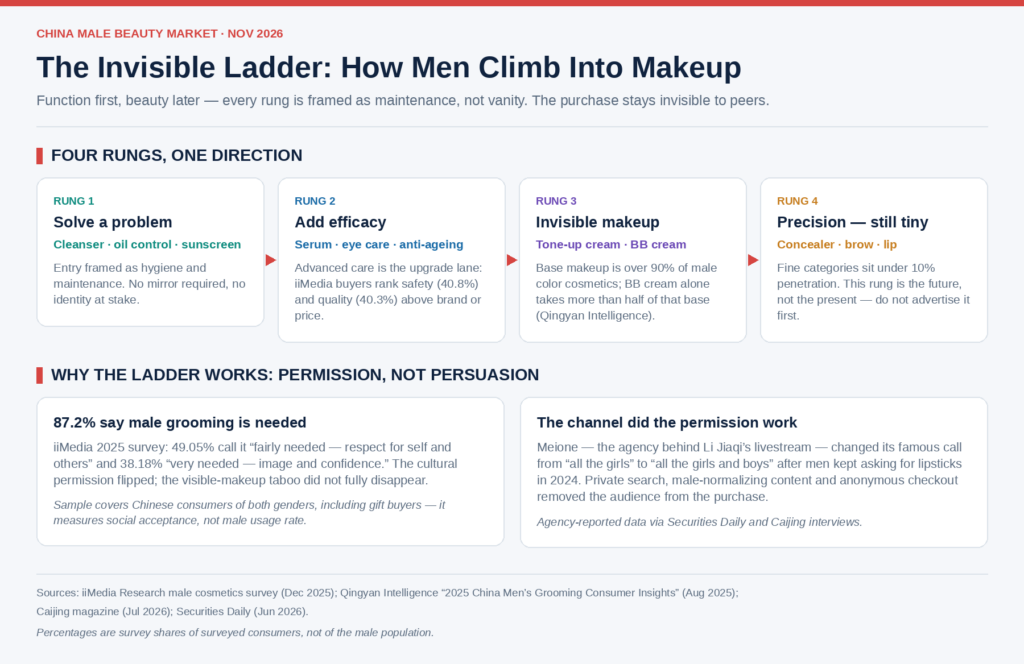
Here’s the mechanism in one picture: men don’t enter through beauty. They enter through problems.
Rung One: Maintenance, Not Vanity
Cleanser, oil control, sunscreen. Male skin runs oilier — more active sebaceous glands, a thicker stratum corneum, plus daily shave damage — so the entry products solve visible, practical problems. A man buying oil-control face wash isn’t “doing beauty”; he’s fixing shine before a meeting. That framing is the permission slip. Xinhua’s reporting quotes brand leaders at GF and Kans building entire lines around exactly this logic: fast, simple, one bottle replacing three.
Rung Two: Efficacy and Evidence
Once the habit exists, the basket deepens: serums, eye care, anti-ageing. And here men shop like engineers. In iiMedia’s 2025 survey, safety (40.80%) and quality (40.27%) topped the purchase-factor list — ahead of after-sales service, brand, price and influencer recommendations. Mintel’s Future of Men’s Grooming 2026 outlook makes the same point globally: win with specific, repeatable claims and dermatologist credibility, not aspiration. Aspiration copy asks a man to believe he’s beautiful. Evidence copy shows him the mechanism. Only one of those survives his group chat.
Rung Three: Makeup That Doesn’t Look Like Makeup
The third rung is where the category gets interesting — and where the revenue already is. Qingyan Intelligence’s 62-page 2025 consumer-insights report found that base makeup accounts for over 90% of men’s color cosmetics, with BB cream alone taking more than half of that base. Tone-up cream, BB, “your face but rested” — invisible makeup is the acceptable next step because it keeps the maintenance frame intact. Concealer, brow and lip products sit below 10% penetration. The precision rung is the future; advertising it first is how brands scare the customer away.
Content Does the Permission Work
Notice who escorts men up the ladder: not ads, but content. Male counter staff — the “counter brothers” now common in department stores — demonstrate routines without embarrassment. GREENLAB, a male-native startup, seeded its early campaigns through professional creators like lawyers whose job demands a clean, sharp look; their followers are precisely the men who need the permission. And Meione’s greeting change did something advertising can’t: it addressed men as customers without othering them. The purchase became invisible to peers while the normalization happened in public. That asymmetry is the whole trick.
One Market, Three Stories: Reading the Calibers Before the Headlines
Before you repeat any number from this market, check its basket. Three research houses tell three different stories about the same year, and all three are right.
The broad caliber — LeadLeo plus iiMedia, compiled by Caijing — puts male skincare above ¥25 billion in 2025, growing 17% and 18%, with an ~11% CAGR forecast for the next three years. Wide categories, wide channels, gifting included: the growth story.
Euromonitor’s May 2026 edition measures men’s grooming as shaving plus toiletries plus fragrances: ¥15.30 billion in 2025, up 1% after a decline phase, with fragrances the bright spot at +4%. L’Oréal leads company share at 22%, ahead of P&G (14%) and Unilever (10%). That’s the stabilization story — a different basket, not a smaller guess.
Zhiyan Consulting counts core facial-care SKUs at retail: ¥7.68 billion in 2025, down 7.8% from ¥8.33 billion in 2020, with a trough in 2024 and the first uptick last year. The reset story: basics topped out, white-label noise got squeezed, the base is finding its floor.
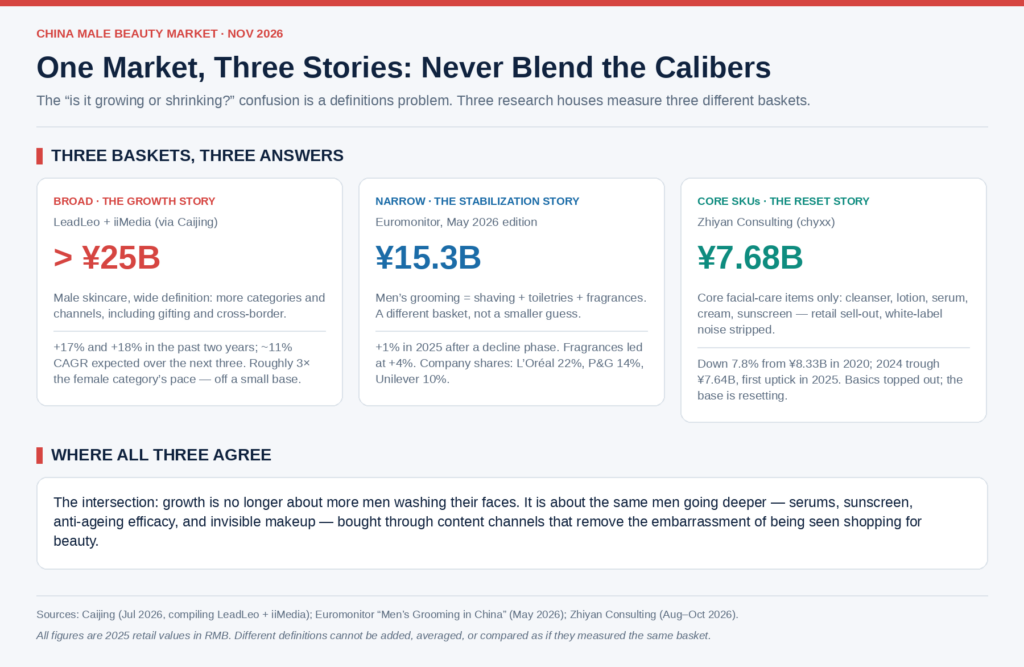
Where do all three agree? Growth is no longer about more men washing their faces. It’s about the same men going deeper — efficacy, serums, invisible makeup — through channels that remove the embarrassment. Segment-level truth survives the aggregate confusion. Blend the calibers and you manufacture a contradiction that isn’t there.
Who Actually Pays: The Gifting Economy and Its Ceiling
A confession the industry rarely makes out loud: much of the “male” market is checked out by women. OIU, a male skincare-and-light-makeup brand, told Caijing that 85% of its 2025 orders were placed by women — girlfriends and wives buying for men who then use the products. Mintel’s 2024 China grooming research found women make up 36% of purchase decision-makers in the category. L’Oréal’s stated playbook is blunt: push self-use during big sales festivals, push gifting around May 20, the romantic holiday. Proya’s men’s line runs the same dual track.
Gifting is real revenue, but it has a ceiling: gifts don’t repurchase on their own. GREENLAB’s founder Xu Zhiwei argues the self-use market is the only one that compounds — “C-end business is about repurchase.” Interestingly, his brand’s female customers grew from 20% to 30% of buyers, but those women buy for themselves: the “refined lazy” positioning travels across gender. The lesson: gifting opens the door; self-use keeps the lights on.
The Land Grab: Giants, Specialists and Male-Native Startups
The supply side smelled the shift and moved fast. In January 2026 Proya announced its return to the men’s track; in February the efficacy-focused indie HBN launched a men’s line; in March L’Oréal China named men a high-growth priority segment, with Biotherm doing something almost unheard of — targeting middle-aged and older men.
The male-native startups skipped the old “women first, men later” path entirely. GREENLAB raised three rounds in two years, the latest in the tens of millions of RMB from Baoding Capital, whose founding partner is a former L’Oréal China vice president. Its origin story is a lesson in listening: the 2024 skincare launch (cleanser plus serum-lotion) flopped — habits take time, and young men wanted visible results now. The pivot to instant-effect tone-up cream became a hit, with creator livestreams regularly clearing seven figures and the founder projecting 2026 sales above ¥200 million. Its offline experiment is even more on-theme: unstaffed grooming booths between Shenzhen office towers, mirrors and products and instructions, no employees, no judgment. About three in ten passersby stepped in; most survey respondents said they’d pay for such a space. A beauty counter with the audience removed — the shame barrier, solved in architecture.
The giants learned too. Back in 2021, L’Oréal Men Expert co-created its “little black tube” tone-up product with 1,638 men aged 18–34 via Tmall — and deliberately avoided the words “foundation” and “BB cream” in naming and packaging. Even the vocabulary does permission work.
What Brands Get Wrong
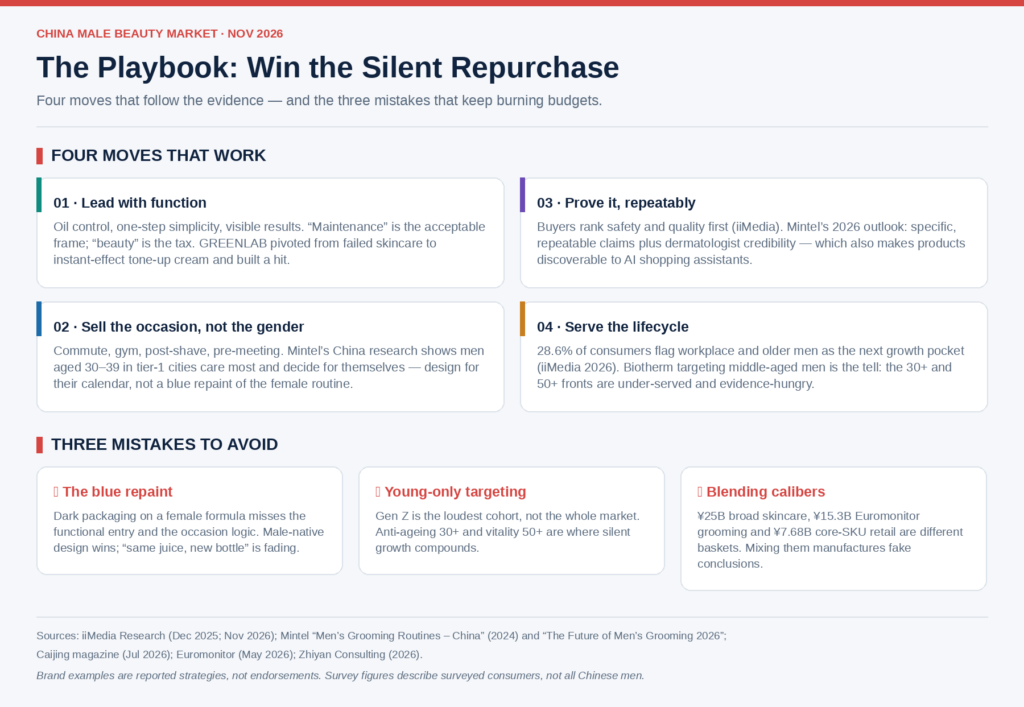
Three mistakes keep recurring. The blue repaint: dark packaging on a female formula, ignoring the functional entry and the occasion logic. Meione’s own supply-side read is that since 2023–2024 the winning products actually subtract — texture, scent, steps — rather than repaint. The young-only miss: Gen Z is the loudest cohort, not the whole market; Mintel’s China data shows men aged 30–39 in tier-1 cities care most and decide for themselves, and iiMedia’s 2026 report flags workplace and older men (28.59% of respondents) as the next growth pocket. And the caliber blend: quoting ¥25 billion, ¥15.3 billion and ¥7.68 billion in one breath, as if they measured the same thing. They don’t.
There’s a fourth, quieter mistake: forcing visibility. The attitude data is genuinely encouraging — 87.2% of surveyed consumers now call male grooming needed (49.05% “fairly needed, respect for self and others” plus 38.18% “very needed”), per iiMedia’s 2025 survey. But that sample includes women and gift buyers; it measures social acceptance, not male usage. And acceptance of grooming is not acceptance of visible makeup. The category grows through invisibility, not against it. Ride the ladder; don’t shove men off it.
The Playbook: Win the Silent Repurchase
So what do you actually do on Monday?
Lead with function. Oil control, one-step simplicity, visible results — maintenance framing, never vanity framing. Sell the occasion, not the gender: commute, gym, post-shave, pre-meeting. Mintel’s global outlook points to styling and hair as gateways into skincare; design for a man’s calendar, not a gendered shelf. Prove it repeatably: specific claims, dermatologist backing, ingredient logic — which, as Mintel notes, also makes you discoverable when AI assistants do the shopping. Serve the lifecycle: evidence-heavy anti-ageing for the 30+ front, vitality for the 50+ front Biotherm is already betting on. And build for the reorder, not the splash: the silent category’s signature metric is the quiet repurchase, not the viral moment.
One more signal worth watching: Xinhua cited platform data showing that in December 2025 alone, men’s skincare listings rose 54.2%, brand count rose 28.5% and store count rose 37.0%. Supply is flooding in. The brands that win won’t be the loudest — they’ll be the ones that let men buy without being seen buying, and then quietly come back.