Ask a room of marketers to define the she economy and watch what happens. Someone says lipstick. Someone says skincare. Someone, inevitably, says pink packaging. The term was born in 2007, when China’s Ministry of Education listed “she economy” as a new word in its annual language report — a label for the economic phenomenon built around women’s consumption and, note this part, their wealth-management needs. Nearly two decades later, most brand decks still remember the lipstick and forget the portfolio.
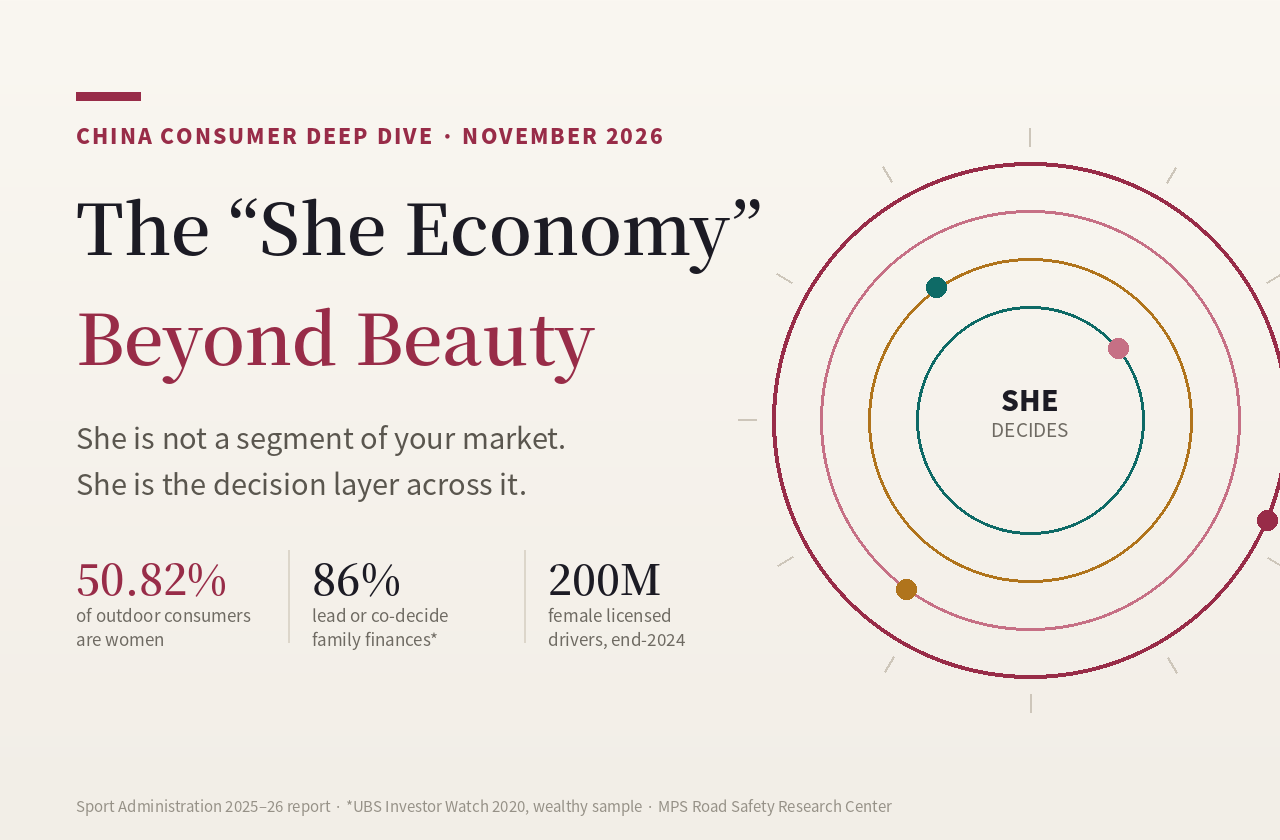
Here is the one-sentence version of this article: the she economy is not a female-coded aisle of the market — it is a decision-making layer across the whole market, and the verified data now proves it. Women are 50.82% of monitored outdoor-sports consumers. They lead or co-decide long-term family finances in 86% of surveyed mainland households in UBS’s research. They hold nearly 200 million driver’s licenses. They are 57% of pet owners and roughly 70% of the medical-aesthetics customer base. Meanwhile the beauty aisle itself — the category everyone still mistakes for the whole story — just posted its slowest growth in years.
If your China strategy still files women under beauty, you are marketing to a consumer who moved out of that aisle a decade ago. Let’s walk through where she actually went, what the evidence says, and what to do about it on Monday morning.
From Pink Aisle to Decision Layer: How the Framing Went Stale
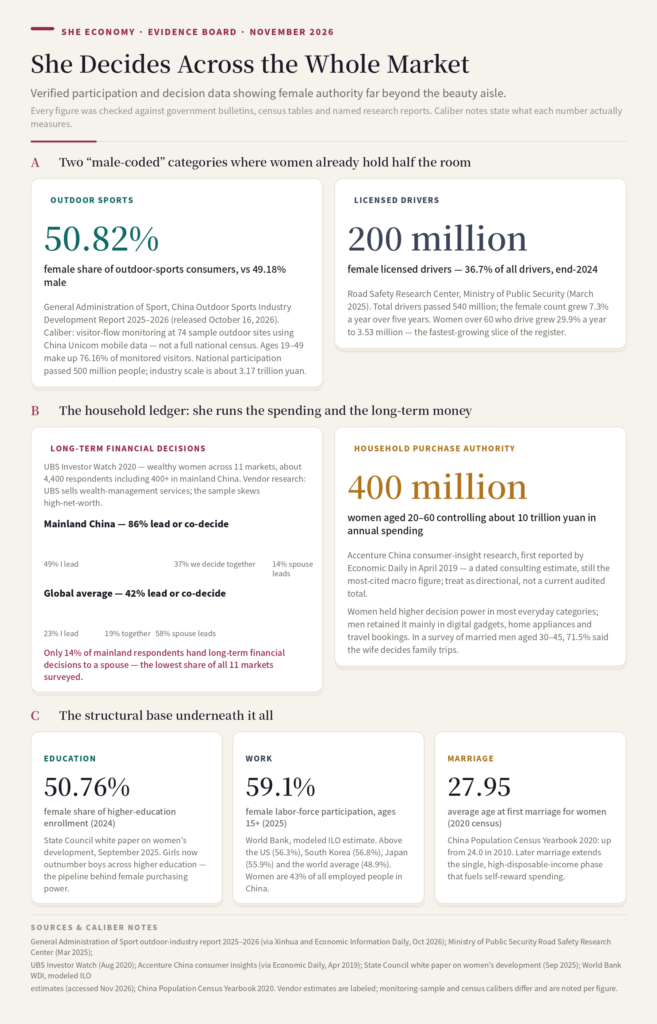
The structural story starts long before any shopping festival. China’s State Council published a white paper on women’s development in September 2025, and its numbers describe a consumer base unlike any the early she-economy marketers imagined. Women now make up 50.76% of higher-education enrollment — girls outnumber boys across Chinese universities. Women are 43% of all employed people, 45.8% of science and technology workers, and a third of the workforce in new digital formats like e-commerce and livestreaming. Average female life expectancy reached 80.9 years, three and a half years longer than in 2010.
Work participation tells the same story from another angle. The World Bank’s modeled ILO estimates put Chinese women’s labor-force participation at 59.1% in 2025 — above the United States (56.3%), South Korea (56.8%), Japan (55.9%), and ten points above the world average (48.9%). This is not a marginal workforce. It is one of the most economically active female populations of any major economy, and it has been compounding for decades.
Then there is time. The 2020 census recorded the average age at first marriage for Chinese women at 27.95 years — up from 24.0 in 2010. Nearly four extra years of single, earning, self-directed life, multiplied across a generation. Registrations did rebound in 2025 to 6.765 million couples, per the Ministry of Civil Affairs’ final annual bulletin, but the late-marriage pattern is structural, not cyclical. That extended single phase is where self-reward consumption — the “pleasing yourself” turn locals call yueji — learned its habits.
Put education, earnings and delayed marriage together and you get the real definition: the she economy is female decision authority across categories, not female-coded categories. Everything below follows from that reframe.
The Old Engine Is Idling: Beauty’s Maturity Problem
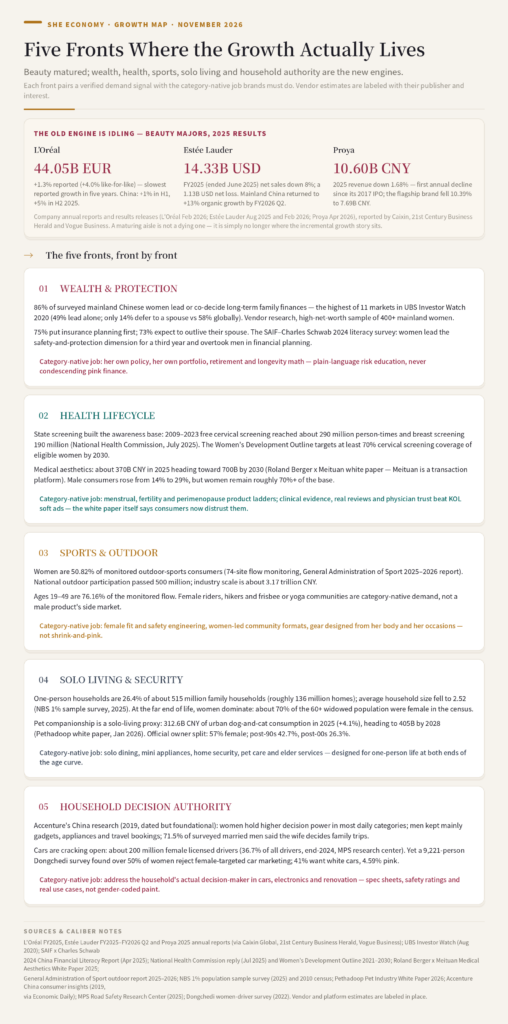
Let’s establish the negative case first, because it is the cleanest evidence that the aisle framing has expired. Look at the beauty majors’ 2025 scorecards — audited company results, not vendor estimates.
L’Oréal, the industry’s bellwether, grew full-year sales 1.3% as reported to €44.05 billion — its slowest reported growth in five years. Like-for-like growth was a healthier 4.0%, and China recovered through the year from +1% in the first half to +5% in the second, as the CFO told reporters. Recovery, yes. Boom, no. Estée Lauder’s fiscal 2025, ended June 2025, was worse: net sales fell 8% to $14.33 billion with a $1.13 billion net loss, dragged down by Asia travel retail. Its mainland China business returned to double-digit organic growth by the December 2025 quarter, but the full-year picture is of a mature category working through inventory and pricing, not discovering new demand.
The domestic champion confirms it. Proya, the Shanghai-listed company that rode the Chinese skincare boom to a decade of growth, reported 2025 revenue of ¥10.60 billion — down 1.68%, its first annual decline since its 2017 IPO. The flagship Proya brand itself fell 10.39%. When the best-executed local beauty operator shrinks, the aisle is telling you something.
None of this means beauty is dying. It means beauty is mature — and the incremental growth story of Chinese female consumption has migrated elsewhere. Five elsewheres, to be precise.
Five Growth Fronts Beyond Beauty
Front One: Wealth and Protection — She Runs the Long-Term Money
The most under-marketed fact about Chinese women is financial. UBS’s Investor Watch survey, published in 2020, studied wealthy women across 11 markets — about 4,400 respondents, including more than 400 in mainland China — and found that 86% of mainland respondents lead or jointly make long-term financial decisions. Forty-nine percent lead outright. Only 14% hand the decision to a spouse, against a global average of 58%. That is the lowest spousal-deference rate of every market surveyed. Read the caliber honestly: UBS is a wealth manager surveying high-net-worth clients, so this skews affluent — but the direction matches everything else we know about Chinese household finance.
The same study found 75% of these women prioritize insurance planning and 73% expect to outlive their spouse — longevity math, not impulse buying. And the literacy gap that pink-finance campaigns like to patronize barely exists: the Shanghai Advanced Institute of Finance and Charles Schwab’s 2024 financial-literacy survey found men slightly ahead overall, but women leading the safety-and-protection dimension for a third straight year and overtaking men in financial planning for the first time. Schwab, note, is a financial-services firm — vendor research again, but from a named, methodologically transparent series.
The category-native opportunity is obvious: her own policy, her own portfolio, retirement products priced for a woman who will likely spend her last decade alone. What fails is condescension — pastel debit cards and empowerment slogans slapped on unchanged products.
Front Two: The Health Lifecycle — From Screening Programs to Aesthetics Maintenance
China quietly built one of the world’s largest female-health awareness infrastructures. The National Health Commission reported in July 2025 that from 2009 through 2023, free public screening programs delivered nearly 290 million cervical-cancer screening person-times and 190 million breast-cancer screenings, detecting over a million cancers and precancerous lesions. The Women’s Development Outline for 2021–2030 targets cervical screening coverage of at least 70% of eligible women. An entire generation of women — including in county towns — has been trained by the state to think about preventive health as a routine, not a crisis.
Commercial demand rides that awareness. The medical-aesthetics market reached roughly ¥370 billion in 2025 and is projected toward ¥700 billion by 2030, according to Roland Berger’s white paper co-published with Meituan’s aesthetics platform — a transaction-platform partnership, so treat the projection as interested, but the behavioral findings are the gold here. The report documents consumers who now triangulate evidence across sources, distrust KOL soft advertising, and rely on authentic user reviews and physician credentials. Male consumers grew from 14% to 29% of the base between 2022 and 2025 — the market is broadening — but women remain its overwhelming majority.
The strategic read: aesthetics is behaving less like vanity retail and more like maintenance healthcare. And the bigger frontier is the underserved lifecycle around it — menstrual health, fertility planning, perimenopause — where state screening created the awareness hook but commercial product ladders barely exist.
Front Three: Sports and Outdoor — The 50.82% Fact
In October 2026, the General Administration of Sport released its outdoor-industry development report for 2025–2026. National outdoor participation passed 500 million people; the industry’s total scale reached about ¥3.17 trillion. And the gender split of monitored consumers: 50.82% female, 49.18% male. Women are not a niche in the outdoor market. They are the majority — slightly.
The caliber matters and we will state it plainly: this split comes from visitor-flow monitoring at 74 sample outdoor sites using China Unicom mobile data, not a national census of every hiker. Ages 19–49 account for 76.16% of the monitored flow. But the direction is unambiguous, and it matches what anyone watching China’s hiking groups, frisbee leagues, yoga studios and cycling clubs already sees. The outdoor industry spent years engineering gear for a male default body and marketing to a male default adventurer. The demand data says that default never matched the customer base. Female-specific fit, safety engineering and women-led community formats are not a diversity initiative here — they are the core market, served late.
Front Four: Solo Living and Security — Her Categories at Both Ends of Life
The household itself is dissolving into smaller units, and women disproportionately inhabit the smallest one. The National Bureau of Statistics’ 1% population sample survey, published in May 2026, counted about 515 million family households averaging 2.52 people — down from 3.44 in 2000. One-person households are now 26.4% of the total, roughly 136 million homes; two-person households add another 33.2%. Nearly six in ten Chinese households contain two people or fewer.
Who lives alone? At the young end, the never-married professionals of the delayed-marriage cohort. At the old end, widows — and widowhood is overwhelmingly female. The census’s primary tables show that among the 60-plus widowed population, about seven in ten were women, a consequence of the longevity gap and marriage-age patterns. (You will see bigger, fresher-sounding widowhood figures circulating online; they are media extrapolations, so we anchor on the census table and the verified household structure instead.) Women also dominate the companion economy that fills solo homes: the pet industry’s authoritative white paper, published by the Pethadoop data platform in January 2026, sized urban dog-and-cat consumption at ¥312.6 billion for 2025, up 4.1%, heading to ¥405 billion by 2028 — with owners 57% female by the publisher’s official count, 42.7% born in the 1990s and 26.3% in the 2000s.
Solo dining, mini appliances, home security, pet care, elder services: these are her categories at both ends of the age curve, and most brands still merchandise them as afterthoughts to the family unit.
Front Five: Household Decision Authority — The Buyer Behind the Male-Coded Product
The oldest evidence is still the most cited: Accenture’s China consumer research, first reported by Economic Daily in 2019, estimated that nearly 400 million women aged 20–60 control about ¥10 trillion in annual spending — a dated consulting estimate, directional rather than audited, but its category findings have held up. Women held higher decision power in most everyday categories; men retained it mainly in digital gadgets, home appliances and travel bookings. In a survey of married men aged 30–45, 71.5% said the wife decides family trips.
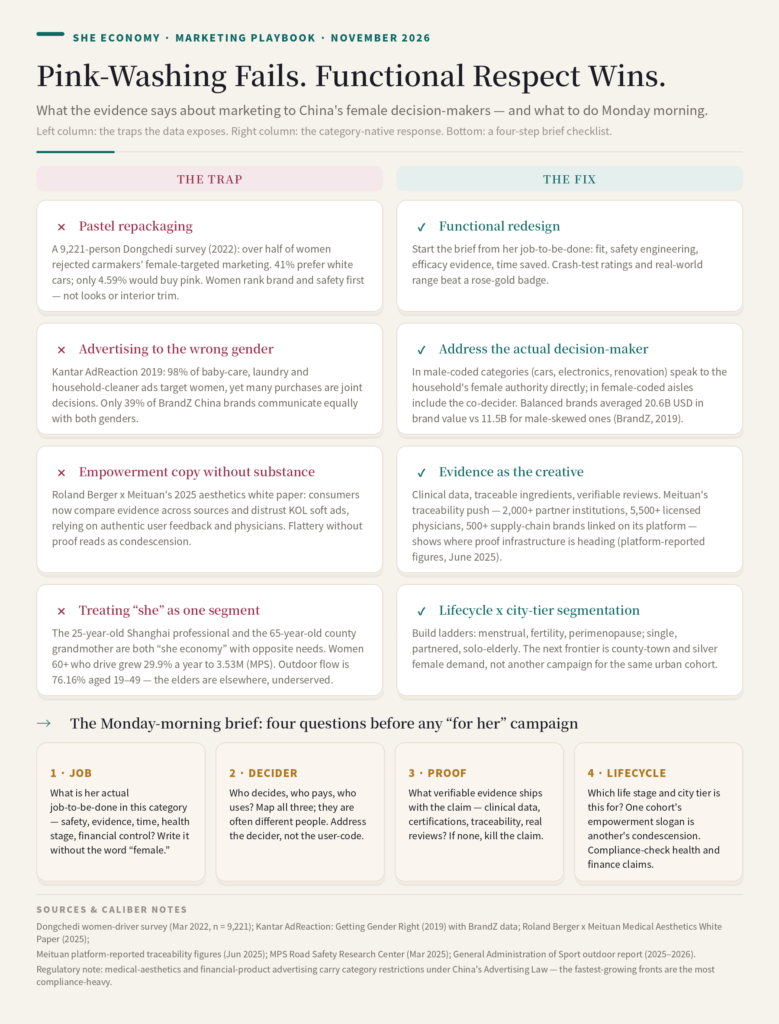
And the male-coded holdouts are cracking. The Public Security Ministry’s road-safety research center reported that by end-2024, female licensed drivers approached 200 million — 36.7% of all drivers — growing 7.3% a year over five years. Women over 60 who drive grew nearly 30% annually to 3.53 million. Car brands noticed, and mostly responded badly: a 9,221-person survey by the auto platform Dongchedi found that over half of women rejected automakers’ female-targeted marketing. More than 41% preferred white cars; only 4.59% would buy pink. They ranked brand and safety first. The lesson generalizes to electronics and renovation: market to the household’s actual decision-maker with specs, safety evidence and real use cases — the user may be coded male, but the buyer often isn’t.
What Everyone Misunderstands
The pink-washing trap. Repackaging a male-default product in pastel is not product development; it is a tax on your credibility. The Dongchedi survey quantified the backlash in cars, and the aesthetics white paper documented the same reflex in beauty-adjacent categories: evidence-demanding consumers read cosmetic for-her moves as condescension. Kantar’s AdReaction research found the mirror-image error too — 98% of baby-care, laundry and household-cleaner ads globally were geared to women even though many of those purchases are joint decisions, and only 39% of BrandZ China brands communicated equally with both genders. Gender-coding fails in both directions.
The monolith error. A 25-year-old Shanghai professional and a 65-year-old county-town grandmother are both the she economy, with opposite needs, opposite media diets and opposite price sensitivities. Segment by lifecycle and city tier, never by gender alone. The privilege skew in she-economy discourse is real: most campaigns chase the urban educated cohort while the larger headcount — county-town and silver female demand — goes underserved.
The empowerment-ad shortcut. Independent-woman copy is table stakes now, and hollow versions actively backfire. This cohort rewards functional respect — products that fit her actual life — over narrative flattery. The strongest empowerment statement a brand can make is a crash-test rating, a clinical trial, a perimenopause product line that exists at all.
The trillion-yuan headline. Vendor estimates of the she economy’s total size circulate with opaque calibers and get laundered into fake precision. We have deliberately anchored this article on participation data, census tables, audited company results and named surveys — and labeled every consulting estimate as what it is. When a number cannot survive that treatment, we left it out.
The Playbook: Four Questions Before Any “For Her” Campaign
First, the job: what is her actual job-to-be-done in this category — safety, efficacy evidence, time saved, a health stage, financial control? Write the brief without using the word female, and see if the product still makes sense. If it only makes sense with the gender label, it is pink-washing.
Second, the decider: who decides, who pays, who uses? Map all three; they are often different people. Address the decider. In male-coded categories that means speaking to her directly; in female-coded aisles it means including the co-deciding partner the ads pretend doesn’t exist.
Third, the proof: what verifiable evidence ships with the claim — clinical data, certifications, traceability, authentic reviews? Meituan’s aesthetics platform says it has linked over 2,000 institutions, 5,500 licensed physicians and 500 supply-chain brands into its verification system — platform-reported numbers, but they show where trust infrastructure is heading. If your claim carries no proof, kill the claim.
Fourth, the lifecycle: which life stage and city tier is this for? Build product ladders — menstrual to fertility to perimenopause, single to partnered to solo-elderly — instead of one campaign for an imagined universal woman. And compliance-check before launch: medical aesthetics and financial products carry advertising restrictions under China’s Advertising Law, which means the fastest-growing fronts are also the most regulation-heavy. Budget for legal review the way you budget for media.
Risks and Honest Caveats
Three risks deserve their own paragraph before you act on any of this. Gender-targeted marketing operates inside a polarized online discourse in China; identity positioning can trigger backlash from either direction, while functional respect is comparatively safe ground. The data itself has limits — monitoring samples are not censuses, the UBS sample is wealthy, the Accenture estimate is from 2019, and platform white papers serve platform interests; we have labeled each, and you should discount accordingly. And the compliance ceiling is real: health and finance claims that would sail through in a beauty campaign can violate category advertising rules. The brands that win these fronts will be the ones that treat regulation as a design constraint, not an afterthought.
Conclusion: She Is the Decision Layer
The she economy outgrew the beauty aisle while most marketing decks weren’t looking. Women decide across wealth, health, sports, solo living and the household’s big-ticket categories — and the participation data, from outdoor sites to driver registries to census tables, proves the breadth. The brands still pink-washing are repackaging for a consumer who moved on. The brands winning design category-native function, follow the lifecycle instead of the aisle, address the actual decision-maker, and earn trust with evidence. She isn’t a segment of your market. She is the decision layer across it — and the sooner your brief reflects that, the sooner your growth numbers will too.