How China’s campaign-crackdown and the West’s case-disclosure police the same internet — and why your compliance team needs two operating systems, not one.
Executive Summary
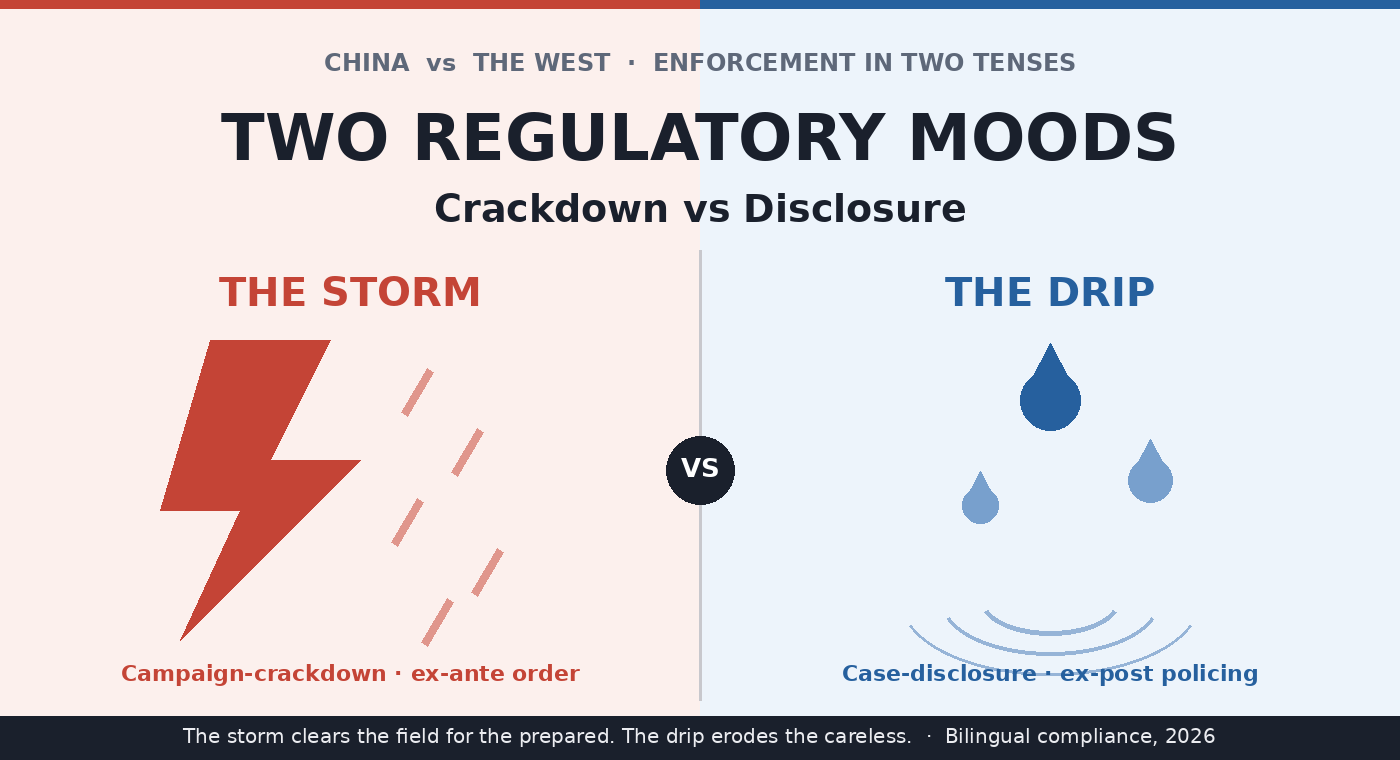
Strip away the headlines and you’ll find that China and the West aren’t just enforcing different rules — they’re enforcing in different tenses. China sets order ex ante, through periodic, category-wide rectification campaigns that can rewrite an industry’s economics in a single quarter. The West polices deception ex post, through a continuous drip of complaints, court rulings and settlements that accumulate for years before landing. Call them the storm and the drip. Neither is more lawful than the other; each is a different institutional heartbeat. And in 2026, with AI regulation arriving on both sides, the subject matter is converging while the grammar stubbornly is not. Global brands that run one universal compliance playbook are, in effect, bringing an umbrella to a flood and a sandbag to a drizzle.
1. The Phenomenon: Two Enforcement Grammars
Ask a compliance officer in Shanghai what keeps her up at night and she’ll talk about policy windows — the wording of a central conference, a regulator’s summons list, a platform’s quietly updated terms. Ask her counterpart in Chicago and he’ll talk about dockets — an FTC complaint, an appellate ruling, a comment period closing on a Friday.
Same job title. Different weather systems.
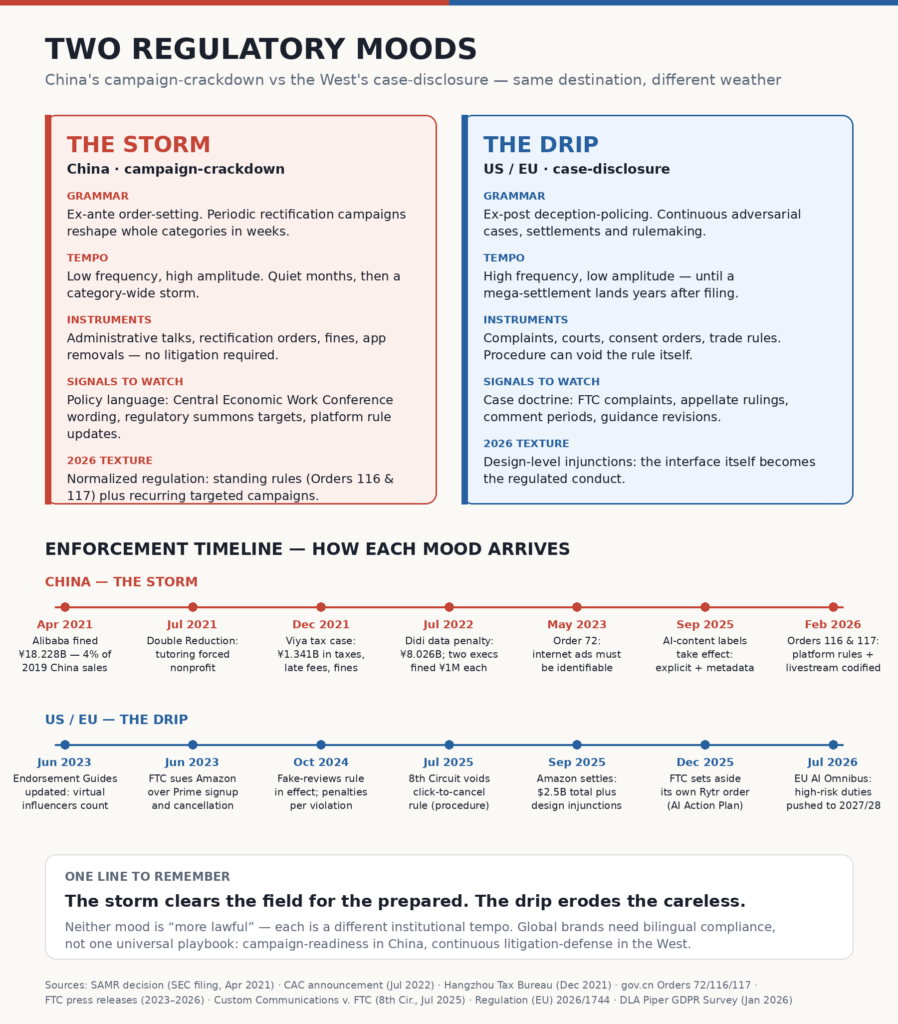
China’s regulatory mood is campaign-crackdown: sweeping, coordinated rectification drives that reshape whole categories at once. The West’s mood is case-disclosure: adversarial, individual-case enforcement that moves slowly, procedurally — and then suddenly, at settlement. The difference isn’t severity. It’s tempo and trigger.
2. The Storm: How China’s Campaigns Actually Land
Let’s walk through the receipts, because the pattern only becomes visible in sequence.
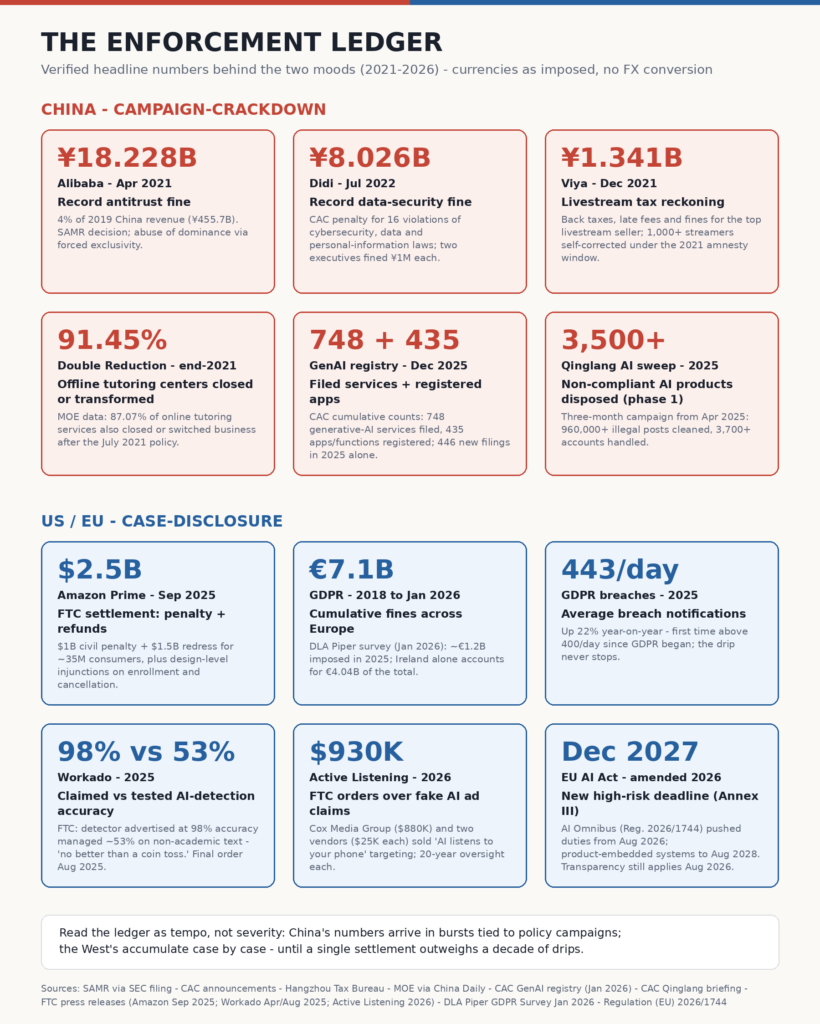
April 2021. The State Administration for Market Regulation (SAMR) fined Alibaba ¥18.228 billion — 4% of its 2019 China revenue — for abusing market dominance through forced merchant exclusivity. The investigation had opened only months earlier. No years-long litigation. An administrative decision, published, done.
July 2021. The Double Reduction policy (双减) landed via a joint opinion from the CPC Central Committee and State Council general offices. Academic tutoring companies were ordered to register as nonprofits, barred from raising capital, and banned from teaching on weekends and holidays. By the end of 2021, Ministry of Education data showed 91.45% of offline tutoring centers and 87.07% of online tutoring services had closed or transformed. An entire venture-backed category, restructured in under six months.
December 2021. Hangzhou’s tax bureau announced that Viya — the country’s top livestream seller — owed ¥1.341 billion in back taxes, late fees and fines. Crucially, this followed a September notice from the State Taxation Administration offering leniency to streamers who self-corrected by year-end. More than a thousand took the deal. The campaign wasn’t just punishment; it was formalization with a deadline.
July 2022. The Cyberspace Administration of China (CAC) fined Didi ¥8.026 billion for 16 violations of the cybersecurity, data security and personal information protection laws — and personally fined its CEO and president ¥1 million each. Again: administrative, category-defining, fast.
Notice the grammar. Each action arrives inside a policy window, applies to a whole category, and executes through administrative power rather than courtroom attrition. The storm doesn’t accumulate. It breaks.
3. The Drip: How Western Enforcement Accumulates
Now cross the Pacific and watch the same decade in slow motion.
The FTC sued Amazon over Prime enrollment and cancellation practices in June 2023. The case ground through discovery and trial prep for two years. Then, days into a Seattle trial in September 2025, Amazon settled: $2.5 billion — a $1 billion civil penalty plus $1.5 billion in consumer refunds covering roughly 35 million people. By September 2026, more than $845 million had been paid out, with the per-consumer cap raised from $51 to $200 under a court-approved revision.
Meanwhile, Europe’s GDPR enforcement kept dripping. DLA Piper’s January 2026 survey puts cumulative fines at €7.1 billion since 2018, with roughly €1.2 billion imposed in 2025 alone. The largest 2025 penalty — €530 million against TikTok for data transfers to China — came from Ireland’s regulator, which alone accounts for €4.04 billion of the European total. Nine of the ten largest GDPR fines ever have landed on tech companies. And the background hum never stops: European authorities now log an average of 443 data-breach notifications per day, up 22% year-on-year.
The drip’s defining feature? Procedure constrains everything. In July 2025, the Eighth Circuit voided the FTC’s entire click-to-cancel rule — six days before it took effect — not because subscription traps are fine, but because the agency skipped a required regulatory analysis. The West’s regulator can be overturned by its own rulebook. That’s not a bug in the mood; it is the mood.
4. Why the Moods Differ: Four Institutional Drivers
So why does one system storm while the other drips? Four drivers, and none of them is about who cares more about consumers.
4.1 The state’s self-conception
China’s regulator acts as a guardian of market order — proactive, campaign-capable, entitled to reshape categories toward policy goals. The Western regulator acts as a referee of deception and competition — reactive, case-bound, policing conduct within a market it doesn’t direct. One is a gardener with pruning shears; the other is an umpire with a rulebook.
4.2 The legal instrument
Chinese administrative power — regulatory summonses, rectification orders, fines, app removals — acts fast and broadly without litigation. Western enforcement runs through courts and rulemaking procedure, which is slower but also self-limiting: the click-to-cancel vacatur showed procedure can kill the rule itself. Speed versus process, and each pays the price of its own virtue.
4.3 The policy linkage
Chinese campaigns couple to national strategy — common prosperity, data security, demographic goals behind Double Reduction. Western cases couple to legal doctrine — deception, unfairness, competition. Different masters produce different calendars: the campaign follows the policy cycle; the case follows the evidentiary record.
4.4 The predictability profile
Chinese compliance faces low-frequency, high-amplitude shocks: quiet months, then a category erased. Western compliance faces high-frequency, low-amplitude friction: constant audits, occasional mega-settlements. Risk management diverges accordingly — scenario preparation versus continuous defense. You cannot hedge a storm the way you hedge a drizzle.
5. What Everyone Misunderstands
5.1 “Chinese regulation is arbitrary”
Only if you don’t read the signals. Campaigns are previewed in five-year plans, Central Economic Work Conference wording, regulatory whitepapers and summons targets. To the signal-reader, the storm has a forecast. To the outsider who only reads English headlines, it looks like lightning from a clear sky. The mood is campaign-driven, not random — which is precisely why compliance in China is partly intelligence work.
5.2 “Western regulation is predictable”
Less than advertised. A rules-based system still lurches: the click-to-cancel rule died on procedure; the FTC’s Amazon settlement dictated interface design — down to banning the decline button the FTC’s complaint had cited as “No, I don’t want Free Shipping.” And in December 2025, the FTC did something almost unheard of: it reopened and set aside its own 2024 consent order against Rytr, an AI writing-tool company, concluding the complaint failed Section 5’s requirements and the order unduly burdened AI innovation under the administration’s AI Action Plan. Doctrine shifts with courts and administrations. The drip has its own surprises.
5.3 “Crackdowns are anti-business”
Often they’re pro-formalization. The livestream tax sweep punished outliers while legitimizing everyone who had been paying properly — over a thousand streamers self-corrected and kept operating. The storm clears the field for the prepared. Early compliance becomes a moat, not a cost.
5.4 “The moods will merge under AI”
The subject converges; the grammar persists. Both systems now regulate algorithms, training data and synthetic content — but China does it through filings and labeling mandates, the West through deception cases and risk-tiered rules. Same chapter, two different languages.
6. The 2026 Update: Both Moods Are Evolving — in Their Own Direction
Here’s where most 2021-vintage analysis goes stale, so let’s be precise about what changed.
China has normalized — without retiring the campaign. In December 2025, SAMR and the CAC jointly issued two measures effective February 1, 2026: the Platform Rules Supervision Measures (Order 116) and the Livestream E-commerce Supervision Measures (Order 117). They codify what campaigns once improvised — platform rule-making procedure, bans on forced refund-only policies and big-data price discrimination, identity verification for streamers, traffic-throttling as a regulatory tool, and mandatory labeling of AI digital-human hosts. At its February 2026 press briefing, SAMR described the posture as “balancing regulation and development” with normalized supervision. Yet the campaign toolkit stays loaded: the three-month Qinglang AI-abuse sweep launched in April 2025 disposed of over 3,500 non-compliant AI products in its first phase, cleaned 960,000-plus illegal posts and handled 3,700-plus accounts. Normalization means standing rules plus recurring campaigns — not the end of storms.
The West has doubled down on cases — while rewriting its AI calendar. The FTC kept policing AI claims one case at a time: Workado’s AI detector advertised 98% accuracy but tested around 53% on non-academic text (“no better than a coin toss,” as the agency put it), settling in a 20-year order finalized in August 2025; Growth Cave’s “nearly 100% automated” AI software resolved in January 2026; and in 2026 the agency secured $930,000 in orders against Cox Media Group and two vendors over “Active Listening” ads that claimed AI could target consumers by listening to their phones — with 20-year monitoring attached. Europe, meanwhile, amended its AI Act through the AI Omnibus (Regulation (EU) 2026/1744), in force since July 27, 2026: standalone high-risk obligations slip from August 2026 to December 2027, product-embedded ones to August 2028. But note what did not slip — Article 50 transparency duties, including synthetic-content labeling, still apply from August 2026, with only a short watermarking grace period for legacy systems. The drip’s calendar moved; its direction didn’t.
7. The AI Chapter: Same Subject, Different Grammar
Zoom in on AI and the contrast becomes almost laboratory-clean.
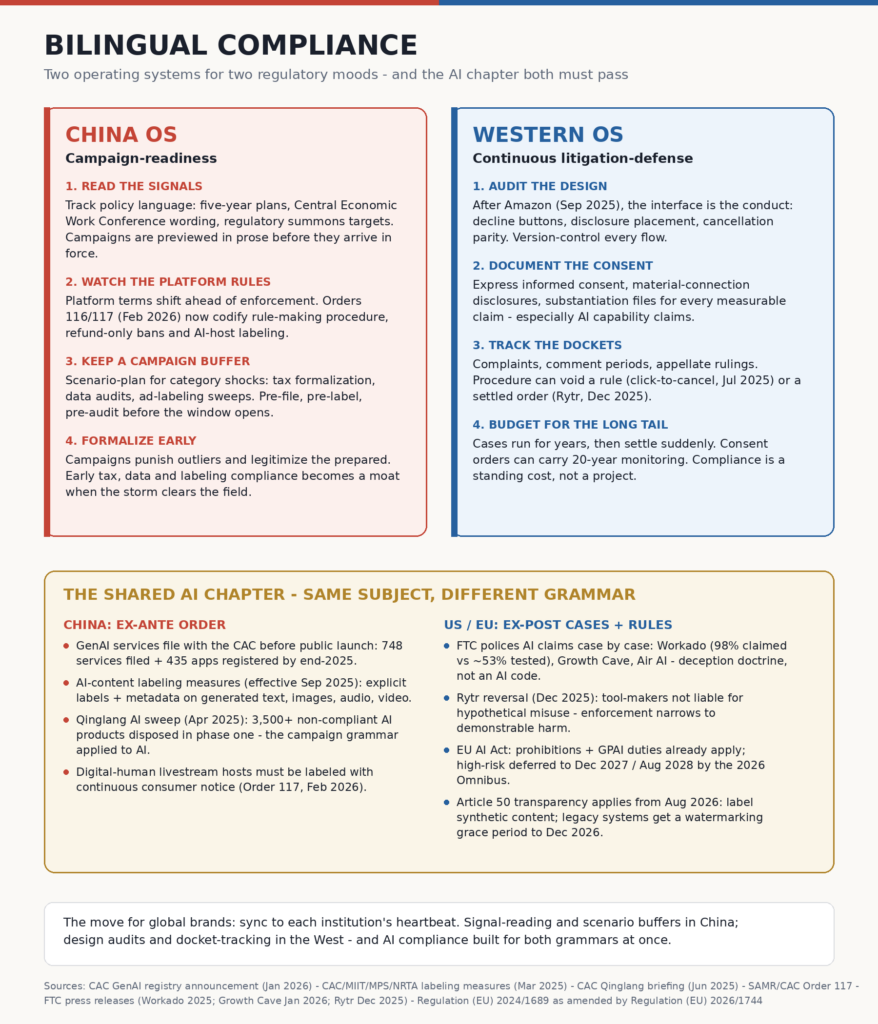
China’s approach is ex-ante order. Generative AI services file with the CAC before public launch — by end-2025, 748 services had completed filing and 435 apps or functions had registered, with 446 new filings in 2025 alone. The AI-content labeling measures, effective September 2025, require explicit labels plus metadata on generated text, images, audio and video, paired with a mandatory national standard. Order 117 extends labeling to digital-human livestream hosts. You comply before you ship.
The Western approach is ex-post cases plus risk-tiered rules. The FTC has no AI code — it has deception doctrine, applied to AI claims case by case, and after the Rytr reversal it will not condemn a tool for hypothetical misuse. The EU AI Act tiers obligations by risk, applies prohibitions and GPAI duties already, and defers the heavy high-risk machinery. You comply against liability, continuously.
For a marketing team shipping one AI-powered campaign into both markets, this means two audits: an order-compliance audit (filing status, labels, metadata, host disclosure) and a deception-liability audit (substantiation for every capability claim, consent architecture, disclosure placement). Neither substitutes for the other.
8. What It Means for Brands: Run Two Operating Systems
8.1 The China OS: campaign-readiness
Monitor policy language, not just published rules — conference wording and summons targets preview campaigns. Track platform terms, which now shift under Orders 116/117’s procedural requirements. Keep a scenario buffer for category shocks: pre-file, pre-label, pre-audit. And treat formalization as strategy — the tax, data and labeling compliance you do early is the moat you own when the storm clears your competitors.
8.2 The Western OS: continuous litigation-defense
Audit design as conduct: after Amazon, your decline button, disclosure placement and cancellation parity are legal artifacts — version-control them. Document consent and substantiation, especially for measurable AI claims; Workado’s 98-versus-53 gap is the cautionary tale. Track dockets and comment periods, because procedure can void rules and even settled orders. And budget for the long tail: consent orders now routinely carry 20-year monitoring. Compliance is a standing cost, not a project.
8.3 The bridge: bilingual compliance
The organizations that get this right don’t translate one playbook — they run two, with a shared evidence layer. One substantiation file, one consent archive, one AI inventory; two enforcement calendars, two audit rhythms. The mood was never the message. It was the institution’s heartbeat, and you have to sync to it.
9. The Counterargument — and Its Limit
Fair pushback exists on both sides.
“China is becoming rule-based and predictable.” True as far as it goes — Orders 116/117, the identifiability guideline of August 2024, and the maturing PIPL/antitrust framework all codify discretion. But the campaign capacity remains institutional, and the policy linkage persists. Predictability improves; the grammar’s DNA stays.
“The West runs sweeps too.” It does — Operation AI Comply launched five actions in a single day in September 2024. But even sweeps run through case procedure and court validation, not administrative fiat. The amplitude resembles a campaign; the grammar doesn’t.
“AI will merge the moods.” The subject merges. The instruments — administrative order versus case procedure — are institutional and durable. The honest synthesis: shared topics, persistent moods.
10. Conclusion: Sync to the Heartbeat
Two regulatory moods, two enforcement grammars. China’s campaign-crackdown sets order ex ante through sudden, category-wide waves tied to national strategy — now layered onto standing rules, but with the storm toolkit intact. The West’s case-disclosure polices deception ex post through continuous litigation and rulemaking — now reaching into interface design and AI claims, but still bound by procedure that can undo its own work.
Neither mood is more lawful. Each is a different institutional tempo, and tempo is what your compliance operations must match: campaign-readiness and signal-reading on one side, continuous litigation-defense and docket-tracking on the other. Formalize early to turn storms into moats. Audit continuously to survive the drip. And build your AI compliance for both grammars at once — because the shared chapter is already being written, in two languages, on two clocks.