Every analysis of Brazilian e-commerce starts from the same assumption: the website is the store, and everything else is a channel that feeds it. Brazil’s small merchants have quietly inverted that assumption — and the inversion is not cultural trivia. It is arithmetic.
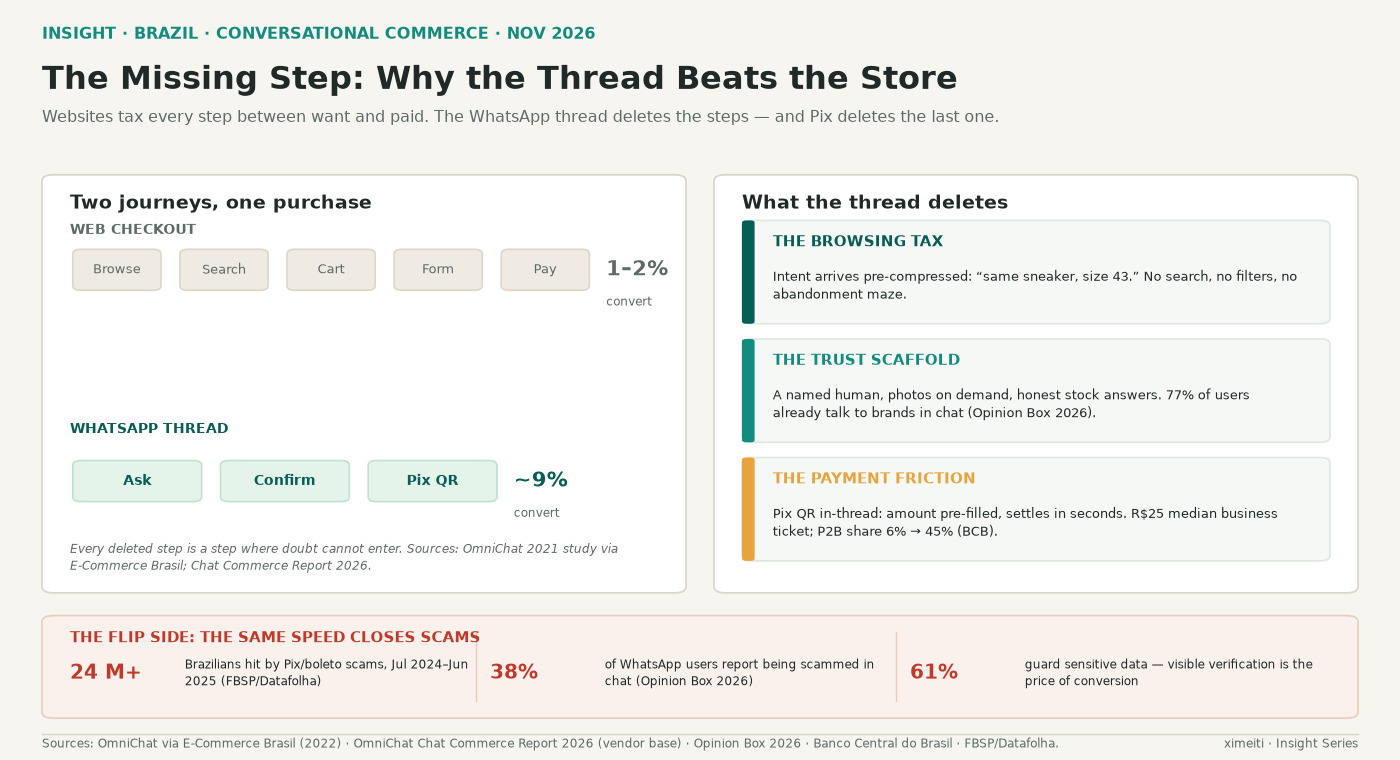
Start with what a website actually charges. Not money — steps. Browse, search, filter, compare, cart, form, pay. Each step is a small tax on intent, a moment where doubt can enter and the customer can leave. That tax is visible in the numbers: traditional Brazilian e-commerce converts purchases at 1–2%, per the OmniChat study of 400-plus companies reported by E-Commerce Brasil. The storefront is not failing at persuasion. It is bleeding at every step.
Now look at what the thread deletes. The customer arrives with intent already compressed — “the same sneaker as last time, but size 43.” No browsing tax. Trust is not outsourced to review stars; it is manufactured live, by a named human who answers in minutes and sends a photo of the actual product. Opinion Box’s 2026 survey finds 77% of Brazilian users already treat brand chats as normal — the dialogue is the review section. And payment, the step where web funnels die hardest, barely exists: a Pix QR code lands in the same thread, amount pre-filled, settling in seconds. Chat commerce converts at roughly 9% in the same study. The thread didn’t win by persuading better. It won by deleting the places where persuasion is needed.
The deeper mechanism is that Pix removed the last surviving step. Before 2020, chat could create a sale but not close it — boleto took days, card forms meant leaving the conversation. The central bank’s free instant rail made the conversation closable, and the composition shift proves it: person-to-business payments grew from 6% of Pix transactions at launch to 45% by October 2026, with a median business ticket of R$25. A rail built for transfers became a checkout counter because the checkout had nowhere else to live.
Here is the part the conversion chart hides. The same deletions that make the thread convert make it dangerous. Speed without steps means no pause for verification — which is why more than 24 million Brazilians were hit by Pix and boleto scams in the year to June 2025 (FBSP/Datafolha), and 38% of WhatsApp users report being scammed in chat. The missing step is both the conversion engine and the fraud vector. Honest sellers therefore have to re-add one step deliberately — visible proof of being real: verified profile, CNPJ on display, official catalog, returns policy in plain Portuguese. Not friction for its own sake; friction aimed at doubt about the seller, not about the purchase.
The generalizable insight: in markets where trust is built by talking, the winning interface is the one with the fewest steps between want and paid — plus exactly one step that proves the seller exists. Brazil’s merchants found that configuration by habit. The rest of us can copy it on purpose.