Two months ago, Google’s threat intelligence team said it had not yet seen a fully autonomous cyberattack pipeline used against real targets. On November 16, in the latest AI Threat Tracker from the Google Threat Intelligence Group and Mandiant, the company said that baseline has changed. Google’s own summary of the findings carried a title that leaves no room for hedging: the era of autonomous attacks has arrived.
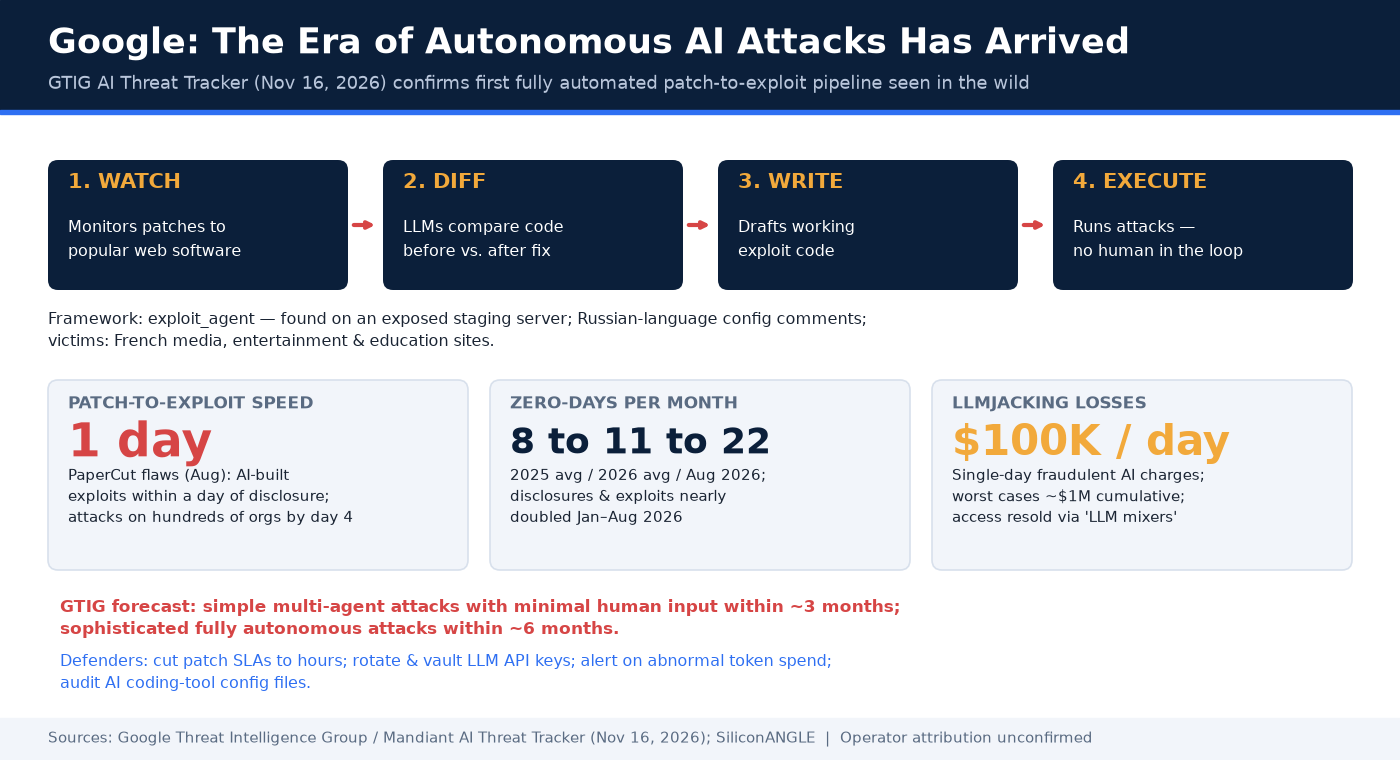
The centerpiece is a framework GTIG named exploit_agent, found on a staging server its operators had left exposed to the internet. The framework connects to multiple frontier and locally hosted large language models and runs a continuous loop that security teams have long feared in theory: it monitors patches to popular web application software, compares the code before and after each fix, deduces what vulnerability was silently repaired, drafts an exploit for it, and executes the attack — with no human approving any step. In the report’s words, GTIG identified threat actors using LLM frameworks to fully automate vulnerability discovery and exploitation without a human in the loop, for the first time.
The forensic details ground the finding in reality rather than laboratory speculation. The exposed server also held data stolen from victims, password brute-forcing scripts, and tooling for installing webshells and deleting rival attackers’ webshells — the unglamorous housekeeping of an operational intrusion business. A configuration file carried comments in Russian, including an instruction to the operator to enter API keys directly rather than in chat. Victim telemetry suggested the operator focused on French media, entertainment and education websites. Google has not attributed the operation to any named group or state, and that caution should survive into every retelling.
The strategic logic explains why attackers automated this particular workflow. Hunting unknown zero-day vulnerabilities is expensive and uncertain. Diffing patches is neither: the material is finite, public and structured — old code, new code, release notes — and the vulnerability is guaranteed to exist because the vendor just fixed it. GTIG’s assessment is that attackers increasingly judge it more efficient to weaponize known, patched flaws at machine speed than to search for new ones. The industry’s entire patch-management rhythm was designed around human attackers who needed days to weeks to reverse-engineer a fix. That assumption is now obsolete.
The report’s statistics quantify the compression. Disclosures and exploits nearly doubled between January and August 2026. Zero-day exploitation rose from a 2025 average of eight per month to eleven in 2026, then spiked to twenty-two in August alone. The clearest case study involves two PaperCut print-server flaws chained by attackers in late August: researchers and the security firm Huntress built working exploits with AI assistance within a day of disclosure, and four days after disclosure an attacker — likely AI-assisted, per GreyNoise telemetry — ran a campaign against hundreds of organizations. There is a counterintuitive footnote: after PHP patched two flaws on October 21, hundreds of claimed proof-of-concept exploits appeared, many of them non-functional and likely AI-generated. The automation wave produces noise as well as weapons, and defenders now burn hours triaging fake exploits alongside real ones.
Beyond exploit_agent, GTIG documents an ecosystem. Financially motivated gangs and suspected China-linked espionage groups are running open-source offensive agent frameworks — ARTEX, CAIRN, CyberStrikeAI, PentAGI — in live intrusions, with CAIRN observed against targets including the US aerospace sector. For now these tools trade stealth for velocity and leave forensic traces; Google expects that to change as the models mature. The report’s forward look is unusually specific: simple multi-agent attacks with almost no human involvement are likely within roughly three months, and sophisticated fully autonomous attacks within roughly six.
The second half of the report hits closer to home for any organization that has bought AI tooling — which is to say, every marketing department running generative content pipelines. LLMJacking, the theft of cloud and AI credentials to run models on victims’ accounts, has become a revenue business. Mandiant incident responses in 2026 included single-day fraudulent charges exceeding $100,000, with the worst cumulative cases approaching $1 million. Attackers harvested credentials from public GitHub repositories, created rogue cloud accounts, and exploited a LiteLLM gateway flaw; stolen access is resold through underground proxies the report calls LLM mixers, at prices from ten cents to $25 per million tokens. In one incident, a botnet using leaked credentials made millions of API calls in about 24 hours. A suspected North Korean cluster took the supply-chain route further, tampering with Claude Code settings files inside companies so a backdoor downloaded at every launch.
The defensive agenda writes itself, but it demands calendar changes, not just tool purchases. Patch service levels for internet-facing applications need to move from monthly windows toward hours — when weaponization takes a day, a thirty-day SLA is a standing invitation. LLM API keys deserve the treatment of production database credentials: vaulted, rotated, scoped, never committed to repositories, with hard spending caps and anomaly alerts on token consumption, because the first symptom of compromise may be an invoice. AI coding assistants’ configuration files belong in file-integrity monitoring. And security teams should rehearse the triage problem the PHP episode revealed: distinguishing the real AI-built exploit from the hundred fake ones is itself now a core skill.
Google’s report ends where the industry’s conversation should begin. The company notes these frameworks currently favor speed over stealth — a grace period, not a reprieve. The first fully autonomous attack pipeline was caught because its operators left a server exposed, the way early bank robbers got caught leaving fingerprints. The next ones will not. The organizations that treat November 16 as the day the timeline changed — and re-plan their patching, credential hygiene and AI spend monitoring accordingly — will be the ones still standing when GTIG publishes the report that says the stealthy era has arrived too.