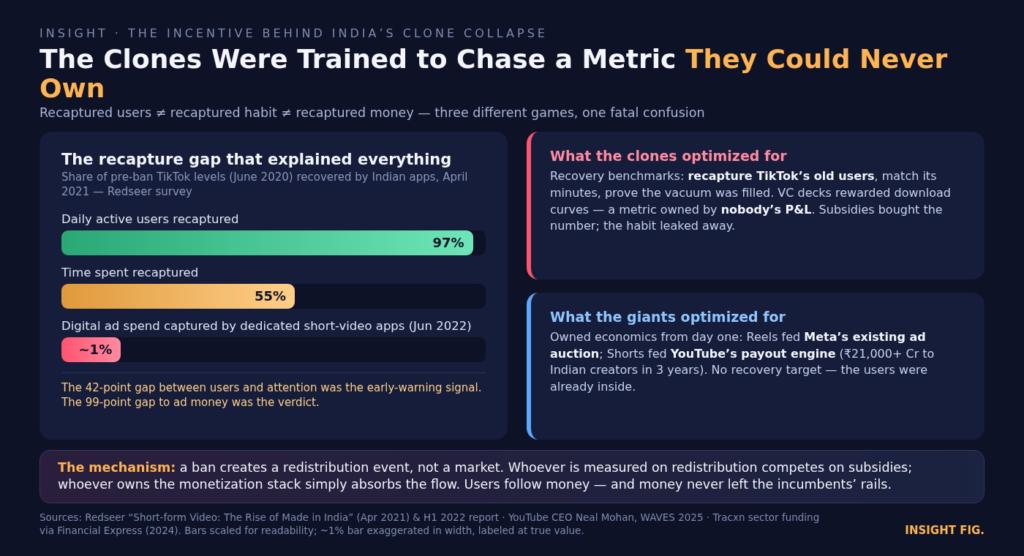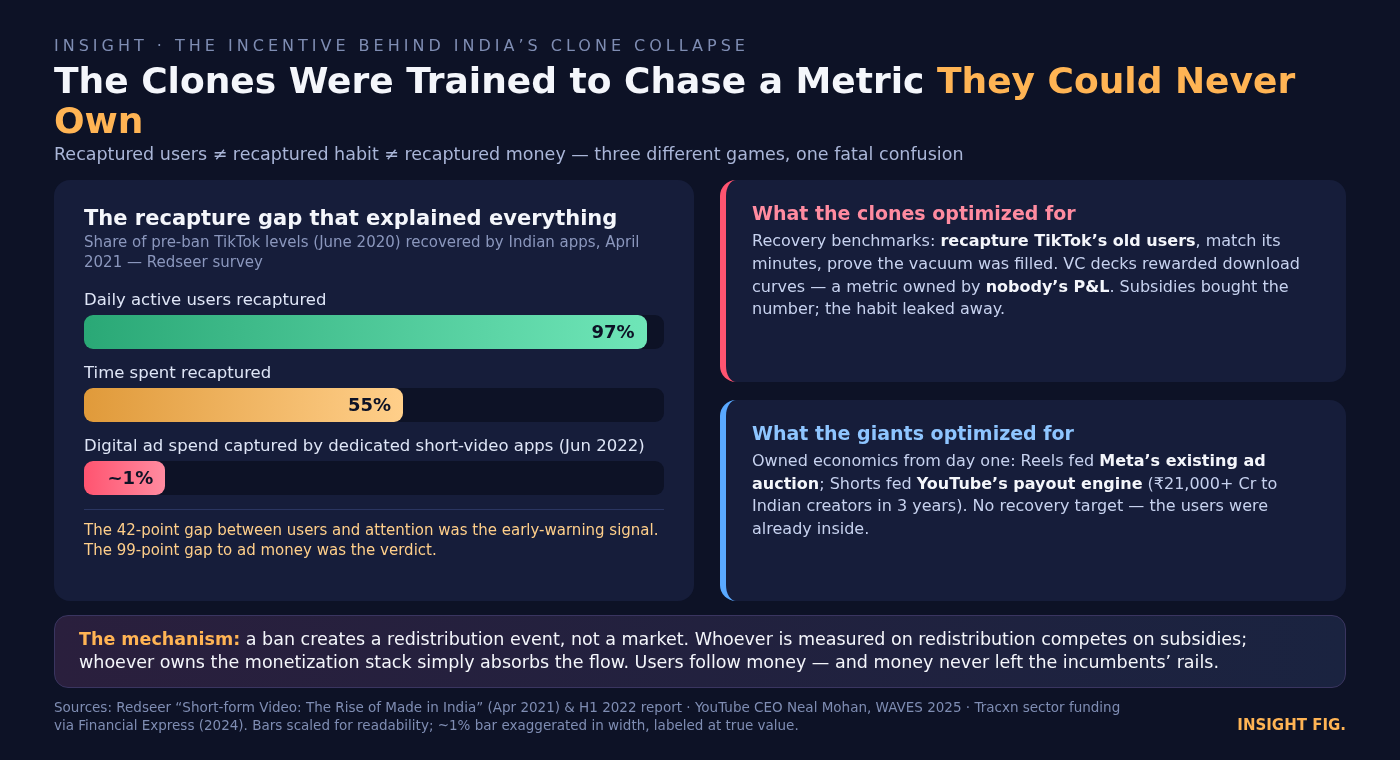
Here’s a number that should have ended the debate in 2021, and almost nobody read it correctly. Ten months after India banned TikTok, Redseer surveyed the short-video market and found that homegrown apps had recaptured 97% of the pre-ban daily-active-user base. Near-total recovery. Champagne, right? Except the same study found time spent had recovered only 55% of June 2020 levels.
Sit with that 42-point gap for a second. The clones got the people back. They didn’t get the habit back. And by mid-2022, dedicated short-video apps were capturing roughly 1% of India’s digital ad spend — the third number in a sequence that reads like a diagnosis: users ≠ attention ≠ money.
The standard story says the clones lost to better products or deeper pockets. True, but shallow. The deeper mechanism is an incentive trap: the clones were measured — by investors, by press, by themselves — on a recovery benchmark they could never own. Recapture TikTok’s users. Match TikTok’s minutes. Prove the vacuum was filled. Every board deck rewarded the download curve, so every rupee of subsidy went toward buying that curve. Josh claimed 150 million monthly actives at its $5 billion peak; third-party trackers later counted single-digit millions. The metric was performable, purchasable, and ultimately disconnected from anyone’s P&L.
Meanwhile, Meta and Google were playing a different game with different scoring. Reels wasn’t trying to recapture anything — it was routing displaced attention into an ad auction that already existed, with advertisers, measurement and brand-safety machinery already humming. Shorts wasn’t chasing TikTok’s minutes — it was feeding a payout engine that would pay Indian creators ₹21,000-plus crore over three years. Their KPI was owned economics from day one. The clones’ KPI was someone else’s ghost.
This is why the funding winter was lethal to one side and irrelevant to the other. When Tracxn counted zero VC dollars flowing into Indian short-video startups in 2023, the clones lost the only thing keeping their recovery metric alive: subsidy. The incumbents never needed it — search and feed profits cross-subsidized the video formats indefinitely. A timed game versus an untimed one.
And it explains the survivors, too. Moj and ShareChat stopped chasing the ghost earlier than most: they shrank headcount by roughly 80%, abandoned the ad-recovery dream, and rebuilt around live gifting and microdrama — revenue they could actually own, from users the giants under-served. Roposo went live commerce. Chingari went paid private streaming, mostly abroad. None of them won the recovery race. They escaped it.
The generalizable lesson, for any market watching any ban: a policy ban creates a redistribution event, not a new market. Whoever is scored on redistribution competes on subsidies and loses when subsidies end. Whoever owns the monetization stack simply absorbs the flow. India’s ban didn’t fail because clones were badly built. It failed — as an economic-sovereignty project — because it moved users without moving the rails that money runs on. And users, in the end, follow the rails.