Six years ago, India pulled the plug on TikTok overnight. Two hundred million users woke up orphaned. A dozen homegrown clones sprinted into the vacuum, backed by billions in venture capital and a wave of patriotic sentiment. Everyone — analysts, investors, even government officials — assumed the throne would pass to a Made-in-India champion.
It didn’t. The format conquered the country. The kingdom went to Silicon Valley.
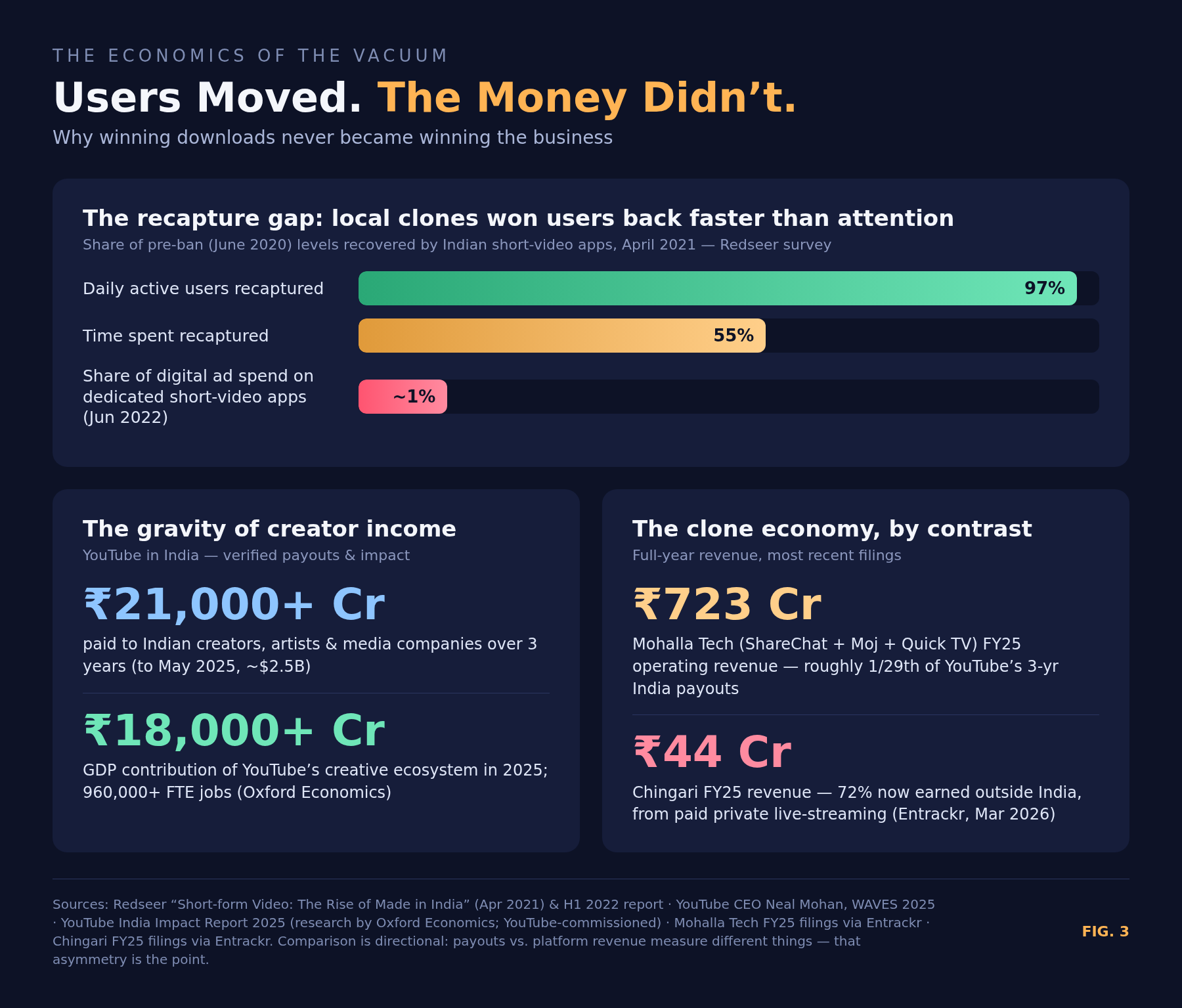
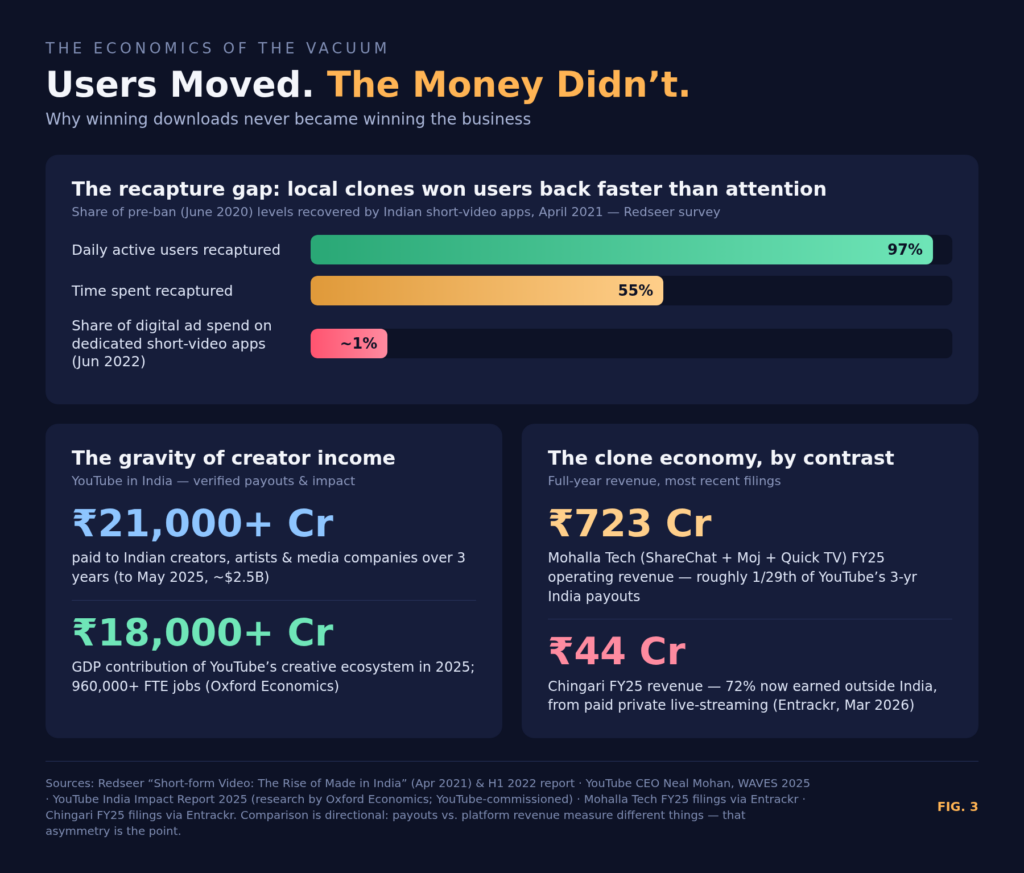
Here’s the verdict, in one paragraph: Instagram Reels became India’s default screen, YouTube Shorts became its creator paycheck, and the funded local champions — Moj, Josh, MX TakaTak, Roposo, Chingari, Trell — merged, shrank, pivoted or vanished. YouTube paid Indian creators, artists and media companies more than ₹21,000 crore (roughly $2.5 billion) in the three years to May 2025, a figure CEO Neal Mohan announced at the WAVES summit in Mumbai. No Indian clone came remotely close. The ban redistributed users. It never redistributed the advertising machine.
Let’s walk through how that happened — and what it actually teaches us.
The Ban That Orphaned 200 Million Users
On June 29, 2020 — two weeks after the deadly Galwan Valley clash between Indian and Chinese troops — India’s Ministry of Electronics and Information Technology invoked Section 69A of the IT Act and blocked 59 Chinese-linked apps, citing threats to sovereignty and national security. TikTok was the biggest name on the list. It claimed over 200 million Indian users at the time, with roughly 120 million monthly actives reported a year earlier — its largest market outside China by a wide margin.
The cutoff was brutal in its completeness. This wasn’t just an app-store delisting. Telecom operators blocked access at the network level, so even users who still had the app installed watched it go dark. In January 2021, the government made the ban permanent, and ByteDance began dismantling its Indian workforce of more than 2,000 people. By the end of 2020, four waves of bans had blocked 267 Chinese apps in total.
For creators, it was a livelihood evaporating overnight. Influencers with eight-figure followings — many from small towns, many with no other income — lost their stage, their audience and their brand deals in a single evening. India’s tech-policy commentator Nikhil Pahwa later noted the strange quiet of it all: no mass protests, just a massive, disorderly migration.
The Land Grab: A Dozen Clones and Two Quiet Giants
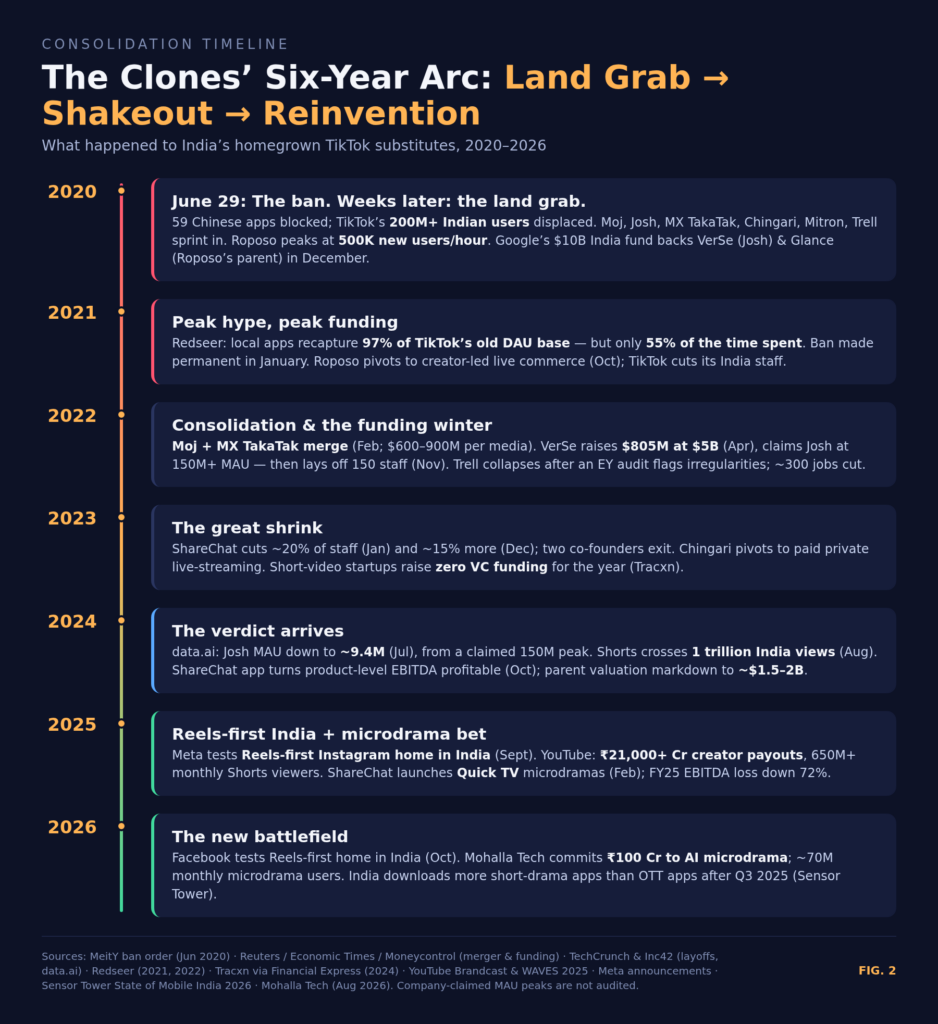
The migration had somewhere to go. Within weeks, dozens of Indian substitutes launched or relaunched: Moj from ShareChat, Josh from Dailyhunt parent VerSe Innovation, MX TakaTak from Times Internet, plus Chingari, Mitron, Trell and a turbocharged Roposo. The numbers looked like a gold rush. Roposo’s team told Bloomberg it was peaking at 500,000 new users per hour. Chingari crossed 10 million downloads in 22 days.
But watch what the giants did, because this is where the story was actually decided. Instagram brought Reels to India on July 8, 2020 — nine days after the ban. YouTube began beta-testing Shorts in India in September 2020, choosing the country as the format’s global launchpad. Neither needed to acquire users. The users were already inside their apps.
And Google hedged both sides of the bet. Through its $10 billion India Digitization Fund announced in July 2020, it invested in December in VerSe’s $100 million-plus round (making Josh’s parent a unicorn) and in Glance’s $145 million round — Glance being the InMobi subsidiary that owns Roposo. Later, in 2022, Google also joined ShareChat’s funding round at a $5 billion valuation. Read that again: the company building the substitute was simultaneously funding the competition. That’s not indecision. That’s a portfolio strategy — whichever app won, Google’s ad ecosystem and infrastructure would sit underneath it.
The Six-Year Verdict: Three Winners, Three Different Games
Instagram Reels: The Creator Magnet
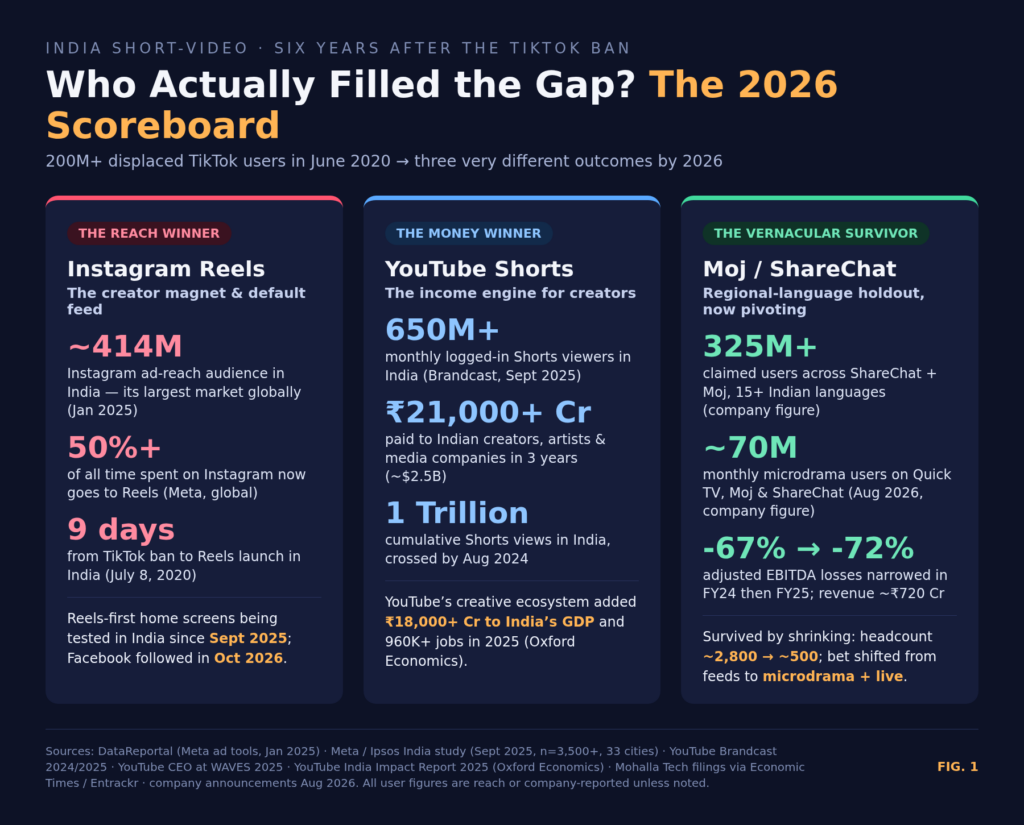
India is now Instagram’s largest market on earth. DataReportal’s January 2025 analysis of Meta’s own ad tools put the Indian advertising audience at roughly 414 million — more than double the United States. Reels did the heavy lifting: Meta says the format now accounts for over half of all time spent on Instagram globally, and a Meta-commissioned Ipsos study released in September 2025 (3,500-plus respondents across 33 Indian cities — note the sponsor’s obvious interest in the result) found 97% of Indians watch short-form video daily, versus 83% who watch TV daily, with Reels the preferred format for 92%.
The clearest signal of victory? Meta now uses India as the laboratory for turning its social apps into video apps. In September 2025 it began testing a Reels-first Instagram home screen with Indian users — open the app, land in the feed of recommended videos. In 2025 it also folded all Facebook video uploads into the Reels format, and by October 2026 it was testing a Reels-first Facebook home in India too. The TikTok-ification of Meta’s empire is being debugged in the very market where TikTok was killed.
YouTube Shorts: The Monetization Engine
If Reels won attention, Shorts won income. At Brandcast in September 2025, YouTube said Shorts reaches more than 650 million logged-in monthly viewers in India — a staggering figure that overlaps with, rather than adds to, YouTube’s roughly half-billion Indian user base. The format had already crossed one trillion cumulative views in India by August 2024.
But the number that matters most to creators is the payout: ₹21,000-plus crore over three years, plus a committed ₹850 crore investment over the next two. A YouTube-commissioned Oxford Economics study — the 2025 India Impact Report, released in September 2026 — estimated the platform’s creative ecosystem contributed over ₹18,000 crore to India’s GDP in 2025 and supported more than 960,000 full-time-equivalent jobs, up from ₹16,000 crore and 930,000 jobs the year before. Over 18,000 Indian channels have passed a million subscribers. When your rent depends on ad revenue share, this is gravity you can’t argue with.
Moj/ShareChat: The Vernacular Holdout
The strongest local survivor didn’t win by beating the giants — it won by owning what they under-served. ShareChat and Moj built their base in 15-plus Indian languages, deep in Tier-2 and Tier-3 towns. In February 2022, parent Mohalla Tech merged Moj with Times Internet’s MX TakaTak in a deal media valued between $600 million and $900 million, claiming a combined 300 million-plus monthly actives and 100 million creators. Treat those as company-reported peaks, not audited counts.
The financial reality was harsher. Mohalla Tech’s losses ballooned to over ₹5,100 crore in FY23 while revenue sat near ₹550 crore. What followed was a brutal, disciplined shrink: roughly 20% of staff cut in January 2023, another 15% that December, two co-founders departing, headcount falling from a peak near 2,800 to about 500 by early 2025 — and a valuation markdown from $5 billion to reported levels of $1.5–2 billion. Yet the surgery worked, directionally: FY24 revenue grew 33% to ₹718 crore with adjusted EBITDA losses down 67%, FY25 revenue held at ₹723 crore with losses down another 72% to ₹219 crore. Live streaming — not ads — became nearly half the business. The ShareChat app itself turned product-level EBITDA profitable in October 2024. This is no longer a TikTok clone. It’s a leaner vernacular entertainment company that happens to own a short-video app.
Josh: The Cautionary Tale
Josh had everything: launched within weeks of the ban, backed by Google and Microsoft, crowned with an $805 million raise at a $5 billion valuation in April 2022 — India’s biggest round that year. The company claimed 150 million-plus monthly actives. Seven months later it was laying off 150 employees and cutting pay.
Then the floor fell out. Third-party tracker data.ai, cited by Inc42 in July 2024, showed Josh’s MAU sliding from about 20 million in mid-2023 to roughly 9.4 million a year later, with monthly downloads down nearly 80%. The gap between the claimed 150 million peak and the tracked single-digit millions is enormous — partly a measurement question, since VerSe leaned heavily on phone-maker preinstalls that store trackers can’t fully see, but the direction is unambiguous. Josh’s standalone FY23 revenue was about ₹300 crore against a parent that had raised over $1.5 billion lifetime. By 2025, reporting described a scaled-down operation experimenting with paid one-to-one call features to stop the bleeding. The best-funded clone became the clearest proof that capital can buy downloads but not a durable attention habit.
The Pivots: Roposo, Chingari, Trell
The other survivors changed category entirely. Roposo, under Glance, launched creator-led live commerce in October 2021, powered by Glance’s acquisition of social-commerce plumbing Shop101. By May 2024, media reported its GMV above $450 million, and Glance’s commerce segment booked ₹254 crore revenue in FY24 — real money, though a rounding error next to India’s overall e-commerce. Chingari rode a crypto wave (its GARI token, fronted by Bollywood star Salman Khan), then abandoned it: today it runs paid private live-streaming, and its FY25 filings show ₹44 crore in revenue with 72% earned outside India. The Bharat-first TikTok alternative now makes most of its money abroad, in a business TikTok never ran. Trell didn’t even get a pivot: an EY forensic audit flagged financial irregularities in March 2022, funding froze, roughly 300 employees were let go, Sequoia exited at a reported 78% loss, and the app effectively wound down.
Why the Clones Lost the War They Won
Here’s the uncomfortable data point everyone skipped in 2021. Redseer’s April 2021 study found Indian apps had recaptured 97% of the pre-ban daily-active-user base — a seemingly total victory. But time spent had recovered only 55% of June 2020 levels. Users came back; the habit didn’t, not fully. And by mid-2022, dedicated short-video apps captured only about 1% of India’s digital ad spend, roughly $100 million, even as Redseer projected a $12–19 billion monetization opportunity by 2030. The gap between those two numbers is the whole story.
Users Are Not an Economy
A clone could copy the format — the vertical feed, the music library, the filters. Early SimilarWeb data (a limited sample, per the firm’s own caveat) showed TakaTak users spending 23 minutes a day, genuinely TikTok-like engagement. What no clone could copy was the ad stack: decades of advertiser relationships, global measurement tools, brand-safety machinery, and an auction already humming with demand. Advertisers buy audiences where their tools already work. A standalone app had to build an advertising business from zero while burning cash just to keep the content flowing. That’s two startups in one trench coat.
Creators Follow Money, Not Flags
When the clone creator-funds thinned, creators did the math. YouTube offers ads, memberships, Premium revenue and a long-form upsell; Instagram offers the brand-deal marketplace where India’s influencer budgets actually live. A creator can post the same clip everywhere, but they invest their best effort where the payout is. The multi-platform career — Reels for reach, YouTube for income, live apps for gifting — became the rational default, and both ends of that trade are American.
Distribution You Don’t Have to Install
Reels and Shorts were tabs inside apps already on every Indian phone. The clones had to win an install, then a habit, then a daily open — three funnel conversions the giants skipped entirely. In a market where Redseer found 59% of short-video users come from rural and semi-urban towns, that friction compounds. This is the same preinstall-and-default logic we’ve documented in China’s app economy: distribution inheritance beats product imitation.
The Capital Cycle Timed Its Betrayal Perfectly
The clones needed years of subsidy to convert borrowed users into an owned ad economy. The funding window slammed shut in 2022 — exactly mid-transformation. Tracxn data shows the sector’s VC funding fell from $65.8 million in 2021 to $29 million in 2022 to zero in 2023. Meta and Google, meanwhile, could cross-subsidize their short-video formats from search and feed profits indefinitely. The startups were playing a timed game; the incumbents weren’t.
What the Ban Actually Built: The Honest Balance Sheet
Credit where due. The format exploded: India became the world’s largest market for both Reels consumption and YouTube’s overall audience, and short-form overtook TV as the daily video habit in Meta’s commissioned survey. A genuine vernacular content layer emerged — Moj and ShareChat proved regional-language demand at a scale the giants had ignored, and the giants have since chased it into the same towns. And India’s creator economy is measurably bigger and more resilient than a TikTok monoculture: YouTube’s Oxford Economics study counts 960,000-plus supported jobs, creative clusters in Jaipur, Lucknow and Kochi, and channels earning six-figure rupee revenues growing over 30% year-on-year.
But the policy’s implicit promise — economic sovereignty, Indian value capture — largely failed. The ad dollars flow to Meta and Google regardless of which app’s logo sits on the home screen. Even the local champions’ cap tables tell the story: Google, Temasek and Lightspeed behind ShareChat; Google and Microsoft behind VerSe; SoftBank behind InMobi. The ban changed the flags on the apps. It didn’t change the plumbing underneath.
The Caveats You Should Keep in Mind
Three honest discounts on everything above. First, data opacity: clone MAU claims (Josh’s 150 million, ShareChat’s 325 million ecosystem) are company-reported peaks, rarely audited, and often diverge wildly from third-party trackers — we’ve flagged each. The giants’ India figures are reach estimates and logged-in viewer counts, not comparable MAUs either. Second, the counterfactual: short video was booming globally anyway; attribute the redistribution to the ban, not the format’s growth itself. Third, sponsored research: the Ipsos survey was commissioned by Meta, and the Oxford Economics impact reports by YouTube — methodologically serious, but the sponsors have an obvious interest in flattering conclusions, so treat the percentages as directional.
The Next Battle Is Already Running: Microdrama
The vernacular survivors found a new format war, and this one looks different. Sensor Tower’s State of Mobile India report (January 2026) found short-drama app downloads grew by over 350 million in 2025 — and after Q3, Indians downloaded more short-drama apps than OTT apps like Netflix and JioHotstar. Local players lead: Kuku TV and ShareChat’s Quick TV outrank global giants ReelShort and DramaBox in India, an inversion of most app categories. Mohalla Tech says its ecosystem now serves roughly 70 million monthly microdrama users, has committed ₹100 crore to AI-generated microdrama production, and claims AI workflows cut production costs by about 40% with a 70% target. Redseer pegged the short-form-plus-microdrama market at a roughly $50 million monthly run rate in late 2025, with analysts projecting $8–12 billion by 2030 — forecasts, not facts.
Will microdrama monetize better than feeds did? Early signs are cautiously interesting: it carries subscriptions (Quick TV charges ₹699 a quarter) rather than depending purely on ads, which sidesteps the exact trap that killed the feed clones. But the giants are entering — Amazon with MX Player Fatafat, Jio with its own plans — and history suggests the format pioneers rarely keep the kingdom. Watch this space with your skepticism handy.
The Takeaway: You Can Ban an App, Not a Business Model
Six years on, the lesson is clean enough to print on a policy memo. India’s ban orphaned 200 million users and midwifed a dozen clones — then handed the kingdom to Instagram Reels and YouTube Shorts, because short video is a monetization-and-ecosystem game, and the ban redistributed users, not advertising infrastructure. The surviving local strategy isn’t cloning what giants do better; it’s owning a layer they under-serve — vernacular depth, live gifting, microdrama — and staying lean enough to outlast the funding winter. For policymakers anywhere weighing a TikTok ban of their own: users follow money, not flags. And for founders: the vacuum is real, but so is the gravity of everything the incumbent already owns.