Vietnam looks like China circa 2015: a young population, phones everywhere, hosts selling lipstick at midnight. The comparison writes itself. The structure doesn’t.
The number that broke the analogy
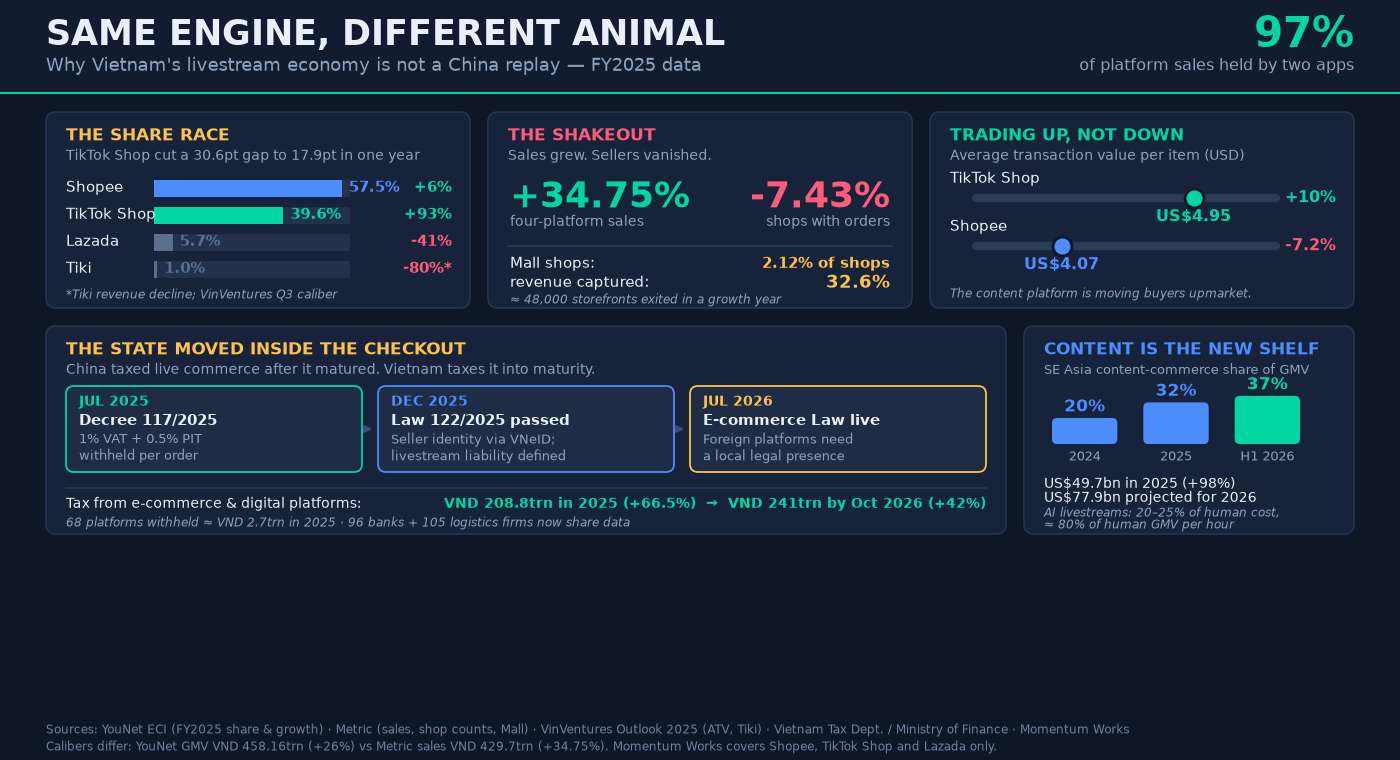
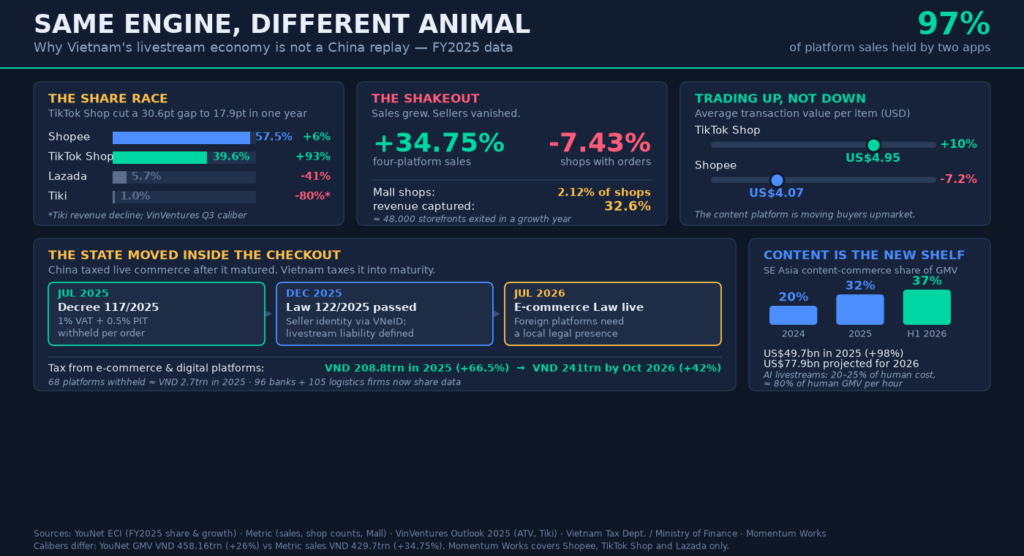
YouNet ECI’s report on Vietnam’s four biggest platforms puts 2025 GMV at VND 458.16 trillion, up 26%. TikTok Shop grew revenue 93% and climbed from 26.9% share to 39.6%. Shopee grew 6%, holding 57.5%. Lazada fell 41% to 5.7%. Tiki sits near 1%.
Two apps, roughly 97% of the market. China’s live commerce ran across five or more competing ecosystems. Vietnam’s runs through two foreign-owned pipes. That isn’t a smaller China. It’s a different shape of risk.
Growth went up. Sellers went out.
Metric counted VND 429.7 trillion in sales, up 34.75% — a different measurement basis, same direction. Meanwhile shops generating orders fell 7.43%, about 48,000 storefronts gone in a boom year. Mall shops, just 2.12% of sellers, took 32.6% of revenue. TikTok Shop’s Mall revenue rose 99%.
This isn’t democratization. It’s professionalization with a body count.
The cheap-goods stereotype is inverted
VinVentures, Vingroup’s investment arm, found TikTok Shop’s average transaction value per item rose 10% to about VND 130,000 (US$4.95). Shopee’s fell 7.2% to VND 107,000. The content platform is trading buyers up. In fashion and accessories — the largest category at 28% of GMV — TikTok Shop took first place with 53.1% against Shopee’s 46.1%.
The real difference: the tax collector is inside the checkout
Decree 117/2025, effective 1 July 2025, made platforms withhold 1% VAT plus 0.5% personal income tax on goods sold by individual and household sellers — deducted the moment an order completes. By year-end, 68 platforms had remitted roughly VND 2.7 trillion. Total e-commerce and digital-platform tax reached VND 208.8 trillion, up 66.5%.
Then came Law 122/2025, passed in December 2025 and live since July 2026: seller identity verification through the national VNeID system, defined liability for sellers, hosts and platforms separately, and local legal representation for foreign platforms.
China taxed live commerce after it matured. Vietnam is taxing it into maturity.
What this means for you
Dual-home or die — single-platform dependence in a 97% duopoly is existential. Enter with quality positioning while transaction values still climb. Treat compliance as a moat, not a cost: registered sellers get platform favor and brand deals.
One caveat worth stating plainly: no reliable public split separates livestream GMV from short-video GMV in Vietnam. Momentum Works puts regional content commerce at US$49.7 billion in 2025, up 98%, and 37% of platform GMV by mid-2026 — but that bundles live, short video and affiliates together. Anyone quoting a precise Vietnamese livestream share is guessing.
Same engine. Different fuel.