Here is a scene that plays out in regional marketing offices every quarter. The Thailand plan lands on the table: Meta for reach, TikTok for discovery, Shopee and Lazada for conversion. Tidy. Familiar. And someone adds LINE at the bottom of the slide, filed under messaging, next to a note about sending order updates.
That single line item is where the plan goes wrong.
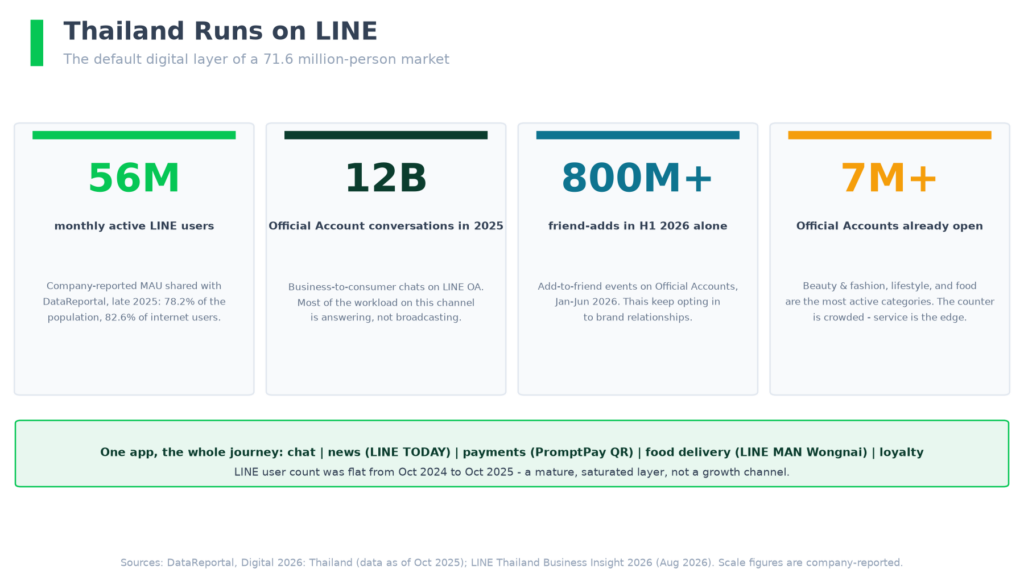
Because in Thailand, the chat app is not the notification layer. It is the sales floor. LINE counts 56 million monthly active users in a country of 71.6 million people, per company data shared with DataReportal for its Digital 2026 Thailand report. That is 78.2% of the population and 82.6% of everyone online. And in 2025, Thai consumers and businesses held 12 billion conversations through LINE Official Accounts, with more than 800 million add-to-friend events in just the first half of 2026, according to LINE Thailand’s Business Insight 2026 disclosures.
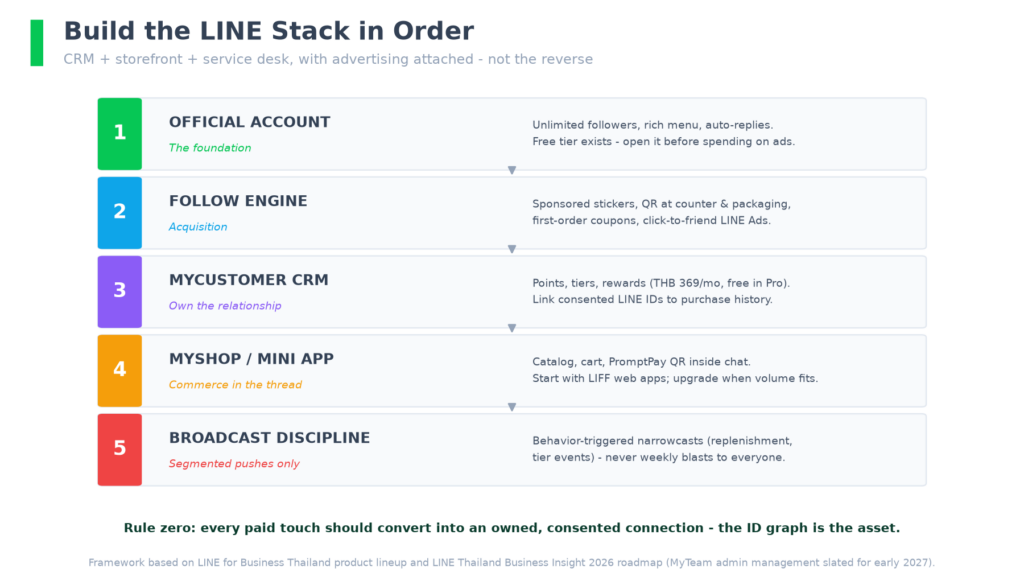
Read that again: 12 billion conversations. Most of the work happening on this channel is answering, not broadcasting. Which means the brands winning Thailand are not the ones with the best broadcast calendar. They are the ones who built a CRM, a storefront and a service desk inside a chat thread, then attached advertising to it — not the other way around.
This playbook walks through how to build that stack, what it costs, where the money leaks, and which numbers you should refuse to put in a budget forecast.
Why Thailand Chat-Buys While Japan Browses
The most useful thing LINE Thailand’s commercial chief, Ratthee Chatdamrongsak, said at Bootcamp Day 2026 in March was not a statistic. It was a comparison. In Japan and Taiwan, brands use LINE mostly to build awareness, then push the customer to a marketplace or a physical store to actually close. In Thailand, the sale closes inside the thread. The buyer asks the price, requests a photo, haggles a little, transfers money via PromptPay, and drops the payment slip into the same conversation. Done.
LINE’s own developers in Japan study the Thai market to understand how it works, because the missing ingredient elsewhere is the payment rail. Thailand has PromptPay, the national instant-transfer system, and Thai consumers treat a transfer-slip screenshot in chat as a normal receipt. No bundled wallet required. The conversation is the checkout.
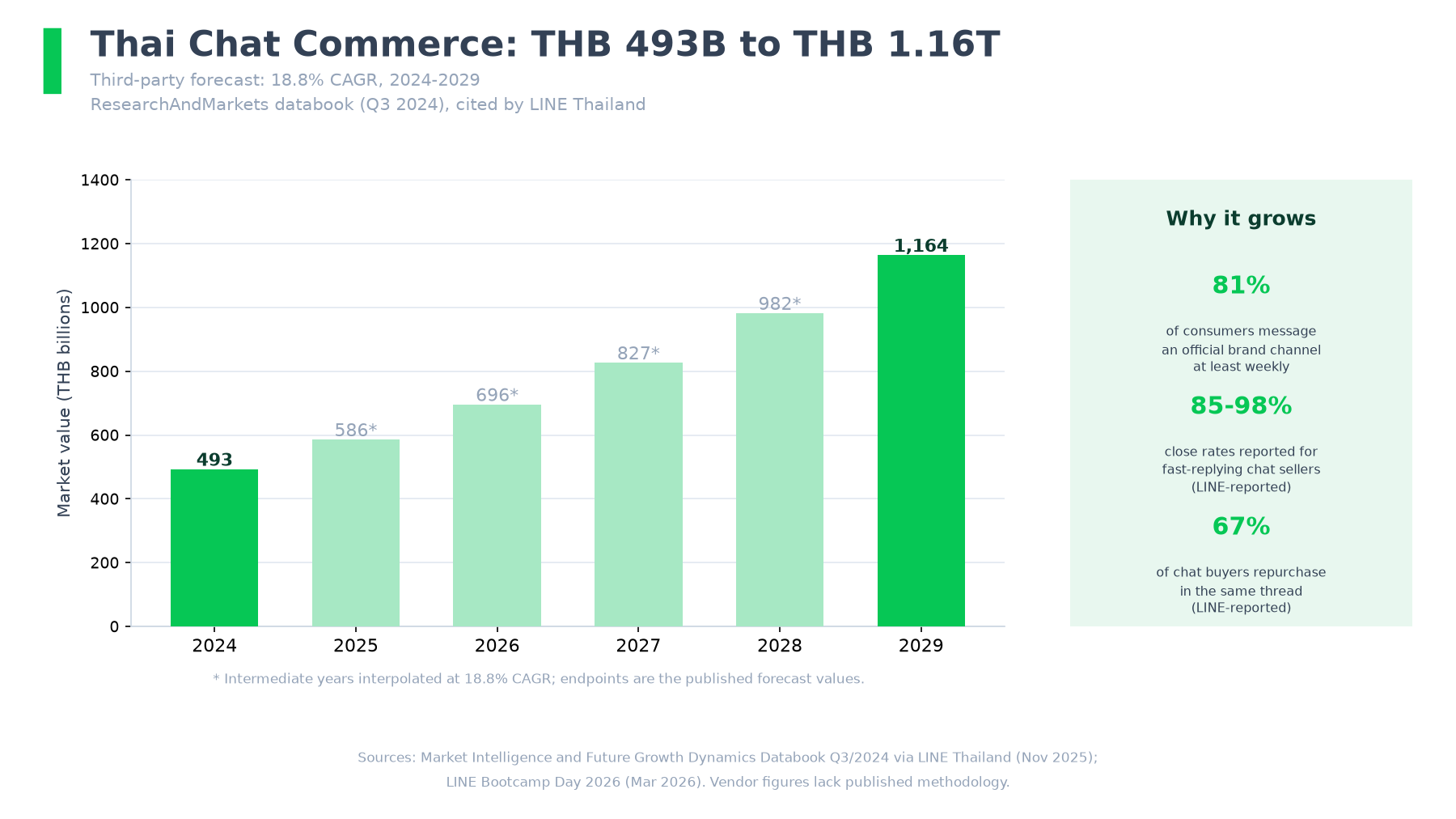
The vendor-reported numbers around this behavior are striking. LINE Thailand says fast-replying chat sellers close 85 to 98% of conversations, that 67% of chat buyers repurchase in the same thread, and that 86% of consumers will pay more for a better, faster chat experience. Treat those as directional, not audited — but the direction is unambiguous: in this market, response quality is a pricing lever.
One more contrast worth internalizing: 77% of Thai SMEs have adopted digital tools for running their business, against a global average of 39%, per figures LINE cited at the same event. Your competition in the reply queue is not just other brands. It is every nimble small shop that answers in two minutes.
The Market Behind the Behavior
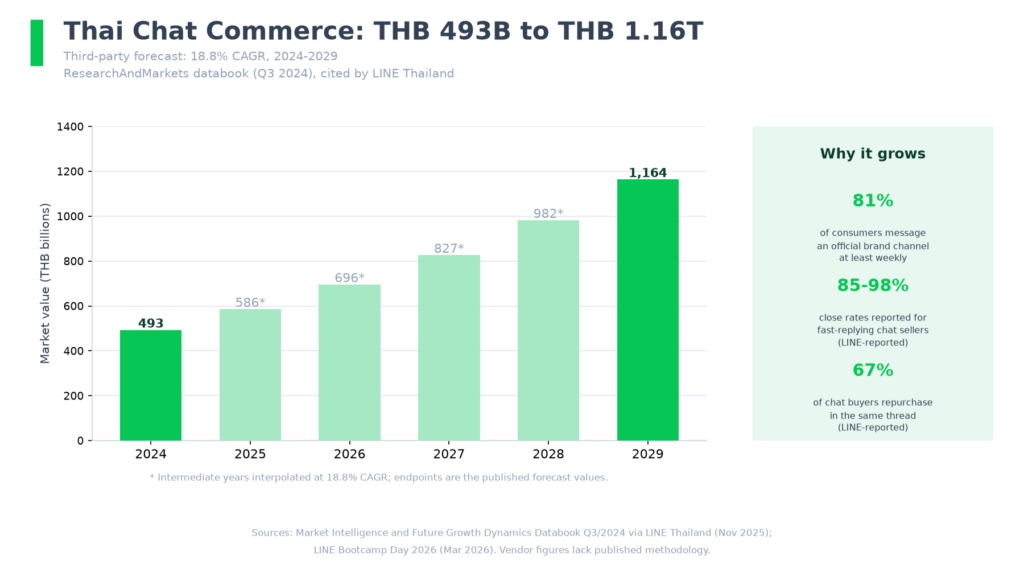
How big is the prize? A third-party forecast LINE Thailand has cited, from ResearchAndMarkets’ Market Intelligence and Future Growth Dynamics Databook (Q3 2024), puts Thai chat commerce at THB 493 billion in 2024, heading to THB 1.164 trillion by 2029 — an 18.8% compound annual growth rate. Roughly a doubling and a half in five years.
A word of caution, because this exact topic is where sloppy numbers breed. You may see a much larger figure, around THB 1.91 trillion, described in some coverage as the chat-commerce market. Check the lineage before you repeat it: THB 1.91 trillion matches the Thai government agency ETDA’s estimate of B2B e-commerce value from 2019 — a different metric entirely. When a market-size claim has no traceable methodology, the professional move is to drop it, not to average it with something else. The ResearchAndMarkets forecast above is the one with a nameable source and a stated growth path, so it is the one this playbook uses.
The One Economic Rule That Designs Everything
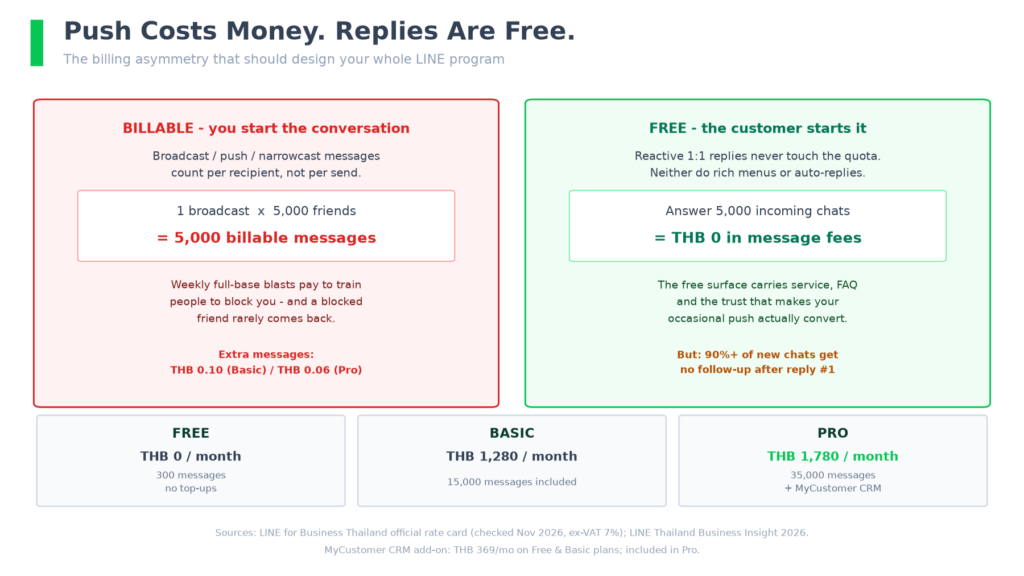
If you remember one mechanic from this article, make it this: push costs money per recipient, and reactive chat is free.
LINE’s Thai rate card bills broadcast-type messages by audience size. One broadcast to 5,000 friends burns 5,000 billable messages, even if the creative is a single image. Reply messages — the ones answering a customer who wrote first — do not count against the quota at all. Rich menus and auto-replies are likewise free surfaces.
Sit with the asymmetry for a second. The platform literally charges you to interrupt and pays you nothing to serve. Every structural decision in your LINE program — cadence, segmentation, staffing — flows from that price signal. Brands that blast their full friend base every week are paying, message by message, to train people to block them. Brands that invest in menus, auto-replies and fast human answers get unlimited service capacity for free, and the trust they build there is what makes the occasional paid push convert.
The current official plans (checked November 2026, before 7% VAT): Free includes 300 broadcast messages a month with no option to buy more; Basic is THB 1,280 for 15,000 messages, with extras at THB 0.10 each; Pro is THB 1,780 for 35,000 messages, extras at THB 0.06, and it bundles the MyCustomer CRM add-on that otherwise costs THB 369 a month. Do the breakpoint math before upgrading: Basic plus overage catches Pro’s price at 20,000 messages a month. And re-verify the rate card at execution time, because tiers and quotas shift by year and country.
Layer One: The Official Account Is the Store
Open the Official Account before you spend a baht on media. Followers are unlimited, the rich menu is your navigation bar, and auto-replies are your night shift. More than 7 million Official Accounts already operate in Thailand, with beauty and fashion, lifestyle, and food and beverage the most active categories, per LINE’s 2026 disclosures. The counter is crowded. Service quality is the differentiator, not presence.
Get verified, too. LINE reports that verified accounts see meaningfully higher friend-add rates than unverified ones, and in a market where scam accounts are a real consumer fear, the badge is cheap trust.
Layer Two: Build the Follow Engine
Every paid touch should end in an owned connection. That is the acquisition doctrine. LINE’s toolkit is unusually good at this: sponsored stickers with an add-to-friend mechanic (Thai users sent sponsored stickers roughly 979 million times in 2025, per LINE), QR codes at the counter and on packaging, first-purchase coupons gated behind a follow, and LINE Ads objectives built specifically to add friends rather than to collect clicks.
LINE has cited ad-driven friend acquisition costs around THB 15 per friend in its own seller case material. Vendor number, no methodology — so use it as a benchmark to beat in your own tests, not a promise. The strategic point stands regardless of the exact cost: a friend you acquired once is an audience you can serve for free and re-engage cheaply, while an ad click evaporates the moment the campaign ends.
Layer Three: MyCustomer Is the Asset Meta Cannot Give You
Here is where the stack stops being a channel and starts being a business asset. MyCustomer, LINE’s native CRM add-on, handles membership pages, points, tiers and rewards, and it connects to purchase behavior. Link consented LINE user IDs to your backend order history and you own something no ad platform rents you: a first-party identity graph tied to actual transactions.
LINE’s 2026 roadmap doubles down on this. A Customer Data Agent is planned to collect, analyze and segment customers automatically, aimed at the roughly 70% of SMEs LINE says lack the time or tooling to segment at all. For a Thai SME, this trajectory makes LINE a plausible substitute for a standalone CDP. For a foreign brand, it means the data you accumulate here compounds — if, and only if, your consent architecture is clean. More on that below, because the regulator is no longer politely waiting.
Layer Four: Close Inside the Thread
MyShop gives you catalog, cart and order management inside the chat window, and LINE has been promoting QR payment acceptance on MyShop with no fee collection as an SME incentive. For bookings and loyalty journeys, MINI Apps are the upgrade path: after LINE opened self-serve developer access in March 2026, the ecosystem tripled to more than 1,000 apps, with total daily active users up fourfold.
Before you commission one, read that pair of numbers honestly. DAU quadrupled on an app base that tripled. Ecosystem expansion is not per-app success, and LINE published no per-app averages. The sensible sequence: start with a LIFF web app for one high-frequency job — a booking flow, a reorder button, a points check — and graduate to a verified MINI App when usage proves the demand.
Layer Five: Broadcast Like a Sniper
The discipline that separates profitable LINE programs from expensive ones is segmenting every push by behavior. The classic illustration is pet food: a customer buys a six-week bag, so the message that matters lands in week five, to that customer, about that product. One timely narrowcast beats ten generic blasts, costs a fraction of the messages, and reads as service rather than spam.
Watch the block rate like a hawk, because it is the one metric that records permanent damage. Ad reach you can buy back. A blocked friend is gone, and reacquisition costs full price. LINE’s roadmap even includes a Return on Broadcast Spend tool — which tells you the platform itself knows most merchants cannot answer the question: was that blast worth it? Until it ships, answer it yourself: revenue per broadcast, cost per first-time buyer, and 90-day repurchase are the numbers that keep you honest.
The Reply Queue Is Where Revenue Dies
Now the most damning statistic in LINE’s entire 2026 disclosure: more than 90% of new chats receive no follow-up after the first reply. The customer asked, someone answered once, and the thread went quiet. No recommendation, no nudge, no close.
Think about what that means. Brands pay to earn the follow, pay again to trigger the chat, then abandon nine out of ten conversations at the exact moment a human was interested. The leak is not in the ad account. It is in the inbox.
This is why LINE is building Seller AI Automation — an AI agent that answers, follows up and closes inside the thread — and MyTeam, an admin-management product slated for early 2027 that lets staff bind their personal LINE accounts to the company OA so conversation history and customer data stay with the business when an employee leaves. Both products exist because the reply queue is the bottleneck. You do not need to wait for them. Staff the queue like a sales floor today: chat agents are revenue staff, not support overhead, and a five-minute response expectation is the market norm you are competing against.
Consent Is the Moat: PDPA Has Teeth Now
Thailand’s Personal Data Protection Act has been fully in force since June 2022, and the enforcement story changed in August 2024, when the regulator issued its first administrative fine: THB 7 million against a major IT retailer for a data breach compounded by missing security measures, no data protection officer and late breach notification. In August 2025 came five more cases across eight entities, totaling roughly THB 14.5 million — bringing cumulative PDPA fines to about THB 21.5 million. Maximum administrative penalties run to THB 5 million per violation, and courts can add punitive damages up to twice actual loss.
For marketers, the operative rule is the consent guideline: marketing consent must be explicit, purpose-specific, logged, and freely given. Bundled or implied consent does not count, and a pre-ticked box is not consent. Collect the opt-in at the moment of follow, separate from service messaging, record it, and honor withdrawals immediately. This is not paperwork. The consented ID graph is the asset the whole stack compounds on, and an unconsented database is a liability wearing an asset’s costume.
What to Refuse to Believe
A playbook that only sells you the upside is a brochure. So, the honest caveats.
The scale numbers are company-reported. The 56 million is LINE’s own MAU figure shared with DataReportal, not an audited census, and the 12 billion conversations come with no published definition of what counts as a conversation. Directionally true — LINE is ubiquitous — but do not build precision reach models on vendor disclosures.
The performance cases lack methodology. The 85–98% close rates, the 67% repurchase figure, and the widely quoted claim that Premium subscribers spend 50% more per order on LINE SHOPPING and 30% more on LINE MAN are all LINE-reported, with no control groups, sample sizes or measurement windows published. Test hypotheses, not budget forecasts.
The stack is assembled, not turnkey. Unlike WeChat, there is no single bundled wallet doing everything; payments run through PromptPay and local rails, so budget real integration work. Pricing shifts year to year. And platform dependence is real: your CRM lives inside someone else’s app, governed by someone else’s roadmap. Export what you are allowed to export, keep your consent records on your side of the wall, and never let the OA become the only copy of your customer relationship.
The Operating Calendar
Translate the stack into rhythm. Daily: work the reply queue against a response-time SLA and tag every conversation. Weekly: review segment-level broadcast performance and the block rate; if blocks trend up, stop acquisition and fix content before buying more friends. Monthly: audit CRM health — points liability, tier movement, consent logs. Quarterly: re-verify the rate card, review MINI App usage against its one job, and measure cost per friend and cost per first-time buyer against your own benchmarks, not the vendor’s.
Notice what is absent from that calendar: the weekly all-friends blast. It was never a rhythm. It was a habit — and habits are what the billing model punishes.
Where This Is Heading
Three trajectories are worth watching through 2027. First, agentic chat commerce: with Seller AI Automation, the assistant does not just answer — it recommends and closes, which turns the 90% abandonment problem into the largest conversion upgrade Thai SMEs have ever had available. Second, the first-party data hub: Customer Data Agent plus broadcast-ROI tooling pushes LINE toward being the default CDP for Thai small business, which raises the stakes on consent quality. Third, character and IP marketing is a separate economy entirely — sponsorship and product drops, not performance media — and it deserves its own budget line rather than being smuggled into cost-per-action math.
The through-line: LINE is repositioning from chat app to what it calls a Trusted Platform. The brands that treat it that way — as infrastructure for relationships rather than a media placement — will compound. The ones still blasting broadcasts will keep explaining why the channel is expensive.
The Takeaway
Thailand’s marketing center of gravity is a chat thread, not a feed. Build in order: Official Account, follow engine, CRM, commerce, disciplined broadcast. Staff replies like a sales floor. Bank consented IDs like an asset. And let the free surfaces do the heavy lifting while your paid pushes stay rare, relevant and behavioral. In Thailand, the conversation is the funnel.





