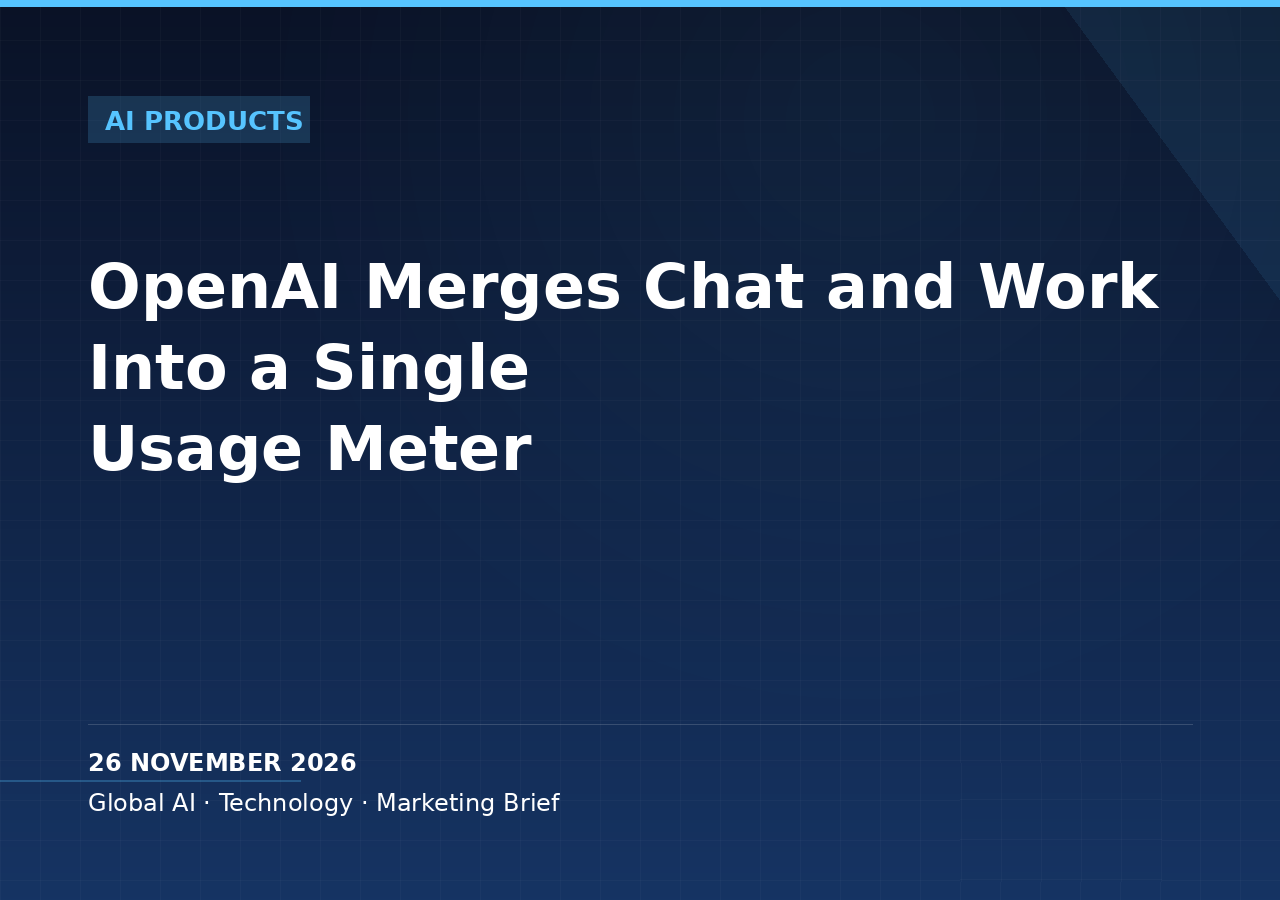
OpenAI has started pushing a combined Chat and Work experience to a small subset of Pro subscribers, unifying what had been two separate usage counters into one. Product lead Thibault Sottiaux confirmed the change on X. The plan is a wider rollout in December.
Two details soften the change. Conversations that use the Instant model do not count against the meter, and once the allowance is exhausted, users can keep going. OpenAI says most people will not trigger resets more often than before, while acknowledging that a minority of the heaviest users will reach the ceiling sooner.
That last sentence is the story. When a vendor merges two meters into one, it is not simplifying a settings page. It is repricing two behaviours against each other — lightweight conversation against long-running agentic work — and deciding which one subsidises the other.
Why the meter is the product
Chat and Codex carry very different consumption profiles. A conversation is bursty and cheap. An agentic task that plans, calls tools, verifies intermediate results and iterates can run for minutes and consume orders of magnitude more tokens. Keeping them on separate ledgers let OpenAI price them separately without forcing a comparison. A single meter forces one.
The practical consequence for teams is budgeting. Anyone running Codex for code review, data pulls or document generation alongside ordinary ChatGPT use now has one number to watch instead of two, and the ceiling arrives faster during heavy build weeks. For individuals, the free-tier concession on Instant conversations is the relief valve: short questions stay effectively unmetered, and deep work absorbs the budget.
There is a second reading, less about billing and more about product shape. Merging the surfaces implies OpenAI expects the same session to move between asking and doing — describe a problem, then let the agent act on it — rather than expecting users to pick a mode before they start. That is a bet on agentic workflows becoming the default rather than a separate app.
The operational risk
OpenAI has had a rough week on exactly this surface. On 24 and 25 November it emailed users acknowledging a miscalculation of Codex usage between 16 and 22 November and issued compensation credits valid to 31 December. A separate error affected billing and invoice retrieval for Team, Business and Pro plans, with the status page reporting recovery.
That matters more than it might appear. If the allowance is the unit customers plan around, then miscounting it is not a billing glitch — it is a budgeting failure on the customer’s side, arriving without warning. A merged meter concentrates that exposure into a single number, which makes accuracy a product requirement rather than an accounting detail.