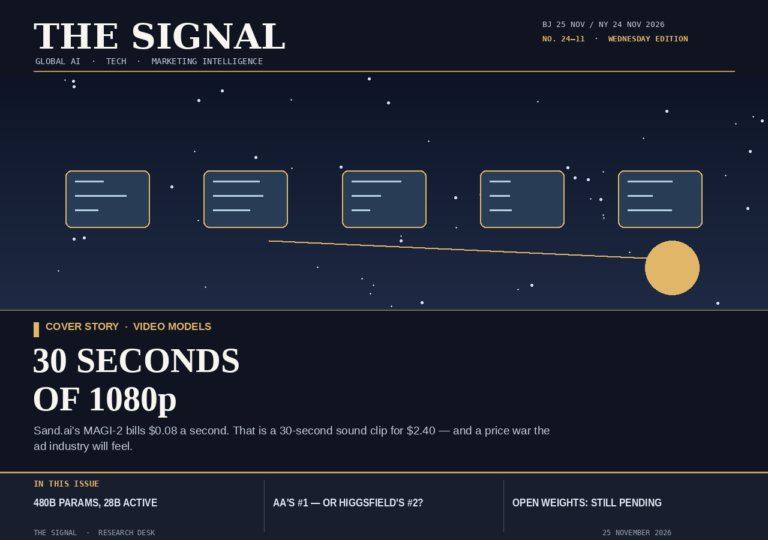
Sand.ai released MAGI-2, a 480-billion-parameter video model that generates up to 30 seconds of 1080p video with synchronized sound in a single pass, priced at $0.08 per second — meaning a 30-second clip costs about $2.40. Set against Seedance 2.5 at roughly $0.569 per second (a 30-second clip around $17), MAGI-2 lands at about one-seventh the price, not the one-tenth that some Chinese summaries rounded to.
The model is a mixture-of-experts design: 480B total, about 28B active per step, pre-trained on roughly 4 trillion tokens (about triple the August preview’s data). It accepts a text prompt plus up to 20 references (10 images, 5 video, 5 audio), supports six aspect ratios, timeline cut points, editing of existing footage, and writes dialogue, lip sync, sound effects and music in the same pass. Prompts can run to 15,000 characters (the Chinese release says 20,000; the API documentation and independent reviews cite 15,000).
The ranking deserves careful wording. Sand.ai’s own release claims the No. 1 spot on the Artificial Analysis video leaderboard. Independent sources, including i10x.ai and Higgsfield’s own board, show MAGI-2 entering the Higgsfield Video Arena in second place (score 1146, 60.5% win rate) — still behind Seedance. There is also a stated parameter discrepancy (480B vs. a platform-listed 400B) and the promise of open weights remains “coming soon” with no date, license, or download path.
The real story isn’t which benchmark line to quote. It’s that long, sound-synced, multi-shot 1080p video just crossed a price point where a hundred ad variants a month cost $240 instead of $1,700 — before rerolls, and rerolls are where the bill actually grows. For anyone producing advertising, e-commerce or short-drama content, the unit economics of iteration have changed. The gap between “one polished hero video” and “a hundred tested variants” is no longer a budget question.