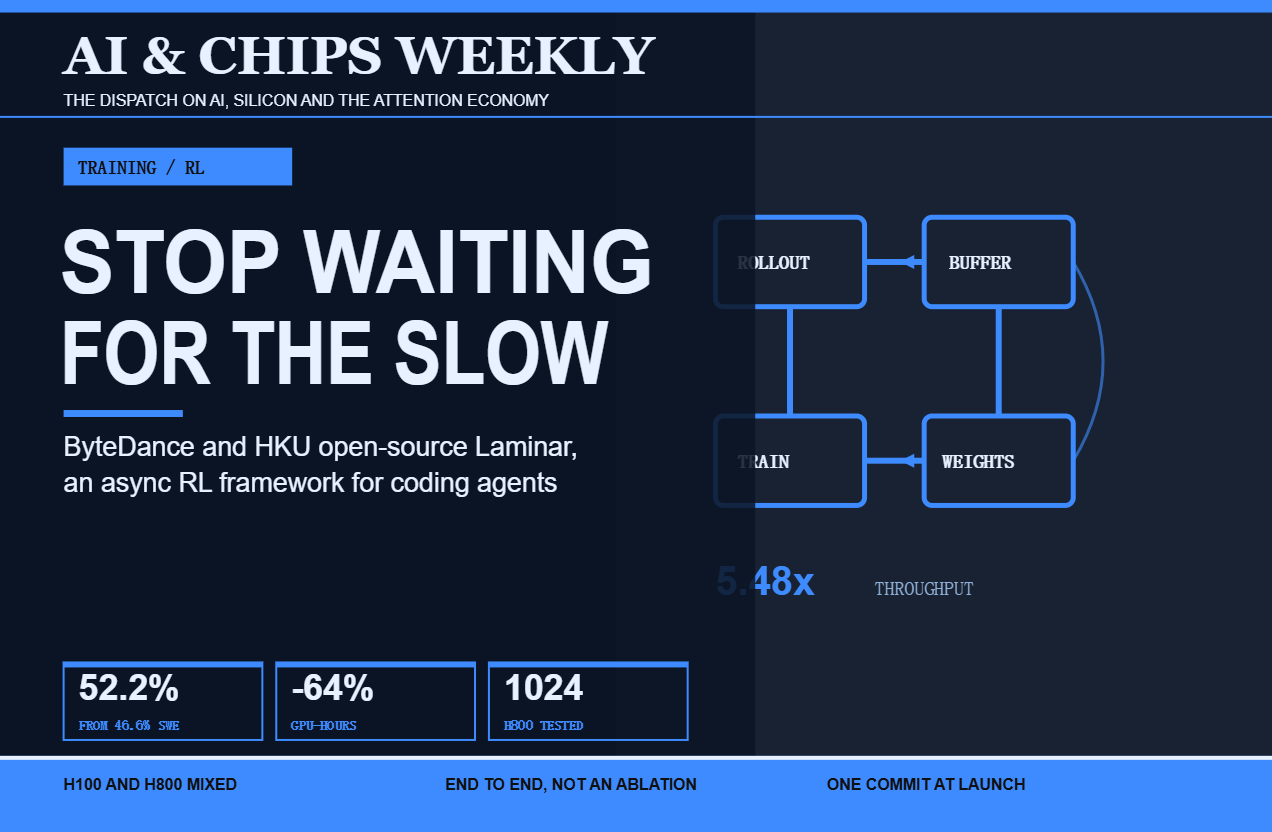
Researchers at ByteDance Seed and the University of Hong Kong open-sourced Laminar, an asynchronous reinforcement learning post-training framework aimed squarely at coding agents. The idea is to stop making every trajectory and every GPU wait for the slowest one, which is where most of the wasted time goes when rollouts are long and uneven. Laminar splits rollout, buffering, training and weight transfer into independent loops, builds on verl and Uni-Agent, and ships under Apache-2.0. Training Qwen3-Coder-30B-A3B-Instruct, it lifted SWE-bench Verified from 46.6 to a peak of 52.2 percent using about 33 percent fewer samples and 64 percent fewer GPU-hours than the baseline peak, with up to 5.48 times the throughput, tested on clusters up to 1024 H800 GPUs. The honest caveats travel with the numbers: the headline comparison mixes H100 and H800 hardware and different batch sizes, so it is an end-to-end result, not a clean ablation of the async design. The repo had a single commit at launch, lists only vLLM for inference, and per-step async checkpointing is still unfinished. Useful to try, not yet a settled benchmark.