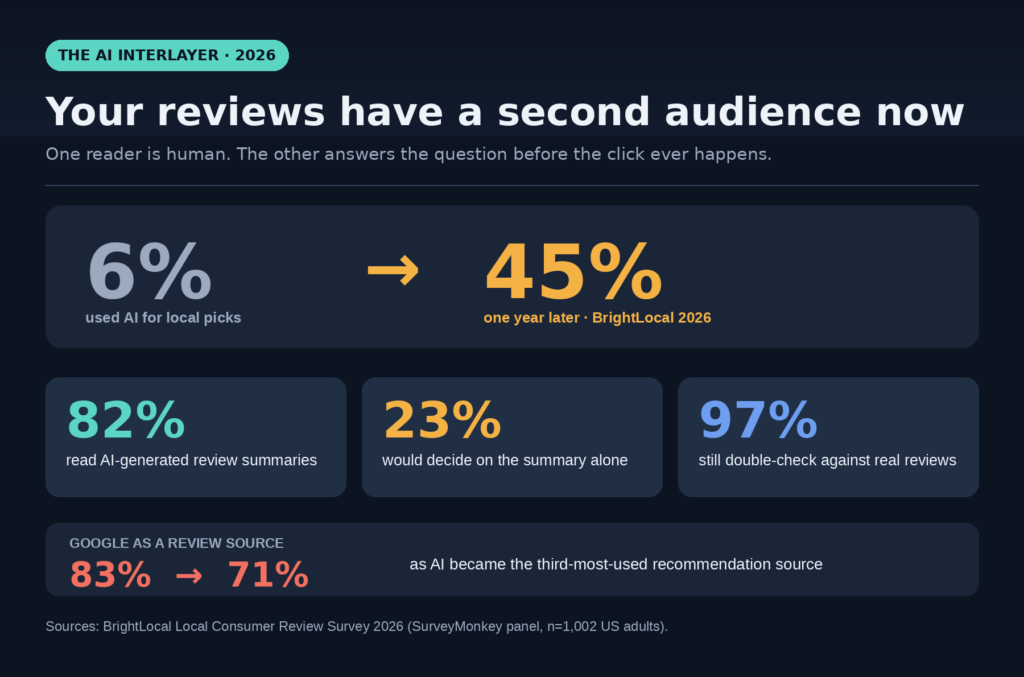
We used to write reviews for one audience: the person hovering over a buy button, trying to decide whether to trust us. That hasn’t stopped. But in the space of a single year, a second reader showed up and sat down in front of the same corpus — and this one answers the question before the human ever clicks. BrightLocal’s 2026 Local Consumer Review Survey, a representative SurveyMonkey panel of 1,002 US adults, found that the share of consumers using AI tools for local business recommendations jumped from 6% to 45% in twelve months. AI became the third-most-used source of business suggestions, behind only Google and Facebook, and outpaced Yelp and Tripadvisor.
That is not a forecast about some distant 2030. It is where discovery already sits. And it changes what a review is. A star rating is no longer just social proof for a shopper; it is training data for the summary that precedes the click. So let’s talk about what happens when your reviews have to satisfy two masters at once — and why the tactics that pleased one of them for twenty years are now quietly failing the other.
The AI interlayer: from review page to answer layer
Here is the mental model worth keeping. An AI assistant doesn’t show a customer your review page. It reads a compressed paraphrase of it. BrightLocal found 82% of consumers read AI-generated review summaries, 23% would happily make a decision on the summary alone, and 59% use it as a starting point and then verify. Google’s share as a review source fell from 83% to 71% in the same survey. Conveniently, 97% of AI users still double-check recommendations against real reviews — so the machine is a gateway, not a verdict. But a gateway decides which door you get to stand behind.
Think of your review corpus as a small, messy dataset that a model is asked to summarise faithfully. Repeated themes — “fast response,” “no hidden fees,” “showed up on time” — get extracted. Isolated one-off complaints get smoothed. Recency matters because a model weighting recent sentiment will describe you as you are now, not as you were three years ago. This is why the same corpus has to be legible to a machine that never scrolls.
The rising human bar: 4.5 stars is the new floor
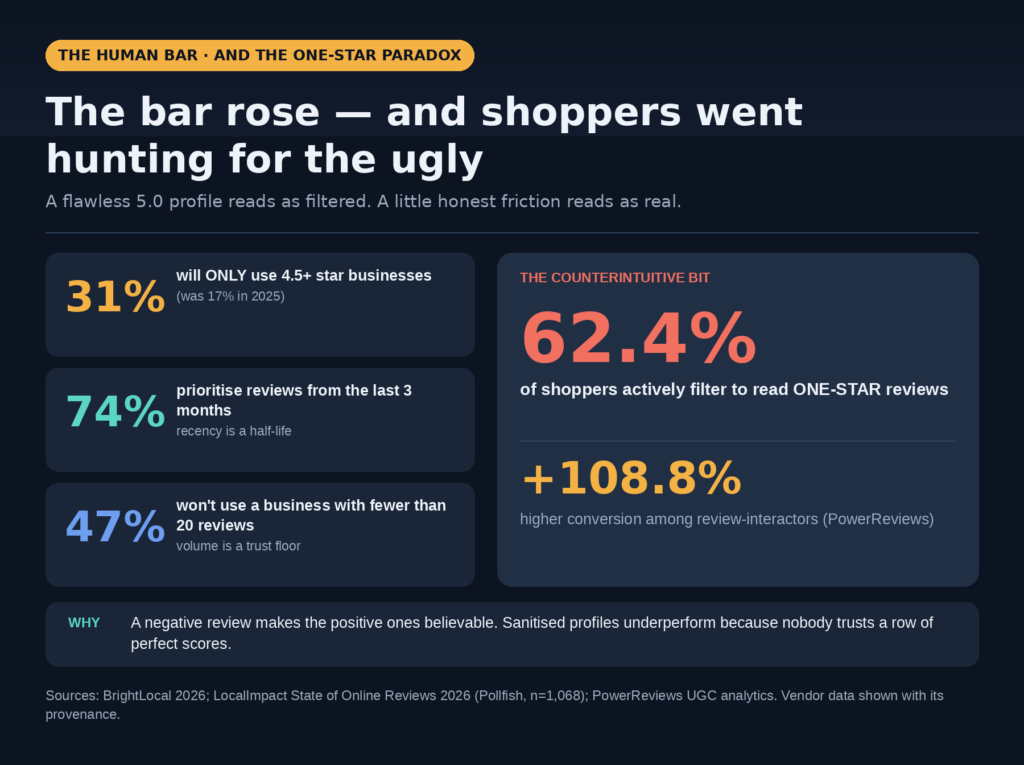
While the machines arrived, the humans got pickier. And they got pickier fast. In BrightLocal’s 2026 data, 31% of consumers will only use businesses rated 4.5 stars or higher — nearly double the 17% who said that in 2025. Some 68% require at least four stars. A separate 2026 survey from LocalImpact, fielded through Pollfish with 1,068 US adults, puts the 4.5-star-only figure at 27% and finds more than 78% won’t consider a business below four stars. Two panels, two slightly different denominators, same direction: the acceptable floor has moved up.
Notice what this does to a 4.2. It doesn’t read as “mostly good” anymore. It reads as filtered out before anyone opens a single review. We spent a decade telling businesses that a few bad reviews were fine; the 2026 thresholds say the average is now a hard gate. That’s a different problem, and it’s one you can’t charm your way past with a friendly reply to a one-star.
Recency has a half-life, and volume has a floor
Then there’s the clock. BrightLocal found 74% of consumers prioritise reviews from the last three months, and the share wanting reviews from the last two weeks rose to 32% from 20% the year before. A five-star rating assembled in 2021 and left to sit is, functionally, decaying. Reputation behaves less like a monument and more like a perishable — fresh stock on a shelf that quietly expires.
Volume is the other gate: 47% won’t use a business with fewer than 20 reviews at all, and the average respondent consults six different review sites before deciding. That six-site habit is worth sitting with. Your GBP profile is one tab. A vertical review site is another. A video, a marketplace, a social platform — the customer is triangulating. A corpus that is thin, stale, or concentrated on a single platform doesn’t just look smaller. It looks less true.
The one-star paradox, or why a perfect 5.0 smells fake
Now the fun part, and the one that reliably surprises people. PowerReviews’ UGC analytics found 62.4% of shoppers who interact with a star-filter specifically filter to read one-star content — and those review-interactors convert at a rate 108.8% higher than the average page visitor. Read that again. The person deliberately reading your worst review is among the most likely to buy.
Why? Because a negative review makes the positive ones believable. A wall of flawless scores reads as curated, scrubbed, managed — the same instinct that makes us squint at a hotel with 4,000 reviews and not a single complaint. Shoppers aren’t looking for a reason to run; they’re stress-testing whether the good reviews were written by humans with actual experiences. A thoughtful answer to a bad review is worth more than ten more five-stars. So don’t sanitise. Document.
Volume and velocity are a compounding asset
If recency is a half-life and volume is a floor, then review generation is not a campaign. It’s a meter that has to keep running. The good news is the raw material is already there: in LocalImpact’s 2026 survey, 72% of consumers have left a review, 65% say a great experience is their main motivation, and more than a third of reviews are written on the day of purchase. Most arrive within a week.
So the ask has a natural window. Post-purchase email, SMS, a QR code at the counter, a tap in the app — the mechanics are boring, and that’s the point. Time the request to the moment the experience is still warm, ask everyone the same way, and let the rating land where it lands. What you’re building isn’t a score. It’s a steady stream of dated, specific, human sentences — exactly the material both a wary shopper and a summarising model can work with.
Response as a causal lever — with an honest asterisk
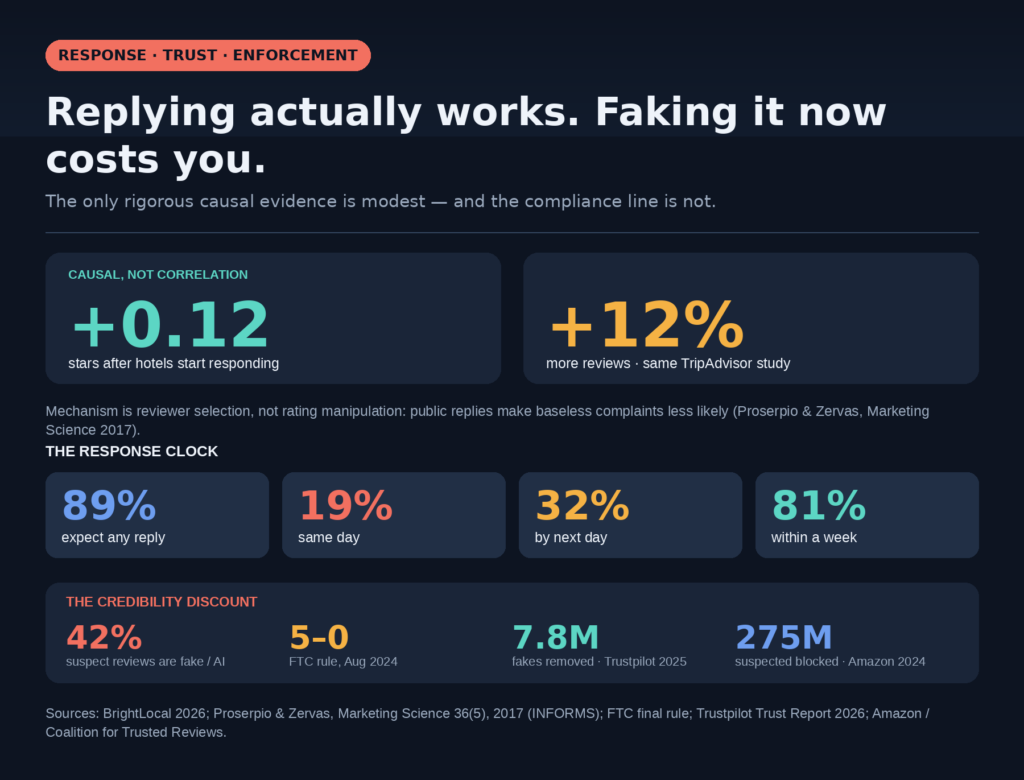
Does replying actually move the rating, or do we just like to think it does? The cleanest answer comes from a peer-reviewed study in Marketing Science (Proserpio and Zervas, 2017, INFORMS), which exploited a neat natural experiment: hotels respond constantly on Tripadvisor and almost never on Expedia. Using difference-in-differences on tens of thousands of hotel reviews, the authors found that when hotels begin responding they receive about 12% more reviews and their ratings rise by an average of 0.12 stars.
The asterisk matters as much as the number. The gain did not come from hotels secretly renovating. It came from reviewer selection: with a manager visibly reading, dissatisfied guests became less likely to fire off short, indefensible complaints. Fewer negative reviews — but longer, more substantive ones. So respond because it signals that someone is home, and because the feedback you get back is better. Don’t respond because you expect a magic half-star. And be careful with the older Womply 2019 figure you’ll still see quoted (replying to a quarter of reviews linked to +35% revenue for 200K US small businesses): that was a correlation, from seven years ago, and it is not causal evidence. The causal claim in this piece rests on the Tripadvisor study alone.
The response clock: same-day is impressive, a week is the edge
Expectations around when you reply have tightened into a ladder. BrightLocal’s 2026 survey finds 89% of consumers expect owners to respond at all, and 42% are unlikely to use a business that ignores its reviews entirely. Then the timing: 19% expect a same-day reply (up from 6% in 2025), 32% want one by the next day (up from 18%), and 81% expect to hear back within a week. The patient customer is basically gone. LocalImpact’s panel agrees on the shape: 70% expect a reply within one to three days, and 78% say a thoughtful response to a negative review makes them more likely to trust a business.
“Thoughtful” is doing heavy lifting there. BrightLocal also found generic, templated replies put roughly half of consumers off — which is the quiet argument against letting a bot answer everything. Use automation for triage, routing, and the easy positive acknowledgements; keep a human in the loop for anything angry, specific, or recoverable. A reply is a sales asset future customers read. Write it like one.
The credibility discount: 42% arrive braced for a con
Here’s the uncomfortable backdrop. Alchemer’s 2026 Retail Report — a survey of 1,002 US shoppers — found 42% suspect the reviews they read are fake or AI-generated, 40.6% suspect they’re paid or incentivised, and 32.5% believe brands manipulate them. And yet reviews remain the single most-trusted input at the moment of purchase, at 36.1%, ahead of friends and family (31.2%) and AI recommendations (15.4%). We trust reviews as a category while distrusting any given review. That’s a strange, brittle kind of trust.
Verified-purchase badges, first-party collection with a visible audit trail, and a dated, photographed, specific review all buy back a little of that discount. The same Alchemer data found Google Reviews the most influential single source at 51.6%, with gen-AI summaries already outranking YouTube product videos and Trustpilot/Yelp as an influence (13.6% vs 12.1% vs 11.9%). Two things are true at once: the corpus is the most trusted asset you have, and its weakest links are the ones a machine will happily average into a confident-sounding sentence.
The generation engine — and the bright legal line
So how do you legitimately feed the meter? Ask everyone, equally, right after the experience, through email, SMS, and QR flows that take seconds. Keep the language neutral: “tell us about your experience,” never “tell us how much you loved it.” And know exactly where the line is now drawn.
The FTC’s final rule on consumer reviews and testimonials was announced in August 2024, approved 5–0, and took effect on 21 October 2024. It prohibits buying or selling fake reviews (including AI-generated ones), paying for reviews of a particular sentiment, insider reviews without disclosure, review suppression, and fake social-media influence indicators. Civil penalties reached $51,744 per violation. Crucially, the rule does not ban incentives outright — a neutral “write a review and save 10% next time” is fine — but conditioning a reward on a positive sentiment is not. BrightLocal found 11% of consumers had been offered an incentive for a positive review, which means this isn’t a hypothetical edge case; it’s happening in the wild.
In short: no gating (only inviting happy customers), no sentiment-conditioned rewards, no scrubbing. Those three aren’t pedantic compliance footnotes. In a market where 42% already suspect manipulation, a clean process is a competitive moat.
The enforcement landscape: compliance as an advantage
The platforms are fighting the same war at industrial scale, and the numbers are a useful sanity check on how polluted the pool is. Amazon’s proactive controls blocked more than 275 million suspected fake reviews in 2024, according to the company and the Coalition for Trusted Reviews. Tripadvisor stopped 2.7 million fake reviews that year. Trustpilot’s Trust Report 2026 says it identified and removed 7.8 million fake reviews in 2025 — 11% of all submissions — with 91% caught by automated systems and the rest by a team of over 200 specialists. On the regulatory side, a European Commission sweep of 223 websites found at least 55% potentially non-compliant with EU consumer rules on reviews — that sweep dates to 2022, but the Omnibus-era obligation it enforced is now in force, so treat it as background, not breaking news.
If you’re a brand reading that, the takeaway isn’t fear. It’s asymmetry. The fakes are being removed upstream, the law now prices the ones that slip through, and your own first-party corpus — genuinely collected, dated, responded to — is the asset that gets more valuable as the surrounding pool gets noisier. Honesty compounds.
AI response tools: efficiency without the uncanny valley
Generative tools will happily draft replies to every review in your queue in about four seconds. Use them, with a leash. The failure mode isn’t that the tool writes badly; it’s that it writes identically, and BrightLocal’s finding that templated replies repel about half of consumers is essentially a detection problem. Set the tool to triage and suggest, give it your brand’s phrasing and the specific detail from the review, and require a human to approve anything negative, emotional, or legally sensitive.
A useful rule of thumb: if a reply could be pasted under any business in your category, it’s the wrong reply. Both audiences can tell — the human because it feels canned, the machine because a hundred near-identical phrases collapse into one bland theme in a summary. Specificity is the one thing automation keeps trying to sand off.
Reviews become a GEO pipeline
Now connect the two halves. Review signals are estimated by industry practitioners to carry meaningful weight in AI-search visibility — commonly cited around 16%, though that is an industry estimate, not an official published weighting, and you should treat it as directional rather than a dial you can set. What we can say firmly: the review corpus feeds the answer. Bazaarvoice and related industry research report that a majority of shoppers trust AI shopping assistance more when it surfaces verified-buyer reviews and photos.
So the practical GEO checklist looks a lot like the reputation checklist. Structured review markup where the platform allows it. Consistent entity data — same name, address, and category everywhere, so a model doesn’t merge you with a similarly named competitor. Regular audits of how AI assistants actually describe your brand: ask the major assistants the obvious questions, read the summary, and check whether it is faithful to your real reviews. If it says you’re “known for slow responses” because three stale complaints from 2022 dominate, that’s not a ranking problem. It’s a corpus problem. Fix the corpus.
The same mechanics rhyme in China, where Dianping ratings and Xiaohongshu comment threads play the role of the dual-audience corpus and negative-review public response is a discipline of its own — but that is a separate playbook, built on different platforms. The underlying logic travels: fresh, voluminous, answered-to feedback beats a polished score.
Measure the corpus, not just the score
If you only watch your average star rating, you’re watching the dashboard after the decision has been made. Track four things instead. Rating trajectory over rolling quarters, not an all-time average. Response rate and median response time against the 19%/32%/81% ladder. Review velocity — how many dated, verified reviews arrive per week. And sentiment themes from a simple NLP pass, so you can see whether “parking,” “billing,” or “wait time” is the phrase a model will extract next month.
Then add one ritual that almost nobody does: an AI-summary audit of your own brand. Monthly, ask several assistants the questions a customer would ask, save the answers, and compare them with what your reviews actually say. You’re not optimising for a ranking here. You’re checking fidelity — that the answer being handed to a stranger is a fair compression of the truth your customers wrote.
So what do you actually do on Monday?
Start with the least glamorous, highest-return habit: reply. To all of them, within 24 hours, with a sentence that could only have been written about that review. Then fix the ask — one neutral, automated, post-purchase request to every customer, no gating, no carrot for positivity. Then refresh: a steady weekly trickle of dated reviews beats a burst once a year. Then go look in the mirror the machines hold up, and correct the description if it’s wrong.
The reframe is simple and a little unnerving. Reputation management used to be the art of looking good to a person. It’s now dual-audience engineering: a fresh, voluminous, responded-to corpus that a human trusts and a machine can summarise faithfully. Same star rating. Two readers. And one of them has already answered before the other one clicks.