Twice already the industry sold you a voice revolution. Around 2016, smart speakers were going to retire the search box. Around 2019, an analyst forecast — half of all searches would be voice by 2020 — got photocopied into every SEO pitch deck. Neither happened. Voice settled into a habit, not a takeover, and “voice SEO” became the punchline of conference hallway jokes.
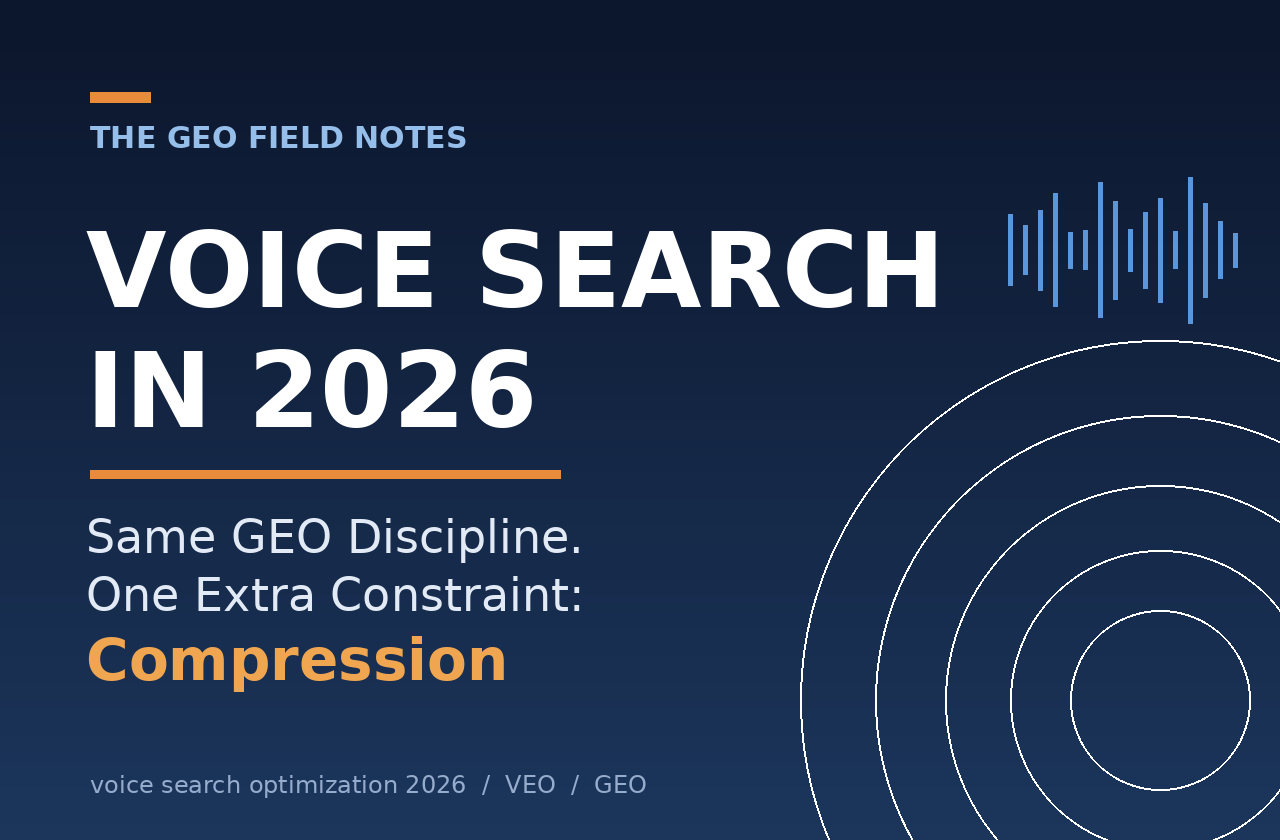
In 2026 it deserves another look, but not for the reason those decks promised. The microphone did not change. The brain behind it did. Every major assistant now runs on the same large language models that power text AI search, which means the GEO work you are already doing carries over to spoken answers almost for free. There is one catch, and it is genuinely new: a spoken answer has a ceiling. Your content has to compress.
So here is the honest framing. Voice in 2026 is not a new discipline. It is the same GEO discipline you should already practice, plus one extra constraint. Let us walk through the brain transplants, the numbers that do not add up, and what that constraint actually asks of your content.
The Three Brain Transplants
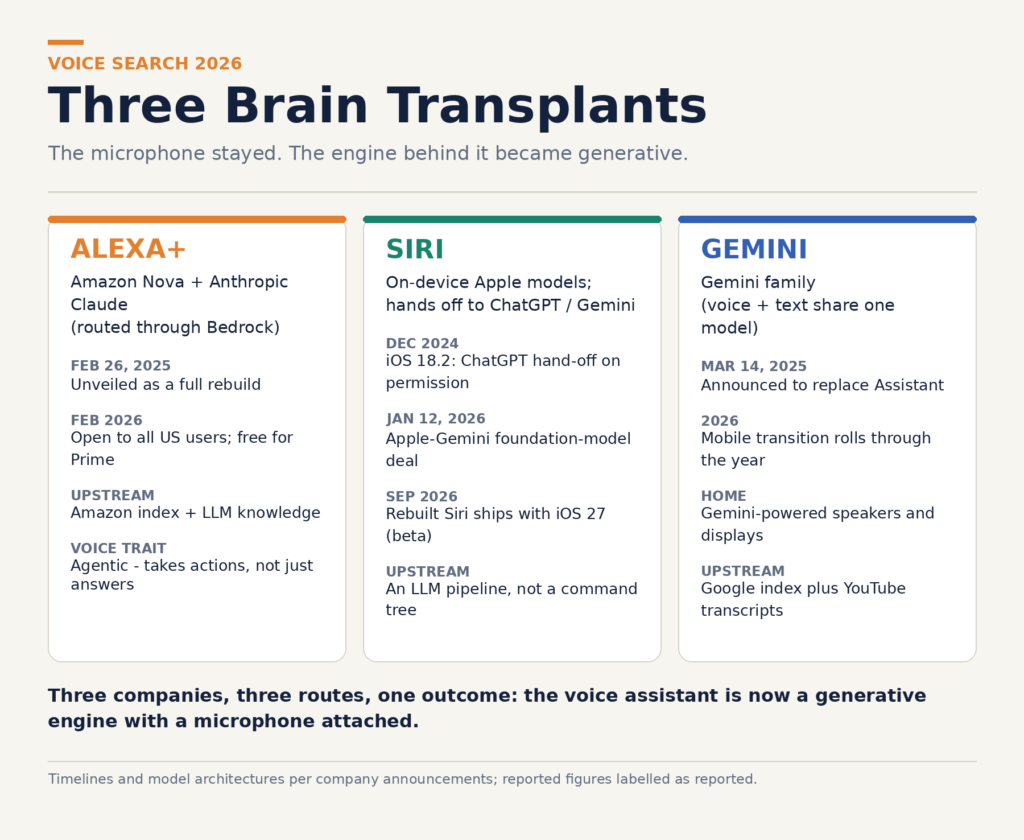
Start with Amazon. On February 26, 2025, the company unveiled Alexa+, not a feature update but a rebuild. Anthropic confirmed the same day that its Claude models help power the new assistant through Amazon Bedrock, sitting alongside Amazon’s own Nova models in a routing system that picks the best model for each request. Amazon’s devices VP called the architecture model-agnostic — an important detail, because the shorthand “Alexa+ runs on Claude” overstates it. The old Alexa matched your words to pre-written commands. Alexa+ generates answers, holds multi-turn conversations, and books things on your behalf.
The distribution move mattered more than the demo. After a long early-access period, Amazon opened Alexa+ to every US customer in February 2026, free for Prime members and about twenty dollars a month for everyone else. This was not an opt-in beta for enthusiasts. It was a brain transplant for an installed base measured in hundreds of millions of devices.
Google took a messier route to the same destination. On March 14, 2025, it announced that Gemini would replace Google Assistant on most mobile devices, with the transition rolling through 2026 and a Gemini-powered experience arriving on speakers, displays and TVs. The old assistant did not go quietly — rollout dates slipped — but the direction was never in doubt. Talking to Google Search is now a conversation with the same model that writes your AI Overviews.
Apple took the strangest path. Since iOS 18.2 in December 2024, Siri has offered to hand a question it cannot answer to ChatGPT, but only after asking your permission, with your IP address obscured. Then, on January 12, 2026, Apple and Google announced a multi-year collaboration under which the next generation of Apple Foundation Models will be based on Gemini models and cloud technology. Bloomberg reported a price near one billion dollars a year for a custom model; neither company confirmed it, so treat that as reported, not fact. The rebuilt assistant finally shipped with iOS 27 in September 2026 as an English-language beta on newer iPhones, missing its originally expected spring release.
Three companies, three routes, one outcome: the voice assistant is now a generative engine with a microphone attached.
The Siri Hand-Off Chain
Here is the detail most coverage skips. When Siri hands a hard question to ChatGPT, your content is not competing in a secret Siri index. It is competing in ChatGPT’s retrieval pipeline — the same one you are already trying to influence for text answers. When Siri handles a query on-device or through Gemini, the retrieval upstream is still an LLM system, not a command tree from 2015.
That kills the case for a standalone voice strategy. If your pages win citations in ChatGPT and Gemini, you are most of the way to winning the spoken answer. Voice does not need its own workstream. It needs yours, plus the compression constraint below.
The Old Model’s Obituary — and the Survivors
From roughly 2016 to 2022, voice answers worked like this: the assistant found a featured snippet and read it aloud. A much-cited 2018 analysis of 10,000 Google Home results found 40.7% of voice answers came straight from snippets, averaging about 29 words. That was real once. It is a historical baseline now, not a description of 2026.
Today’s assistants retrieve, synthesize and generate. They may cite several sources, one, or none. But the honest picture is layered. Simple lookup queries still ride the old rails: ask for business hours and you get an answer driven by structured local data; ask for a unit conversion and a deterministic system answers it; ask for a definition and a snippet or knowledge panel still does the heavy lifting. Research-style questions go through the generative pipeline. The featured-snippet game is not dead, but it is no longer the main event. Any 2026 article quoting that 40.7% figure as current is handing you a 2018 map of a 2026 city.
The Adoption Numbers Do Not Add Up
Now the numbers fight. You have seen the headlines: 27% of searches are voice. Thirty percent. Half. Where do these come from?
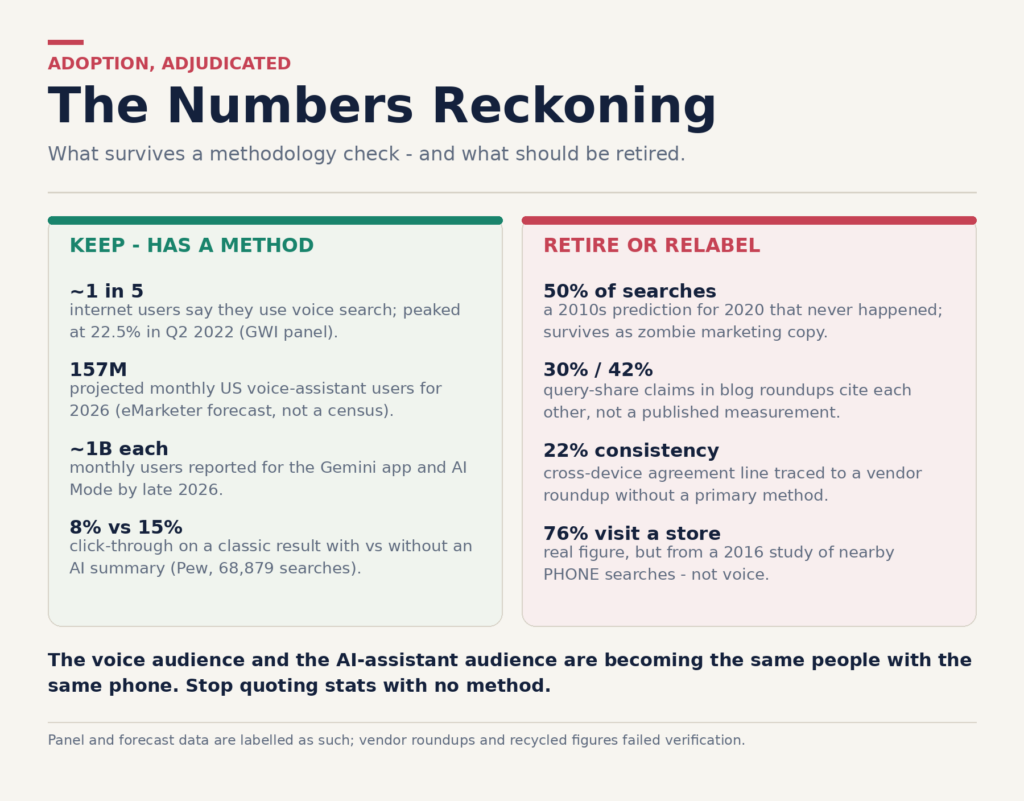
Trace them and most dissolve. The “50% by 2020” line descends from a late-2010s prediction that never materialized and survives as zombie marketing copy. The 30% and 42% query-share claims circulating in 2026 blog roundups cite each other, not a published measurement. No major search engine publishes an independent voice-query share. The famous “76% visit a business within 24 hours” statistic is real, but it comes from a 2016 Google-commissioned study of people searching nearby on their phones — mobile local search, not voice. And the “22% cross-device consistency” line traces to a vendor roundup without a primary method. We left all of them out of this article’s argument; you should leave them out of your decks too.
What survives a methodology check? Panel data published through DataReportal puts voice search usage near one in five internet users worldwide, peaking at 22.5% in the second quarter of 2022 and plateauing since — a mature habit, not a moonshot. eMarketer projects roughly 157 million monthly voice-assistant users in the US for 2026, a forecast, not a census. Meanwhile the audience is merging with AI: by late 2026 Google reported roughly a billion monthly active users for both the Gemini app and AI Mode, with AI Overviews reaching more than two billion. The voice audience and the AI assistant audience are increasingly the same people holding the same phone.
A 2025 Pew Research Center study of 68,879 real searches by 900 US adults adds the sobering part: when an AI summary appeared, people clicked a traditional result 8% of the time, versus 15% without one. The answer absorbs the click. Voice, where there is often no screen at all, pushes that logic to its endpoint. Optimize to be the answer, because being the tenth blue link is worth less every quarter.
The One New Constraint: Compression
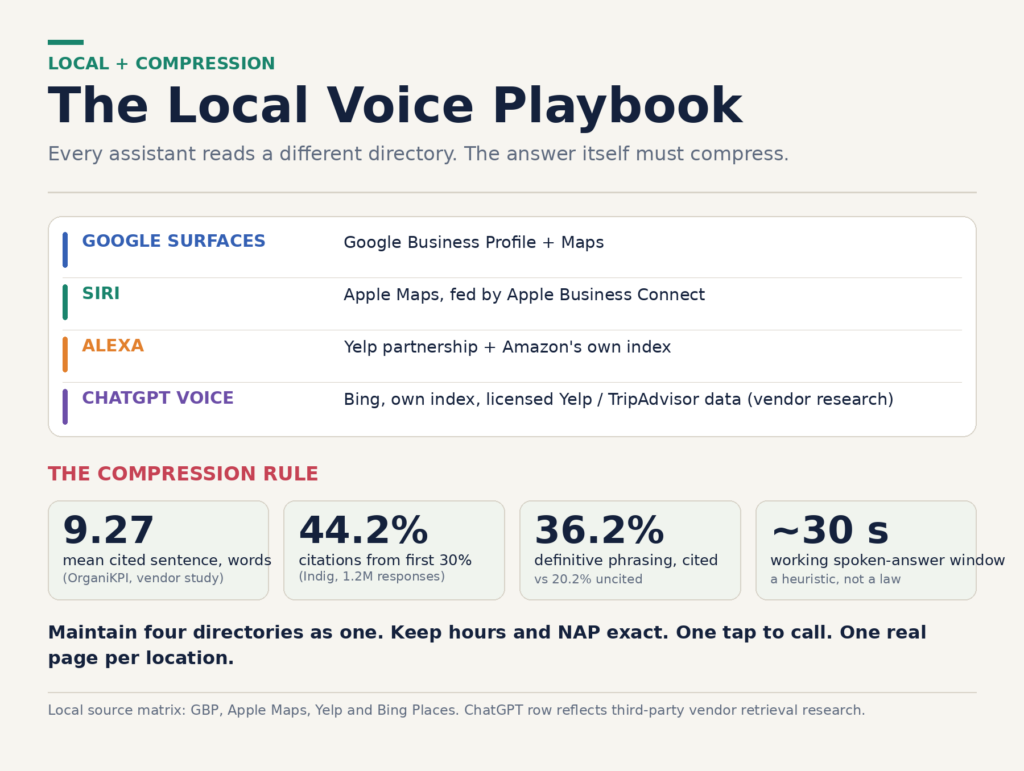
Here is what voice genuinely adds. A spoken answer has a ceiling. Practitioners often cite a rough window of 80 to 150 words — about 30 to 60 seconds of audio — though no standards body has published that range; treat it as a working heuristic, not a measured law. What is measured is the shape of the answer that survives extraction.
A May 2026 analysis by OrganiKPI, an SEO tooling vendor — vendor-produced research, not peer-reviewed, so directional — examined 153,425 AI citations and found the average cited sentence ran 9.27 words, with 74.9% of cited sentences in the first half of the source document. Independent consultant Kevin Indig’s analysis of 1.2 million ChatGPT responses, covering 18,012 verified citations and reported through Search Engine Land, found 44.2% of citations came from the first 30% of a page, and that definitive phrasing such as “X is Y” appeared in 36.2% of cited passages versus 20.2% of uncited ones. Two very different datasets, same animal: short, plain, front-loaded sentences get lifted.
Voice intensifies that pattern because the answer has to fit in a breathing window. Text AI answers can sprawl across paragraphs. Spoken answers cannot. Your content has to survive being compressed into one clean sentence, then elaborated for the humans who tap through.
The writing rule is easy to state and hard to sustain. Put a direct, self-contained answer immediately under every question-shaped heading. One idea per sentence. Numbers with units — a real price range or a real duration — not vague gestures like “mid four figures.” Then elaborate below. Journalists call it the inverted pyramid. The military calls it BLUF, bottom line up front. The retrieval systems, it turns out, call it lunch.
Short Sentences, Front-Loaded Evidence
One nuance worth keeping. Indig’s data shows that within a paragraph, 53% of citations came from the middle sentence, not the first. Front-loading does not mean stuffing your introduction with every claim and letting the rest of the page limp. It means each section opens with a genuine answer, then earns trust with a substantive middle and a clean close. Structure the page, not just the first paragraph.
The VEO Tech Stack, Quietly Demolished
If your voice checklist still says “add FAQ schema and speakable markup,” it is time for a demolition notice. Google retired FAQ rich results entirely on May 7, 2026 — the expandable question-and-answer boxes are gone for every site. HowTo rich results died in 2023. Speakable markup, the one genuinely designed for text-to-speech, remains a beta confined to English-language news content for US users on Google Assistant. It was never a ranking lever for typical business sites, and it is invisible to ChatGPT, Claude and Perplexity, which read your rendered text rather than your JSON-LD wish list.
That does not mean ripping out your schema. FAQPage remains valid markup that helps machines parse the structure of your answers, and harmless, unused structured data does not hurt you. Keep it if it is already there. Stop selling it as a voice shortcut. What actually carries weight now: LocalBusiness markup with accurate hours, question-shaped headings with self-contained answers, fast pages, and entity clarity that lets an assistant resolve who you are. The schema layer describes your content. The content itself wins the citation.
The Local Source Matrix
For local businesses, this is not abstract. Voice queries skew toward immediate intent — is it open, where is it, can someone fix this today — and each assistant consults a different address book. Google’s surfaces lean on your Business Profile and Maps data. Siri’s local answers come from Apple Maps, fed by Apple Business Connect. Alexa draws on its long-running Yelp partnership plus Amazon’s own index. ChatGPT is the messy one: third-party retrieval research suggests its local answers blend Bing, its own index, licensed Yelp and TripAdvisor data, and scraped map listings. Treat that row as vendor-produced research, not an official disclosure.
The practical translation is syndication, not optimization for one engine. Maintain four directories as if they were one: Google Business Profile, Apple Business Connect, Yelp, and Bing Places. Keep name, address and phone identical across all four. A 2025 field study by BrightLocal, a local SEO firm, searched twenty queries across ten industries in AI Mode, Gemini, Perplexity and ChatGPT; it found Yelp surfaced as a source in roughly a third of searches and that Google’s Business Profile remained the backbone for Google’s own models. That is a small, practitioner-run sample, but it is more useful than a recycled percentage with no method.
The Economics of “Open Now”
Hours are the quiet killer. “Open now” is a filter, and a wrong evening or weekend hour silently deletes you from the spoken answer before any ranking system gets involved. Reviews that name a specific service — not just “great job” — do double duty, feeding both ranking systems and the synthesizing model that writes the answer. One more reason local deserves attention: a 2026 BrightLocal survey of 1,002 US adults found 45% now use AI tools for local business recommendations, up from 6% a year earlier, while trust in Google reviews slipped. Discovery is fragmenting exactly as the assistants did.
One-Tap Call, One Page per Location
Voice users are usually in motion — driving, walking, cooking with a free hand. The handoff must be one tap. A click-to-call number that actually connects. A directions link that resolves. If you run several locations, each needs its own genuinely local page with real hours, real staff knowledge and real reviews. Template pages with the city name swapped perform badly when an assistant is synthesizing an answer, because there is nothing local in them to lift. Compression punishes filler hardest where the answer matters most.
There Is No Voice Search Console
Measurement is where voice keeps its humility. No platform gives you a voice-analytics dashboard, and analytics platforms cannot cleanly separate spoken queries from typed ones. So you measure by proxy and label it as proxy. Filter Search Console for question-shaped queries — how do I, what is the best, where can I — which over-index on voice. Track featured-snippet ownership for your lookup queries. Watch Business Profile calls, direction requests and site clicks. Then run the ritual that costs nothing but discipline: once a week, speak your twenty most valuable queries into an Android phone, an iPhone and a smart speaker, and log what each says and whom each names. That three-device log is the closest thing to a voice rank tracker that exists, and it will teach you more than any recycled statistic.
The B2B Verdict: Do Not Start a Voice Project
If you sell enterprise software, nobody is asking their kitchen speaker to shortlist CRM vendors. The honest priority order: local businesses first, consumer brands second — mostly entity clarity, so “order more of my brand” resolves to you — and B2B a distant third. But the B2B move is not to ignore voice. It is to notice that the atomic-answer, front-loaded structure that wins compression is the same structure that wins AI citations, featured snippets and AI Overviews. One discipline, many surfaces. Build the GEO workstream; collect voice as a dividend. Anyone selling you a separate voice retainer in 2026 is selling you a second coat of the same paint.
The Takeaway
Voice search did not die and did not conquer. It got absorbed. The assistants swapped snippet readers for generative brains, the audience merged with the AI-assistant audience, and the optimization target collapsed into one: be the clearest, shortest, most front-loaded answer in your niche, syndicated everywhere the machines look. The 2019 playbook asked you to write like people talk. The 2026 playbook asks you to write like an answer — because that is what gets extracted, compressed and read aloud in someone’s kitchen. Same voice. New brain. Same GEO discipline you should already be doing, plus one extra constraint: make it fit in thirty seconds.