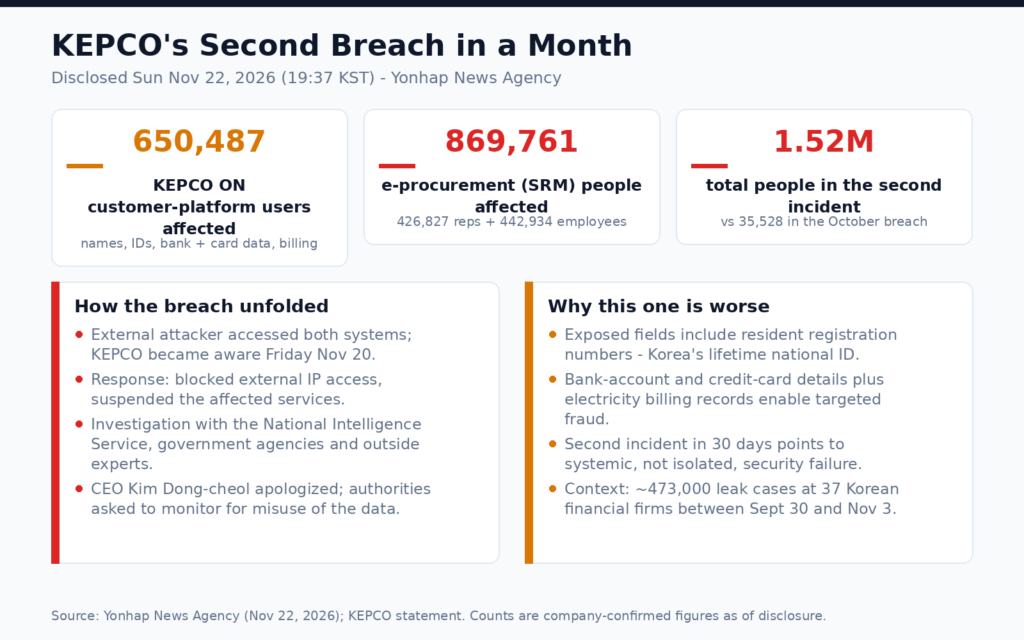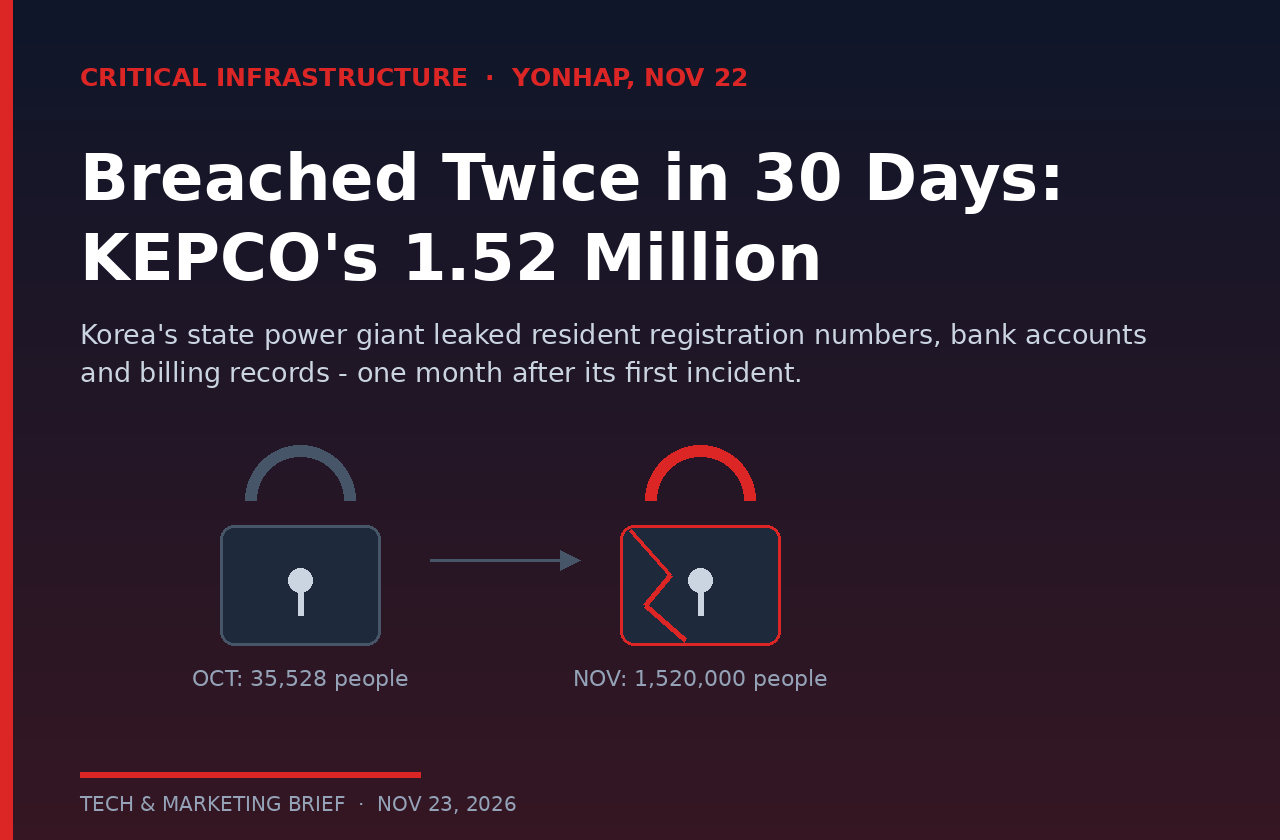
Korea Electric Power Corporation has spent November learning a security lesson twice. KEPCO — the state-controlled utility that transmits and distributes electricity across South Korea — confirmed that attackers accessed the company PCs of nine employees by exploiting a vulnerability in its remote-work VPN. The company detected abnormal traffic on November 9 and began blocking access. Then, on November 20, it disclosed something worse: the attackers had come back, and this time the haul included personal information on approximately 1.52 million residential electricity customers.
Read the two incidents carefully, because the sequence is the real story. In the September intrusion, attackers got into internal systems through the VPN flaw, and KEPCO said no customer data was exposed. The attackers apparently used that foothold — or the same pathway — to plant malware. When KEPCO blocked access on November 9, the malware remained. KEPCO ran its own investigation, found and removed malicious code, and considered the incident contained. On November 20, additional code turned up. Analysis linked it to the same campaign, and the newly identified payload had touched the personal details of about 1.52 million households — enough for the utility to notify customers directly.
The pattern is familiar to incident responders and alien to most executives: blocking access is not eradication. A VPN entry point can be closed in an afternoon; proving that every implant is gone from every endpoint takes forensic work, and “we found and deleted the malware” is a statement about what was found, not about what remained. KEPCO’s second November disclosure is, in effect, a public demonstration of that gap — first containment declared, then a second payload discovered eleven days later.
There is context that makes this harder to shrug off. KEPCO has been here before: a 2016 case involving a contractor’s compromised machine exposed data on roughly 22 million customers, one of the largest breaches in Korean corporate history. Korean reporting around the new incident notes that the 1.52 million affected residential users represent about 6% of the customer base — a fraction of 2016, but a repeat of the same institutional failure mode: attackers reaching customer data through the utility’s own access infrastructure rather than through a customer-facing website.
For enterprises, three practical points follow. First, treat VPN and remote-access appliances as crown-jewel attack surface: patch cycles measured in weeks are too slow when exploitation is measured in days. Second, define “contained” forensically — an incident is not closed when traffic is blocked but when endpoint sweeps, credential resets and persistence checks come back clean, ideally verified by a third party. Third, assume staged disclosure: KEPCO’s November 9 and November 20 statements show how initial scoping can miss payloads, so communication plans should anticipate revisions rather than promise finality.
KEPCO says it is strengthening monitoring and cooperating with authorities. The investigation continues, and the final count could move. What is already certain is the shape of the failure: two disclosures, one month, one access pathway — and 1.52 million households notified because “blocked” was mistaken for “gone.”