Every failed analytics rollout I’ve traced follows the same script. The demo dazzles. The contract gets signed. The dashboards get built — once. Six months later, the platform that was supposed to end guesswork is a browser tab nobody opens. The tool didn’t fail. Something upstream of the tool did.
Two Budget Lines, One Champion
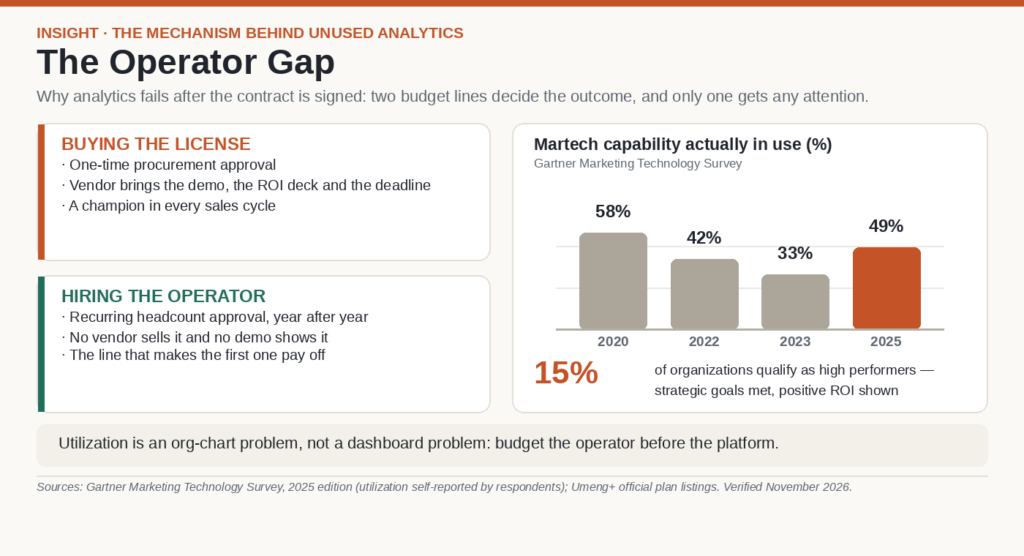
Here’s the mechanism. An analytics deployment needs two approvals: a license and an operator. The license is a one-time procurement decision, and it arrives with a full cheerleading squad — a vendor sales team, an ROI deck, a quarter-end discount deadline, and an internal champion who wants the win on their record. The operator is recurring headcount: an analyst or ops lead who defines metrics, guards event quality, and converts queries into decisions. That line has no vendor selling it, no demo showcasing it, and no deadline forcing it. It loses the budget fight almost every time.
Gartner’s 2025 Marketing Technology Survey puts the consequence in numbers: teams use just 49% of purchased martech capability — down from 58% in 2020, bottoming at 33% in 2023 — and only 15% of organizations qualify as high performers meeting strategic goals with positive ROI. Two honest caveats: utilization is self-estimated by respondents, and the sample skews large-enterprise. The direction still indict the buying process, not the software.
Why the Free Tier Proves the Point
Watch what happens when the license cost drops to zero. Umeng+ U-App’s Standard edition is permanently free — and its paid tiers start at a published CNY 12,000 per year. Cheap, transparent, easy to approve. Yet free tools go unused too, because removing the license line doesn’t create the operator line. The scarce input was never money for software. It was a named human whose job description includes looking at the data every week. That’s why “we’ll start free and upgrade later” fixes nothing if “later” never gets a hire attached to it.
The Fix Is a Sequencing Rule
Invert the purchase order. Name the operator before signing the license — one person, in writing, with the tool in their objectives. Define three metrics before instrumenting thirty events. Pilot one real funnel end-to-end before the enterprise contract; vendors confident in fit accept scoped proofs. And in the budget meeting, present the two lines as one indivisible package: a platform without an operator is not a cheaper option, it’s a 100% loss with extra steps.
The vendors know this, quietly. Both Sensors Data and GrowingIO now sell services layers precisely because they’ve watched capable software die of neglect. Until buyers price the operator as seriously as the license, the utilization number will keep telling the same story — and the story is about org charts, not dashboards.