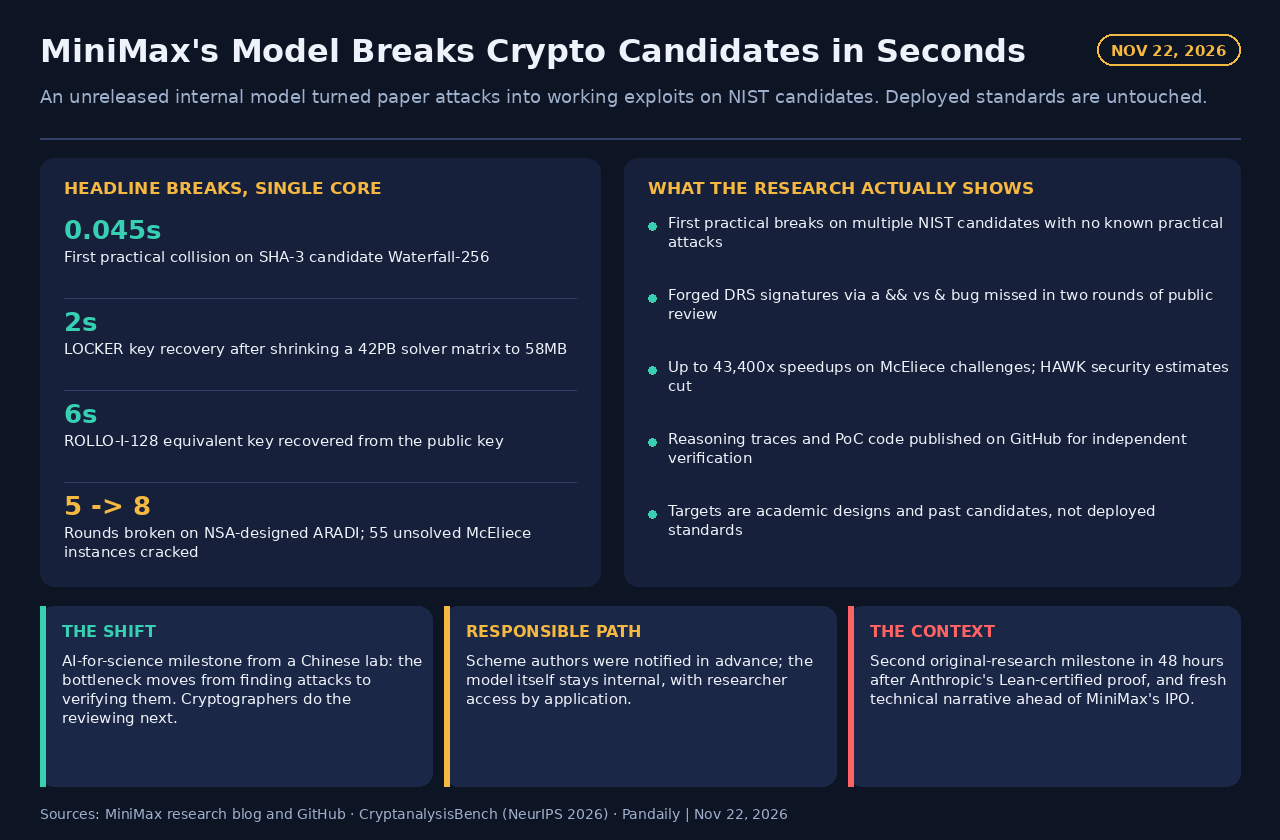
MiniMax says its unreleased internal model turned theoretical cryptanalysis into working attacks measured in seconds. In results published Sunday night, the model built the first practical collision on SHA-3 candidate Waterfall-256 in 0.045 seconds on a single core, broke full-round Blender-256 in under three seconds, and recovered keys from post-quantum candidates LOCKER and ROLLO-I after shrinking a 42-petabyte solver matrix to 58 megabytes. It forged signatures on the DRS scheme by exploiting a verification bug that survived two rounds of public review, extended practical key recovery on the NSA-designed ARADI cipher from five rounds to eight, and cracked 55 previously unsolved McEliece challenge instances at up to 43,400 times prior solver speeds. MiniMax stresses the targets are academic designs and past competition candidates, not deployed standards, and has released reasoning traces and proof-of-concept code for independent review. Cryptographers will now do the verifying.