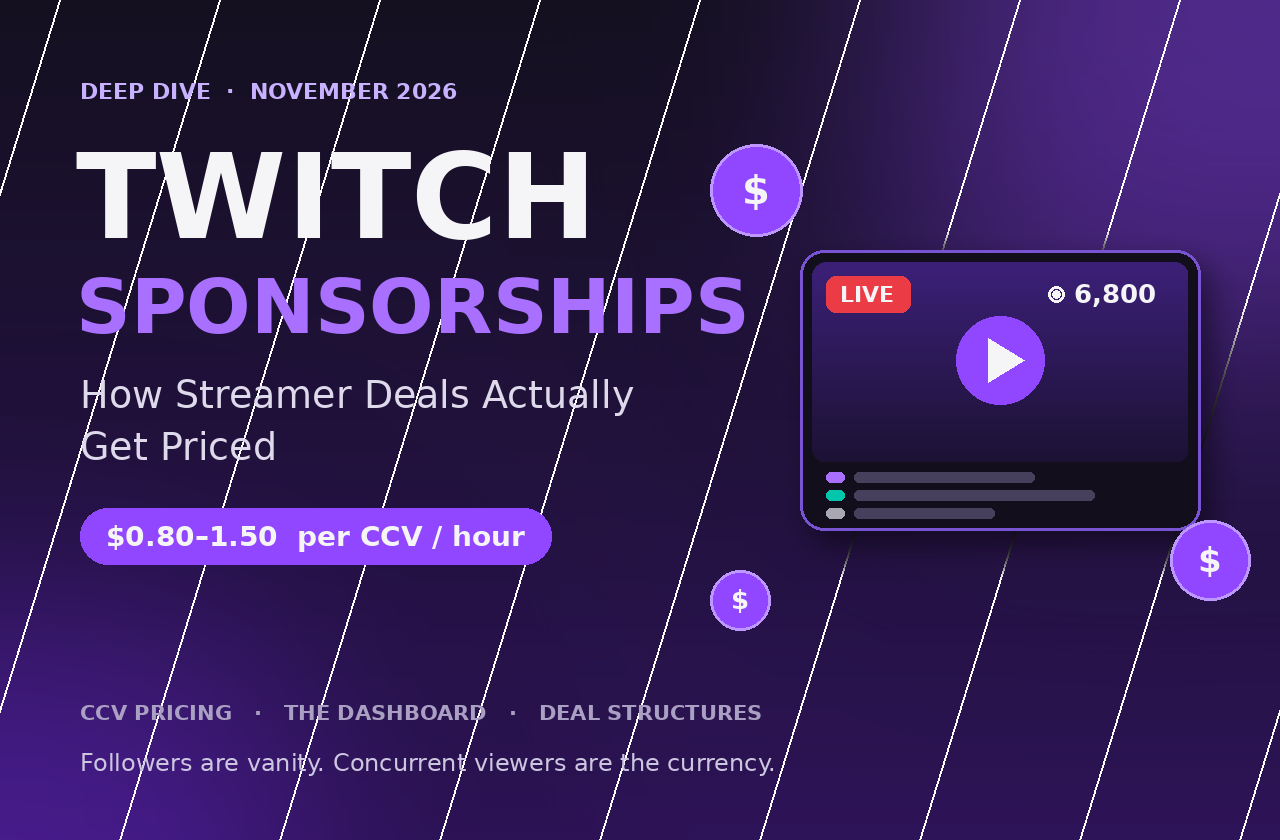
Twitch sponsorship pricing runs on concurrent viewers, not followers — and most brands still buy it backwards. Agency-reported cases show effective costs falling by roughly 4x when budgets shift from mega-follower channels to consistent mid-tier streamers. The market pays roughly $0.80–1.50 per concurrent viewer per sponsored hour, yet Twitch’s own Sponsorship Dashboard reportedly opened at about a tenth of that. Meanwhile, peer-reviewed research in Marketing Science finds the median sponsored game stream loses money for publishers — which means the pricing math alone won’t save you; structure, measurement and disclosure will. This deep dive walks through the real rate mechanics, the deal structures that share risk sensibly, and a renegotiation playbook for a softening 2026 market.
A $30,000 Lesson in Vanity Metrics
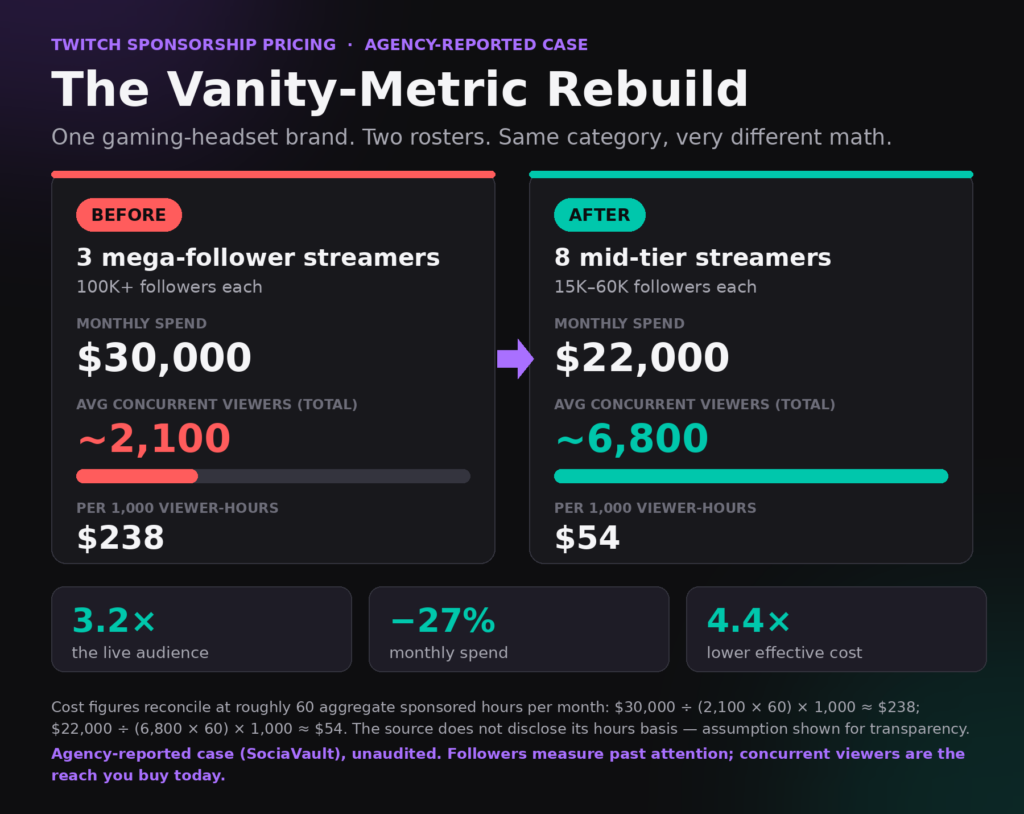
Here is a story that should make every media buyer uncomfortable. A gaming headset brand was paying $30,000 a month for three Twitch streamers, each with more than 100,000 followers. On paper, it looked like a premium roster. In reality, those three channels delivered a combined average of roughly 2,100 concurrent viewers. The brand was buying a number next to a name.
After a data-driven rebuild, the same brand signed eight streamers in the 15,000–60,000 follower range, cut spend to $22,000 a month, and lifted combined concurrent reach to roughly 6,800 viewers — more than triple the audience for about 27% less money. The agency behind the case (SociaVault, which sells Twitch data tooling) reports the effective CPM falling from $238 to $54.
One honest caveat before we go further: those CPM figures only reconcile if you assume roughly 60 aggregate sponsored hours per month — $30,000 ÷ (2,100 viewers × 60 hours) × 1,000 ≈ $238, and $22,000 ÷ (6,800 × 60) × 1,000 ≈ $54. The source doesn’t disclose its hours basis, so treat the dollars as cost per thousand viewer-hours under that assumption, not as audited media metrics. The direction of the result, though, survives any reasonable assumption: fewer vanity metrics, more actual eyeballs.
Followers are a receipt of past attention. Concurrent viewers — CCV in industry shorthand — are the attention you are actually buying today. Everything else in this article follows from that distinction.
Where Sponsorships Sit in the Revenue Stack
To price a deal, you need to know what you’re competing with. A Twitch channel monetizes through five streams, and creator-economy guides consistently rank them by payoff: sponsorships, subscriptions, bits, ad revenue, then donations and merch — for channels above roughly 200 concurrent viewers. Below that line, subscriptions usually dominate.
The platform-side economics are official and verifiable. A standard Tier 1 subscription costs $5.99 on US web since July 2024 (mobile pricing is higher), and most creators keep roughly half of net subscription revenue. Twitch’s Plus Program improves that split in two steps: 60/40 at 100 Plus Points and 70/30 at 300 points, earned through recurring paid subscriptions over three consecutive months and then locked for a year. Gifted and Prime subs still pay, but they don’t count toward qualification — Twitch is explicitly rewarding retention, not spectacle.
Ads are simpler: run at least three minutes of ads per hour and both Partners and Affiliates earn a 55% share of net ad revenue, a policy Twitch announced in June 2022 and has kept since. That’s real money at scale, but it’s passive money — and it rarely rivals a single well-priced brand integration.
How lopsided can creator income get? In October 2021, a Twitch data breach exposed actual platform payouts from August 2019 to October 2021. CriticalRole topped the list at about $9.6 million; xQc earned about $8.4 million. Remember what those figures exclude: sponsorships, donations, merch. For top channels, off-platform brand deals routinely exceed everything Twitch itself pays — while the long tail of Affiliates earns almost nothing from the platform. When you negotiate with a mid-size streamer, you are often their most important revenue line. Price accordingly, and expect them to know it.
The Pricing Unit: Dollars per Concurrent Viewer per Hour
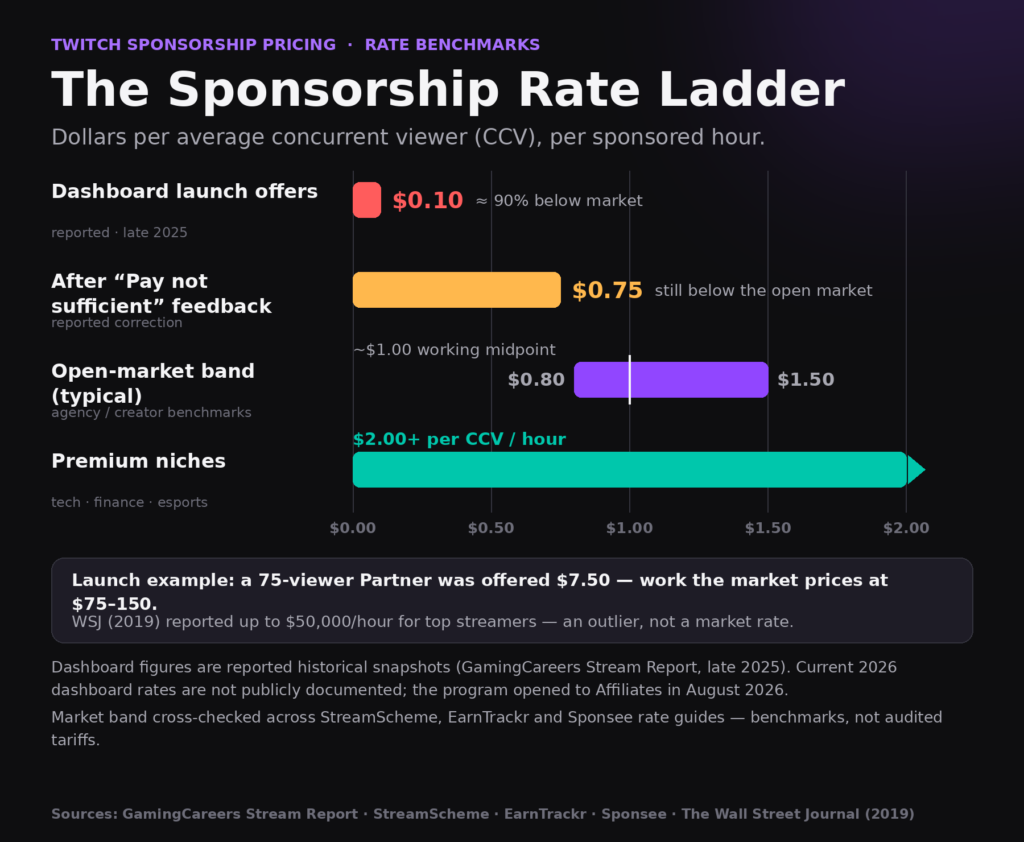
The market’s unit of account is astonishingly simple: brands pay per concurrent viewer, per sponsored hour. Cross-checking creator-economy rate guides — StreamScheme, EarnTrackr, Sponsee and others — the typical band for game-play bounties lands around $0.80–1.50 per CCV per hour, with roughly $1 as the working midpoint. Premium niches (tech, finance, esports) push toward $2 and beyond. At the celebrity ceiling, The Wall Street Journal reported back in 2019 that publishers like EA and Activision had paid up to $50,000 an hour for top streamers — an outlier that tells you about scarcity, not about market rates.
Translate the band into practice and rough illustrations look like this: a channel averaging 500–2,000 concurrent viewers might charge several hundred to a couple thousand dollars per sponsored stream; a 2,000–10,000 CCV channel commands a few thousand to around ten thousand. Treat these as agency and creator benchmarks, not audited tariffs — published tier tables disagree at the edges, and category, deliverables and exclusivity move every number.
This is also the arithmetic that exposes bad buys. A channel with 100,000 followers and 300 concurrent viewers is not a 100,000-reach channel. It is a 300-person channel with a big number next to its name.
The Sponsorship Dashboard: A Rocky Launch Worth Watching
For years, Twitch earned exactly zero dollars from streamer sponsorships. Deals happened off-platform, over email and DMs, and Amazon’s streaming giant watched the biggest revenue stream on its own platform flow past it. The Sponsorship Dashboard is the attempt to change that — the same play YouTube runs with BrandConnect.
After nearly three years of testing, the dashboard launched for Partners: Twitch sources deals (typically, play a specific game for a set duration), matches them to creator demographics, and handles the paperwork. The launch economics, as reported by the creator-industry newsletter GamingCareers’ Stream Report in late 2025, were rough. Opening offers worked out to roughly $0.10 per CCV — about 90% below the market band. A Partner averaging 75 viewers was offered $7.50 for work the open market prices at $75–150.
Creators pushed back through the dashboard’s own feedback loop, declining offers with the reason “Pay not sufficient.” Reported rates then climbed to around $0.75 per CCV — closer to respectable, still below the open market. Why start so low? Twitch hasn’t said. The prevailing speculation among creators is that the platform was testing the floor: would the convenience of integrated deal-flow convince streamers to accept less, leaving Twitch a bigger cut? That remains unconfirmed.
Two updates matter for 2026 buyers. First, the program expanded to Affiliates in August 2026, widening the supply of dashboard-priced inventory. Second — and this is a genuine data gap — no authoritative source publishes current dashboard rates, so the $0.75 figure should be read as a reported historical snapshot, not today’s price list. If a creator quotes you dashboard rates as “the market,” you now know better.
The strategic logic is sound even if the launch was clumsy. Guaranteed payouts from a trusted platform beat chasing invoices from unknown agencies, and in-house deal flow can expand beyond game titles into physical products and lifestyle brands. But a marketplace only works if both sides believe the price is fair. Squeeze creators to pad the platform’s margin, and the dashboard becomes shelfware.
Why Streamer Endorsements Convert: Viewers as Stakeholders
Why would a brand pay thousands of dollars for someone to mention a headset while playing Fortnite? The academic answer is better than the usual influencer-marketing fluff.
In their 2019 study in Social Media + Society, Mark R. Johnson and Jamie Woodcock — drawing on more than 100 interviews with successful streamers plus extensive ethnography — showed that streamers actively gamify monetization. Donation alerts, sub goals, milestone rituals and on-stream leaderboards turn paying money into part of the show. Viewers don’t just watch; over hundreds of hours they become emotionally invested stakeholders, accustomed to money changing hands in public and proud when the channel succeeds.
In that environment, a sponsor read doesn’t land like an interruption. It lands like a recommendation from a friend you’ve spent a thousand hours with — and the community’s norm is to support the things that support the streamer. That is the mechanism brands are buying.
It’s also completely normalized. Stanford GSB researcher Ivan Li, studying sponsorship disclosure on Twitch, found that 821 of the 1,157 streamers in his sample — over two-thirds — had run at least one developer-sponsored stream. Paid promotion is not an exception on Twitch; it’s infrastructure. Which is precisely why disclosure scrutiny keeps rising, a point we’ll return to.
The Uncomfortable Research: Most Sponsored Streams Lose Money
Now the finding that should humble every rate card. Yufeng Huang (Rochester) and Ilya Morozov (Northwestern’s Kellogg School) tracked roughly 60,000 top Twitch streamers every ten minutes from May to December 2021, matching sponsored and organic streams against Steam player counts and sales data. Their paper, published in Marketing Science in 2025, delivers a cold verdict: for the typical game, sponsored streams had a deeply negative return on investment — a median around −95% as reported by Kellogg Insight. Organic streams actually moved more players, lifting concurrent Steam audiences by roughly 3%.
Read that again: the unpaid streams outperformed the paid ones.
The exceptions are the strategy. Little-known games from small developers saw real, sometimes large positive returns — sponsorship bought discoverability that nothing else could. Critically acclaimed games also converted streaming attention into players and sales. The researchers estimated streamers’ opportunity cost at roughly $144 per hour (a back-of-envelope figure derived from subscription earnings), which anchors why rates can’t fall to zero — but the burden of proof sits with the brand.
What does this mean for you? Three things. If you’re launching an unknown title or product, Twitch sponsorship can be genuinely efficient — you’re buying discovery. If you’re a known brand chasing direct response, expect the spreadsheet to disappoint and budget the deal as brand marketing, with brand metrics. And in every case, the difference between the −95% median and a winning campaign is what the rest of this article covers: who you pick, how you structure the deal, and what you measure.
The Agency Screening Framework: Ratios Over Raw Numbers
Esports agencies vet Twitch talent on ratios, not totals. The following thresholds come from agency practice, as documented by SociaVault from conversations with agency partners — treat them as screening heuristics, not Twitch platform data.
Start with the audience-quality screen: average concurrent viewers divided by followers. A healthy channel runs roughly 1–5%; below about 0.3–0.5% suggests dead or inflated followers — raid leftovers, follow-for-follow history, a viral moment that never returned. A 100K-follower channel averaging under 500 concurrent viewers is a classic avoid. Where possible, use median CCV across the last 30 streams rather than the mean, so one raid spike doesn’t skew your buy.
Then consistency, which agencies treat as the single biggest predictor of sponsorship reliability. Does a published schedule exist? Do VOD timestamps match it? Fixed days, fixed times, 90%+ adherence earns premium always-on deals; erratic schedules earn short tests or performance-only terms; a channel silent for two weeks doesn’t get signed at all. Fewer than two streams a week or average sessions under two hours are common rejection triggers — there’s simply not enough exposure time to sponsor.
Category context decides the rest. A Just Chatting audience is there for the person — stronger parasocial pull, better for lifestyle brands. A game-specific audience is there for the game — often better conversion for peripherals and in-game items. Same CCV, different asset.
Finally, the initial screen most agencies run in thirty seconds: at least ~10,000 followers as a viability floor, Partner or Affiliate status, a stream within the last seven days, and category alignment. The floor filters noise; the ratios make the decision.
Deal Structures: Four Ways to Share the Risk
Every sponsorship contract is, underneath the deliverables list, a risk allocation. Who eats the loss if viewership softens? Four structures cover nearly the whole market.
A flat per-stream fee or monthly retainer puts viewership risk on the brand. It fits top-tier creators with consistent, brand-safe channels — you’re paying for certainty of access, and agency frameworks put serious retainers in the five-figure monthly range for elite talent.
A hybrid — lower base plus performance bonuses tied to hours, average viewers or conversions — splits the risk. This is the workhorse structure for the mid-tier in a soft market, and the single highest-leverage renegotiation move available right now: creators who keep delivering can earn as much or more, while your downside is capped.
Performance-only deals (CPA, CPC, revenue share) push risk onto the creator. They suit small-but-authentic channels where reach is modest but trust is high, and risky channels you’re not ready to commit to. Expect selective acceptance: creators with options don’t take pure-risk deals cheaply.
Long-term lock-ins — say, twelve months at a reduced per-unit rate — trade price for predictability on both sides. Platform payout instability makes this genuinely attractive to creators right now; you get budget certainty, they get income certainty. That’s a trade, not a squeeze.
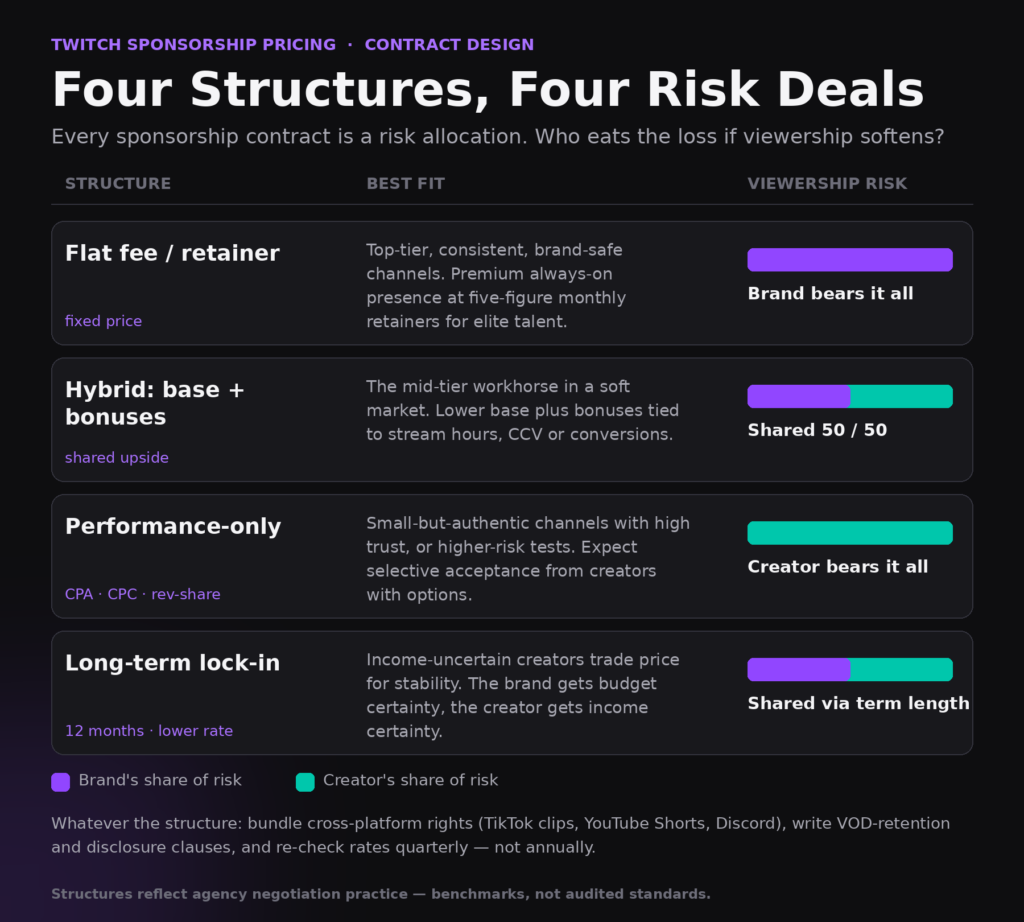
One more lever regardless of structure: bundle. Most gaming creators are no longer Twitch-exclusive — they clip to TikTok, post YouTube Shorts, run Discord communities. Renegotiate the whole relationship, not the Twitch line item, and a lower per-stream rate plus cross-platform amplification rights often buys more total reach for less money.
Measurement and Disclosure: The Boring Parts That Save You
Measure effective cost against actual concurrent reach — ideally cost per thousand viewer-hours, with your hours basis written down — not against follower counts. Cross-reference reach against spend over three cycles before you conclude anything; single-stream snapshots lie in both directions. Use promo codes and affiliate links for conversion truth, and write VOD-retention clauses into contracts so you can verify delivery after the fact. Creators who delete VODs erase your audit trail.
Disclosure is not optional and not one-and-done. The FTC’s Endorsement Guides (revised in 2023) require clear and conspicuous disclosure of any material connection — payment, free product, family or business ties. Live streams need the disclosure repeated periodically, because viewers join mid-broadcast and miss the opening mention. Twitch provides a built-in branded-content label, and its terms require using it for sponsored content — but a platform toggle is not a legal safe harbor. Your contract should require both verbal and on-screen disclosure, and remember that creators posting clips to YouTube or TikTok face those platforms’ labeling rules too. Renegotiated contracts inherit every one of these obligations; a rate change is exactly the moment legal review gets skipped, so build it into the renewal checklist.
The 2026 Renegotiation Playbook
Multiple creator-economy sources describe a softening market for mid-tier gaming sponsorships: streaming hours have flattened, viewership has fragmented across TikTok Live, YouTube Live and Kick, and the supply of streamers pitching brands has grown faster than brand demand. The money is still flowing toward creators overall — the IAB puts US creator ad spend at $37 billion in 2025, up 26% year over year and growing roughly four times faster than the total media industry. But within Twitch’s mid-tier, we deliberately won’t attach a percentage to the rate compression — the circulating figures trace to a single unaudited agency claim — and the direction alone changes how you should walk into renewals.
Lead with data, not demands. Pull average concurrent viewers, chat engagement, clip performance and conversion history before the call. “We see you averaging 1,400 concurrent viewers across four weekly streams” opens a different conversation than “budgets are tight.”
Anchor to current category benchmarks, not platform nostalgia. Rates set when Twitch felt like the only game in town are indefensible in a fragmented market — and fair negotiation runs both ways: ask creators to show comparables from recent deals in your category.
Offer structures, not ultimatums. Present two or three options — lower flat rate, hybrid with bonuses, longer lock-in — and let the creator choose. Agency experience says creators with options sign faster than creators who feel cornered.
Give something back. Creators talk. A brand that cuts rates with nothing in return poisons its own recruiting pipeline. Longer commitment, expanded creative freedom, co-marketing, product drops, event appearances — every rate conversation should include something the creator gains.
Then maintain the relationship: quarterly rate check-ins instead of annual auto-renewals, a 60–90 day follow-up after any restructure, and continuous scouting so no single negotiation can hold your content calendar hostage.
Failure Modes to Avoid
Four mistakes account for most of the wasted money in this category. Paying for followers instead of viewers — the $30,000 lesson from the opening. Treating dashboard floor rates as “the market” — underpaying creators burns relationships and, per the launch reporting, the market itself pushed back. Cutting rates with nothing in return — word travels fast in creator communities. And skipping disclosure review during renegotiation — the cheapest moment to fix compliance is the moment you’re already rewriting the contract.
There’s a fifth, subtler one: ignoring the research. If your product is established and your goal is direct response, the Marketing Science evidence says the median deal loses money. Buy discovery when you need discovery, buy brand when you need brand, and never let a rate card substitute for a thesis.
Summary
Twitch sponsorships are priced on concurrent viewers and consistency, not follower counts. The open market runs roughly $0.80–1.50 per CCV per sponsored hour, with premium niches higher; Twitch’s own dashboard reportedly opened near a tenth of that and corrected upward, though current rates aren’t public. Vet with ratios and schedule adherence, match deal structure to tier and risk, bundle cross-platform rights, measure cost per thousand viewer-hours with disclosed assumptions, and disclose repeatedly and contractually. The endorsement works because Twitch viewers are stakeholders, not spectators — but the peer-reviewed median says most sponsored streams lose money, so the winners will be the buyers who treat pricing as one input in a disciplined system, not the system itself.