The hardest part of taking a Chinese brand to America is not the language, and it is not the logistics. It is the motives — the social reasons a product matters — and the proof. Practitioner export methodology shows that hooks built on Chinese social relations fail abroad because the audience does not live inside those relations. Agency operating evidence shows campaign tempo stretching from 10–15 days at home to 40 in Vietnam and 60+ in Japan. And new cross-market trust research shows why the US is its own problem: Americans sit in the global middle on AI trust, verify aggressively, and accept AI recommendations mainly for brands they already know. For a Chinese brand entering the US, localization means three rebuilds: rewrite why the product matters, satisfy American claim-substantiation and disclosure rules, and construct the verification surfaces — specs, reviews, retailer listings — where both humans and AI assistants go to check. In an AI-mediated market, familiarity is the trust shortcut that price cannot buy.
The product was ready. The social relations weren’t.
Picture a short-drama team in Hangzhou with a domestic hit. The hook is a mother-in-law placing a thin red envelope on a tea tray — an insult every Chinese viewer decodes in half a second. Ship the same scene to Ohio with perfect subtitles and the viewer sees… a woman handing over money? The words translate. The humiliation doesn’t.
That gap is the whole story of Chinese brands going West, and it has almost nothing to do with grammar.
Practitioner export playbooks for China’s content-commerce machine describe the failure bluntly: domestic hooks are engineered around specific social relations — in-law hierarchy, wealthy-family status games, workplace ranking, relative comparison. A tea ceremony, a bride-price comment, a boss addressed by title: these compress entire power structures into a single shot. When the audience doesn’t inhabit those relations, the hook itself misfires. Viewers understand every word and still don’t believe the character would feel wronged.
The prescribed fix is not better translation. It is motive rewriting — swapping the cultural vehicle while keeping the emotional charge. Industry teams report three layers of work: rebuild address and honorific systems so status reads naturally in the target language; localize conflict motives so the insult lands (the dumpling critique becomes the ruined Thanksgiving turkey); and adapt shot-level sensitivities, because intimacy, alcohol, violence and religious symbols carry different ratings in different markets. Dubbing versus subtitles, in these playbooks, is a completion-rate decision — not the localization itself.
Notice what this implies for a hardware brand, a skincare line, a shoe company. Your ad hook also rests on a social premise: who compares themselves to whom, which embarrassment stings, which upgrade signals status. If the premise doesn’t exist in Minneapolis, the creative fails at the same place the drama does — second one, before anyone reads your subtitle.
The tempo tax nobody budgets for
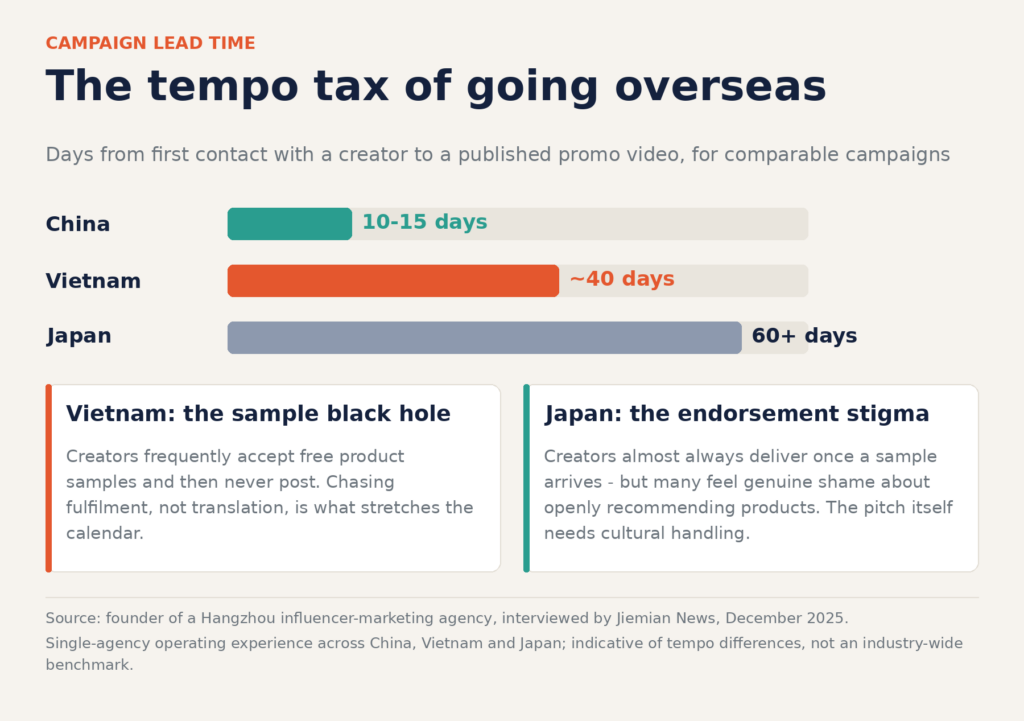
The second mismatch is the calendar. Wen Congyin, founder of the Hangzhou influencer-marketing agency Morpheus, told Jiemian News in December 2025 that a creator campaign — from first contact with an influencer to a published promo video — takes 10 to 15 days in China. In Vietnam, about 40. In Japan, at least 60.
The reasons are cultural mechanics, not laziness. In Vietnam, he said, creators take product samples and frequently never post — the sample-chasing loop eats the schedule. In Japan, creators almost always deliver once a sample arrives, but many feel genuine shame about openly recommending products. You cannot fix either problem with a faster translation vendor. One requires different contract and incentive design; the other requires a pitch that respects the local meaning of endorsement.
His agency still grows fast overseas — it entered Japan in mid-2025 — but it does so by rebuilding the operating calendar, not by compressing the China one. If your US launch plan assumes domestic tempo, the plan is fiction. American creators, agencies and retailers run on their own clocks, their own contract norms, their own ideas of what a paid recommendation means.
America is not “overseas”
Here is where lazy strategy goes to die: treating “the West” as one segment. The trust data says otherwise, and the US occupies a genuinely distinct position.
Ipsos surveyed roughly 8,500 consumers across 15 markets for its July 2026 paper Shopping With AI. Trust in companies using AI to protect personal data ranges from 73% in India and 68% in China down to 26% in France and 25% in Canada. The United States sits at 39% — squarely in the middle. Ipsos labels the US, Brazil and South Korea the “AI-ambivalent” cluster: interested, but demanding transparency and control.
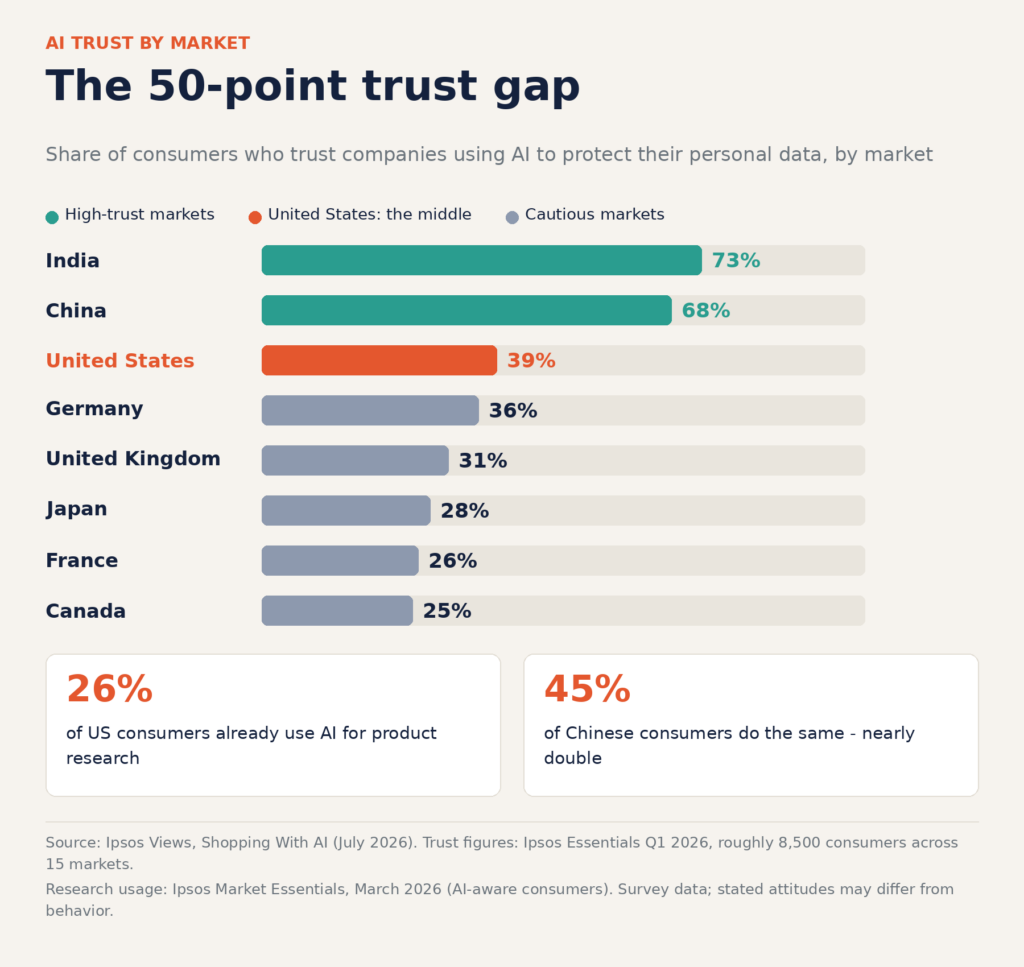
Behavior tracks trust. Among AI-aware consumers, 45% of Chinese already use AI for product research; in the US it is 26%. Openness to letting AI buy autonomously: 66% in China (21% have actually done it), 60% in India — versus 16–17% in Japan, France, Germany and Canada, where actual usage barely registers at 2–4%.
So when a Shenzhen team reasons from domestic user behavior — everyone asks the AI, everyone trusts the recommendation, everyone converts in-app — and projects that onto American consumers, the forecast is structurally too optimistic. At Google Marketing Live China in July 2026, eMarketer principal analyst Sky Canaves put numbers on the mood gap: AI optimism runs at 84% in China versus 38% in the US. One caveat worth stating: that event is hosted by Google, which sells the search ads that AI-verification behavior flows into, so treat the Google-ecosystem figures as directionally useful, commercially interested.
Layer one: rewrite the motive, not the copy
Start with the job your product does inside a social relationship. A charging brand in China might sell “never lose face with a dead phone in front of your boss.” The American version of that anxiety exists — but it lives in different scenes: the airport gate, the kids’ soccer tournament, the road trip. Same underlying fear, different stage.
The practical sequence practitioners describe: map the emotional beat that must land (the embarrassment, the relief, the status signal); check whether the original cultural vehicle still carries that weight for the target audience; if not, replace the vehicle, keep the beat. Then test hooks locally instead of translating domestic winners. A translated winner is a hypothesis, not an asset.
This is also why the “just add subtitles” plan fails quietly. Language work affects whether people finish watching. Motive work affects whether they want the product. You need both, but only one of them creates demand.
Layer two: substantiation — the rules American ads play by
The second rebuild is legal-cultural, and Chinese teams routinely underestimate it because domestic platforms now demand similar discipline — but with different reference documents and different teeth.
Three American rules matter for almost every consumer brand:
First, prior substantiation. Under the FTC’s advertising substantiation policy, objective claims — express and implied — need a reasonable basis before the ad runs. If your ad says “tests prove,” you must hold the tests. Health-related efficacy claims need competent and reliable scientific evidence. An influencer’s enthusiasm is not substantiation; the advertiser remains responsible for the claims its endorsers convey.
Second, disclosure. The FTC’s Endorsement Guides, revised in 2023, require any material connection — payment, free product, even a family tie — to be disclosed clearly and conspicuously. Behind a “more” link doesn’t count. Buried in a hashtag stack doesn’t count. The platform’s built-in paid-partnership label alone doesn’t count. In video, the disclosure should be in the content, not just the description.
Third, reviews with actual penalties attached. The Consumer Review Rule (16 CFR Part 465), effective October 2024, bans fake reviews — including AI-generated ones — buying positive sentiment, suppressing negative reviews, undisclosed insider reviews, and fake follower metrics. And it has teeth: civil penalties up to $53,088 per violation. This is not theoretical. In December 2025 the FTC sent warning letters to ten companies, its first broad enforcement signal under the rule.
For a brand raised on seeding campaigns and review-velocity tactics, the message is uncomfortable: several growth habits that are merely risky at home are federally penalized in the US. Compliance is not a tax on marketing here. It is part of the product’s trust surface.
Layer three: build the verification surface
Now the layer most China playbooks skip entirely — because at home, the platform compresses discovery, proof and checkout into one feed. In the US, verification is a separate journey, and it happens on surfaces you may not control.
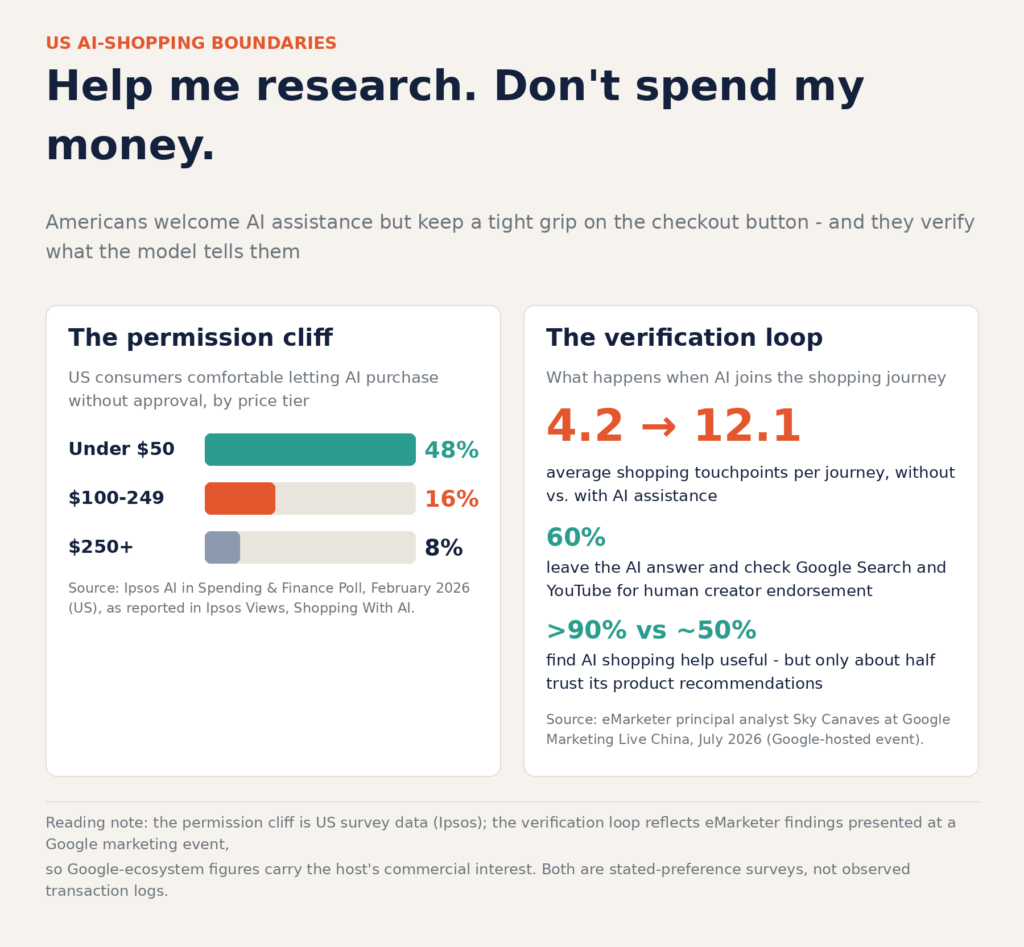
Canaves’s data at the Google event describes the loop: with AI assistance, the average shopping journey balloons from 4.2 touchpoints to 12.1. More than 90% of AI-assisted shoppers find the help useful, but only about half trust the recommendations. And roughly 60% take the AI’s answer and immediately go check Google Search and YouTube for human creator endorsement. The AI compresses research; it does not close the sale. It opens a verification loop.
Americans also draw hard limits around AI’s wallet access. In Ipsos’s February 2026 US poll, 48% of respondents would let AI buy something under $50 without approval — but for purchases of $100–249 that collapses to 16%, and above $250 it is 8%. The higher the price, the more human the decision. (That poll’s conditional-buyer subsample is small — 557 respondents — so read the tiers as direction, not decimal precision.)
What does a shopper — or an AI assistant shopping on their behalf — actually check? Your official site’s specs. Third-party reviews. Retailer listings. Community threads. If those surfaces disagree with each other, or are thin, or read like translated catalog copy, the recommendation dies at the verification step no matter how good the ad was.
There is direct evidence that the verification surface beats the chat window. Walmart put roughly 200,000 products into OpenAI’s Instant Checkout starting November 2025, letting people buy inside ChatGPT. By March 2026, Walmart EVP Daniel Danker told WIRED that in-chat purchases converted at about one-third the rate of shoppers who clicked through to Walmart’s own site. He called the experience “unsatisfying.” OpenAI phased Instant Checkout out; Walmart is instead embedding its own assistant, Sparky, into ChatGPT and Gemini, with carts syncing back to Walmart’s system. Discovery may move into the chat box. Conversion still happens where the brand controls the experience — where the trust surface lives.
Familiarity is the trust shortcut price can’t buy
Put the trust data and the verification loop together and you get the strategic punchline: American consumers accept AI recommendations mainly for brands they already recognize. That was eMarketer’s core finding as relayed at the Google event — brand familiarity is the key to crossing the AI trust barrier. Ipsos’s US data rhymes with it: asked how AI should choose products, the largest group (29%) wants it to buy the brands they already purchase most often, and another 16% would restrict it to brands they’ve bought before. AI mostly executes existing preferences; it does not create them.
For an unknown Chinese brand, that is a structural disadvantage no discount can fix. When the assistant flattens information asymmetry — every spec, price and review comparable in one answer — the remaining differentiator is whether the consumer has heard of you and believes you. Price wins the comparison table. Familiarity wins the recommendation.
This reframes brand-building from luxury to performance lever. The awareness campaign you were going to cut is, in an AI-mediated market, upstream of conversion.
The Anker template: graduate from channel to brand
The clearest published precedent is Anker Innovations. Founded in 2011 by a former Google engineer, it entered the US through Amazon — and treated the product page as its storefront and its review section as its R&D department. Customer reviews fed a product-iteration system the company calls VOC; the founder has said customer feedback is the most important input to product development. Ratings became the trust surface, and the trust surface became the brand.
The financials show what that compounded into: 2024 revenue of RMB 24.71 billion, up 41.14%, with net profit up 30.93%. Then came the deliberate graduation. In the first half of 2025, Amazon’s share of revenue fell below 50% for the first time — to 49.97% — while offline channels reached 32.58% of revenue, roughly RMB 4.19 billion in that half-year alone, through Walmart, Best Buy, Target and Costco.
Read that as a localization sequence, not a channel spreadsheet. Anker first earned verifiable proof (reviews, ratings, return data) on a platform Americans already trusted. Then it converted that proof into shelf space at retailers Americans already trusted. Then it built a brand Americans recognize without a platform intermediary. Verification surface first, familiarity second, pricing power third. The order matters.
What everyone gets wrong
Four errors recur in China-to-US launch plans.
The translation-first plan. Subtitles and dubbing affect completion, not persuasion. The failure point is the hook’s social premise, upstream of language.
The port-the-playbook assumption. Creator behavior, contract norms and campaign tempo differ by market — the agency evidence shows calendars doubling and quadrupling across borders. Rebuild the operating plan; don’t compress the domestic one.
The price-sufficiency belief. Temu and Shein proved that supply chain plus cheap traffic can buy enormous scale. True — and note the limit: their model competes on the comparison table, exactly the layer AI flattens, while the trust evidence says recommendations flow to familiar brands. Both strategies coexist; they have different durability profiles, and only one compounds into pricing power.
The one-West error. US, European and Japanese consumers differ materially in AI trust, disclosure norms and creator culture. “Overseas” is a mailing address, not a segment.
The honest limitations
Two caveats keep this analysis honest. First, the sharpest operating evidence — the tempo numbers, the creator-behavior mechanics — comes from Southeast Asia and Japan, not the US. It demonstrates the mechanism (localization is motives and tempo, not language); the US-specific claims here rest on separately sourced US data: Ipsos’s US polls, the FTC’s rules, Walmart’s disclosure, Anker’s filings. Second, most trust figures are stated preferences from surveys, not observed transactions, and the eMarketer figures were presented at a Google-hosted event with obvious commercial interest. The one hard behavioral datapoint — Walmart’s one-third conversion disclosure — happens to point the same way as the surveys, which is why it carries so much weight in this piece.
The sequence that works
If you are taking a Chinese brand into the US, the evidence supports a specific order of operations.
Rewrite the motive before the copy: map the local social relation that makes your product urgent, and test hooks with local audiences instead of translating domestic winners. Build the verification surface before the campaign: accurate specs, honest third-party reviews, consistent retailer listings — the destination for both human and AI checking. Budget the real calendar: local creators and partners run on local tempo, and the contract and incentive design must match local endorsement culture. Treat compliance as product: substantiate claims before launch, disclose material connections inside the content, and never touch review velocity tactics that the FTC now fines. And invest in familiarity deliberately, because in an AI-mediated market, being recognized is what converts a recommendation into a sale.
The product crossing the Pacific is the easy part. What has to cross with it is a reason Americans care, proof they can check, and a name they already know. Translation gets your words across the ocean. Only localization gets your meaning across.
Conclusion
The documented localization problem for Chinese brands entering the US is motives, substantiation and verification — not language. Hooks fail when their underlying social relations don’t exist locally; campaign tempo stretches when creator cultures differ; and American consumers, sitting mid-pack on AI trust, verify aggressively and follow AI recommendations mainly toward brands they recognize. The winning sequence is Anker’s sequence: earn checkable proof, convert it into familiarity, and let pricing power follow. In a market where assistants flatten every information advantage, familiarity is the one shortcut price cannot buy.