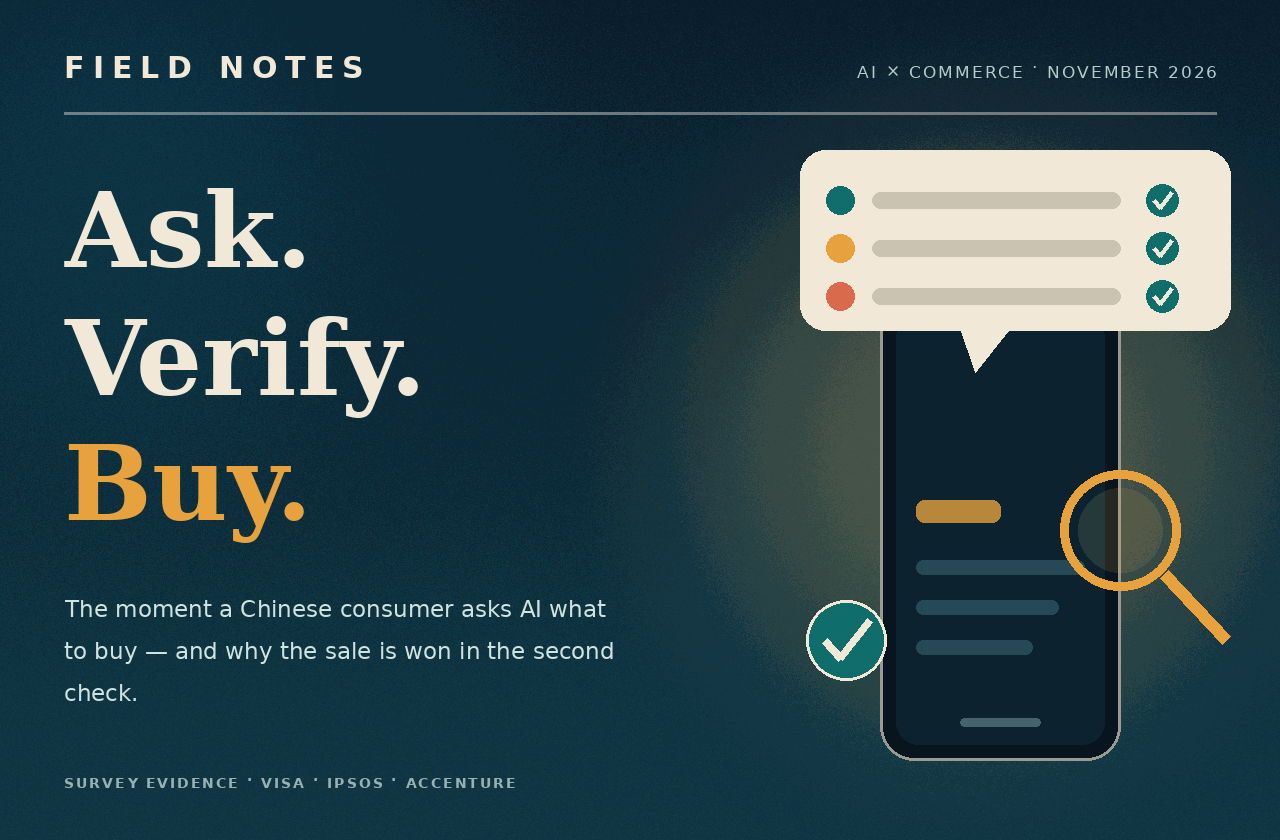
It is 10 p.m., and someone in Chengdu wants a tent. Not any tent — a three-person, rainproof, breathable tent under 2,000 yuan. Two years ago, that request meant an evening of scrolling: two hours on RedNote, an hour of price-hunting on Taobao, thirty minutes of second-guessing in the review section. Tonight, it is one sentence typed into an AI assistant. Five minutes later, there is a shortlist.
And then — this is the part most coverage misses — the shopper leaves the AI and goes to check.
That small detour is the whole story. Across four independent research programs published between October 2025 and mid-2026, the same pattern keeps appearing: Chinese consumers ask AI what to buy, treat the answer as a shortlist rather than a verdict, and verify it somewhere else before spending money. The moment of asking is real, routine and enormous. The moment of deciding still belongs to the human. If you market to Chinese consumers, the difference between those two moments is where your budget should go.
Executive Summary
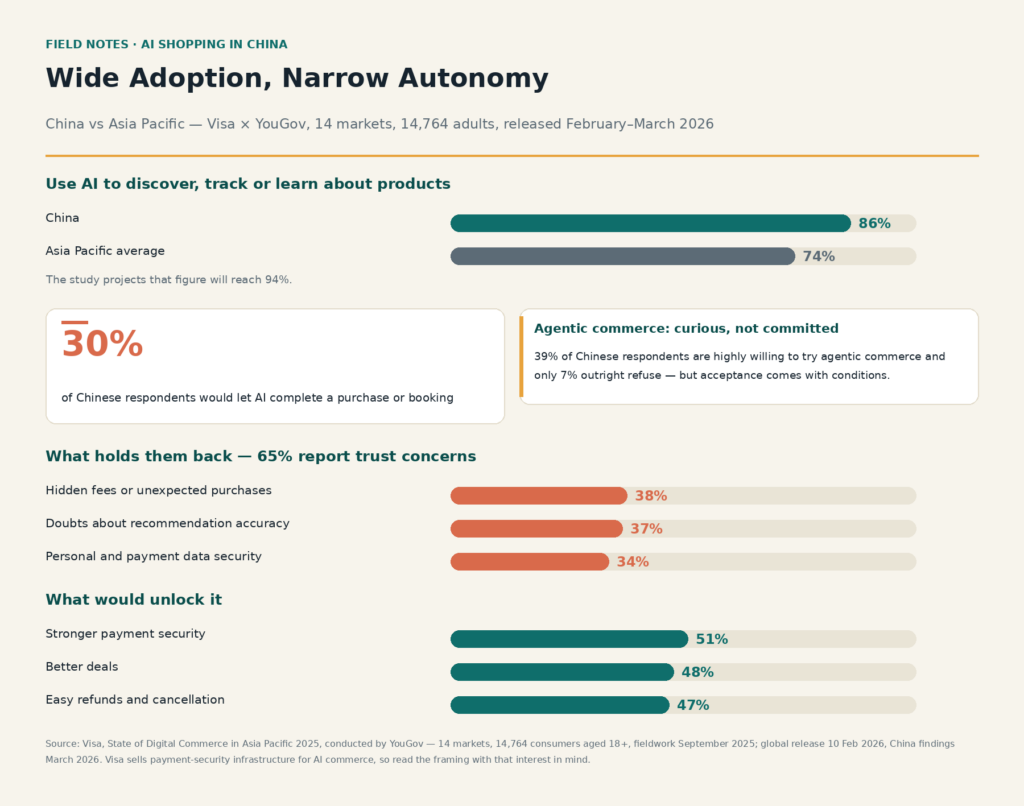
- AI-assisted discovery is mainstream in China: Visa’s YouGov-conducted study across 14 Asia-Pacific markets found 86% of Chinese respondents already use AI to discover, track or learn about products, against a 74% regional average.
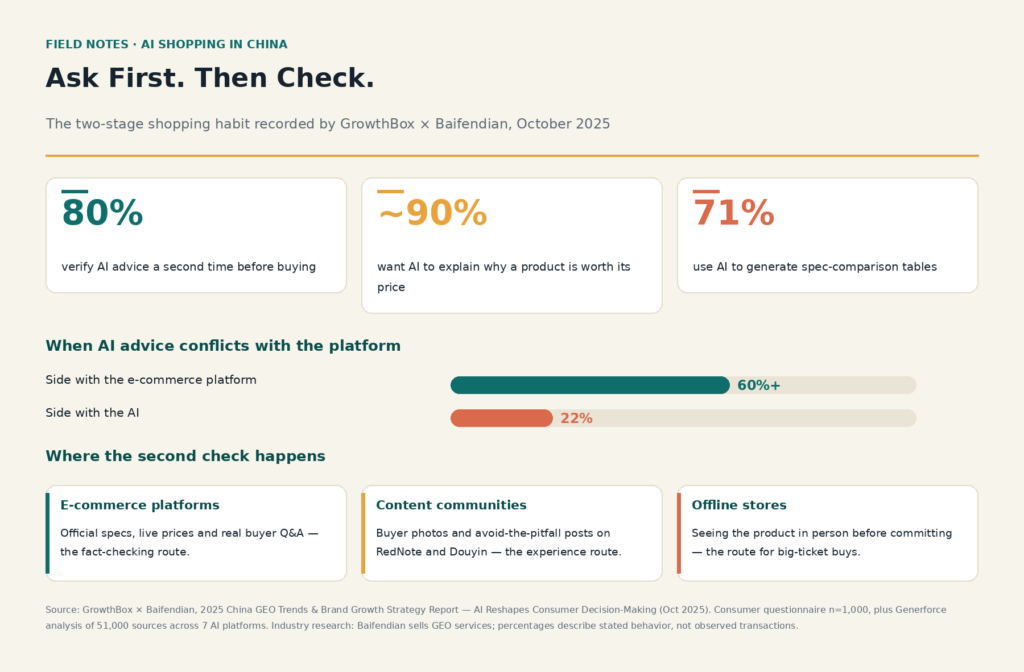
- The shortlist is not the sale: GrowthBox and Baifendian’s October 2025 study found 80% of users verify AI advice a second time, and when AI conflicts with platform information, over 60% side with the platform while only 22% side with AI.
- Reasons beat prices: nearly 90% of respondents want AI to explain why a product is worth its price, not just what it costs.
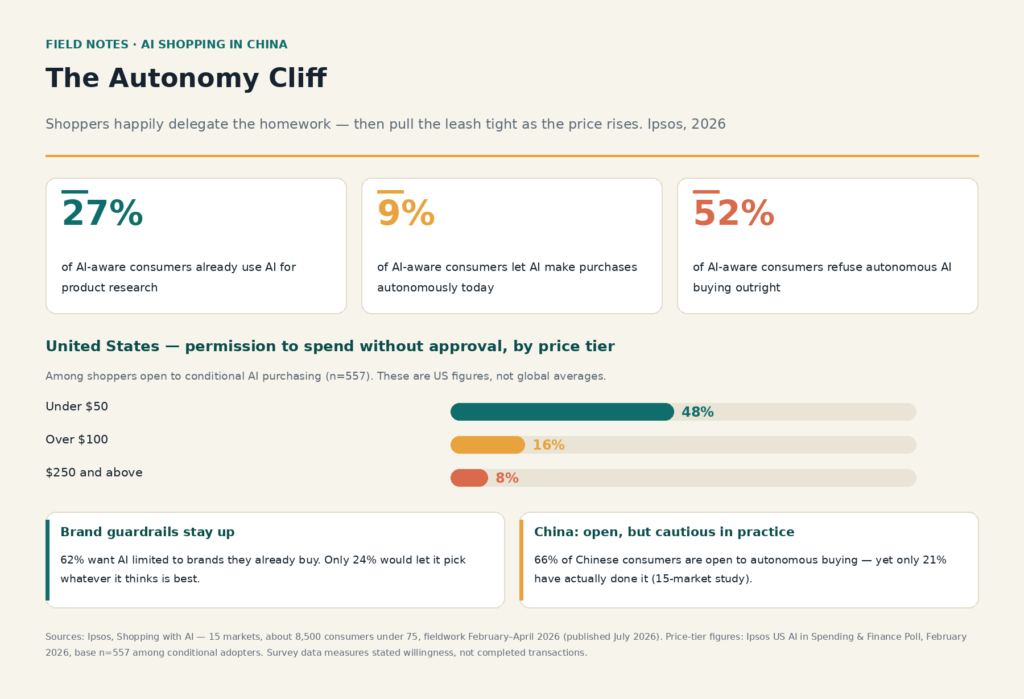
- Checkout autonomy is a boundary, not a horizon: only 30% of Chinese respondents would let AI complete a purchase; globally, just 9% of AI-aware consumers actually do (Ipsos).
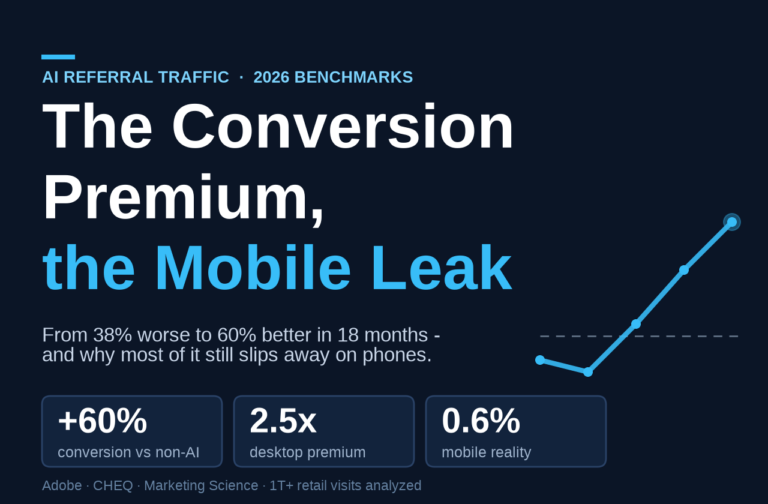
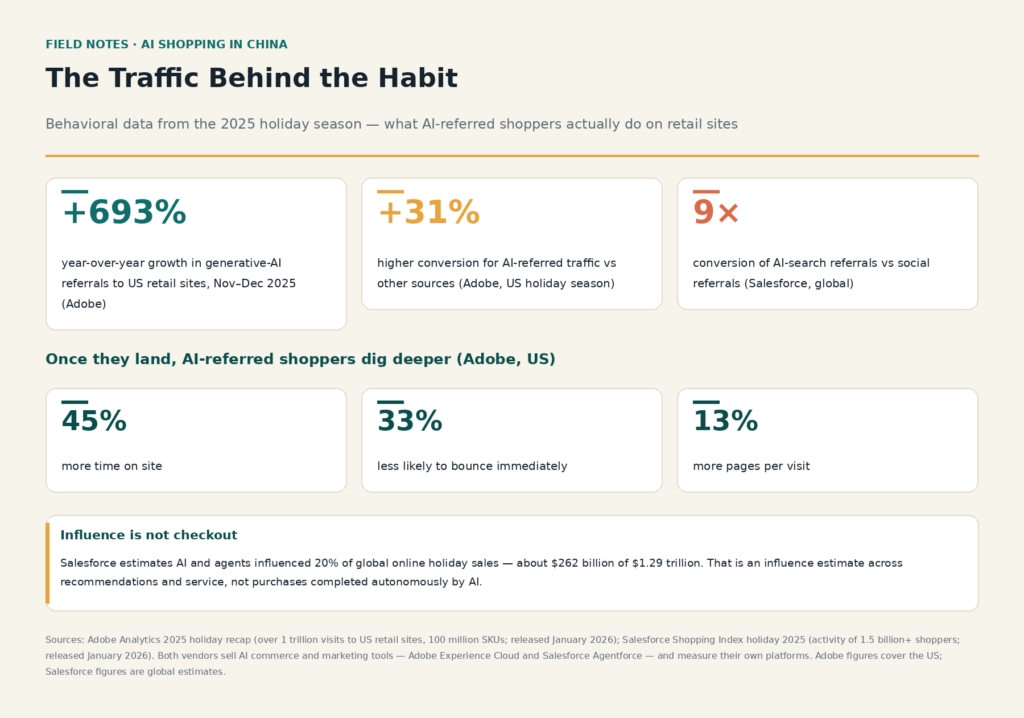
- The traffic is high-intent: Adobe’s holiday 2025 data shows AI-referred visitors to US retail sites converting 31% better than other traffic. Brands win by being checkable at the second step, not merely mentionable at the first.
The Moment, Recorded
Let us start with the scale, because the scale is easy to underestimate from a Western desk.
Visa’s State of Digital Commerce in Asia Pacific 2025 study — conducted by YouGov with 14,764 adults across 14 markets, fielded in September 2025 and released in early 2026 — found that 74% of Asia-Pacific consumers already use AI tools to discover, track or learn about products. In China, the figure is 86%, and the study projects it will reach 94%. This is not early-adopter behavior. It is default behavior.
Accenture’s China Consumer Insights report (survey of 5,000 consumers aged 18–65 across tier-one to tier-five cities, fielded August–September 2025) adds texture: 37% of Chinese consumers already use AI tools for shopping assistance when you exclude the assistants built into e-commerce platforms. Their top jobs for AI are exactly what you would expect from a rational shopper — help in unfamiliar categories (67%) and quick comparisons of brands or models (59%). Weekly-or-daily AI use rose from 77% in August 2025 to 86% by January 2026, up from 63% at the start of 2025.
Notice what these numbers describe: research, comparison, orientation. Not checkout. Keep that distinction in your pocket; it will matter in a moment.
Stage One: AI as the Filter
The most granular picture comes from GrowthBox, a marketing research firm, and Baifendian, a data-intelligence company, in their October 2025 report 2025 China GEO Trends & Brand Growth Strategy Report — AI Reshapes Consumer Decision-Making. It combines 1,000 consumer questionnaires with a technical analysis of 51,000 sources across seven Chinese AI platforms. One caveat before the numbers: Baifendian sells GEO services, so this is industry research with a commercial angle, not an independent audit. The sample is modest, and the percentages describe stated behavior.
That said, the findings are strikingly consistent. Nearly half of users (45%) invoke AI at the compare-and-filter stage — the middle of the journey, where a fuzzy need becomes a set of comparable parameters. A quarter (25%) say the shopping idea itself originated from an AI recommendation. And the tasks are unglamorous, practical ones: 71% use AI to generate spec-comparison tables, 55% to distill selling points, 47% to analyze user reviews.
Why do shoppers trust a machine with this job? Because they believe it is less biased than the alternatives: 53% consider AI more reliable than social media content. After adoption, nearly 60% say they spend less time hunting for shopping information on social platforms — roughly two hours less, on average. The feed did not die. It got demoted.
Stage Two: The Second Verification
Here is the finding that should reorganize your content strategy: 80% of users perform a second verification after receiving AI advice. It is not an occasional habit. It is standard operating procedure.
The verification routes split three ways. Shoppers check official specs, live prices and real buyer Q&A on e-commerce platforms; they hunt for buyer photos and avoid-the-pitfall posts in content communities like RedNote and Douyin; and for big-ticket items, they go offline to see the thing in person. Facts get checked on platforms, experience gets checked in communities, risk gets checked in stores.
Trust is partial and task-specific. Some 74% trust AI’s price comparisons — yet when AI’s advice conflicts with platform information, over 60% side with the platform and only 22% with the AI. Read those two numbers together and the consumer’s mental model becomes obvious: AI is a brilliant analyst with no fiduciary duty. You take its work seriously. You do not sign on its dotted line.
The Explainability Premium
One more number from the same study deserves its own paragraph: nearly 90% of users want AI to provide clear recommendation reasons — they want to know why a product is worth its price, not merely what the price is.
Think about what that means for content. A listing answers what. A justification answers why — and a justification is checkable. When the model says this tent is worth 1,800 yuan because of its hydrostatic head rating, pole material and warranty, the shopper can verify each claim on the platform page. When the model says only buy this one, the shopper has nothing to check except the model’s mood.
Explainability is not a nice-to-have feature of AI answers. It is the bridge between stage one and stage two. Brands that publish the reasons — structured, specific, verifiable — give both the model and the human something to hold onto. Brands that publish only prices and slogans leave the bridge unbuilt.
The Checkout Boundary
Now the money question. How many people would actually let AI finish the job?
In Visa’s study, only 30% of Chinese respondents said they would let AI complete a purchase or booking. Some 65% hold trust concerns, and the breakdown is instructive: hidden fees or unexpected purchases (38%), doubts about recommendation accuracy (37%), and personal or payment data security (34%). These are not complaints about model intelligence. They are complaints about accountability — who pays when the agent gets it wrong.
The agentic-commerce picture is more nuanced than a flat refusal. In the same China findings, 39% of respondents are highly willing to try agentic commerce and only 7% outright refuse — but willingness comes with conditions: stronger payment security (51%), better deals (48%), easy refunds and cancellation (47%). Curiosity is high. Commitment is conditional. That is a market asking for guardrails, not a market asking to be automated.
The Autonomy Cliff: Price Changes Everything
Ipsos’s Shopping with AI study — about 8,500 consumers under 75 across 15 markets, fielded February–April 2026 — shows how sharply permission narrows as stakes rise. Among AI-aware consumers globally, 27% use AI for product research, but only 9% let it make autonomous purchases, and 52% refuse outright.
The price gradient, measured in a companion US poll of shoppers open to conditional AI purchasing (n=557, February 2026), is brutal in its clarity: 48% would let AI spend under $50 without approval; that falls to 16% above $100 and 8% at $250 and above. These are American figures, not global ones — but the shape of the curve is the point. Every shopper has a price at which the assistant becomes a stranger.
China sits at the open end of the spectrum: 66% of Chinese consumers are open to autonomous buying, yet only 21% have actually done it. And even the open majority wants brand guardrails — across markets, 62% want AI constrained to brands they already buy, while only 24% would let it pick whatever it thinks is best. The agent is welcome as an executor of existing preferences. It is not welcome as a taste-maker.
What the Behavioral Data Adds
Surveys measure what people say. What do they do? The 2025 holiday season produced two large behavioral datasets — both from vendors with something to sell, so handle with the usual care.
Adobe Analytics, covering over a trillion visits to US retail sites, found generative-AI referrals to retail sites grew 693% year over year in November–December 2025. More importantly, that traffic behaved: AI-referred visitors converted 31% better than other sources, were 33% less likely to bounce immediately, spent 45% more time on site and viewed 13% more pages per visit. These are pre-qualified shoppers arriving with a shortlist already formed.
Salesforce’s Shopping Index, aggregating activity from over 1.5 billion shoppers, estimated that AI and agents influenced 20% of global online holiday sales — about $262 billion of $1.29 trillion. Note the word influenced: that is an estimate of AI’s role in recommendations and service along the path, not purchases completed by robots. Shoppers arriving via third-party AI search channels converted nine times more often than social referrals.
Two caveats worth stating plainly: Adobe sells Experience Cloud and AI-visibility tooling; Salesforce sells Agentforce. Each measures its own platform. But the direction of both datasets matches the survey evidence — AI sends fewer, better-prepared visitors, and the receiving site decides what happens next.
Four Misreadings to Retire
Misreading one: AI replaces search and social. The data shows augmentation with a return trip. Time shifts toward AI at the discovery stage, then verification flows back to platforms and communities. The funnel did not collapse; it grew a loop.
Misreading two: being mentioned by AI equals conversion. A mention starts a verification journey. If your official specs contradict the AI’s claim, or your reviews are thin, the shortlist entry dies quietly. Mention is the invitation; verification is the interview.
Misreading three: shoppers only want price comparisons. Nearly 90% want reasons. Price is one row in the comparison table; justification is the whole table’s purpose.
Misreading four: autonomous checkout is imminent. Thirty percent willingness in China, 9% actual use globally, and a price cliff that turns 48% into 8% — the near-term behavior is assisted decision plus human confirmation. Build for that, not for the demo video.
The Brand Playbook: Win the Verification Layer
If the sale is decided at the second step, your job is to make the second step easy and favorable.
First, make official surfaces checkable: accurate, consistent specs and live prices across every platform where the shopper lands after asking AI. A single stale spec page can kill a shortlist entry that cost you nothing to earn and everything to lose.
Second, publish reasons, not just prices. Value-justification content — materials, warranty, use-case fit, honest trade-offs — gives the model quotable substance and the human verifiable claims. This is the explainability premium, and it compounds.
Third, show up in community evidence. Buyer photos, candid limitation posts, answers in avoid-the-pitfall threads: this is the second verification route, and it cannot be faked at scale without eventually being caught.
Fourth, design for assisted checkout, and disclose plainly. Fees, data use, refund mechanics — the named blockers in Visa’s data are all transparency problems. Transparency is cheap; distrust is not.
The Counterarguments, and Their Limits
Surveys measure stated behavior, and novelty inflates self-reporting. Fair. But four independent instruments — a payments network’s cross-market study, a consumer-protection authority’s survey, a consultancy’s national panel, and a global research firm’s 15-market study — converge on the same two-stage pattern. Convergence is not proof, but it is much harder to dismiss than any single poll.
China is an outlier, so none of this generalizes? Partly true — Ipsos shows China and India at the open end, Japan and France at the cautious end. But the pattern (assist, then verify) appears across markets; only the thresholds move. And will verification disappear as models improve? The named blockers are institutional — fees, accountability, data security — not just accuracy. Better models do not, by themselves, answer who is liable when the agent buys the wrong thing.
One more limit, from Shanghai: the city’s consumer-protection council surveyed 3,200 users of its own WeChat account in April 2026 — a self-selected, consumer-aware sample, not a random one. Its findings still rhyme with everything above: 91.32% open to trying full-process AI consumer services, yet 64.22% worry about privacy and data security and 62.53% question AI’s decision accuracy. Over 90% say they can feel platform recommendations nudging them. High dependence, low trust — the same psychological weather, measured by a different instrument.
Conclusion: Be Checkable, Not Just Mentioned
The documented moment when a Chinese consumer asks AI what to buy is a shortlisting moment, not a decision. Eighty-six percent use AI for discovery; 80% verify elsewhere; nearly 90% want reasons rather than prices; only 30% would hand over the checkout. The brand’s win happens in the verification layer — accurate official specs, authentic community evidence, and explainable value the model can quote and the human can check. Optimize to be checkable, not just mentioned. The consumer’s second step is where the shortlist becomes a sale.