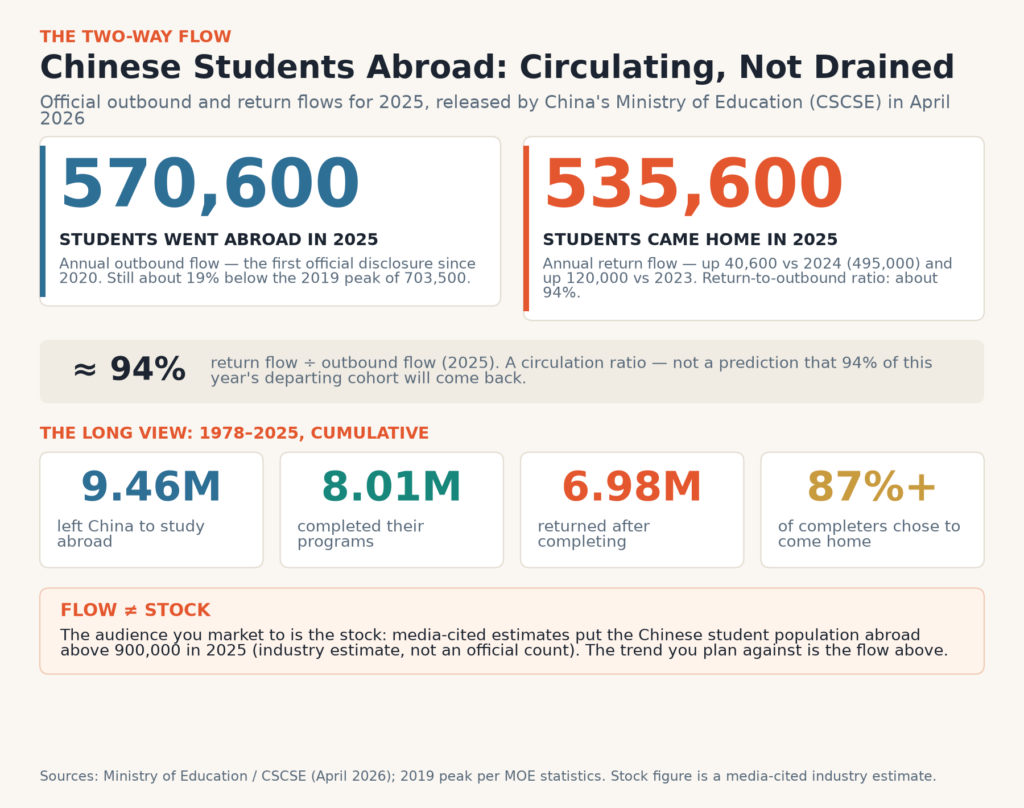
Chinese students abroad are not a geographic segment — they are a transnational bridge node. In 2025, 570,600 students left China to study overseas and 535,600 came home, a return-to-outbound ratio of roughly 94%. Since 1978, 9.46 million have gone out, 8.01 million finished their programs, and 6.98 million returned — more than 87% of completers. This population consumes in two markets simultaneously: buying Chinese brands abroad, buying foreign brands for Chinese social display, carrying preferences home, and steering family purchases in both directions. Brands that file them under “overseas consumers” or “future returnees” miss the loop. Brands that market the circulation inherit a high-influence audience that seeds both markets.
The Number That Reframes the Audience
Let’s start with the statistic that should change how you build your segmentation model.
In April 2026, at the China Study Abroad Forum in Beijing, the Chinese Service Center for Scholarly Exchange — the Ministry of Education’s official body for overseas study — disclosed that 570,600 Chinese students went abroad in 2025, while 535,600 returned after completing their studies. It was the first official outbound disclosure since 2020, and the symmetry is striking: for every hundred students who left, roughly ninety-four came home in the same year.
Now zoom out. From 1978 to 2025, cumulative outbound students reached 9.46 million. Of those, 8.01 million completed their programs, and 6.98 million chose to return — a completion-to-return rate above 87%. The “brain drain” narrative that dominated headlines for two decades is, statistically speaking, a story about circulation.
And here’s the part marketers keep missing: the 570,600 figure is a flow — people moving in one year. The audience you can actually market to is the stock: media-cited industry estimates put the Chinese student population abroad above 900,000 in 2025. That stock figure is an estimate, not an official count, so treat it as directional. But the distinction matters enormously. The flow tells you the trend; the stock tells you the market size. Both are large. Neither is a drained-away population.
Why “94%” Is a Circulation Ratio, Not a Promise
Before we go further, one calibration — because sloppy readings of this number are already circulating.
The 94% figure divides one year’s return flow by the same year’s outbound flow. It does not mean 94% of the students who departed in 2025 will eventually return. Those are different cohorts at different lifecycle stages. What the ratio legitimately tells you is that the system has reached a near-steady state: outflows and inflows are almost balanced, and the return side is accelerating. Returnees rose by 40,600 versus 2024 (495,000, itself up 19.1% year-on-year) and by 120,000 versus 2023.
For a marketer, the strategic reading is simple: this is a revolving door with a very wide frame. People pass through it in both directions, continuously, carrying preferences with them. Your customer doesn’t leave your market. She connects two.
The Transnational Consumption Loop
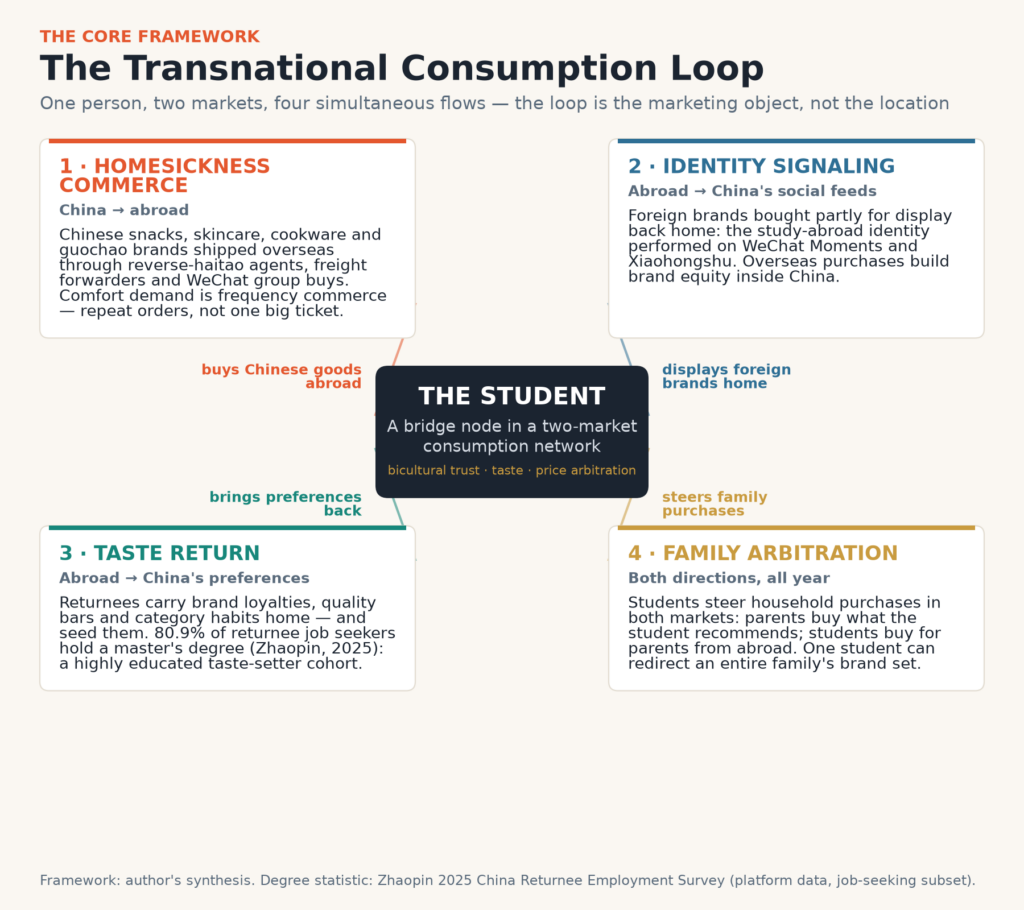
Here is the framework the rest of this piece hangs on. The student abroad runs four consumption flows at once — and each flow is a marketing channel most brands aren’t buying.
Flow 1: Homesickness Commerce (China → Abroad)
The student in Manchester or Melbourne still wants Chinese snacks, the skincare brand she trusts, a rice cooker that works the way home works. This demand flows through reverse-haitao purchasing agents, parcel-forwarding warehouses, and WeChat group buys organized by campus seniors. It is comfort commerce, and its defining feature is frequency: weekly and monthly reorders, not one annual luxury splurge. Chinese brands reach these buyers abroad through cross-border rails and diaspora channels — no local retail footprint required.
A note on evidence: circulating “market size” figures for reverse haitao come almost entirely from vendor blogs selling forwarding software. We couldn’t trace any of them to a research institute or official statistic, so we’ve left them out. The phenomenon is real and observable; the billion-dollar claims are not yet auditable.
Flow 2: Identity Signaling (Abroad → China’s Social Feeds)
The second flow runs the other way — not in goods, but in meaning. A purchase made in London gets photographed for WeChat Moments and Xiaohongshu, where the audience is back home. The study-abroad identity is partly performed through consumption: the tote bag, the coffee brand, the weekend trip. Foreign brands, in other words, accumulate Chinese brand equity through a channel that never appears in their UK sales reports. If you’re a Western brand, your student customers are unpaid media buyers targeting Chinese consumers.
Flow 3: Taste Return (Abroad → China’s Preferences)
When students come home, they don’t reset to factory settings. They bring brand loyalties, quality expectations, and category habits — oat milk, specialty coffee, ingredient-list skincare, secondhand fashion — and seed them into urban Chinese consumption. The returnee cohort is unusually well-equipped to do this: Zhaopin’s 2025 China Returnee Employment Survey found that 80.9% of returnee job seekers hold a master’s degree, with another 3.1% holding doctorates. That’s platform data covering the job-seeking subset, not all returnees — but it skews the picture toward a highly educated, high-income-trajectory taste-setter class. Fresh-graduate returnees entering the job market grew 12% in 2025, reaching 2.25 times the 2018 level — an eight-year high.
Flow 4: Family Arbitration (Both Directions)
The least visible flow may be the most valuable. The student is her household’s designated expert on things foreign — and increasingly on things domestic too, since she comparison-shops across both systems. Parents buy the supplements she recommends; she buys gifts for them from abroad; she vetoes the brand her mother saw in an ad. One student can redirect an entire family’s brand set, in two countries, for years. New Oriental’s 2026 survey puts the average intending family’s annual income at RMB 488,000 — this arbitration moves serious money.
What Everyone Gets Wrong
The Geographic-Segment Error
Most CRM systems force a choice: is this customer “overseas” or “Chinese”? The student is both, now. Tag her as overseas and you suppress the Chinese-language campaigns she actually responds to; tag her as domestic and you miss the cross-border purchases she makes weekly. The segmentation unit should be the loop, with lifecycle stage and destination as attributes — not a single country field.
The Drain Narrative
We’ve covered the numbers, but the mindset lingers: teams treat study abroad as customer attrition. It isn’t. With returns at 535,600 a year and climbing, and 6.98 million returnees already embedded in Chinese cities, the “lost” customer is usually a customer in transit — often becoming more valuable, not less.
The Luxury-Only Assumption
The classic student-abroad marketing deck is about luxury and tuition-adjacent services. But the loop’s highest-frequency flows are snacks, skincare, tech accessories, and household goods. If your category is everyday consumption, this audience is more relevant to you than to a watchmaker — you just have to show up in the forwarding warehouse and the group chat, not the duty-free mall.
The Monolith Error
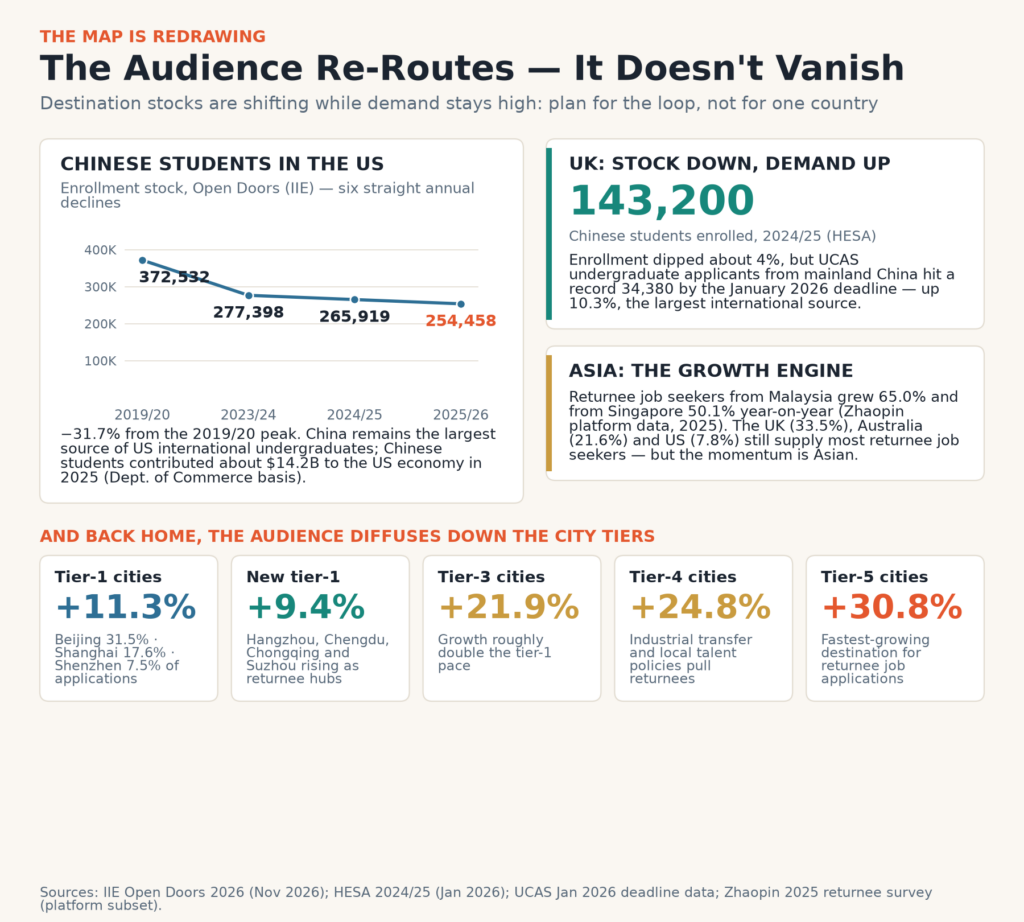
“The Chinese student” doesn’t exist. A self-funded undergraduate in California, a one-year master’s student in Glasgow, and a scholarship PhD in Singapore differ in budget, platform diet, and return intention. Zhaopin’s data shows returnee job seekers still come mostly from the UK (33.5%), Australia (21.6%), and the US (7.8%) — but the fastest growth is from Malaysia (+65.0%) and Singapore (+50.1%). The Asia cohort is a different audience with different price sensitivity. Segment by destination × lifecycle, or don’t segment at all.
The Map Is Redrawing — The Audience Isn’t Shrinking
If you’ve watched the headlines, you might think this audience is collapsing. Look closer: it’s re-routing.
The US stock has genuinely declined. IIE’s Open Doors 2026 report, released in November 2026, counted 254,458 Chinese students in the US for 2025/26 — down 4.3% year-on-year and down 31.7% from the 2019/20 peak of 372,532. That’s six consecutive annual declines, driven substantially by visa friction: among institutions reporting declines, 88% cited the visa application process. Yet China remains the largest source of US international undergraduates, and Chinese students still contributed roughly $14.2 billion to the US economy in 2025 on the Commerce Department’s economic-impact basis. The relationship is shrinking, not severing.
The UK tells an even more interesting split story. HESA’s January 2026 release showed Chinese enrollment at 143,200 for 2024/25, down about 4% — India (146,480) now leads. But UCAS undergraduate applications from mainland China hit a record 34,380 by the January 2026 deadline, up 10.3% and easily the largest international source. Stock down, demand up: the one-year master’s segment cooled while undergraduate demand surged. A brand reading only enrollment headlines would wrongly exit a growing pipeline.
Meanwhile the outbound flow itself remains about 19% below the 2019 peak of 703,500 — solid demand, redistributed. The CSCSE’s 2026 environment evaluation ranks the UK, Germany, and Singapore top on its composite index, and returnee employment is diffusing beyond the usual hubs: applications to tier-5 cities grew 30.8%, tier-4 cities 24.8%, tier-3 cities 21.9% — all far ahead of tier-1’s 11.3%. The audience re-routes abroad and down the city tiers at home. Your distribution plan should do both.
The Economics: Why This Audience Punches Above Its Headcount
Five hundred seventy thousand a year sounds small against 1.4 billion people. Here’s why the influence multiplier matters more than the headcount.
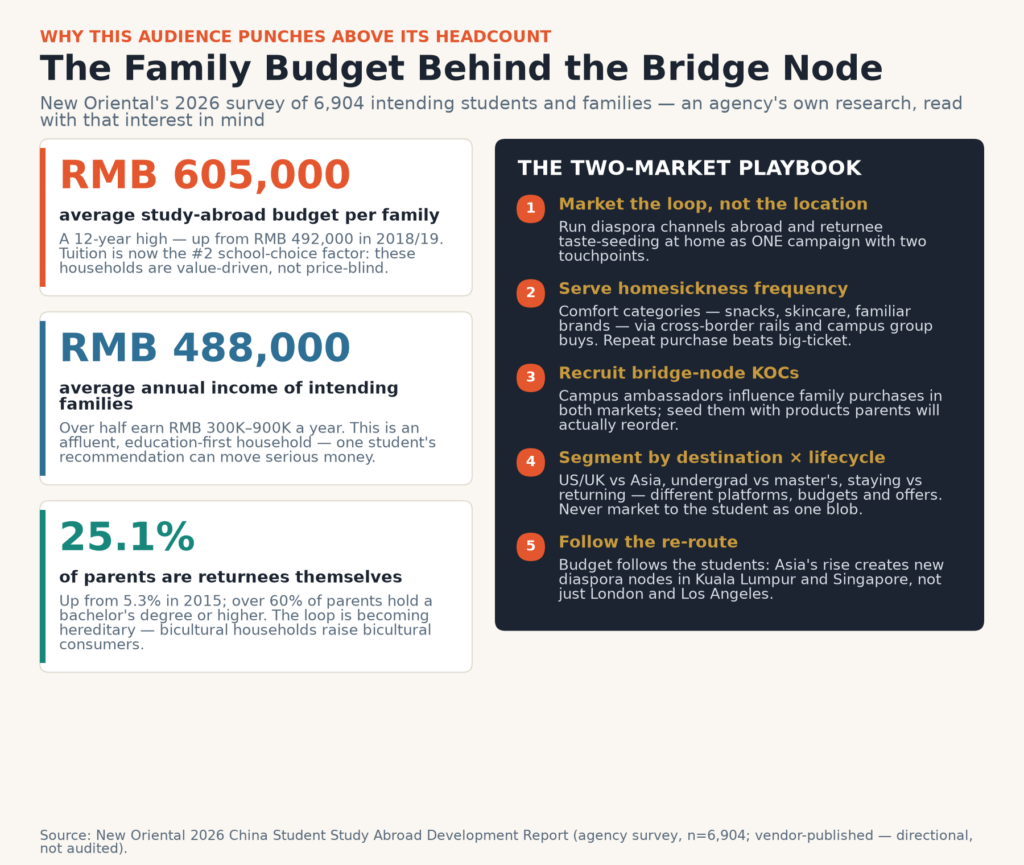
New Oriental’s 2026 China Student Study Abroad Development Report — an agency survey of 6,904 intending students and families, so read it as vendor-published directional research — found the average study-abroad budget reached RMB 605,000, a twelve-year high, up from RMB 492,000 in 2018/19. Tuition has become the #2 school-choice factor: these households are value-driven, not price-blind. Average family income sits at RMB 488,000, with over half earning RMB 300,000–900,000.
The most under-appreciated number in the report: 25.1% of parents are returnees themselves, up from 5.3% in 2015, and over 60% hold at least a bachelor’s degree. The loop is becoming hereditary. Bicultural households raise bicultural consumers, who will send their children through the same loop — each generation deepening the two-market consumption pattern. You’re not marketing to a one-off traveler. You’re marketing to the founding generation of permanently transnational households.
Add the 6.98 million returnees already embedded in Chinese cities — concentrated in Beijing, Shanghai, and the Greater Bay Area, with Hangzhou, Chengdu, Chongqing, and Suzhou rising — and the “small audience” objection dissolves. The annual flow is the acquisition channel; the cumulative stock is the installed base.
The Two-Market Playbook
So what do you actually do on Monday? Five moves.
1. Market the loop, not the location. Run diaspora channels abroad and returnee taste-seeding at home as one campaign with two touchpoints. The student who discovers your brand in a Melbourne group buy should meet it again in a Shanghai lifestyle feed six months later. Same identity graph, two geographies.
2. Serve homesickness frequency. If you’re a Chinese brand, comfort categories — snacks, skincare, familiar household names — travel through forwarding rails and campus group buys. Optimize for repeat purchase and parcel economics, not flagship-store glamour.
3. Recruit bridge-node KOCs. Campus key opinion consumers influence family purchases in both markets. Seed them with products their parents will actually reorder, and let the household arbitration flow do your distribution. This is the cheapest high-trust channel in the entire loop.
4. Segment by destination × lifecycle. US/UK versus Asia, undergraduate versus master’s, staying versus returning — each cell has different platforms, budgets, and offers. The Malaysia/Singapore growth cohort deserves its own plan, not a translated version of the London plan.
5. Follow the re-route. As flows shift toward Asia and returnees diffuse to tier-3/4/5 cities, your diaspora nodes and domestic seeding should shift too. Kuala Lumpur and Chengdu are the new edges of this audience — and edges are where acquisition is cheap.
The Counterarguments — And Their Limits
“The audience is too small.” The annual flow is modest; the influence isn’t. Taste-setters, household arbitrators, and 6.98 million embedded returnees multiply the reach of every student contact. You’re buying influence density, not impressions.
“Returnees assimilate and lose their transnational taste.” Partly true, eventually. But the early-adopter window — the first years back, when returnees seed trends before converging — is exactly when they’re most valuable to brands. And the circulating flow keeps refreshing the bridge with new returnees every year.
“Geopolitics will shrink the flow to irrelevance.” Destinations shift; the loop persists. The US decline is real and steep, but UK undergraduate demand is at a record, Asia is growing double digits, and the outbound total remains above half a million. The transnational audience re-routes. It doesn’t vanish. Plan for elasticity in where, not existence of whether.
Conclusion
The Chinese student abroad is a bridge node in a two-market consumption network: 570,600 out, 535,600 back, four simultaneous flows of goods, meaning, taste, and family influence. The brands that win this audience won’t be the ones with the best airport ads. They’ll be the ones that recognize the loop — and build for the circulation, not the location. The student isn’t leaving your market. She’s connecting two. And she’s taking your brand, or your competitor’s, across the bridge with her.