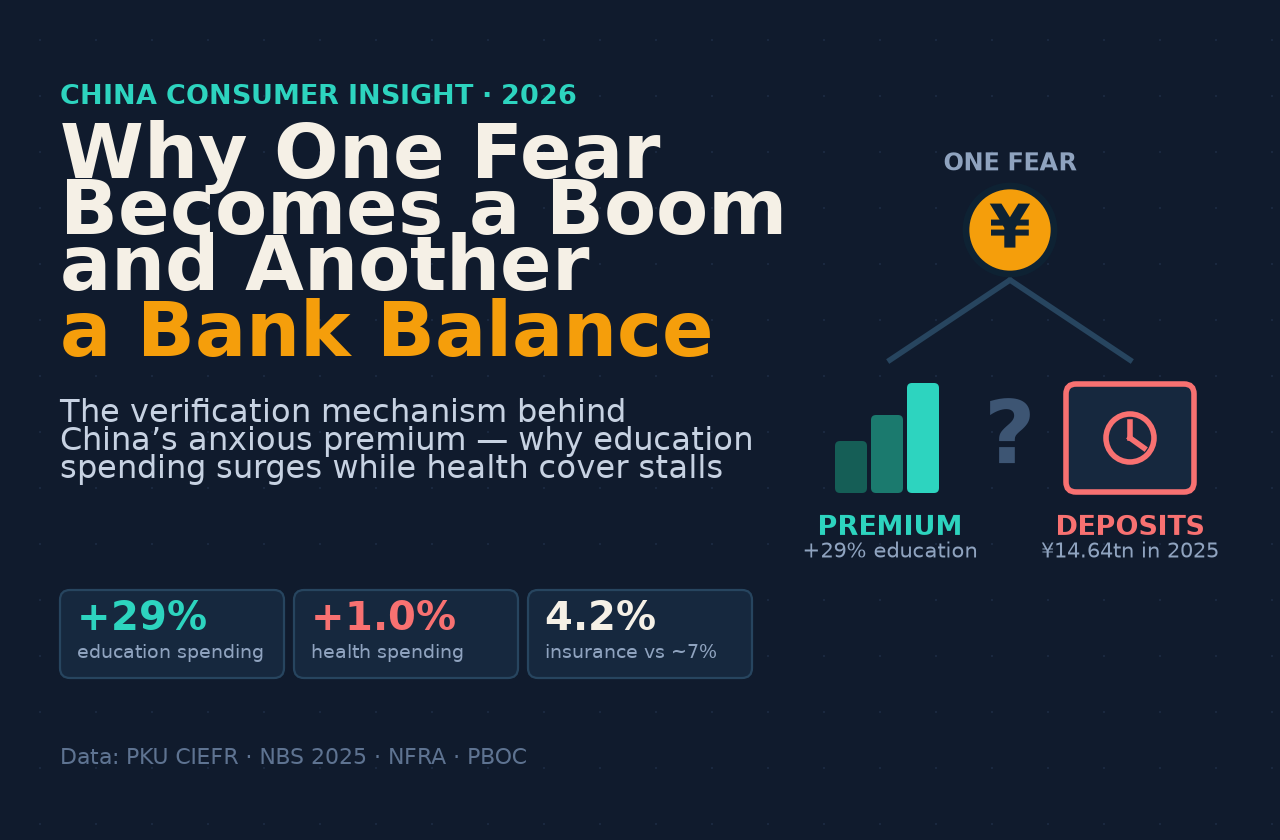
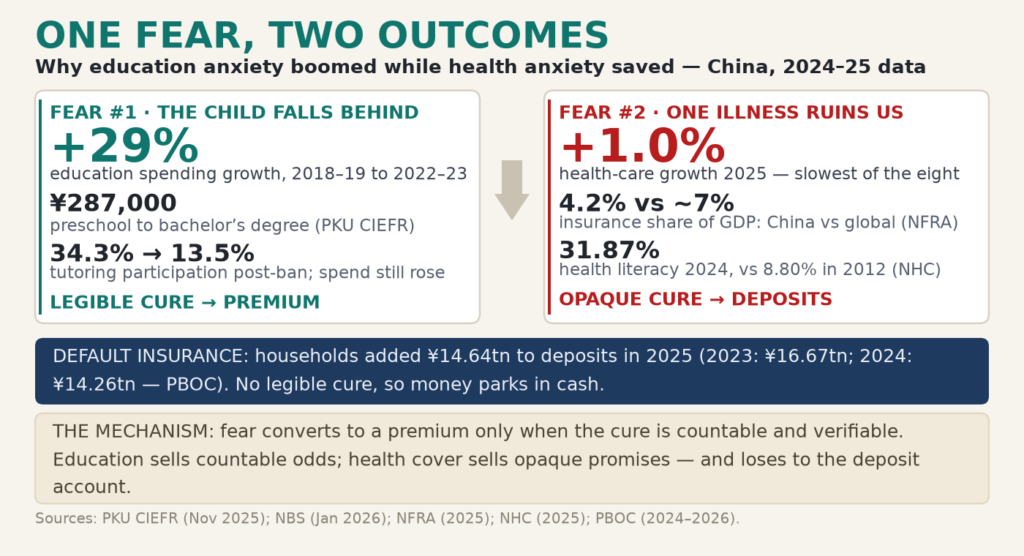
Here is a contradiction that most China consumer commentary walks straight past. Chinese households are afraid of two things above all: their child falling behind, and one illness wiping them out. Both fears show up in every survey. Yet the spending response is wildly asymmetric. Family education spending rose 29% between the 2018–19 and 2022–23 school years, according to Peking University’s household survey of 26,804 families — straight through a nationwide tutoring crackdown. Health-care spending, in the official 2025 data, grew 1.0%: the slowest of all eight categories. Insurance premiums sit at about 4.2% of GDP against a global average near 7%.
Same intensity of fear. Opposite behavior. Why?
The Mechanism: Fear Needs a Legible Cure
The answer isn’t that people care less about health. It’s that fear converts into spending only when the solution is verifiable — and education and health protection sit on opposite sides of that line.
Education anxiety comes with a price list. You can count the hours of tutoring, compare the school rankings, read the exam results, see the ¥287,000 lifecycle cost from preschool to a bachelor’s degree laid out in the PKU data. The purchase is imperfect, but it is legible: you know what you bought, roughly what it does, and how to compare offers. So when the 2021 tutoring ban deleted the dominant channel — participation fell from 34.3% to 13.5% — the money didn’t evaporate. It migrated to whatever still looked like a countable edge. The fear had somewhere to go.
Health protection anxiety has no such list. Will this insurance policy actually pay out? Is this screening package clinically meaningful or theater? Is the “organic” label real? The average buyer cannot verify any of it at the moment of purchase, and the product’s value only reveals itself in a future that may never arrive. Faced with an opaque cure, a rational household does the one thing that is perfectly legible: it holds cash. Chinese households added ¥14.64 trillion to bank deposits in 2025, after ¥16.67 trillion in 2023. The deposit account is the default insurance policy — crude, liquid, and fully verifiable.
Why This Isn’t Irrational — and What Changes It
Behavioral economists would call this ambiguity aversion: people pay less for risks they cannot model, even when the expected loss is identical. A middle-class family with one leveraged asset cannot afford to be wrong twice, so it discounts unverifiable promises to nearly zero. Note the tell in the health data: literacy is rising fast — 31.87% in 2024, up from 8.80% in 2012 — while spending stays flat. People are learning what good protection looks like faster than the market is supplying it in a form they can trust. The demand isn’t missing. The legibility is.
The Marketer’s Implication
This reframes the entire “anxious premium” opportunity. You don’t unlock defensive spending by amplifying fear — the fear is already maxed out. You unlock it by making the cure countable: payout terms in plain language, clinical evidence on the package, traceability codes on the label, per-day pricing that can be compared. Every unit of verifiability you add converts parked deposits into spendable premium. The brands that win the health-protection gap won’t be the loudest fearmongers. They’ll be the first to make an opaque promise legible — because in this market, verification is the product.