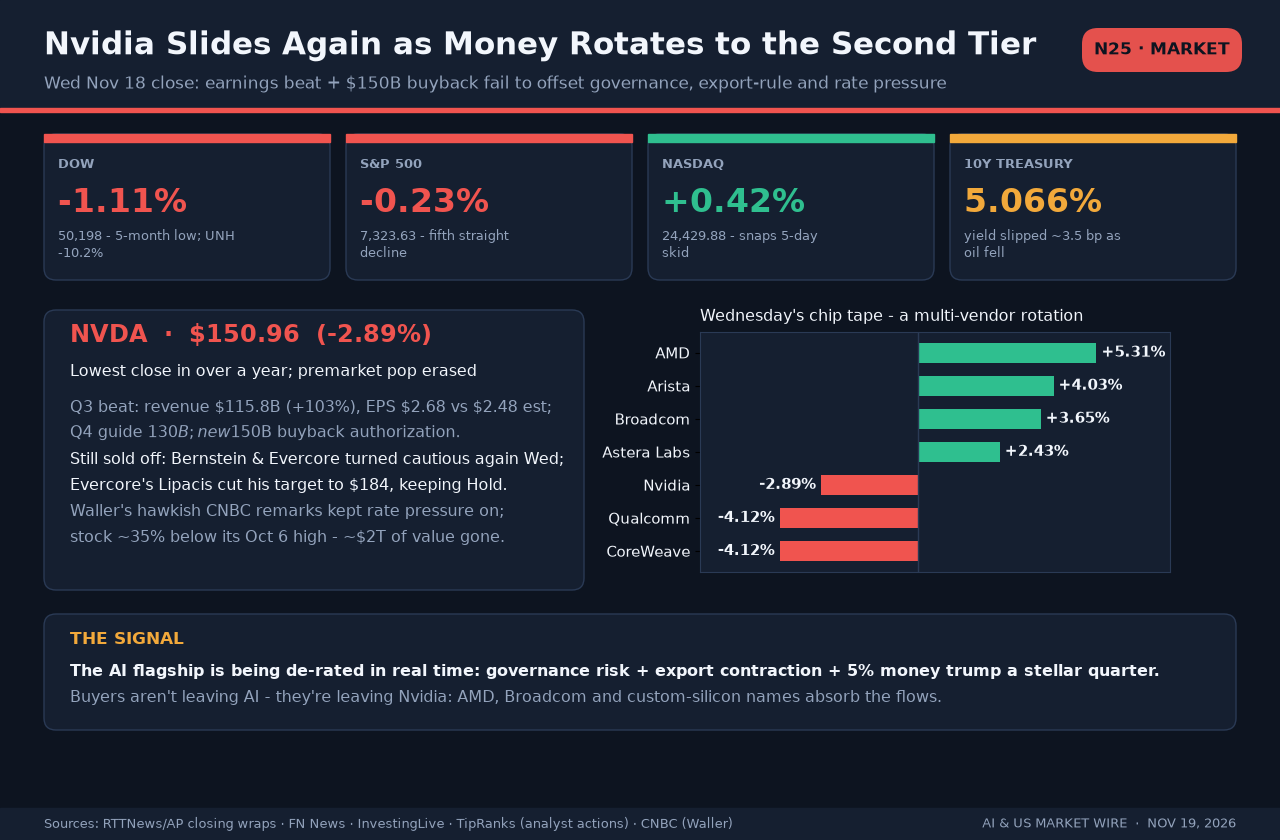
At Wednesday’s close on November 18, Nvidia fell 2.89% to $150.96 — its lowest finish in over a year and fifth consecutive daily decline — fully erasing a premarket pop earned by a genuine blowout quarter (revenue $115.8 billion, +103%; adjusted EPS $2.68 vs $2.48 expected; $130 billion Q4 guidance) and a fresh $150 billion buyback authorization, as Bernstein and Evercore turned more cautious again that day (Evercore’s Mark Lipacis trimmed his target to $184, keeping Hold, citing the CEO vacuum and investigations) and Waller’s hawkish CNBC remarks kept rate pressure on the multiple. The broader tape split: the Dow dropped 561 points (-1.11%) to a five-month closing low of 50,198, dragged ~236 points by UnitedHealth alone (-10.2% on a federal proposal to expand Medicare Advantage audits); the S&P 500 slipped 0.23% to 7,323.63 for a fifth straight loss; but the Nasdaq rose 0.42% to 24,429.88 on selective chip buying — AMD +5.3%, Arista +4.0%, Broadcom +3.7% — while the 10-year Treasury yield actually eased ~3.5 bp to 5.066% as oil fell. With the stock now ~35% below its October 6 high and roughly $2 trillion of market value gone since the peak, the message is unambiguous: governance risk, export contraction and 5% money outweigh any quarter, and buyers aren’t leaving AI — they’re leaving Nvidia for the multi-vendor world.




