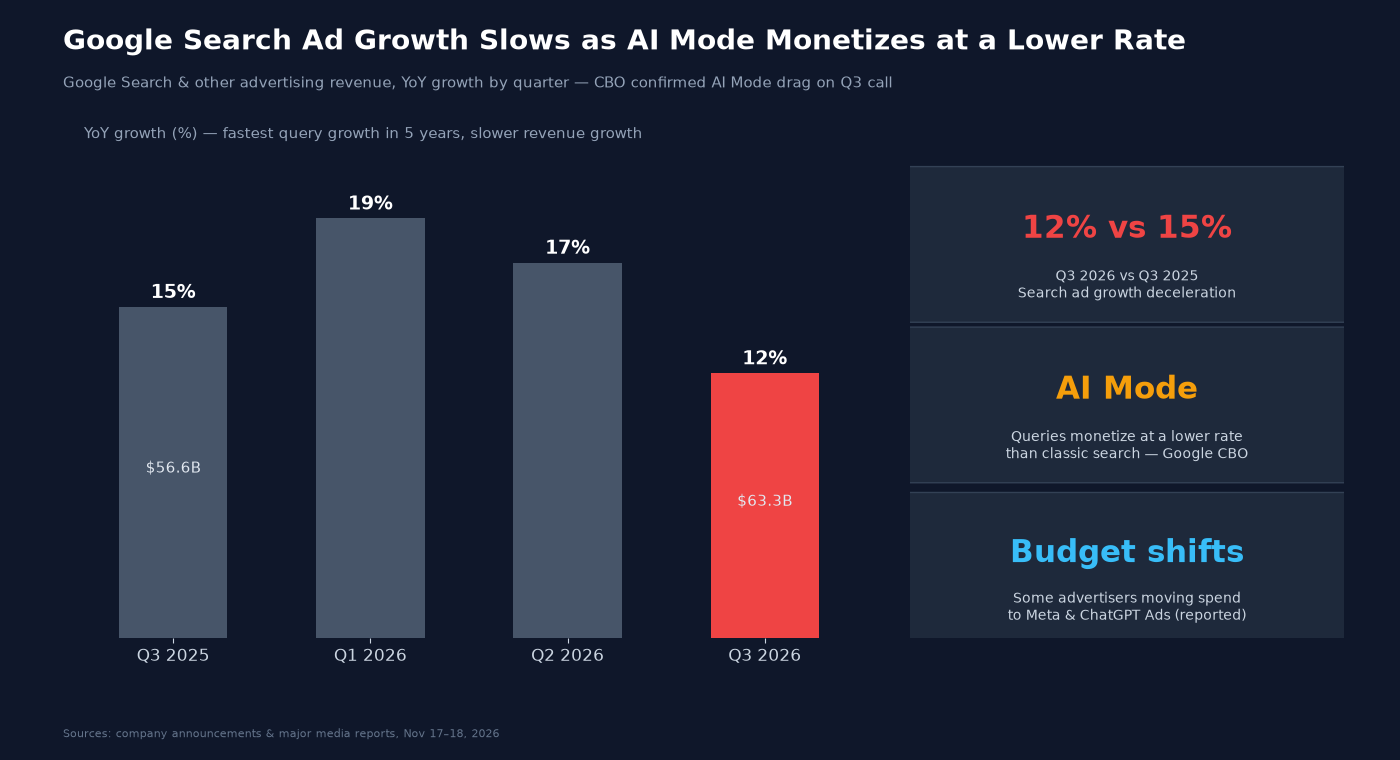
For years, the scariest question hanging over Google’s business was hypothetical: what happens to the world’s most profitable ad machine when an AI answer replaces ten blue links? On its third-quarter earnings call, Google finally answered in public — and the answer was uncomfortable. Chief business officer Philipp Schindler told investors that the explosive growth of AI Mode queries was weighing on search revenue growth because those queries monetize at a lower rate than classic search results. It was a rare moment of a platform admitting that its own flagship AI feature is cannibalizing its core product.
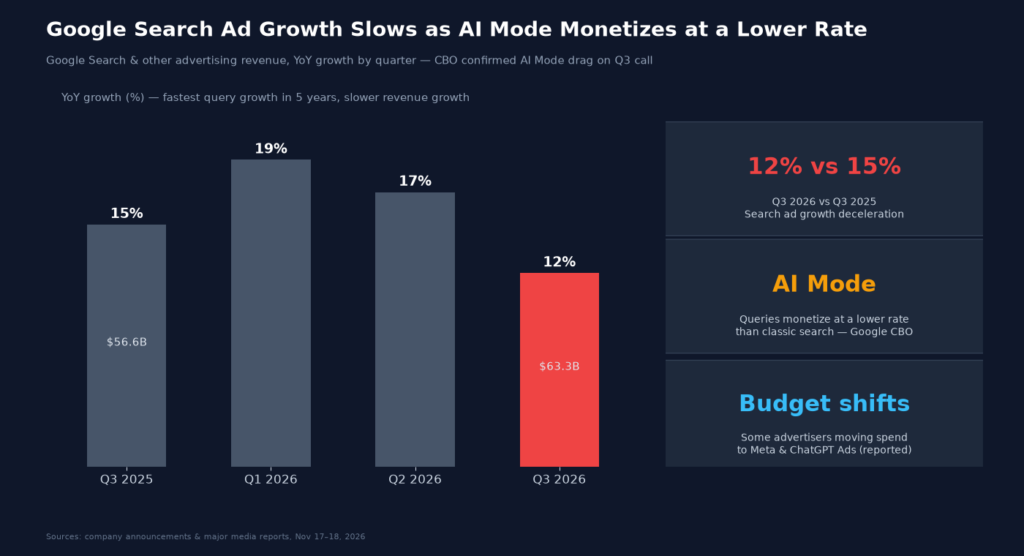
The numbers frame the confession. Google Search and other advertising revenue grew 12% year over year in the third quarter of 2026, reaching $63.3 billion. That is still a growth rate most companies would envy. But it decelerates a clear trend line: 19% in the first quarter of 2026, 17% in the second, and 12% now — against 15% in the same quarter a year earlier. The paradox is that query volume is growing at its fastest pace in five years. People are asking Google more questions than ever. Google is simply earning less per question.
Why an AI answer is worth less than a results page
The mechanics are straightforward once you look at the inventory. A classic search results page can carry several labeled ads — top, bottom, shopping units, sitelinks — each a separately auctioned slot. An AI Mode response is a synthesized answer. Google has been experimenting with ads inside and around these answers, and in late October it announced a multi-turn ad format for the U.S. that places sponsored content within conversational flows. But a conversational answer naturally accommodates fewer commercial interruptions than a page of links, and users in “answer mode” behave differently from users in “shopping list mode.” Fewer slots, different intent, lower revenue per query. Multiply that by hundreds of millions of AI interactions and the drag becomes visible in a $63 billion quarterly line item.
This is not a Google-specific flaw; it is the structural economics of generative interfaces. Every platform replacing lists with answers faces the same compression. What makes Google’s admission significant is scale and honesty: the company is telling advertisers and investors, ahead of the holiday season, that its AI transition has a real revenue cost.
The budget shift is anecdotal — but it’s spreading
Reporting from The Information, summarized by AdExchanger, describes advertisers who concluded their Google spend was no longer delivering and moved budget to Meta. Inc.’s reporting quotes agency leaders describing 2026 as the first year Google faces genuine competitors for performance budgets — ChatGPT’s ad business and Meta’s automated creative systems among them. These are account-level stories, not a measured market-wide migration, and should be read as such. But direction matters in media buying. When enough practitioners share the same story, procurement teams start running the tests that turn anecdotes into allocation.
Meanwhile, the alternative inventory is multiplying fast. ChatGPT’s visual ads began appearing after OpenAI’s early-October announcement. Microsoft is showing ads atop responses inside Bing’s AI Mode and AI Overviews. Google itself is expanding AI Mode ads internationally while rolling out multi-turn formats at home. The AI search ad market is being built in public, in a scramble, with limited inventory and unproven measurement — which is exactly the kind of moment when early, disciplined testers earn an edge.
What this means for marketers before Black Friday
Three practical implications follow from Google’s admission.
First, watch delivery before cost. When a platform’s new format throttles how widely your ads can serve, the symptom shows up as under-delivery long before it shows up in cost per result. If your search campaigns suddenly struggle to spend budget on queries that used to convert, check whether those queries are now being answered by AI surfaces with thinner ad coverage. That is a placement problem, not a bidding problem.
Second, treat AI surfaces as a portfolio, not a replacement. The honest read of the data is that classic search still grows 12% and still carries the overwhelming majority of commercial intent. The right posture is to defend proven search campaigns through the holiday peak while allocating a small, ring-fenced test budget to AI placements — ChatGPT ads, Bing AI Mode, Google’s multi-turn format — with enough spend per format to produce a readable signal. Spreading a token budget across five new surfaces produces five inconclusive tests.
Third, invest in being the answer. If AI interfaces compress paid inventory, the brands that get named inside the generated answer itself capture demand that no auction can reach. That is the case for generative engine optimization: structured, quotable, fact-dense content — pricing pages, comparison tables, FAQs, verified statistics — that AI systems can lift and attribute. As monetization per query falls, the non-paid real estate inside answers becomes relatively more valuable.
None of this means Google’s ad business is breaking. A company earning $63.3 billion a quarter from search can afford a transition. But the direction is now confirmed by the platform itself, and confirmed directions are what media plans should be built on. The advertisers who re-read their channel mix this quarter — rather than copying last year’s Black Friday spreadsheet — will be the ones who notice the shift while it is still cheap to adapt.