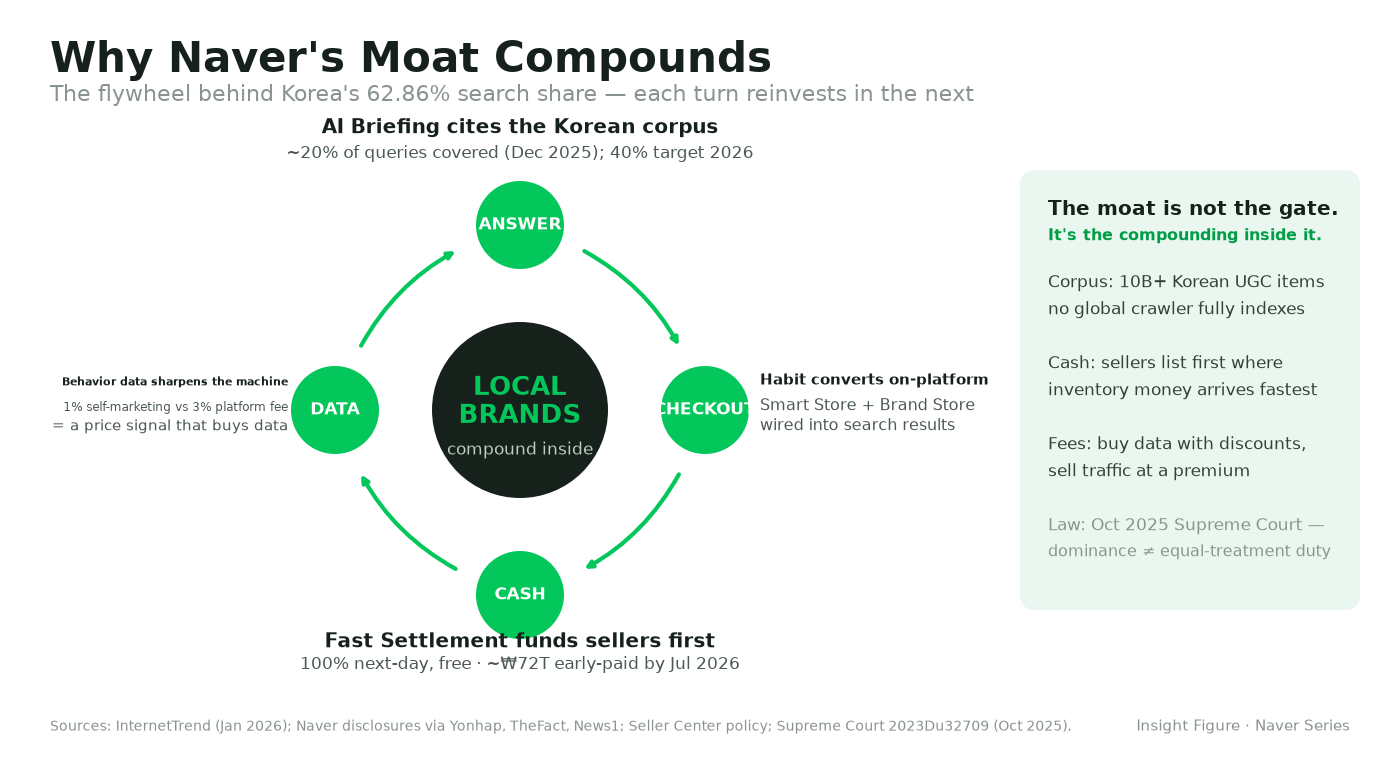
Here’s the puzzle every global brand gets wrong about Korea. Naver’s search share grew back to 62.86% in 2025, its AI answers cite only trusted Korean sources, and its shopping machine compounds. The instinct is to call it a wall — language, policy, patriotism. But walls are static. What Naver built is a flywheel, and the difference explains why twenty years of Google’s best efforts produced a 29.55% plateau instead of a conquest.
The mechanism is a closed loop of four reinvestments, and each turn makes the next turn cheaper.
Start with the corpus. Two decades of Korean blogs, cafés and Knowledge iN answers — more than 10 billion user-generated items by the company’s own count — are not just content. They are training data that no global crawler fully indexes. When Naver launched AI Briefing in March 2025, it didn’t have to buy authority; it inherited it. The AI cites hospitals, filings and institutions that already live inside the garden. Every answered query keeps the user on-platform, which generates more behavior data, which sharpens the next answer. Google’s index is the open web. Naver’s index is a habit.
The habit converts because of cash. Fast Settlement pays sellers 100% of proceeds the day after shipping starts — free. By July 2026 that rail had moved roughly ₩72 trillion early, across some 160,000 sellers, 93% of them micro-businesses. Think about what that does to seller psychology: the platform that funds your inventory fastest becomes the platform where you list first, price best and answer fastest. Better sellers produce better reviews; better reviews feed the corpus; the corpus feeds the AI. The loop closes.
Fees are the flywheel’s throttle, not its brake. The June 2025 redesign charges 1% when sellers bring their own customers and 3% when they ride Naver’s traffic — a price signal that says: market yourself, but do it inside our rails. Sellers who comply hand Naver the conversion data its recommendation engine needs; by May 2026, AI-recommended items drove over half of the Naver Plus Store app’s transaction value. The fee structure pays for the very data that makes the fee structure worth paying.
And the Supreme Court just told the regulator why this is hard to unwind. In October 2025 it reversed the KFTC’s self-preferencing fine, ruling that dominance alone creates no duty of equal treatment. You can legislate open access. You cannot legislate a corpus, a settlement habit, or a trained citation hierarchy into existence.
So the insight for any market watching any walled garden: the moat is not the gate. It’s the compounding inside the gate. Korea’s local brands stay local because every turn of Naver’s loop — answer, checkout, cash, data — reinvests in the next turn. Global brands don’t lose at the border. They lose on flywheel speed.