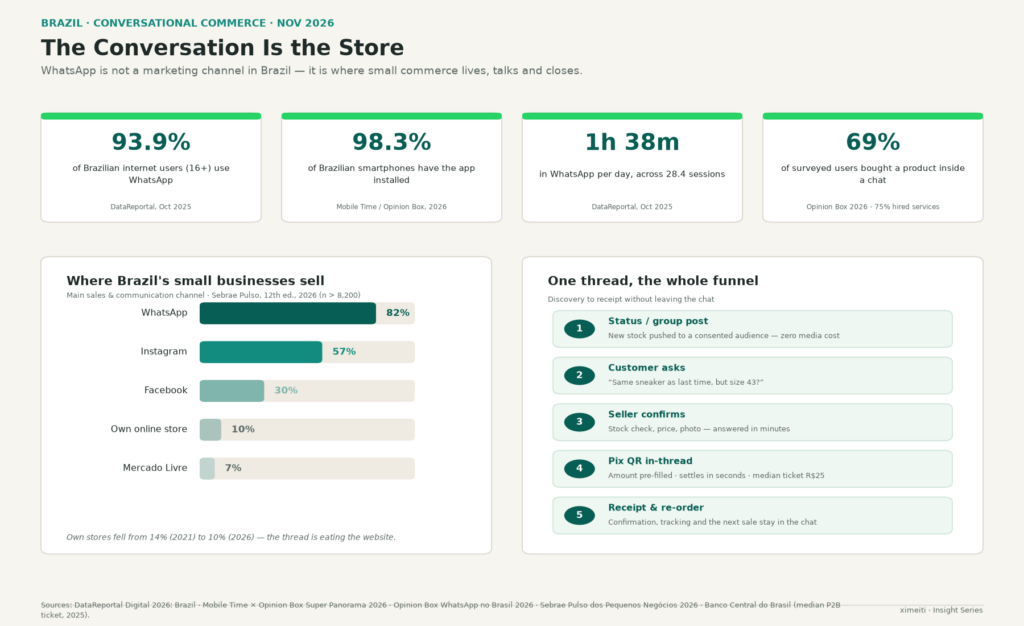
Brazil’s social-commerce headlines follow TikTok Shop and Instagram. The money follows something quieter: a WhatsApp thread that ends in a Pix QR code. WhatsApp sits on 98.3% of Brazilian smartphones and is used by 93.9% of the country’s internet users, according to the Super Panorama Mobile Time/Opinion Box 2026 survey and DataReportal’s Digital 2026 report. Sebrae’s 2026 small-business pulse finds that 82% of micro and small entrepreneurs name WhatsApp as their main sales and communication channel — well ahead of Instagram’s 57%, while standalone online stores slid to 10%. The unlock was Pix, the central bank’s free instant-payment rail: person-to-business payments grew from 6% of Pix transactions at launch to 45% by October 2026, per Banco Central do Brasil. Chat commerce converts purchases at roughly 9% versus 1–2% for traditional Brazilian e-commerce, in the OmniChat study reported by E-Commerce Brasil — and the OmniChat Chat Commerce Report 2026 finds AI-led conversations matching that 9% at human parity. Brazil did not attach a shop button to a social network. It put a central-bank rail underneath a century-old habit of talking to the shopkeeper, and the conversation became the store.
A Commerce Habit Older Than the App
Ask a Brazilian where they shop online and the survey answers say Mercado Livre, Shopee, Amazon. Ask them where they actually bought the sneakers, the cake, the phone repair, the dress for Saturday — and a surprising share of the answers live in a chat window.
This is not a new behavior. Brazilian commerce was conversational long before smartphones: the neighborhood shopkeeper who knows your size, the feira stall where you haggle, the phone call to the bakery. WhatsApp did not invent talking to the seller. It digitized a habit that already had a century of muscle memory.
That distinction matters because it explains why the pattern looks nothing like China’s feed-first discovery economy or America’s checkout-optimized storefronts. In China, platforms engineered a new behavior — scrolling a feed until desire appears. In Brazil, the behavior never needed engineering. It needed plumbing.
And for years, the plumbing was missing. Before 2020, a chat sale died at the moment of payment. A boleto took days to clear. A card form meant leaving the conversation, typing sixteen digits into a browser, and praying the customer came back. Cash on delivery carried risk for the seller. The conversation could create the sale; it could not close it.
Then the plumbing arrived — not from Meta, not from a startup, but from the central bank.
The Numbers Behind the Thread
Start with reach, because in Brazil the word “reach” undersells it. DataReportal’s Digital 2026: Brazil report, published in November 2025 with October 2025 data, counts 185 million internet users — 86.9% of the population — and finds WhatsApp used by 93.9% of internet users aged 16 and above, ahead of Instagram at 91.2%. Brazilians spend an average of 1 hour 38 minutes a day inside WhatsApp, across 28.4 separate sessions. Nearly twenty-nine times a day, the average user opens the app where the shopkeeper also lives.
The Super Panorama Mobile Time/Opinion Box 2026 survey — 4,138 smartphone owners, fielded in March 2026 — puts WhatsApp on 98.3% of Brazilian smartphones, with 97% of users opening it daily or almost daily. Absolute user counts are estimates rather than company disclosures; Statista figures cited by Valor Econômico and O Tempo cluster around 147–148 million, which makes Brazil the app’s second-largest market after India — a ranking Brazil’s own antitrust authority CADE noted back in its 2020 review of WhatsApp payments.
Now the seller side. Sebrae’s Pulso dos Pequenos Negócios, twelfth edition — more than 8,200 entrepreneurs surveyed in February and March 2026 — asked micro and small businesses to name their main sales and communication channel. WhatsApp: 82%. Instagram: 57%. Facebook: 30%, down from 42% in Sebrae’s November 2021 pandemic-impact study. Their own virtual stores: 10%, down from 14% in 2021. Mercado Livre: 7%. Read that trajectory again: over five years, while every platform vendor on earth was selling website builders to small merchants, the share of Brazilian small businesses relying on their own online store fell by nearly a third. The thread ate the website.
And the buyer side confirms the loop is closed, not just open. Opinion Box’s WhatsApp no Brasil 2026 survey — roughly 1,000 smartphone users, fielded June–July 2026 — reports that 69% of respondents have bought a product through WhatsApp (58% more than once), 75% have hired a service through it, and 77% regularly talk to brands on the app. This is not a funnel experiment. It is a purchasing habit with repeat behavior.
Pix: The Rail That Made Conversations Closable
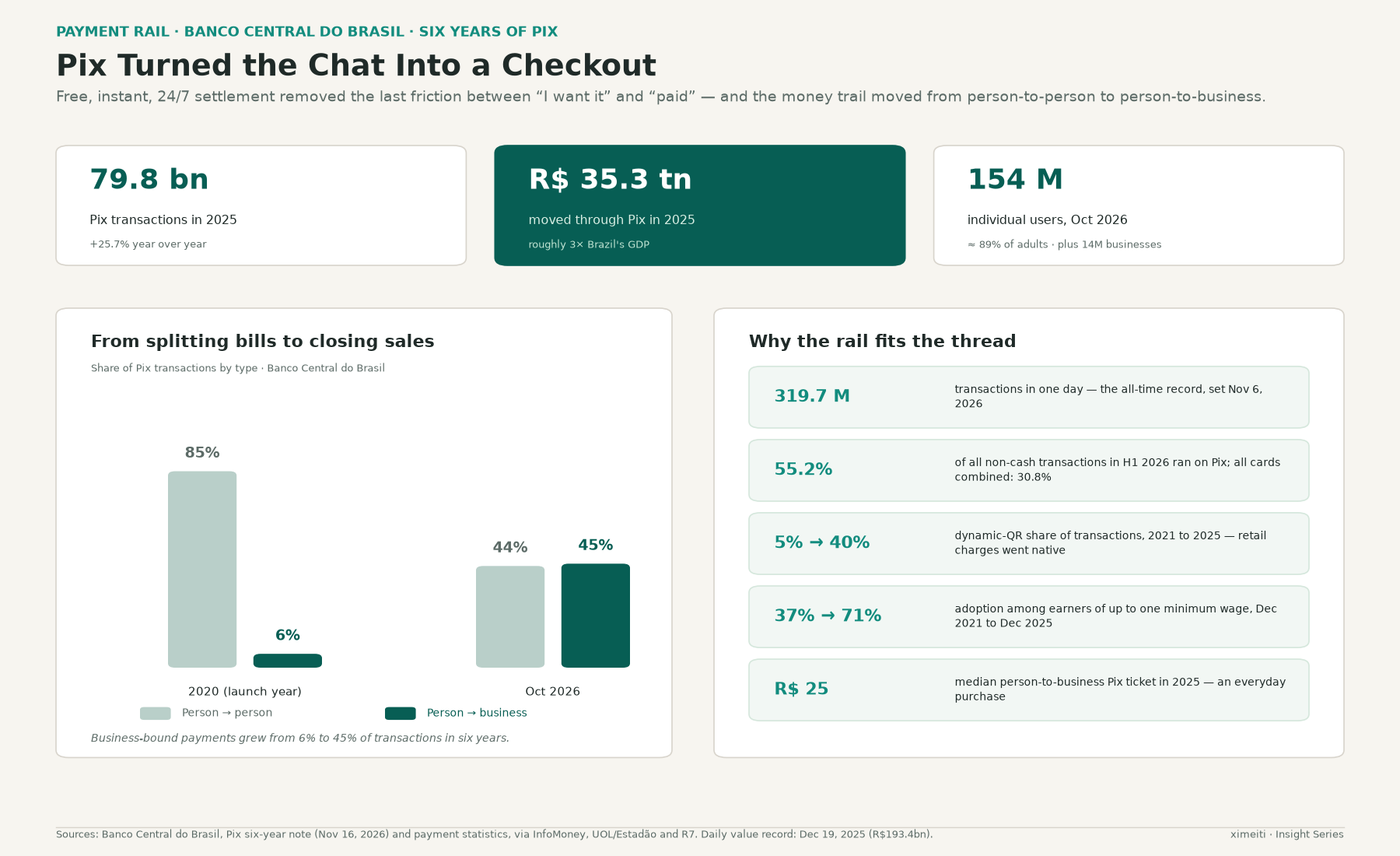
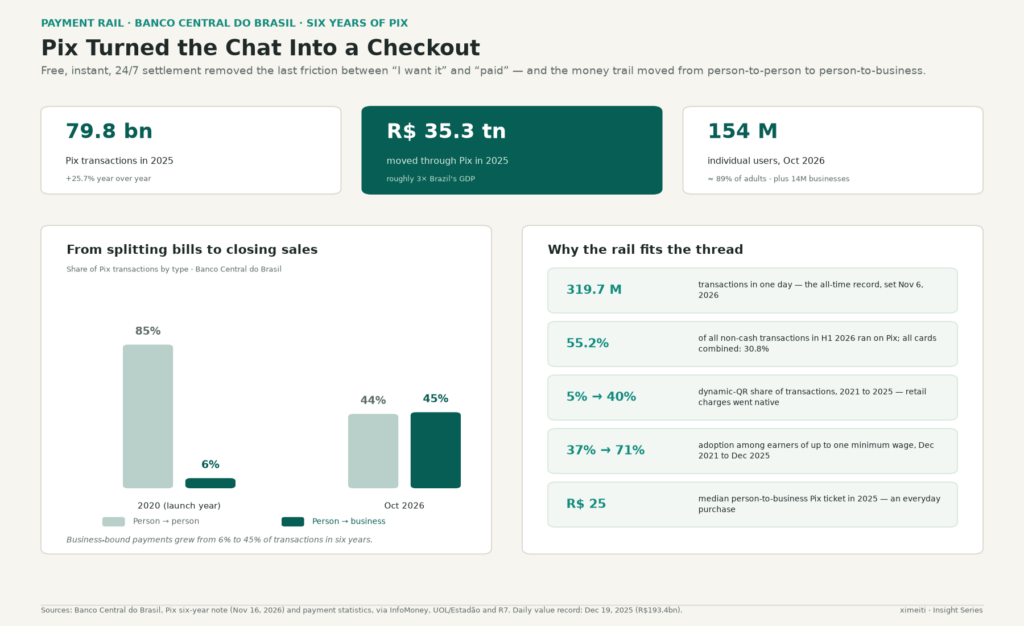
Pix launched in November 2020 as the Banco Central do Brasil’s instant-payment system: free for individuals, available 24/7, settling in seconds. Six years on, the central bank’s own anniversary figures — released November 16, 2026 — describe something closer to national infrastructure than a payment app.
In 2025, Pix processed 79.8 billion transactions, up 25.7% year over year, moving R$35.3 trillion — roughly three times Brazil’s GDP. In the first ten months of 2026 it ran at 76 billion transactions, up another 17.6%. On November 6, 2026, it set an all-time daily record of 319.7 million transactions in a single day. By October 2026, 154 million individuals — about 89% of Brazil’s adult population — plus 14 million businesses were using it, with more than a billion registered Pix keys.
But the statistic that matters most for commerce is not the volume. It is the composition. At launch in 2020, 85% of Pix transactions were person-to-person and just 6% were person-to-business. By October 2026, per the central bank’s data, person-to-business payments had climbed to 45% of transactions while person-to-person fell to 44%. The median person-to-business Pix ticket in 2025 was R$25 — the price of a lunch, a phone case, a kilo of açaí. Dynamic QR codes, the retail-style charge a seller generates with the amount pre-filled, grew from 5% of transactions in 2021 to 40% in 2025.
Read those three numbers together — 45% business share, R$25 median ticket, 40% dynamic QR — and you are looking at a checkout counter, not a money-transfer app. Pix quietly became the point-of-sale system of informal and small formal commerce alike. And because it lives inside any app that can display a QR code or a copy-paste key, it slid into the WhatsApp thread without asking permission.
The economics for a chat seller are almost unfair. The customer says “quero esse” — I want that one. The seller sends a QR code with the amount already filled in. The customer pays in their bank app in seconds, the money lands instantly, and the receipt screenshot goes back into the same thread. No website. No card form. No waiting three days for a boleto to clear. No payment-processing percentage skimmed off a R$25 sale. The rail deleted the exact friction that used to kill chat commerce.
One clarification the hype cycle keeps getting wrong: the much-discussed “Pix Parcelado” is not a central-bank product. It is a family of bank credit products — the seller receives the full amount instantly while the buyer pays in installments at roughly 5% monthly interest, with total effective costs around 8% a month. The central bank spent 2025 trying to standardize the product, postponed the rules repeatedly, and on December 4, 2025 abandoned the regulation entirely — even banning institutions from using the names “Pix Parcelado” and “Pix Crédito,” while permitting labels like “Pix no crédito.” Consumer-defense institute Idec called the retreat unacceptable. For sellers, the practical takeaway is simpler than the regulatory saga: installment-powered chat selling exists and moves financed baskets, but it is bank credit riding the Pix rail, priced accordingly — not free money.
Why the Thread Converts: Four Engines Under One Roof
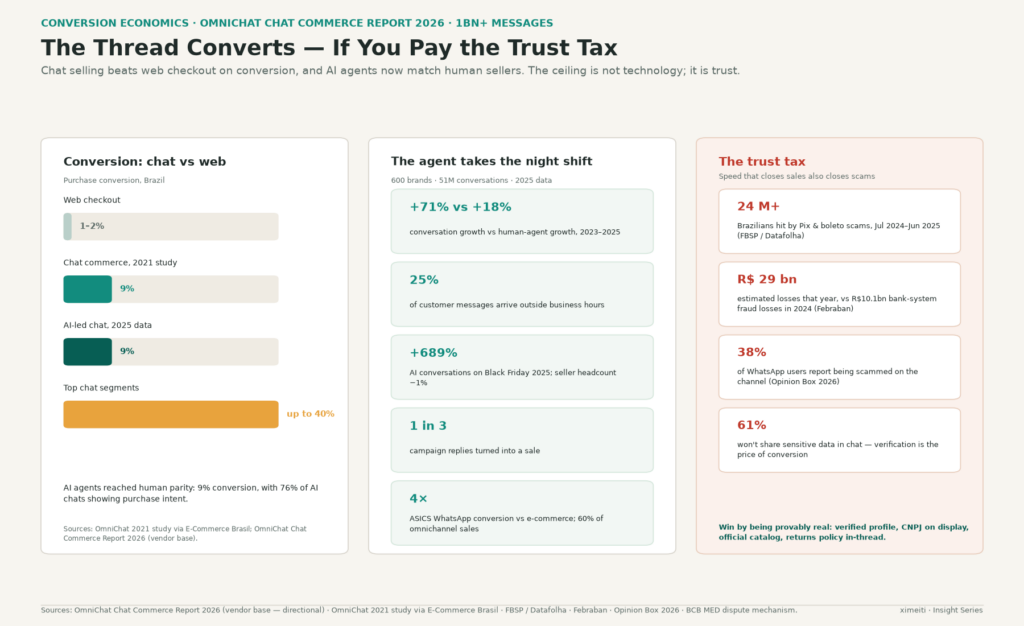
Conversion is where the story stops being cultural and starts being financial. E-Commerce Brasil reported in January 2022 on a study by conversational-commerce platform OmniChat covering more than 400 companies — L’Oréal, Decathlon, Leroy Merlin among them — across 10 million consumers and roughly 18 million interactions in 2021. Purchase conversion in chat commerce averaged 9%, against 1–2% for traditional e-commerce, reaching as high as 40% in some segments. Treat the top end as segment-specific, but the central comparison — roughly five times web conversion — has held up: OmniChat’s Chat Commerce Report 2026, built on more than a billion messages across 600 brands, still finds AI-agent-led conversations converting at 9%.
Why does a chat window beat a polished storefront? Four engines, working together.
Engine one: intent compression. A website makes the customer do the work — browse, search, filter, compare, hesitate, abandon. A thread starts after all of that. The customer arrives having already decided: “the same sneaker as last time, but size 43.” The seller confirms stock, names the price, sends the charge. The funnel collapses from browse-search-cart-checkout to ask-confirm-pay. Every step you delete is a step where doubt cannot enter.
Engine two: trust through dialogue. Web commerce outsources trust to scaffolding — reviews, ratings, brand pages, return policies written in legalese. Chat commerce builds trust the way the feira always did: a named human answers in minutes, sends a photo of the actual product on request, tells you honestly that the blue one is out of stock. Opinion Box’s 2026 data shows 77% of users already treat brand chats as normal. The dialogue is the review section.
Engine three: Pix as the closing rail. Covered above, but worth restating in conversion terms: payment happens without leaving the conversation, in seconds, with the amount pre-filled and an instant receipt. The moment of highest abandonment in any funnel — the checkout — barely exists here.
Engine four: Status and groups as the demand engine. Brazilian sellers post new stock to WhatsApp Status — the Stories equivalent — and to community groups. This is push distribution to a consented audience at zero media cost. No auction, no ad budget, no algorithm tax. It is the private-domain pattern with a Brazilian accent: the audience is yours because they saved your number, and a block is the only unfollow that matters — permanent, silent, and entirely their choice.
One honest caveat before you screenshot the 9% figure: these are vendor-platform numbers drawn from companies that chose conversational commerce, not a randomized national census. The direction is corroborated by the behavioral surveys — 69% have bought, 58% bought again — but the precise multiple will vary by category, ticket size and how warm the lead is. The insight is the mechanism, not the decimal.
The 2026 Update: AI Agents Take the Night Shift
The obvious objection to chat commerce has always been labor. A shopkeeper can hold maybe a few dozen conversations a day. The habit does not scale; the human does not clone.
That objection is being dismantled in real time, and the OmniChat Chat Commerce Report 2026 — released in April 2026 on 2025 data from 600 brands, 51 million conversations and 22 million unique consumers — is the best available x-ray. WhatsApp carries 96% of commercial conversations on the platform. Message volume grew 28% year over year; total conversations grew 71% between 2023 and 2025, while human agent capacity grew only 18%. Something had to absorb the gap, and it was AI: conversations handled by agents convert at 9%, matching human sellers, with 76% of AI conversations showing purchase intent.
The operational details are where sellers should pay attention. A quarter of customer messages — 25% — arrive outside business hours; the agent is the night shift that used to be lost revenue. On Black Friday 2025, AI-handled conversations on the platform rose 689% while seller headcount fell 1%. One in three replies to a campaign message turned into a sale. Cart-recovery flows delivered returns up to 176 times spend on an average ticket of R$619 — vendor-reported, selected clients, but the shape is unmistakable. ASICS, in the same report, attributes 60% of its omnichannel sales to WhatsApp, converting at four times its e-commerce rate.
Notice what the automation is not doing. It is not replacing the conversation with a decision-tree bot. The winning systems understand colloquial Portuguese — “manda aquele mesmo tênis, mas no 43” — check real stock, generate a real charge, and hand the exceptions to a human. Brazilians have a name for one-to-one selling with a salesperson who knows you: “venda no x1.” The agent scales the x1; it does not turn it into a call center.
The tooling layer is industrializing around exactly this. VTEX acquired the Brazilian AI-service company Weni in September 2024, keeping it as an independent unit with an outcome-based pricing model — a success fee tied to interactions the AI actually resolves. Its documented flows include supermarket chain Prezunic asking customers, inside WhatsApp, whether they will accept a substitute product when an item is out of stock. Meta, for its part, announced business-AI expansion at its July 2025 Conversations event starting with Mexico and the Philippines; Brazilian SMBs got Business AI availability around late February 2026, per Mobile Time’s coverage of Meta’s WhatsApp Sessions event. Then, at Conversations London in June 2026, Meta launched the Business Agent globally after pilots in India, Mexico and Brazil that signed up more than a million businesses — an agent that answers, recommends from the catalog, books appointments and closes sales, with human takeover. Meta says WhatsApp hosts over 200 million small-business users worldwide, and its paid business messaging reached roughly a $2 billion annual run rate as of December 2025. The world’s largest messaging company has decided that the thread is a storefront — and Brazilian shopkeepers got there first, manually, years earlier.
What Everyone Gets Wrong
Mistake one: the chatbot-is-the-strategy error. Rigid menu bots — “type 1 for sales, 2 for support” — insult the habit. Brazilian consumers notice bots and tolerate them only when they behave like the shopkeeper. In Opinion Box’s 2026 survey, among users who realized they were talking to automation, 52% continued the conversation anyway and 43% asked for a human — tolerance is conditional on competence, and the escape hatch must be one message away. The separate Super Panorama survey scores chatbot satisfaction at a mediocre 5.6 out of 10. Automate the habit; do not replace it with a phone tree.
Mistake two: the website-first playbook. The reflex of global e-commerce advice is to graduate small sellers onto Shopify-style stores. In Brazil, the data says the graduation is a demotion: own-store reliance among small businesses fell from 14% to 10% while WhatsApp climbed to 82%. A browser detour inserts steps between “I want it” and “paid” — and every inserted step is where the 1–2% web conversion rate comes from. The site can exist as a catalog and a credibility anchor. The thread is home.
Mistake three: dismissing chat commerce as unmeasurable informal trade. It looks invisible because it does not happen in a dashboard. But Pix digitized the money trail — the central bank can see 45% of its transactions flowing to businesses, with median tickets and QR types — and formalization tools (MEI registration, in-thread electronic receipts) keep spreading. The data exists even when your analytics suite cannot see it. If your measurement plan cannot observe a Pix QR in a chat, your measurement plan is blind to nearly half of Brazil’s payment evolution.
Mistake four: assuming in-chat payments run on Pix because everything else does. They do not. WhatsApp’s own payment feature has a bruising Brazilian history: launched June 15, 2020, suspended by the central bank within eight days over competition concerns, reauthorized for person-to-person transfers only in March 2021, and cleared for merchant payments in March 2023 with processors like Cielo, Getnet and Mercado Pago. Crucially, in-chat purchases ride Visa and Mastercard rails — there is no confirmed native Pix integration inside WhatsApp checkout, and no evidence the native feature has reached mass scale. The dominant pattern remains the informal one: a Pix key or QR pasted into the conversation, paid in the customer’s bank app. The central bank built the rail; the thread borrowed it. Do not confuse Meta’s card-based feature with the country’s actual checkout.
The Trust Tax: Fraud Is the Category’s Conversion Ceiling
Here is the uncomfortable symmetry: the same speed that closes a sale closes a scam. Pix settles instantly and, by design, is hard to reverse. A fake profile wearing a real brand’s logo can take the money and vanish before the customer finishes typing “cadê meu pedido?”
The scale is documented, not anecdotal. The Fórum Brasileiro de Segurança Pública, with Datafolha, found that more than 24 million Brazilians were hit by Pix and boleto scams between July 2024 and June 2025, with losses estimated around R$29 billion — nearly triple the R$10.1 billion in fraud losses Febraban recorded across the banking system in 2024. Opinion Box’s 2026 survey found 38% of WhatsApp users reporting they had been victims of some scam through the channel, and 61% saying they are uncomfortable sharing sensitive data in a chat.
For honest sellers, this is not background noise. It is a conversion tax. Every customer who has been burned — or knows someone who has — arrives at your thread with a hand on the block button. The sellers who win pay the tax visibly: a verified business profile, the CNPJ tax ID on display, links to an official catalog, a returns policy stated in plain Portuguese inside the chat, consistent history in Status. And the infrastructure is catching up: the central bank’s MED refund mechanism for fraud gained a self-service contestation button in October 2025, giving victims a path to recovery that did not exist when Pix launched.
The strategic reading: trust verification is not compliance overhead in Brazilian chat commerce. It is the differentiator. In a channel where anyone can impersonate anyone, being provably real is the entire brand.
The Playbook: How Brands Should Actually Operate
Translate the mechanism into operations and five rules fall out.
Design thread-native, not thread-redirected. Catalog, dialogue, Pix charge, receipt — all inside the conversation. Every outbound link is a leak. If you must send a link, send it as proof (the official catalog, the tracking page), never as the place where the sale happens.
Set response-time SLAs in minutes, and staff the gaps. A quarter of messages arrive outside business hours; Mondays alone carry roughly a fifth of weekly volume in OmniChat’s data. The agent handles the night shift and the Monday spike; humans handle the exceptions and the relationship. Measure time-to-first-response the way you measure page-load speed — because in this channel, it is the page-load speed.
Treat Status and groups as owned media with a frequency contract. Opinion Box’s respondents named once a week as the ideal brand-contact frequency (33%), and 11% want no messages at all. Segment, ask, and respect the block. A consented audience is an asset; a blasted audience is a countdown.
Automate the habit in colloquial Portuguese. The agent must parse “aquele mesmo” — the same one as last time — against real order history and real stock. Outcome-priced tooling (pay for resolved interactions, as Weni by VTEX charges) aligns the vendor’s incentive with yours. Keep the human handoff one tap away, and say so upfront; the 43% who ask for a human are not a failure state, they are a feature.
Pay the trust tax where the customer can see it. Verified profile, CNPJ, official catalog, in-thread returns policy, real photos on request. In a fraud-adjacent channel, authenticity signals are not decoration — they are the conversion rate.
The Counterarguments, and Where They Break
“It doesn’t scale past the shopkeeper.” True of manual chat; false of the habit. The 2026 data shows the labor ceiling lifting: conversations up 71% against 18% human-agent growth, AI at conversion parity, a million businesses piloting Meta’s agent. The ceiling was tooling, not behavior — and the tooling has arrived.
“TikTok Shop will eat it.” TikTok Shop went live in Brazil on May 8, 2025 — after invite-only onboarding began in April — with Arezzo, Natura, Boticário and Riachuelo at launch, aggressive shipping subsidies, and payments by card, boleto and Pix. It is growing fast in a market where TikTok claims around 126 million users. But watch what sellers actually do: feeds create demand; threads close it. The emerging Brazilian pattern is TikTok discovery followed by WhatsApp negotiation and Pix settlement — the same live-to-private-domain handoff visible across Asia. The surfaces are complements. The feed is the window display; the thread is the counter.
“Fraud will poison the well.” The losses are real and the fear is rational. But the arms race has visible momentum: MED’s self-service dispute flow, platform verification badges, consumer literacy compounding with every news cycle. China’s review economy went through the same trust panic and industrialized its way out. The sellers who invest in provable authenticity will inherit the customers the scammers burn. The tax is heavy; it is also a moat for those who pay it.
Conclusion: The Store Is a Conversation
Strip away the platform lore and Brazil’s lesson is unusually clean. A commerce culture built on dialogue met a payment rail built for immediacy, and the two snapped together like they had been waiting for each other. The result is not “social commerce” as the West defines it — content with a buy button — but conversational commerce in the literal sense: the message thread is the storefront, the negotiation table, the checkout and the CRM, all at a median ticket of R$25.
For global marketers, three things travel. First, measure the habit before you build the funnel: where trust is built by talking, a website is a detour, not a destination. Second, payment rails are strategy: Pix did more for Brazilian chat conversion than any creative optimization ever could, because it deleted the last step where doubt lives. Third, automation must scale the relationship, not substitute for it — the agent that converts at human parity does so by sounding like the shopkeeper, not like a menu.
Brazil’s messaging habit — spanning an estimated 147–148 million users — did not move commerce online. It moved commerce into the conversation, and the central bank, of all actors, made the conversation closable.