Every conversation about super-apps eventually circles back to WeChat. One app, one billion people, payments and groceries and government appointments. It became the template: win messaging, then swallow everything adjacent.
Kakao had the same starting hand. KakaoTalk reached roughly 49.67 million domestic monthly active users by Q3 2026 — in a country of about 51 million. It owned payments, a bank, mobility, webtoons, music, games. On paper, Korea’s WeChat was inevitable.
It didn’t happen. And the interesting part is that it didn’t happen for reasons you can actually point at: a regulator, a court date, a competitive map, and a capital structure that made fusion expensive.
Here’s the thesis I’ll defend across this piece. Kakao is the control group in the super-app experiment. Same assets, different constraints, different answer — gifting instead of a marketplace, federation instead of fusion, partnership AI instead of sovereign models. And in February 2027, that federation stops being a description and becomes two separately listed companies.
Start with the numbers, because they’re misreported everywhere
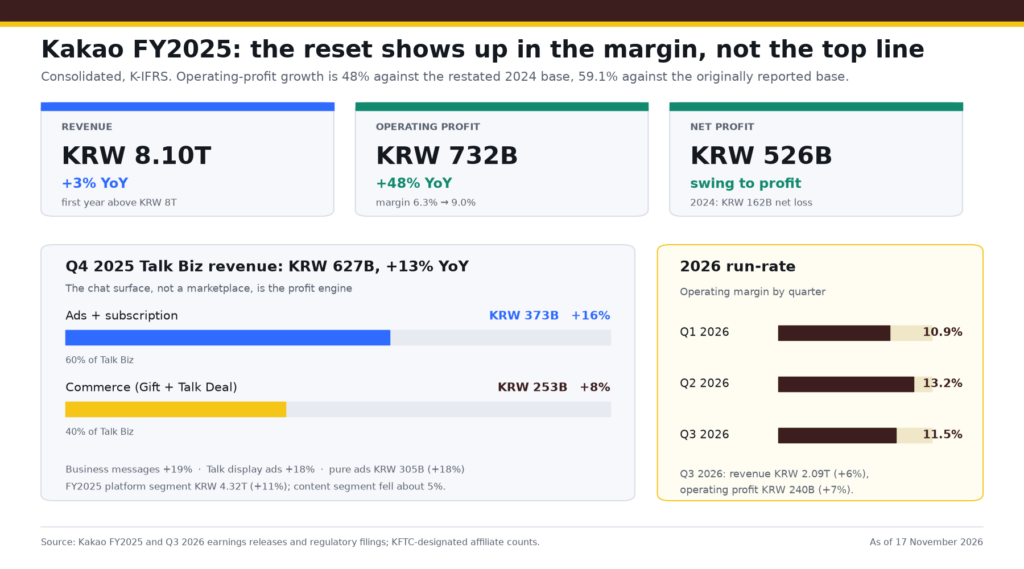
Kakao’s FY2025 was a record. Revenue crossed KRW 8 trillion for the first time — KRW 8.0991 trillion, up 3%. Operating profit hit KRW 732 billion. Net profit swung to KRW 526 billion from a KRW 162 billion loss in 2024.
Now, the trap. You’ll see operating profit growth quoted as 48% and as 59.1%, sometimes in the same week, sometimes in the same newspaper. Both are real. They’re different denominators.
Kakao sold its healthcare business to Cha Bio Group and reclassified those results as discontinued operations. The regulatory filing shows FY2025 operating profit of KRW 732.04 billion against a restated 2024 base of KRW 460.21 billion — that’s +59.1%. The company’s own press release compares against the pro-forma 2024 figure of KRW 495.3 billion, which gives +47.8%, rounded to 48%.
Same profit. Two bases. If you’re citing this in a deck, say which one you’re using. I’ll use the company’s headline 48% and flag the restatement, because that’s what the earnings call used.
The margin story is the real story: operating margin went from 6.3% to 9.0%. Revenue grew 3%. Profit grew far faster. That gap is the whole strategy in one line — Kakao got better by getting smaller.
The chat layer: saturation without attention
Let’s be precise about the asset, because the round numbers floating around are wrong.
Kakao’s Q4 2025 domestic MAU was 48.954 million, with global MAU at 54.048 million — meaning overseas users were about 5 million. By Q2 2026 global MAU crossed 55 million for the first time (55.346 million), with domestic at 49.631 million. Q3 2026 domestic sat around 49.67 million.
If you’ve seen “49.5 million domestic / 54.5 million global” quoted for Q4 2025, that pairing doesn’t match the filing-derived figures. Use the ones above.
But here’s the uncomfortable nuance. Ubiquity is not attention. WiseApp·Retail’s panel survey of Korean smartphone users found KakaoTalk was the most-used app in 2025 (January–November, roughly 48.23 million average monthly users) — yet YouTube led on total time spent, with KakaoTalk at about 32.4 billion minutes against Instagram’s 27.9 billion. IGAWorks Mobile Index data showed per-user monthly time falling from around 800 minutes in July 2021 to 674 minutes in August 2025.
These are panel estimates, not census counts, so treat the levels as directional. The direction is clear: Koreans open KakaoTalk constantly and live somewhere else.
Management knows it. On the Q4 2025 call, daily time spent had stabilised around 25 minutes, and the stated goal was a 20% engagement lift. Users of the AI services spent roughly four extra minutes a day. That’s the metric the AI bet is actually chasing.
The 2025 redesign that failed — and what it proved
In September 2025 Kakao shipped its biggest overhaul in fifteen years, internally called the Big Bang project. The Friends tab became an Instagram-style grid feed. The logic was pure super-app: more content surface, more ad inventory, more time.
Users hated it. Not abstractly — app-store ratings cratered to one star, and people circulated guides for blocking auto-updates. The core complaint was Korean and specific: KakaoTalk relationships include your boss, your landlord, your client. Nobody wanted their manager’s profile photos pushed into a feed.
Kakao announced a rollback within about a week and shipped it in mid-December 2025, restoring the list view by default and moving the feed into an optional tab.
Here’s what makes this genuinely instructive. Usage barely moved. WiseApp·Retail measured October MAU at 47.97 million, down 0.4% from August — inside the margin of error. Per-user monthly time did dip, from about 700 minutes in September to 678 in October.
So: enormous brand-satisfaction damage, essentially zero churn. That’s lock-in, demonstrated in the wild. And it’s a warning to every marketer who assumes a national chat layer is infinitely elastic. It isn’t. It’s a utility with a tolerance limit, and Kakao found it.
Why gifting, and not a marketplace
Look at the map before you judge the choice.
Naver closed FY2025 with revenue of KRW 12.035 trillion and operating profit of KRW 2.2081 trillion, with commerce revenue up 26.2% to KRW 3.6884 trillion. Coupang posted FY2025 revenue of about KRW 49.12 trillion (US$34.53 billion) with 24.6 million active customers in Q4.
One owns discovery. The other owns fulfilment. A general marketplace inside KakaoTalk would have fought both, on their strongest ground, with no logistics network of its own.
Gifting was the uncontested scenario. It’s native to chat in a way that shelf-shopping isn’t: you already have the relationship, you get a birthday notification, and — crucially — you don’t need the recipient’s address. They enter it themselves. That single design choice removes the friction that kills social commerce everywhere else.
FY2025 integrated commerce GMV reached KRW 10.6 trillion, up 6%. Q4 was the first KRW 3 trillion quarter, up 12%, with Gift GMV up 14% on Chuseok timing and year-end promotions.
Six percent is a mature number, not a hypergrowth one. Which is exactly why the next move matters.
The plot twist: gifting’s fastest growth is people buying for themselves
This is the part most English-language coverage still misses.
Kakao has spent roughly three years deliberately building self-purchase inside Gift. It started with a “For Me Week” promotion in April 2024, added a dedicated FOR ME tab in May 2025 with personalised rankings and exclusive coupons, and added a “my own money” ranking section in January 2026.
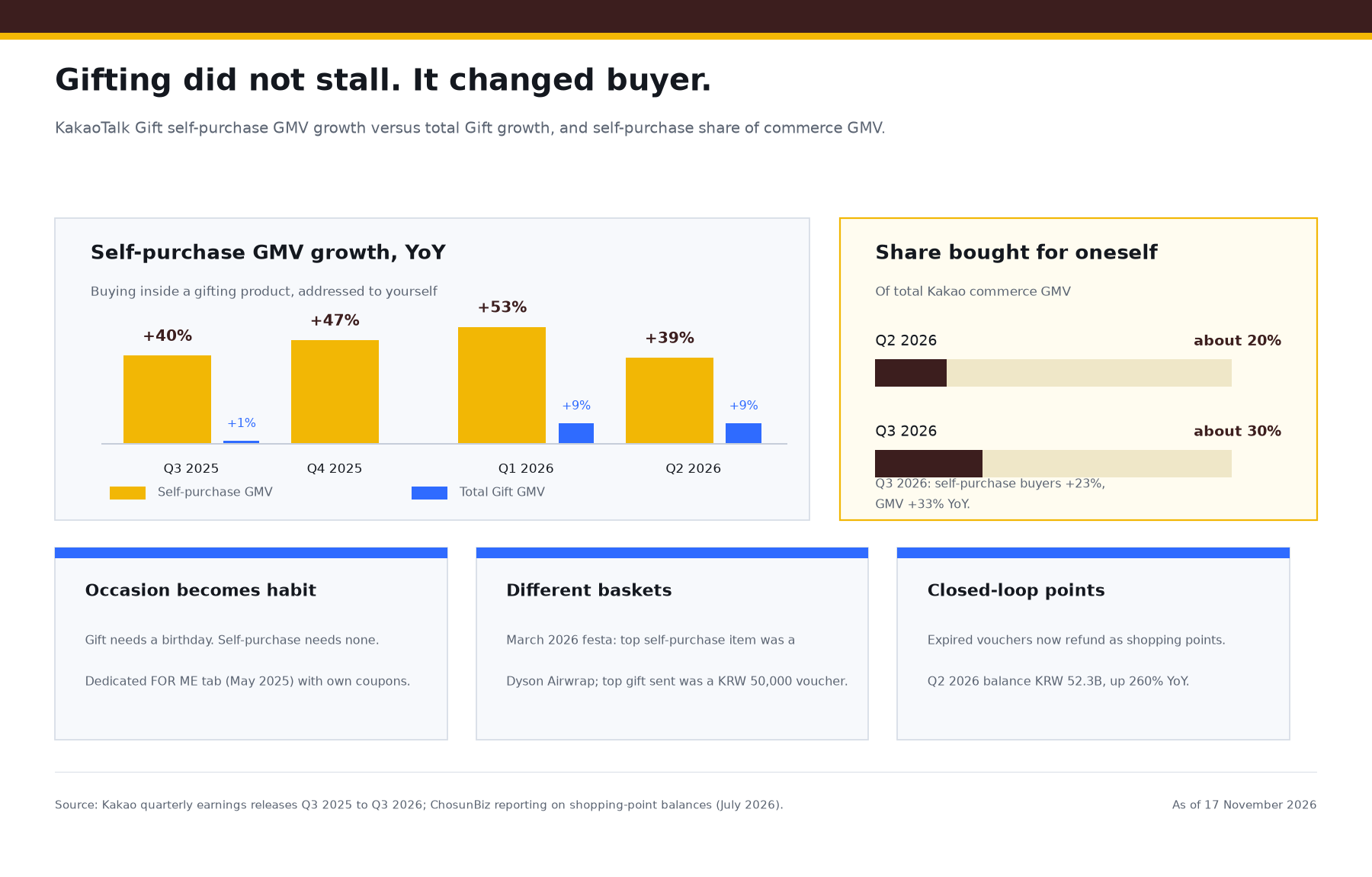
The results, from Kakao’s own quarterly disclosures: self-purchase GMV grew 40% in Q3 2025, 47% in Q4 2025, 53% in Q1 2026, and 39% in Q2 2026. In Q3 2026 self-purchase buyers rose 23% and GMV rose 33% year-on-year.
The share is what should make you sit up. Self-purchase was about 20% of Gift GMV in Q2 2026, and around 30% of total commerce GMV by Q3 2026. Gift overall hit its highest-ever monthly GMV in September 2026.
And the baskets differ in a way that’s almost poetic. During the March 2026 Shopping Festa, the top self-purchase item was a Dyson Airwrap. The most-sent gift to other people was a KRW 50,000 food-delivery voucher. We give others flexibility. We give ourselves taste.
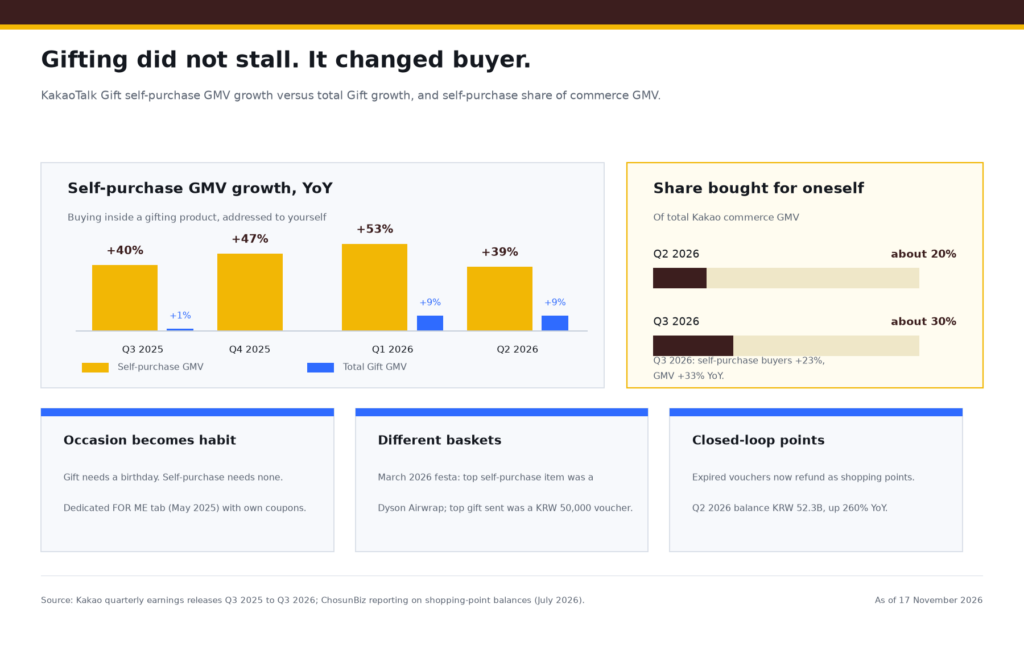
There’s a quiet mechanism underneath. Since October 2025, expired mobile vouchers refund as shopping points rather than cash. The shopping-point balance hit KRW 52.259 billion by end-Q2 2026, up 260.2% year-on-year, while outstanding voucher balances fell 4.1% to KRW 1.1078 trillion. Points can be cashed out, but they can also be spent immediately inside Kakao commerce. Refund became retention.
So the honest reading: Kakao avoided the marketplace war, then started drifting toward everyday shopping anyway — through the side door, framed as self-gifting. Whether that’s clever positioning or a slow collision with Naver and Coupang is the open question of 2027.
Fintech grew outside the chat window
WeChat embedded the wallet. Kakao listed it.
KakaoPay’s FY2025 transaction volume reached KRW 185.6 trillion, up 11%, on revenue of KRW 958.4 billion (+25%) — and it booked its first full-year operating profit, KRW 50.4 billion, with net profit of KRW 55.7 billion. Q4 volume alone was KRW 49.3 trillion.
By Q2 2026 the shape had changed again: revenue KRW 335.1 billion (+40.6%), operating profit KRW 58.6 billion (+528.2%), margin 17.5%. Financial services became 52% of revenue, overtaking payments for the first time. Offline payment crossed 6 million monthly users. Average revenue per user rose 38.7% to KRW 13,979.
KakaoBank tells a parallel story. FY2025 net profit was KRW 480.3 billion (+9.1%) on 26.7 million customers, with non-interest income breaking KRW 1 trillion for the first time (KRW 1.0886 trillion, +22.4%). By Q3 2026 it had 27.94 million customers and 20.57 million MAU.
One caveat worth carrying: KakaoBank’s nine-month 2026 net profit rose 25.2%, but roughly KRW 93.4 billion of that came from revaluing its Indonesian Super Bank stake. Strip that out and operating profit growth was about 8%. Don’t read the headline as underlying momentum.
The structural point stands. These are separately listed companies with minority shareholders. They cannot be folded into a chat window the way WeChat folded in payments. Capital structure enforced federation before strategy did.
The AI bet: rent the model, own the doorway
Kakao entered the LLM race late and made a deliberate trade.
ChatGPT for Kakao launched in October 2025 through the OpenAI partnership. It reached about 8 million users by Q4 2025 and roughly 13 million cumulative sign-ups by Q2 2026, averaging six messages and eight minutes per day. Kanana in KakaoTalk — built on Kakao’s own lightweight on-device model — went live in March 2026 after an iPhone-only beta, with retention climbing from about 70% to 80%.
Then came the second partnership. On the Q4 2025 call, CEO Shina Chung announced a strategic tie-up with Google for on-device Android optimisation, Android XR AI glasses, and discussions about operating TPU cloud capacity in Korea. Her framing was explicit: Google for devices, OpenAI for consumer AI, cover the stack without duplicating it.
This is the anti-Naver bet. Naver went sovereign full-stack. Kakao went distribution-sovereign, model-rented.
And Kakao pruned its own AI experiment: the standalone Kanana app and PC service shut down on 15 October 2026, folded back into KakaoTalk. One doorway, not two.
The honest ledger: AI is losing money and management said so
I want to be careful here, because the partnership story sounds smoother than the P&L.
Kakao’s AI segment posted an operating loss of KRW 64 billion in Q3 2026, wider than KRW 46 billion a year earlier. Management targets breakeven in 2028. The near-term goal is 10 million monthly active AI users by end-2026; the 2030 ambition is 20 million-plus daily active AI users.
On that same November call, Chung did something unusual for a Korean platform CEO. She said the pace of AI diffusion had fallen short of capital-market expectations and accepted the criticism as CEO.
The roadmap: Kanana Space, an AI hub invoked from anywhere in KakaoTalk, pilots in December 2026; an AI Crew agent for advertisers in closed beta the same month; Kanvas for PC task automation and Modu-ui AI, a government-consortium public-agent project, both slated for launch within the year.
Notice what AI Crew is for. It’s not consumer magic — it’s letting small advertisers who can’t run campaigns actually buy ads. That’s revenue plumbing, and it’s probably where AI monetisation lands first.
Regulation polices presentation, not just structure
In July 2025 the Korea Fair Trade Commission finalised a consent decree over KakaoTalk Gift. The issue wasn’t ownership. It was how a price was displayed.
Kakao had required suppliers to bundle shipping into the item price, show it as free shipping, and then charged commission on the whole amount — shipping included. Under the Large-Scale Retail Business Act, the KFTC accepted a voluntary remedy: suppliers may now separate item price from shipping and pay commission on the item price only. A KRW 10,000 item can display as KRW 7,000 plus KRW 3,000 shipping; the consumer still pays KRW 10,000.
Kakao committed roughly KRW 9.2 billion in supplier support — about KRW 6.4 billion in fee relief and KRW 2.8 billion in marketing. This was the first time the consent-decree mechanism, introduced in 2022, was applied to an online shopping mall.
And it hasn’t stopped. On 9 November 2026 the KFTC opened consent-decree proceedings for Kakao Mobility and Tmap over designated-driver insurance and grading practices, with roughly KRW 1.51 billion in driver support and KRW 1.265 billion in safety programmes proposed.
For marketers the lesson is blunt: in Korea, your creative’s price presentation is a compliance surface, not just a conversion lever.
The court date that could unwind a bank stake
Founder Kim Beom-su was arrested in July 2024 over alleged share-price manipulation during the 2023 SM Entertainment acquisition fight. In October 2025 the first-instance court acquitted him and Kakao entities, finding that large open-market purchases moving a price isn’t by itself manipulation.
Prosecutors appealed. In September 2026 they again sought 15 years and a KRW 500 million fine. The appeal verdict is scheduled for 20 November 2026 — three days from this writing.
Why should a marketer care about a securities case? Because of what Kakao itself wrote in its annual report.
Kakao holds about 27.2% of KakaoBank. Under the Internet-Only Bank Act, a non-financial shareholder holding above 10% must have no fine-level-or-heavier financial-law conviction in the past five years. Kakao disclosed that if such a penalty becomes final, the Financial Services Commission could order disposal of the stake above 10% — roughly 17.16 percentage points.
That’s not a hypothetical. It’s a company filing describing the mechanism. An acquittal on 20 November reduces the overhang; it doesn’t end it, because prosecutors can still appeal to the Supreme Court.
February 2027: the federation gets incorporated
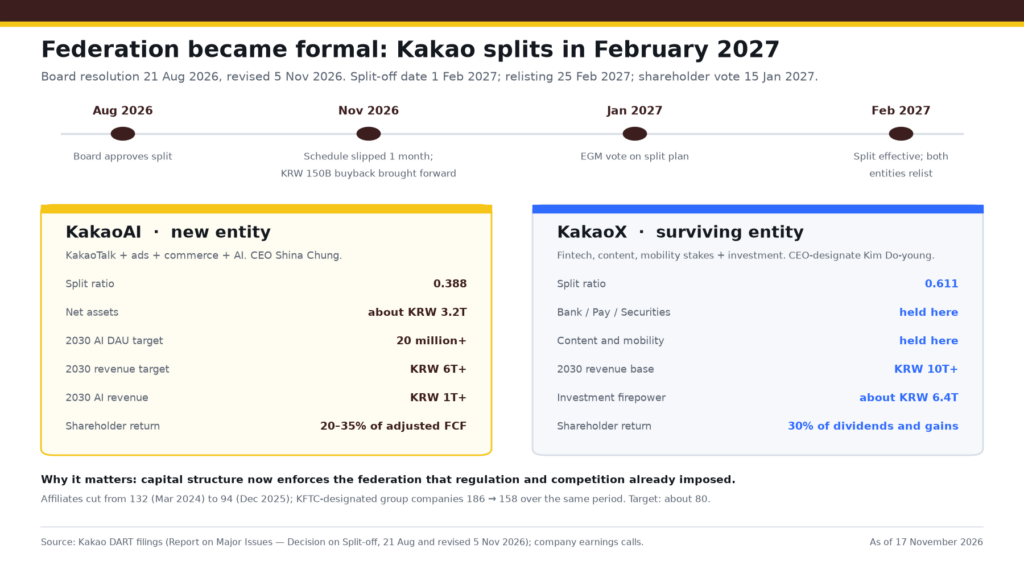
On 21 August 2026 Kakao’s board resolved to split the company. A revised filing on 5 November 2026 pushed the timeline back a month.
The current plan: an extraordinary shareholder vote on 15 January 2027, split effective 1 February 2027, relisting 25 February 2027.
KakaoAI (new entity, CEO Shina Chung) takes KakaoTalk, advertising, commerce and AI. Split ratio 0.388, net assets around KRW 3.2 trillion after an extra KRW 263.6 billion cash allocation. Targets: 20 million-plus AI DAU and KRW 6 trillion-plus revenue by 2030, with AI revenue above KRW 1 trillion. Shareholder returns of 20–35% of adjusted free cash flow, up to 40% if FCF grows more than 50%.
KakaoX (surviving entity, CEO-designate Kim Do-young) holds fintech, content and mobility stakes plus group investment. Split ratio 0.611, targeting a KRW 10 trillion-plus revenue base by 2030, returning 30% of subsidiary dividends and 30% of investment gains.
Kakao also brought forward KRW 150 billion of buyback-and-cancellation — half of the KRW 300 billion originally planned for after the split.
Why did they do it? Kakao’s own explanation is refreshingly unglamorous: over the past five years, 85% of non-routine board agenda items concerned subsidiary support and restructuring. The board was doing portfolio maintenance instead of strategy.
The affiliate count tells the same story. Domestic affiliates went from 132 in March 2024 to 94 by December 2025 — about a 30% cut. KFTC-designated group companies fell from 186 to 158 over the same span, and to 93 in the April 2026 disclosure round. The stated target is around 80.
Note the caliber difference: consolidated subsidiary counts, KFTC-designated affiliate counts, and domestic-only counts are three different numbers. When you see “150 to 94” or “119 to 94,” someone has mixed them.
What this means if you buy media or sell products in Korea
Build for occasions, then build for the self-gift. Two distinct creative briefs, not one. Gift-native means premium packaging, recipient-addressed, calendar-aware. Self-purchase means taste, scarcity, and a reason to buy on a Tuesday. The Dyson-versus-voucher split is your segmentation, handed to you free.
Treat business messaging as the performance spine. Business message revenue grew 19% in Q4 2025 and 20% in Q2 2026, with finance advertisers piling in. Talk display ads grew 35% in Q3 2026. This is CRM with an ad engine attached — and it runs under PIPA consent norms, so build your opt-in architecture before your creative.
Watch the affiliate and agentic surfaces early. Talk Affiliate — short-video creators tagging products that convert inside Gift — was trademarked in January 2026 and piloted with general users by early February, with commission terms written into the ad policy but rates unpublished. Kakao has also disclosed a Coupang Eats partnership for conversation-to-order flows. Get in before fee schedules settle.
Automate the reply, not just the send. The national chat layer is where Korean consumers ask questions. A campaign that generates messages and then leaves them unanswered is leaking the most expensive part of the funnel.
Get compliance into the creative review. The Gift shipping-fee case shows regulators looking at how a price is presented. Route price and shipping claims through legal before launch, not after.
Risks I’d actually price in
The gifting lane is drifting toward general shopping, which means drifting toward Naver’s and Coupang’s cost structures. Coupang’s own Q4 2025 showed how fragile that ground is — a data breach knocked active customers down 100,000 quarter-on-quarter and cut operating profit 97%.
AI is a real cash cost with a 2028 breakeven target and a partner-dependent stack. If agents become the gateway, Kakao’s toll depends partly on terms it doesn’t set.
The 20 November verdict is binary in the short run and unresolved in the long run. And attention keeps leaking to global apps even as functional ubiquity holds.
The takeaway
Kakao isn’t a failed WeChat. It’s a different answer to the same starting conditions — and the answer was shaped by things outside the product team’s control: two entrenched competitors, an activist regulator, minority shareholders in listed affiliates, and a founder’s criminal case.
What’s striking is that the constraints produced better economics. Revenue up 3%, operating profit up 48%, margin from 6.3% to 9.0%, and a commerce lane growing 39–53% in its fastest segment precisely because it refused to become a shelf.
The everything-app was never destiny. Sometimes the winning form is a scenario ecosystem that knows what it won’t do — and, from February 2027, has the corporate structure to prove it.
Same chat. Different choices. Different empire.