Nobody at the National Payments Corporation of India set out to build a media channel. They built plumbing — a bank-to-bank instant payment rail, free for consumers, free (until recently) for merchants, interoperable across every app and every bank. That was the whole pitch.
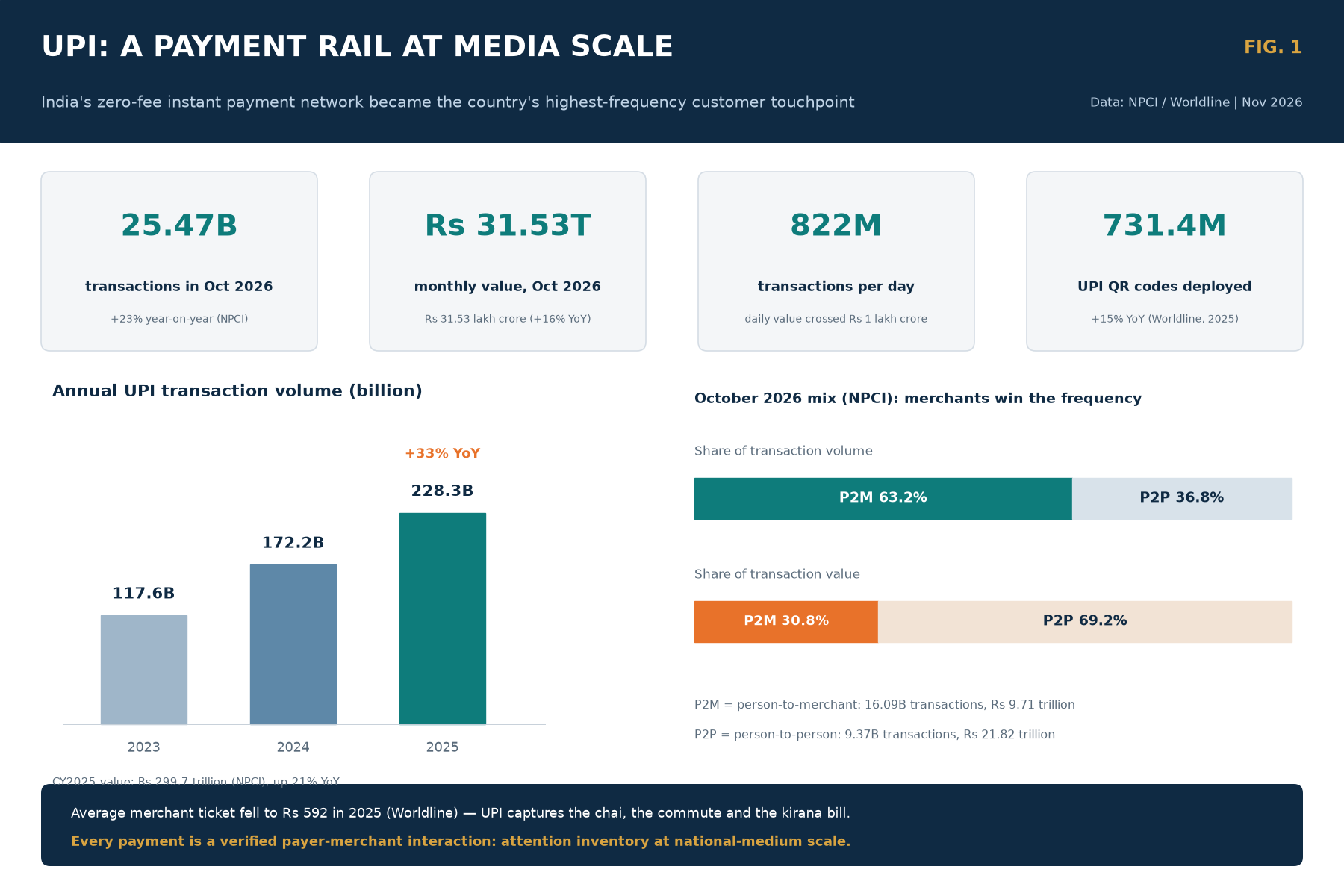
Then something strange happened. In October 2026, UPI processed 25.47 billion transactions worth ₹31.53 lakh crore — roughly $355 billion moving through a single rail in a single month, up 23% in volume year-on-year, according to NPCI data. The average day now carries 822 million transactions, and daily transaction value crossed ₹1 lakh crore for the first time.
Here is the reframe most marketing teams have missed: each of those transactions is a verified interaction between a known payer and a known merchant. Not an impression. Not a cookie. A completed commercial event with identity attached. Twenty-five billion of those a month is not a payments statistic — it is attention inventory the size of a national medium.
China built its growth loops inside super-apps. India is building them on top of a public rail. And the brands that understand the difference are quietly buying tomorrow’s prime media at today’s discovery prices.
The Scale: Reading the Numbers Like a Media Planner
Start with the trajectory. UPI closed calendar 2025 with roughly 228 billion transactions worth about ₹300 lakh crore (₹299.7 trillion), up 33% in volume from 172.2 billion in 2024, per NPCI data reported by Mint and The Hindu BusinessLine. PwC’s Indian Payments Handbook projected the rail would approach one billion transactions a day by FY2026-27 and carry 90% of India’s retail digital payment volumes. The October 2026 daily average of 822 million says that forecast is landing roughly on schedule.
But the number a media planner should stare at is not the total. It is the mix. NPCI’s October 2026 breakdown shows merchant payments (P2M) accounted for 63.2% of transaction volume — 16.09 billion merchant interactions in one month — while carrying only 30.8% of value. Personal transfers moved the big money; merchants won the frequency.
Worldline’s India Digital Payments Report puts a price tag on that frequency: the average merchant ticket fell to ₹592 in 2025, while overall average ticket size dropped 9% to ₹1,314. UPI is no longer where Indians pay rent. It is where they pay for chai, autos, groceries and the corner-shop bill — the small, repetitive purchases that used to be invisible cash. For a marketer, high-frequency low-ticket behavior is the holy grail: it is habit territory, and habits are where retention budgets earn their keep.
The Zero-Fee Anomaly — and Its 2026 Expiry Date
Why did this surface get so cheap? Because the rail itself was subsidized public infrastructure. Standard UPI carried no merchant discount rate (MDR) — contrast that with card networks, where merchants routinely pay processing fees measured in percentage points. When payment costs nothing and works everywhere, adoption compounds; when adoption compounds, the moment after payment becomes the cheapest verified attention in the economy.
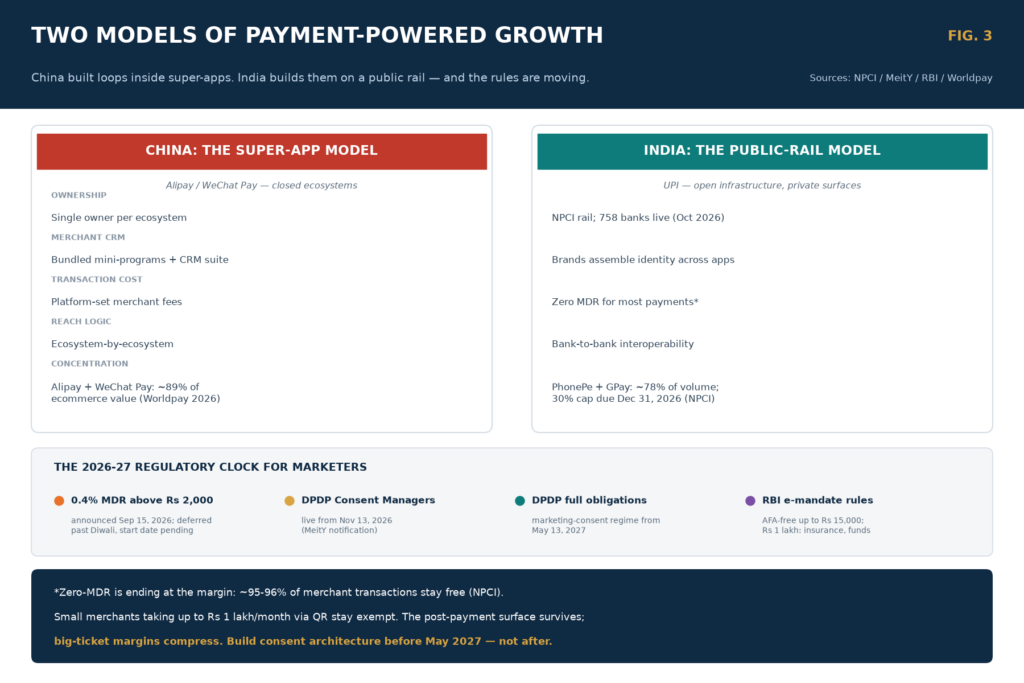
That anomaly now has an expiry date, and honest analysis has to say so. On September 15, 2026, NPCI published a framework introducing a 0.4% MDR on eligible merchant transactions above ₹2,000, capped at ₹300, with flat ₹5 fees for categories like railways, telecom, insurance and fuel, and a 0.02% rate for capital-market payments. Small merchants collecting up to ₹1 lakh a month through UPI QR codes stay exempt, and NPCI says roughly 95–96% of merchant transactions by volume remain untouched. The rollout, originally set for October 15, was deferred by the UPI and Services Steering Committee on October 13 until after Diwali; as of mid-November 2026, the start date is still pending.
The strategic read: the zero-fee era is ending at the margin, not at the core. The micro-ticket habit loop — the chai, the kirana run — stays free. Big-ticket merchants absorb a cost that still sits far below card economics. The marketing-surface logic survives; a slice of merchant margin compresses.
Surface One: The QR Code as an Acquisition Pixel
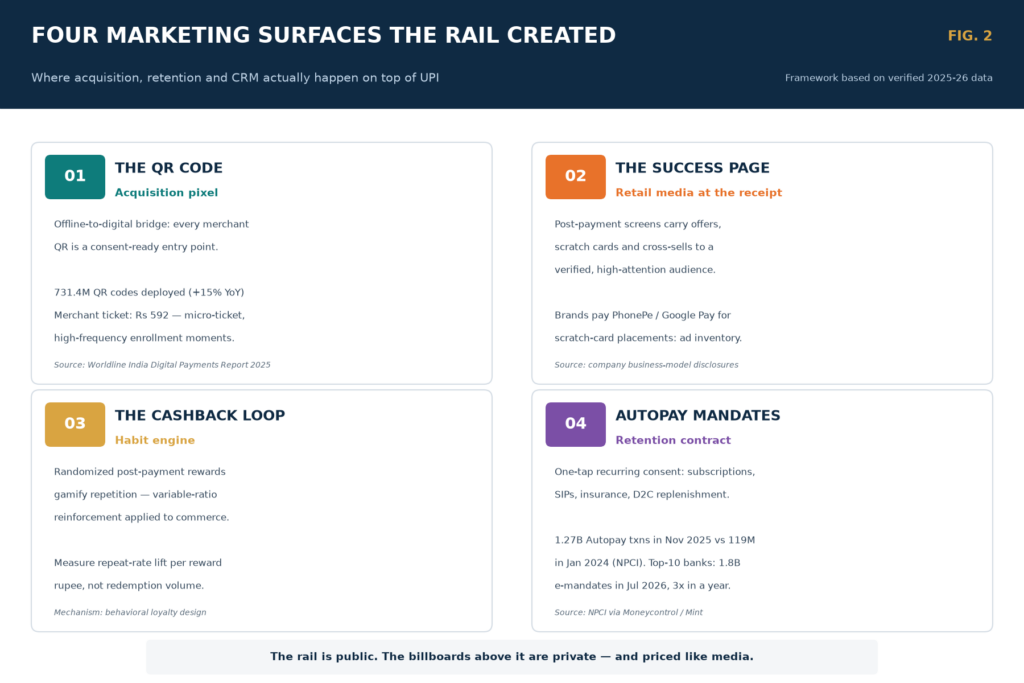
Worldline counted 731.38 million UPI QR codes deployed across India at the end of 2025, up 15% year-on-year, against just 11.48 million point-of-sale terminals. The report calls the ecosystem QR-first, PoS-as-needed. That ratio matters: India skipped the card-terminal buildout the West paid billions for and went straight to printed stickers.
For a growth team, every one of those stickers is an offline-to-digital bridge. A scan-to-pay flow captures a first-party, consent-ready identity at the exact moment of purchase — no ad click, no attribution guesswork. Put a QR on packaging or a counter standee that routes to enrollment rather than just payment, and a physical product becomes a CRM entry point. The QR renaissance Western marketers keep predicting already happened in India. It just happened at the chai stall first.
Surface Two: The Success Page as Retail Media
Open PhonePe or Google Pay after paying anyone, and look at what happens next: offers, brand placements, scratch cards, cross-sells. That post-payment screen is media inventory — high-attention (the user is watching for confirmation), verified-audience (a payment just completed), and contextually rich (the app knows the merchant category).
This is retail media at the receipt, and the business model is documented, not speculative. Industry reporting on the payment apps’ revenue models describes brands paying PhonePe and Google Pay to feature offers through scratch cards — the little rewards are ad placements wearing a gift’s clothing. PhonePe’s updated IPO prospectus makes the strategy explicit: UPI is the distribution layer, and monetization increasingly comes from merchant services, financial distribution and, in its own words, advertising that lets merchants pay to promote themselves inside the app.
Surface Three: The Cashback Loop as a Habit Engine
The scratch card deserves its own analysis, because it is doing two jobs at once. As media, it sells brand visibility. As behavioral design, it is a variable-ratio reward schedule — the same psychology that makes slot machines compelling, applied to payment frequency. You do not know what the next scratch will yield, so you pay through the app again to find out.
If you run cashback programs on these surfaces, measure them like a retention channel, not a promotion: repeat-rate lift per reward rupee, not redemption volume. A ₹12 reward that moves a customer from one purchase a month to four is cheap media. A ₹50 reward redeemed by someone who was buying anyway is a discount you did not need to give. The reward is the ad spend; the habit is the asset.
Surface Four: Autopay Mandates as Retention Contracts
The quietest surface is the most structural. UPI Autopay turns recurring payments into one-tap consent — subscriptions, SIPs, insurance premiums, loan EMIs, and increasingly D2C replenishment. A mandate is not a payment; it is a retention contract with a cancellation cost.
The growth is staggering. NPCI data reported by Moneycontrol shows Autopay transactions rose from about 119 million in January 2024 to 1.27 billion in November 2025 — more than tenfold in under two years. By July 2026, the top ten banks processed nearly 1.8 billion UPI e-mandate transactions in a single month, roughly triple the 585 million of July 2025, per Mint.
Two operational caveats keep this honest. First, success rates fell from roughly 50% to about 30% over that growth period — mostly insufficient balances, not technical failures — so mandate counts overstate collected revenue. Merchants still prefer Autopay because scale beats success rate: 30% of a huge base collects more than 50% of a tiny one. Second, the rules are actively improving: RBI’s consolidated e-mandate directions of April 21, 2026 allow authentication-free recurring debits up to ₹15,000 (₹1 lakh for insurance, mutual funds and credit-card bills) with a mandatory pre-debit notification at least 24 hours ahead, and NPCI is building mandate portability across apps. If you sell anything replenishable to Indian consumers and you are not offering UPI Autopay, you are choosing friction your competitors have already removed.
What Everyone Misunderstands
Three errors keep showing up in how brands budget for this channel.
The first is treating payment apps as finance tools. Marketers allocate to Meta and Google, then file PhonePe under utilities. But PhonePe’s own prospectus shows a company with over 650 million registered users and 47 million merchants as of September 2025, whose revenue rose 40% to ₹7,114 crore in FY25 — increasingly from businesses layered on top of payments. These are super-apps in training, and their offer surfaces are media channels with rate cards.
The second is assuming free rail means free marketing. Zero MDR made the transactions cheap; it never made the attention free. The surfaces above the rail belong to an oligopoly — NPCI’s September 2026 data puts PhonePe at roughly 45.6% of listed-app transaction volume, Google Pay at 32.2%, Paytm at 8.1% — and oligopolists price attention normally. The rail is public; the billboards are private.
The third is the lazy China comparison. UPI is not Alipay. There is no single owner, no bundled merchant CRM suite, no mini-program ecosystem handed to you. Alipay and WeChat Pay together carry an estimated 89% of Chinese ecommerce value inside their closed loops (Worldpay’s Global Payments Report 2026); India’s equivalent concentration sits at the app layer, not the rail layer. The public-rail model trades integration convenience for universal reach and near-zero cost — and hands brands the job of assembling consented identity across apps themselves.
The Privacy Clock: DPDP Changes the Build
Payment data is financial data, and India’s consent regime is arriving on a published schedule. The government notified the Digital Personal Data Protection Rules on November 13, 2025. Consent Manager provisions took effect on November 13, 2026 — days ago as this piece publishes — and the full substantive regime, including itemized consent notices and withdrawal-as-easy-as-consent obligations, lands on May 13, 2027.
For anyone marketing on payment surfaces, this is not legal trivia; it is product architecture. Consent flows that unify identity across payment apps must be designed now, while the transition window is open. Brands that instrument the payment moment with pixel-era logic and retrofit consent in 2027 will be rebuilding their newest channel from the foundations up.
The Fraud Tax on Trust
The counterargument section would be incomplete without the risk that erodes the whole asset: trust. Parliament was told in December 2025 that UPI-linked fraud reached 10.64 lakh reported incidents involving ₹805 crore in the first eight months of FY26, following 12.64 lakh incidents and ₹981 crore in FY25. Recovery is brutal — roughly 6% of amounts were recovered in H1 FY26.
The dominant patterns are not technical breaches. QR-swap stickers redirect payments at physical counters; fake refund collect-requests trick users into authorizing debits they believe are credits. The rail’s cryptography holds; human verification fails. Brands carry reputational exposure on their own QRs and success-page placements, which means tamper-evident QR hardware, beneficiary-name confirmation habits and daily reconciliation are marketing hygiene, not just ops hygiene. A channel built on trust budgets for defending it.
The Playbook: What Brands Should Do Next
Four moves, in order of urgency.
Instrument the payment moment as a channel with its own budget and tests: success-page offers, receipt cross-sells, QR-to-CRM enrollment. The second sale is where margin lives, and the post-payment screen is the cheapest place to ask for it.
Design cashback as behavior, not bribe. Randomized post-purchase rewards build frequency; measure repeat-rate lift per reward rupee and kill placements that only subsidize existing buyers.
Ride Autopay for anything replenishable. The consent rails are trusted, the authentication limits just rose, and mandate portability is coming — retention contracts are getting easier to win and (fair warning) easier for customers to move.
Build the consent architecture before May 2027. Itemized notices, easy withdrawal, cross-app identity within DPDP limits. The brands that treat this as infrastructure will own the channel when the compliance shakeout arrives.
Conclusion
UPI turned India’s checkout into public infrastructure — 25 billion verified interactions a month, near-zero transaction cost, universal bank reach — and accidentally created the economy’s cheapest attention surface. The QR became a pixel. The receipt became a media slot. Cashback became a habit engine. Autopay became a retention contract. China built growth loops inside super-apps; India is building them on a public rail, with private billboards rising above it and a regulatory clock ticking underneath. The marketers who instrument the payment moment now are buying tomorrow’s prime media at today’s discovery prices. The window is real, and like every discovery-priced window, it closes.