In September 2023, Indonesia told TikTok it could no longer sell anything inside its app. Four months later, TikTok was back — not by winning an argument, but by buying a wedding ring. It paid its way into Tokopedia, the country’s homegrown e-commerce champion, and turned the regulator’s wall into a door. This is the story of how a ban became a merger, how a disruptor became a stakeholder, and how a government discovered it could charge rent for market access. If you run a platform, or you regulate one, this is the case study you’ll be arguing about for the next decade.
Why Indonesia Was the Prize
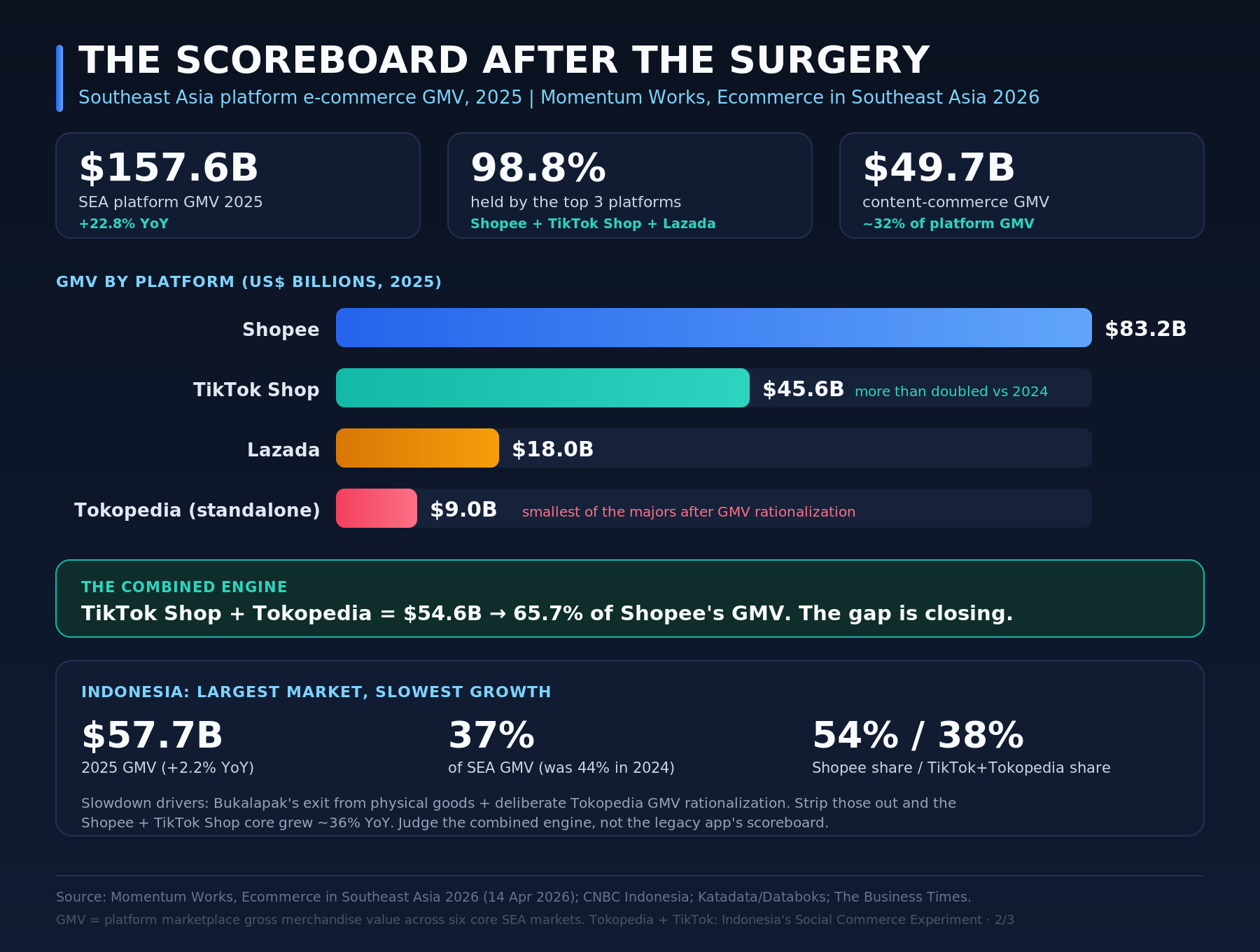
Start with the stakes, because they explain everything that followed. Indonesia is Southeast Asia’s largest e-commerce market — roughly 37% of the region’s gross merchandise value, about $57.7 billion in 2025, according to Momentum Works. It was also TikTok’s second-biggest user market on earth, with around 125 million people scrolling, watching, and increasingly buying. When you fuse that many eyeballs with a checkout button, you don’t just get a shopping feature. You get a machine that can rewrite how a nation of 280 million shops.
A market too big to ignore
TikTok Shop had launched in Indonesia in 2021 and grown fast by pairing local creators with local sellers. More than 6 million merchants and nearly 7 million affiliate creators were riding it when the lights went out. That’s not a user base; that’s an economy. And the runway looked endless — Google, Temasek and Bain have projected Indonesian e-commerce could reach roughly $160 billion by 2030. That’s exactly why Jakarta felt it had to act, and why TikTok felt it couldn’t afford to leave.
The Rule That Pulled the Plug
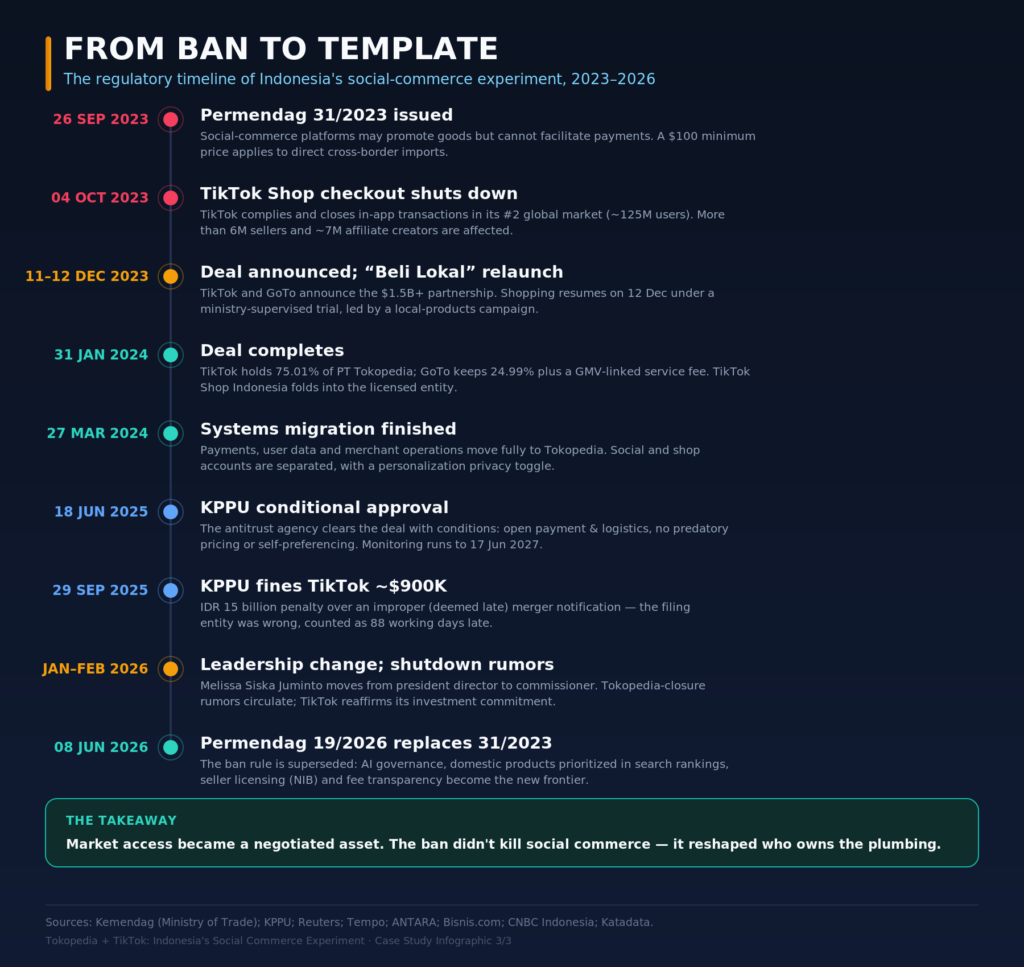
The instrument was Permendag 31/2023, a Trade Ministry regulation issued on 26 September 2023. Its logic was blunt: social media is for promotion, not transactions. A “social-commerce” platform could show you a product, even let a creator rave about it, but it could not process the payment. That had to happen somewhere else, on a separately licensed e-commerce system. The rule also set a $100 minimum price on goods shipped directly from overseas sellers, barred marketplaces from acting as manufacturers, and forbade the misuse of user data to tilt competition.
The politics behind it were loud. Offline traders — especially in Jakarta’s Tanah Abang textile market — said revenues had collapsed by more than half as ultra-cheap imports flooded the feed. Ministers framed the ban as protection for micro, small and medium enterprises, or MSMEs, and as a way to keep payments and data onshore. On 4 October 2023, TikTok complied and switched off its Indonesian checkout.
The seam in the wall
Here’s the detail that made the whole drama possible: the regulation banned social platforms from facilitating payments, but it did not ban joint ventures with licensed e-commerce companies. Read that again. The wall had a seam. TikTok couldn’t build its own checkout inside the social app — but it could buy into an entity that already had a license. The ban didn’t say “leave.” It said “marry local.” And that distinction is worth billions.
Anatomy of the Workaround
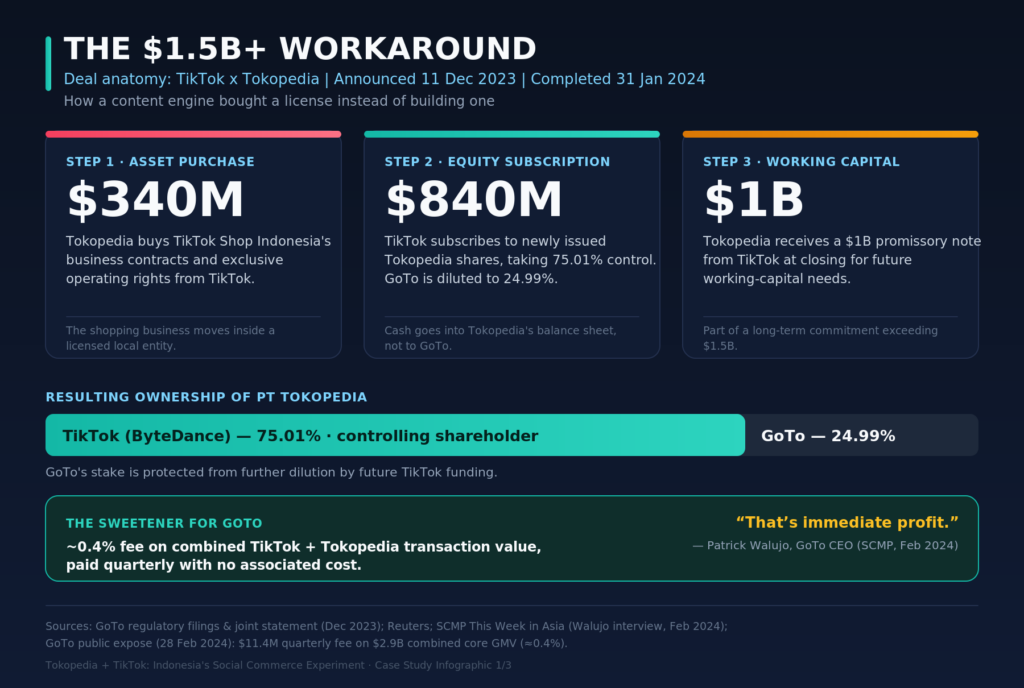
The deal, announced on 11 December 2023 and completed on 31 January 2024, was not a simple acquisition. It was a three-piece structure designed to satisfy the regulator while handing TikTok control.
Three numbers and a promissory note
First, Tokopedia paid $340 million to buy TikTok Shop Indonesia’s business contracts and exclusive operating rights — folding the shopping business into a licensed local entity. Then TikTok subscribed $840 million of newly issued Tokopedia shares, taking 75.01% control. Note the mechanics: that $840 million went into Tokopedia’s balance sheet as fresh capital, not into GoTo’s pocket as a cash-out. Finally, Tokopedia received a $1 billion promissory note from TikTok at closing for future working capital, part of a long-term commitment exceeding $1.5 billion. GoTo kept 24.99%, protected from further dilution.
Why GoTo said yes
GoTo CEO Patrick Walujo didn’t pretend Tokopedia was winning. It was burning cash, and transaction volumes had fallen more than 25% at the start of 2023 as the company cut subsidies to chase profitability. Against deep-pocketed foreign rivals, it needed a lifeline. Walujo described the process as a “beauty contest” his company wasn’t even initially in the running for. The deal converted a declining asset into equity upside plus something sweeter: a fee of roughly 0.4% on the combined TikTok-and-Tokopedia transaction value, paid quarterly with no associated cost. “That’s immediate profit,” Walujo told SCMP. He also got access to Chinese e-commerce engineering — the AI and recommendation know-how his rivals already had. “You don’t know what you’re missing until you look under the hood,” he said.
Compliance you can inspect
This is the part most retellings skip, and it’s the part that matters. By 27 March 2024, the systems migration was complete. Payments now ran entirely through Tokopedia’s licensed system — money in from buyers, money out to sellers, all onshore. Social and shop accounts were split into separate user IDs, with a privacy toggle that lets users switch off shopping personalization drawn from their viewing habits. Merchant operations, consumer protection and dispute resolution all moved under Tokopedia, and the app picked up its electronic-system registration from the communications ministry. The Trade Ministry publicly confirmed the integration was complete. TikTok stayed the discovery layer; Tokopedia became the transaction layer. Separation in law, fusion in commerce — exactly the split the rule demanded, and verifiable rather than promised. With more than 90% of merchants classified as MSMEs, the structure was sold as a win for the little seller.
Reading the Scoreboard Without Flinching
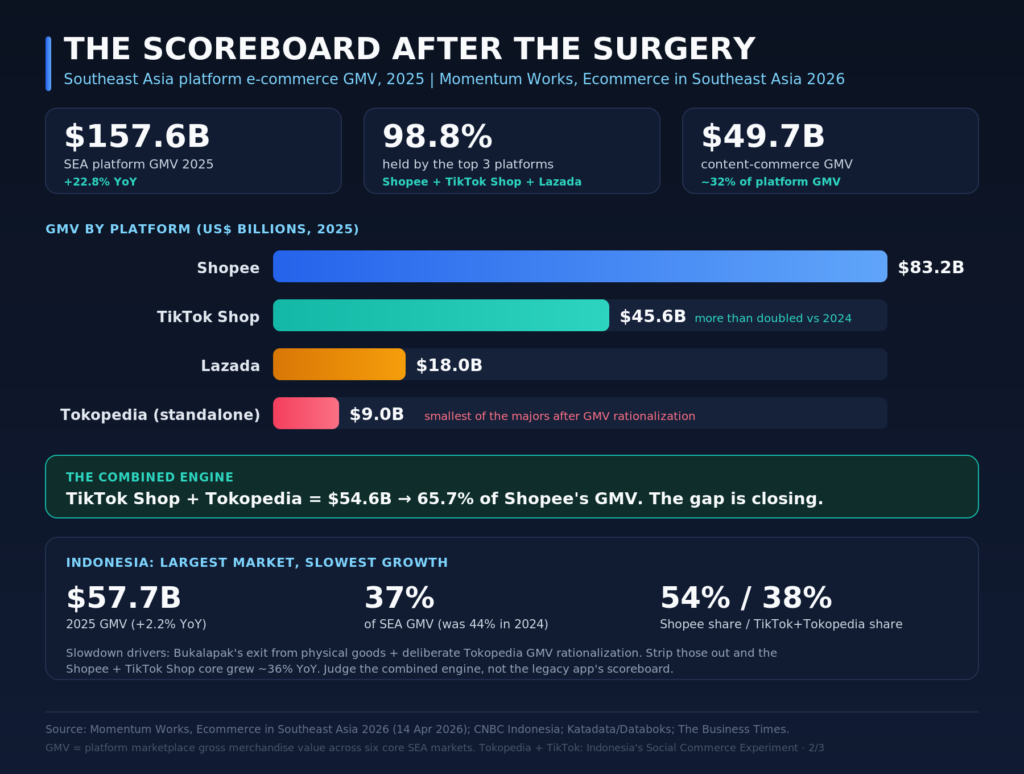
Now the awkward part. If you glance at Tokopedia’s standalone number, the merger looks like a disaster. Momentum Works’ 2026 report puts Tokopedia’s 2025 GMV at roughly $9 billion — the smallest of the major platforms. Indonesia’s overall e-commerce growth slowed to just 2.2%, the weakest in the region, and its share of Southeast Asian GMV slipped from 44% to 37%.
Rationalization, not collapse
But read the fine print before you write the obituary. Momentum Works attributes that slowdown to two things: Bukalapak exiting physical-goods e-commerce, and a deliberate “rationalization” of Tokopedia’s GMV after the takeover. In plain English, the new owners pruned low-quality, subsidy-chasing volume. Strip out the exit and the pruning, and the Shopee-plus-TikTok-Shop core of Indonesia actually grew around 36% year on year. The demand didn’t die; it got cleaner.
And the combined engine is formidable. TikTok Shop’s Southeast Asian GMV more than doubled to $45.6 billion in 2025. Add Tokopedia and you get $54.6 billion — 65.7% of Shopee’s $83.2 billion. The gap is closing. Across the region, the top three platforms now control 98.8% of platform GMV, and content commerce — the video-and-livestream selling TikTok pioneered — has become core infrastructure, generating roughly $49.7 billion, about a third of platform GMV. Meanwhile Thailand and Malaysia grew more than 47%. Judge the merged entity, not the legacy app’s scoreboard, and the surgery looks far less like failure and far more like a diet.
The Friction Nobody Photoshops Out
Let’s not romanticize it. Post-merger integration was messy. Local media reported roughly 420 job cuts across July and August 2025 — about 180 in July, then 240 in August — spanning IT, customer care, fulfillment and warehouse teams. TikTok framed it as routine organizational review rather than confirming layoffs, so treat the figure as reported, not audited.
Then came the leadership shuffle. In January 2026, Melissa Siska Juminto — the Tokopedia veteran who had steered the merged business — stepped down as president director and moved to a commissioner’s role. Almost immediately, rumors spread that the Tokopedia app would be shut down and absorbed into TikTok Shop. TikTok pushed back by reaffirming its continued investment, which the market read as a denial. The antitrust watchdog, meanwhile, kept its leash on. In June 2025 KPPU granted conditional approval, demanding open payment and logistics, no predatory pricing and no self-preferencing, with monitoring running to June 2027. And in September 2025 it fined TikTok about $900,000 over an improper merger filing — the notification came from the wrong entity and was deemed 88 working days late. The message: you bought your way in, but you’ll be watched every quarter.
Did the Little Sellers Actually Win?
This is the question the whole experiment was supposed to answer, and the honest reply is: it’s complicated. The ban’s stated goal was to protect MSMEs and revive offline trade. Yet peer-reviewed Indonesian research suggests the shutdown did not meaningfully restore conventional merchants’ sales, because consumer behavior had already shifted durably toward digital. You can’t un-ring that bell with a regulation.
A separate body of academic work frames the merger as “adaptive compliance” — a legally sound way to keep the shoppertainment engine running while raising real concerns about data sovereignty and the share of foreign-made goods on the platform. The trade-off is genuine on both sides: MSMEs kept a powerful sales channel, but the flag flying over Indonesia’s champion marketplace now sits on a cap table that is 75% foreign-controlled. Protection was the slogan; consolidation was the outcome. Whether that counts as a win depends on which ledger you’re reading.
The Playbook: Regulatory Judo in Five Moves
Strip away the specifics and you’re left with a reusable method. Call it regulatory judo — using the regulator’s own force to redirect rather than resist.
- Map the seam, not just the wall. The ban targeted payment processing on social platforms, not joint ventures. Find the precise thing that’s prohibited, then build around its edge.
- Turn opponents into shareholders. GoTo — and the domestic interests behind it — gained equity upside and a transaction fee. Alignment beat lobbying. As Momentum Works’ Jianggan Li put it, the deal turned “enemies into allies.”
- Pay the sovereignty tax in structure, not promises. Onshore payments, separated data, local merchant operations — a compliance architecture anyone can inspect, not a press release anyone can doubt.
- Trade technology for license. The local partner got engineering it couldn’t easily buy; the foreign partner got a market it couldn’t otherwise enter. A genuine two-way asset swap.
- Expect the pruning phase. Post-merger GMV rationalization looks like decline but is quality selection. Judge the combined engine, not the legacy scoreboard.
The Template Is Already Traveling
Here’s where the story stops being history and starts being a forecast. The Tokopedia template — licensing-for-equity, content-and-commerce split — is now a reference point for other restrictive markets. But the most telling development is that Indonesia itself has moved on.
Jakarta rewrites its own rule
In June 2026, Indonesia promulgated Permendag 19/2026, formally replacing the very regulation that forced the merger. The new rule widens the net to eight business models, including ride-hailing and travel agents, and pushes into new frontier: it requires platforms to prioritize domestic products in search and recommendation rankings, mandates seller licensing, forces fee transparency with downloadable contracts, and — for the first time at the trade level — sets governance rules for AI, requiring disclosure of AI-generated content and recommendations. The sovereignty logic that birthed the TikTok deal has matured from “separate the plumbing” into “control the algorithm and the shelf.”
Hanoi takes a different road
Contrast Vietnam. Its new E-Commerce Law, passed in December 2025 and effective July 2026, does not force structural separation at all. Instead it regulates conduct: verify livestream sellers’ identities, make platforms publish rulebooks and handle real-time complaints, retain broadcast recordings for at least a year, and appoint a locally accountable representative. Where Indonesia said “split the company,” Vietnam said “police the behavior.” Two answers to the same anxiety — and a live experiment in which approach actually protects consumers without strangling innovation.
The Honest Caveats
Before you copy the playbook, read the warnings. The precedent cuts both ways: it teaches platforms how to buy back in, but it also teaches governments that a ban can extract equity-level concessions. Expect copycat regulatory leverage. Data sovereignty remains contested — onshore systems satisfy the letter of the rule, yet ultimate control by foreign capital is still a live political concern in Jakarta. Merchant fairness is the weak seam; if preferential treatment ever tilts the field against local sellers, it would undercut the entire MSME-protection rationale. And concentration is now extreme, with the merged entity plus Shopee defining Indonesian e-commerce and KPPU’s conditional oversight acting as the thin counterweight. The experiment’s ledger is still open.
The Takeaway
The Tokopedia–TikTok merger is the most consequential platform-regulator bargain of the decade. A ban became a marriage, a disruptor became a stakeholder, and commerce sovereignty was purchased with structure rather than promises. For platforms, the lesson is that market access is now a negotiated asset — and the winning move is converting your loudest opponents into shareholders. For governments, it’s that leverage works best when it demands verifiable architecture, not vague commitments. The methodology is already being copied. The only question is who copies it smarter.