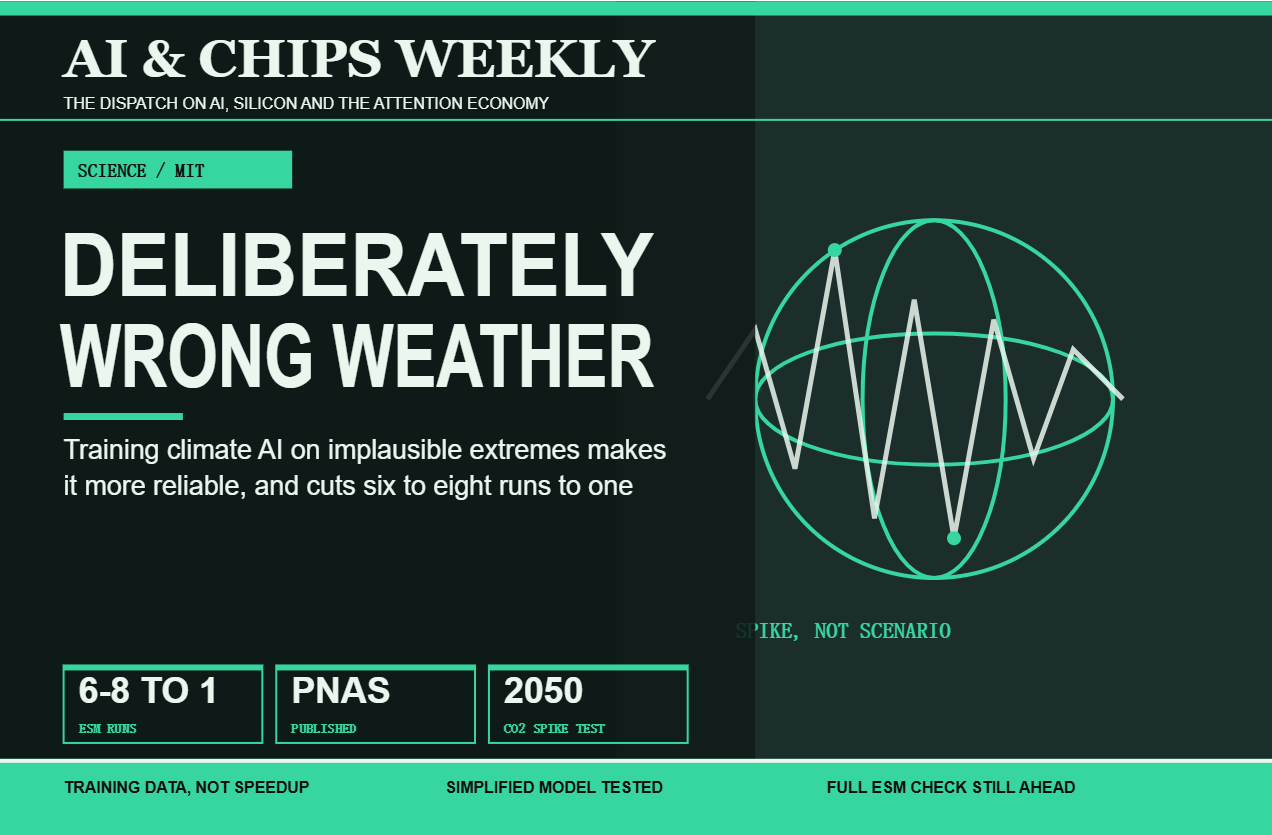
A team from MIT, ETH Zurich and Imperial College London found that training a climate emulator on synthetic, physically implausible scenarios makes it more accurate, not less. Standard practice had been to run six to eight full Earth System Model simulations across realistic emissions pathways, each costing months of supercomputer time, so emulators were often obsolete before they shipped and tended to fail on futures outside their training set. The new algorithm generates targeted extremes instead, a sudden carbon dioxide spike in 2050 or a methane collapse in 2037, and iterates until prediction error falls below a threshold. One full simulation run then suffices for data generation. In tests published in PNAS the resulting emulator held up on unseen scenarios and captured the effect of a local pollutant control that the conventional emulators missed entirely. Lead author Christopher Womack and senior author Noelle Selin are careful about the boundaries: the validation used a simplified climate model, and the win is faster and better training data, not a six-to-eightfold speedup of the whole forecasting chain.