Somewhere in your quarterly planning doc, there’s a key result that reads “publish 20 blog posts.” It has a number. It has a deadline. It looks rigorous. And it’s not a key result at all — it’s a task wearing a costume.
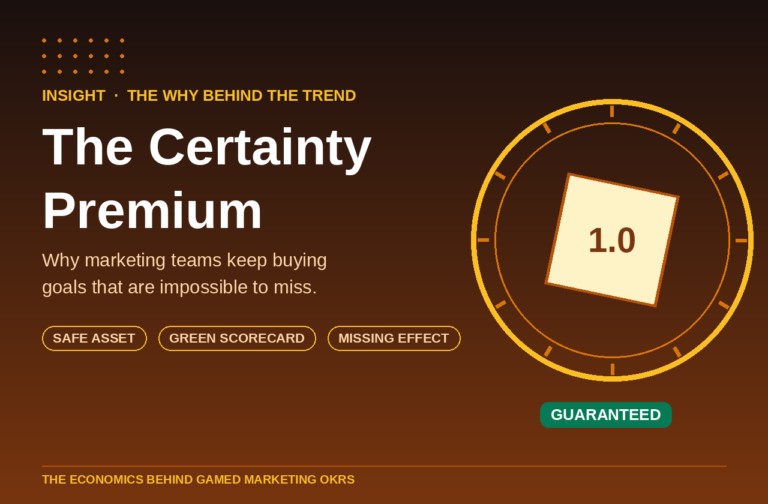
Here’s the uncomfortable test: your team could publish all 20 posts, hit the KR at a perfect 1.0, and watch organic traffic flatline. Nothing in that goal forces the posts to matter. Google’s own OKR playbook — the internal guidance the company reprinted for John Doerr’s What Matters — says key results must describe outcomes, not activities. If your KR contains words like “consult,” “help,” or “analyze,” you’ve written down a to-do, not a result.
But the output trap is only the first failure mode. The deeper one is gaming: pick only measurable outputs and you’re busy-but-flat; pick only lagging revenue and you can’t diagnose a miss until the quarter is already dead. This playbook is about the structural fixes — pairing, calibration, cadence, and a new AI layer your 2024 goals never accounted for.
Outputs vs. Outcomes: The Discipline Everything Else Rests On
“Publish 20 posts” is an output — what the team produced. “Grow organic sessions from 12K to 35K per month” is an outcome — what changed because the team existed. The first measures effort. The second measures effect.
Why do smart teams keep writing outputs? Because outputs are safe. They’re fully within your control, they’re easy to verify, and nobody can argue about whether a post was published. Outcomes are messy: algorithms shift, sales cycles lag, attribution fights break out. Writing outcomes means accepting that you might do everything right and still miss.
That discomfort is the point. An OKR framework that never makes you uncomfortable isn’t managing your priorities — it’s decorating them.
Brand marketers get a partial pass here, and it’s worth being honest about it. You can’t directly measure “brand love” in a quarter. But you can measure proxies: unaided recall in a survey moving from 12% to 28%, direct traffic trends, branded search volume in Search Console. Imperfect proxies beat “run 3 campaigns” — as long as you label them as proxies and don’t pretend they’re the thing itself. (All target numbers in this article are illustrative examples, not industry benchmarks.)
The Lead/Lag Pair: Your Steering Wheel and Your Speedometer
Pure outcome goals have a flaw: by the time the number moves, the quarter’s decisions are already made. What Matters’ own guidance notes that lagging measures like revenue only tell you whether you were on track after the cycle is over. You need something you can steer.
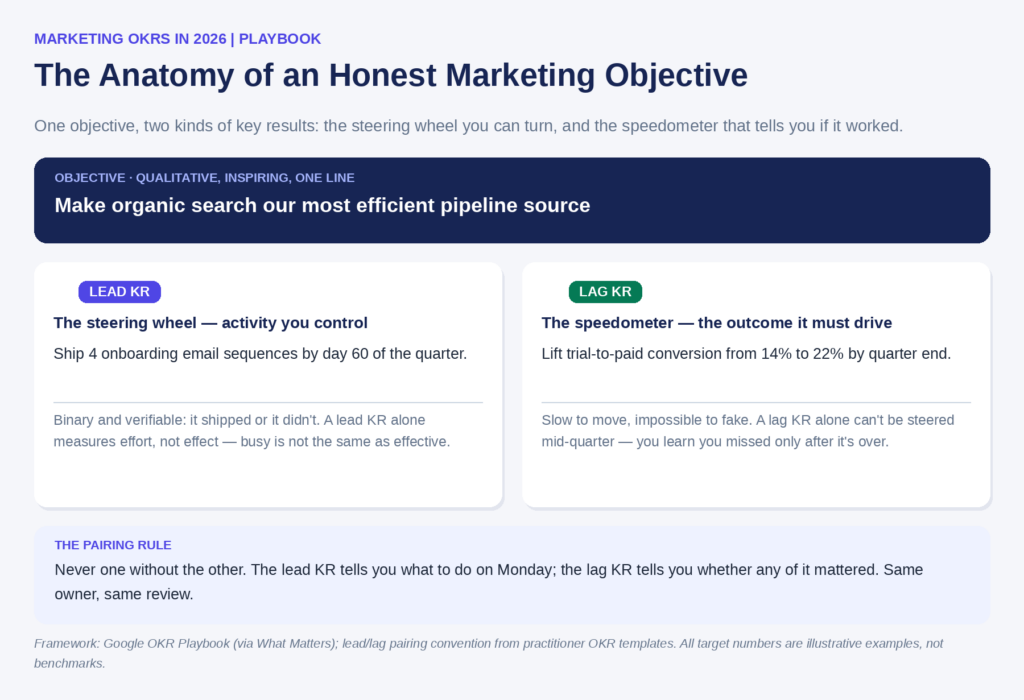
The fix is structural: every objective gets two kinds of key results.
- The lead KR is the controllable activity: “ship 4 onboarding email sequences by day 60.” It’s binary, verifiable, and yours to execute. This is the steering wheel.
- The lag KR is the outcome it must drive: “lift trial-to-paid conversion from 14% to 22%.” It’s slow, honest, and impossible to fake. This is the speedometer.
A steering wheel without a speedometer is motion without direction — you shipped 4 sequences, congratulations, did anything improve? A speedometer without a steering wheel is anxiety without agency — you know conversion is stuck, but what do you do Monday morning?
One of each, per objective, reviewed together, owned by the same person. The pairing is what keeps the goal honest.
Committed vs. Aspirational: Label It Before You Set It
Google’s playbook draws a hard line between two OKR species, and blurring them is listed as trap number one.
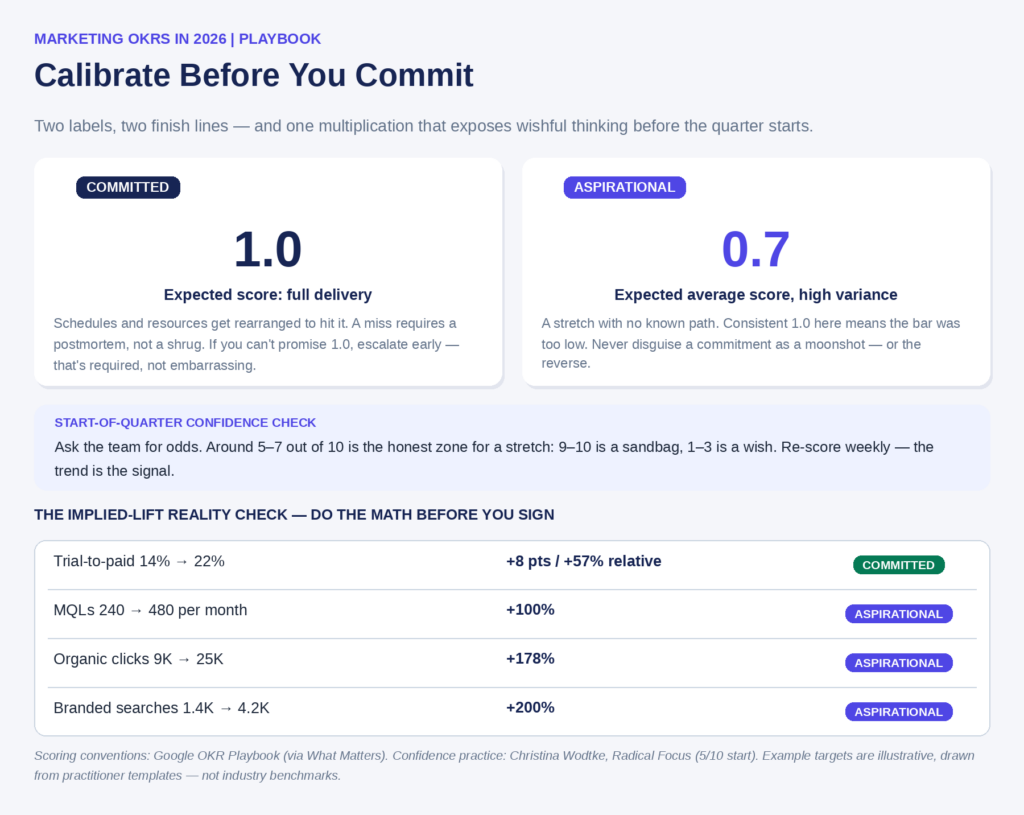
Committed OKRs are agreements: the team will rearrange schedules and resources to deliver them. The expected score is 1.0, and anything less requires a postmortem — not punishment, but an honest look at what broke in planning or execution. If you can’t credibly promise 1.0, the playbook says escalation isn’t just okay, it’s required.
Aspirational OKRs are moonshots: how you’d like the world to look with no clear path to get there. Expected average score: 0.7, with high variance. Consistently scoring 1.0 on your aspirational goals doesn’t mean you’re great — it means your bar is too low.
The traps run both directions. Mark a commitment as aspirational and nobody rearranges priorities to hit it. Mark a moonshot as committed and you get defensiveness, sandbagging, and teams quietly de-staffing real commitments to chase a fantasy. Declare the label at the start, in writing.
Confidence Calibration: The Line Between a Goal and a Wish
Here’s a question most teams never ask out loud: what are the odds we actually hit this?
Christina Wodtke’s Radical Focus method starts every KR at 5-out-of-10 confidence — a genuine coin flip — and re-scores weekly. Google’s grading tradition lands the aspirational sweet spot at 0.6–0.7 attainment. Different mechanics, same insight: a healthy stretch sits around fifty-to-seventy percent belief, not certainty and not fantasy.
Use it as a smell test. If the team rates a KR 9 or 10 out of 10, you’ve written a sandbag — a number chosen to be hit. If they rate it 1 or 2, you’ve written a wish. Neither belongs in the committed column. And the weekly trend matters more than the starting number: confidence sliding from 6 to 3 by week five is an early-warning system no end-of-quarter grade can match.
One warning Wodtke makes mechanically, not morally: the moment OKR scores feed bonuses, the confidence signal dies. People paid on a number will always lowball the number. Keep OKRs out of compensation math.
The Implied-Lift Reality Check: One Multiplication That Exposes Wishful Thinking
Before any KR gets signed, do the arithmetic the enthusiasm is hiding:
- Trial-to-paid from 14% to 22%: +8 points, but a +57% relative lift. Stretch — yet plannable with a real onboarding rebuild. Committed, if you resource it.
- MQLs from 240 to 480 a month: +100%. That’s a doubling. Aspirational, full stop.
- Organic clicks from 9K to 25K: +178%. Aspirational.
- Branded search from 1,400 to 4,200: +200%. Aspirational, and probably a multi-quarter arc.
Teams commit to +100% lifts because the absolute numbers look modest on the slide. The percentage is the truth. Write the implied lift next to every proposed KR and let the math — not the mood in the room — decide which column it goes in.
Cycle Architecture: 90 Days Under a 12-Month North Star
Annual marketing OKRs are archaeology. Channels shift, algorithms update, and a goal written in January describes a market that no longer exists by June. Doerr’s guidance is dual-track: quarterly OKRs for execution, annual OKRs keyed to longer-term strategy, running in parallel.
Practically: pick 3–4 objectives per quarter with 3–5 KRs each — more than that and you’ve built a wish list, not a focus tool. Set one 12-month North Star above them (the pipeline number, the efficiency ratio, the category position) so quarterly pivots don’t become strategic drift. Brand and content moats are the legitimate slow lane: they compound across years and shouldn’t be reset every 90 days.
And reconcile the OKR doc to your weekly scorecard. If the doc says one number and the dashboard tracks another, the doc is fiction. One source of truth, checked weekly — Wodtke’s Monday commitments and Friday wins exist precisely to keep goals in the room instead of in a drawer.
Revenue-Tied, Not Vanity: What’s Out and What’s In
The 2026 standard is blunt: campaign volume and raw lead counts are out. They measure the marketing team’s activity level, not the business’s health.
What replaces them:
- MQL-to-SQL conversion (e.g., 18% → 25%): are we generating leads sales actually wants?
- Blended CAC and CAC payback (e.g., 16 → 12 months): is growth getting cheaper or just louder?
- Cohort LTV:CAC (e.g., 3.5x+ on a defined cohort): does the math work per customer segment, not on average?
- Net revenue retention (e.g., 108%+ for SaaS): does marketing’s promise survive contact with the product?
For DTC, the equivalents are 60-day repeat purchase rate, blended ROAS with a stated floor, and channel concentration — an OKR that takes Meta from 70% to 50% of paid spend is a risk goal, and a legitimate one. The common thread: every KR should survive the question “would the CFO care if this moved?”
Anti-Gaming Guardrails: Four Rules That Keep the System Honest
Goals create incentives, and incentives create creativity — sometimes the wrong kind. Four guardrails, drawn from the failure modes Google’s playbook explicitly names:
- Baseline before target. No KR without a verified starting number. “Improve engagement” with no baseline is an invitation to redefine success in week 11.
- The sufficiency test. Google asks: could you score 1.0 on every KR and still not achieve the objective? If yes, your KRs are necessary but not sufficient — rework them until hitting all of them guarantees the outcome.
- Proxy honesty. Label brand proxies as proxies. Review them alongside direct traffic and branded search so no single soft number carries the verdict.
- Doc-dashboard reconciliation. The weekly scorecard and the OKR doc track the same metrics with the same definitions. Ambiguity (“1 million users” — all-time or weekly active?) is where gaming lives.
An OKR that can be gamed isn’t a goal. It’s a vanity metric with a deadline.
Shared OKRs: Kill the “Thrown Over the Wall” Loop
Marketing hits its MQL number; sales misses its pipeline number; both teams are “right” and the company is still stuck. This is the most expensive failure mode in B2B, and it’s structural — separate goals manufacture separate realities.
Google’s playbook handles this with cross-team OKRs: every group that must materially contribute carries the shared commitment explicitly in its own OKR list. Translate that to your funnel: marketing and sales co-own the pipeline number. Marketing and product co-own trial-to-paid. Same number, both scorecards, one review meeting.
When the number is shared, the conversation changes from “your leads are weak” to “our handoff is broken” — which is the conversation that actually fixes things.
Cascade by Connection, Not by Copying
A common alignment mistake: the company OKR says “grow revenue 40%,” so every team’s OKR says “grow revenue 40%.” That’s not alignment, it’s wallpaper — nobody can act on it, and it hides who actually owns what.
The healthier pattern is connection: each team OKR should ladder to at least one company OKR, but express the team’s specific contribution. Demand-gen connects to revenue through pipeline efficiency; content connects through organic-sourced pipeline; lifecycle connects through retention. Doerr also recommends a healthy share of bottom-up OKRs — roughly half — because the people closest to the work see opportunities the planning deck misses. Alignment means every goal has a traceable line to strategy, not that every goal repeats it.
Templates by Function: Steal These Structures
All numbers illustrative — replace with your verified baselines and label each KR committed or aspirational after the implied-lift check.
- Demand gen: Lead — launch 3 intent-matched landing experiences by day 45. Lag — MQL-to-SQL from 18% to 25%; cost per lead from $312 to $185.
- Content/SEO: Lead — rebuild top 10 pages to answer-first structure. Lag — organic sessions 12K → 35K/month; plus an AI-citation KR (below).
- Brand: Lead — ship 2 research-backed flagship reports. Lag — unaided recall 12% → 28% in tracked survey; branded search volume up on a defined baseline.
- Product marketing: Lead — ship 4 onboarding sequences by day 60. Lag — trial-to-paid 14% → 22%.
- Lifecycle: Lead — deploy behavioral win-back flow. Lag — 60-day repeat purchase 18% → 30%; email to 25% of attributable revenue.
- Paid media: Lead — restructure top campaign into tested creative angles. Lag — blended ROAS above a stated floor with Meta share cut from 70% to 50%.
The 2026 AI Layer: Rankings Stopped Predicting Citations
Here’s the update most OKR templates haven’t absorbed: the search scoreboard split in two.
BrightEdge’s twelve-month Generative Parser study, reported by Search Engine Journal in February 2026, found AI Overviews on about 48% of tracked queries — up 58% year over year. The industry spread is stark: healthcare at 88% of queries, education at 83%, B2B tech at 82%, restaurants at 78% (levels as of December 2025). If you sell to researchers, students, patients, or software buyers, the AI answer is now the front door. (BrightEdge sells SEO software, so weigh its framing accordingly; the tracking methodology is disclosed and the figures have been consistently reported.)
The kicker for goal-setting: only about 17% of sources cited in AI Overviews also rank in the organic top 10 for the same query. Ranking #1 no longer gets you cited, and ranking #47 doesn’t disqualify you. Your ranking KR and your visibility can now move in opposite directions.
Meanwhile, clicks are being rationed. Pew Research Center — an independent research center, not a vendor — tracked 900 U.S. adults across 68,879 Google searches in March 2025: users clicked a traditional result on 8% of visits with an AI summary versus 15% without, and clicked a link inside the summary just 1% of the time. Google disputed the study’s methodology, which is worth noting — but the directional signal matched what publishers were already seeing in their own analytics.
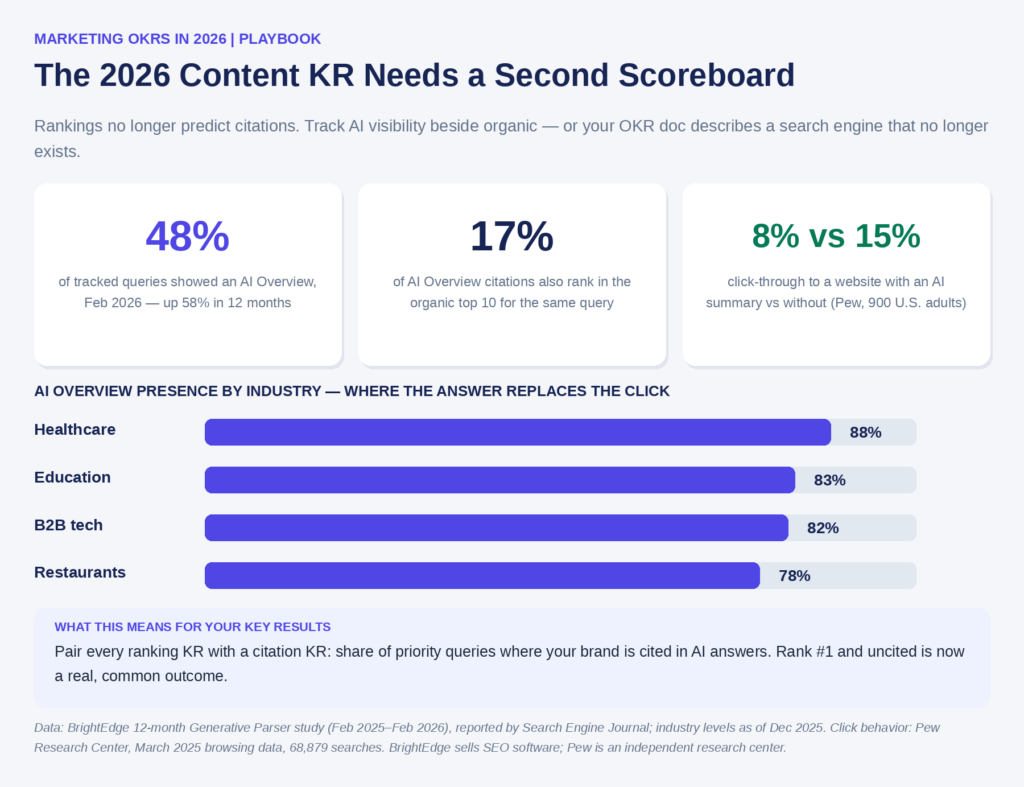
The practical fix is one extra KR on every content objective: share of priority queries where your brand is cited in AI answers, tracked on a fixed query set alongside rankings. Same lead/lag logic — the lead KR is the structural work (answer-first rewrites, entity clarity, source-worthy data), the lag KR is citation share, and organic sessions stay on the sheet as the health metric you refuse to sacrifice.
Conclusion: Make the Goal Survive Its Own Success
The unifying test for every marketing OKR: imagine your team hits it perfectly. Does the business actually improve? If a 1.0 on all KRs could coexist with flat revenue, invisible AI presence, and a sales team that hates your leads — the goals were theater.
Pair lead and lag. Label committed vs. aspirational. Check the implied lift. Run 90-day cycles under a fixed North Star. Share the numbers that cross team walls. And in 2026, give every content goal a second scoreboard, because the AI answer layer isn’t coming — it’s already on half the queries your buyers type.
An OKR that can be gamed isn’t a goal. Build ones that can’t.