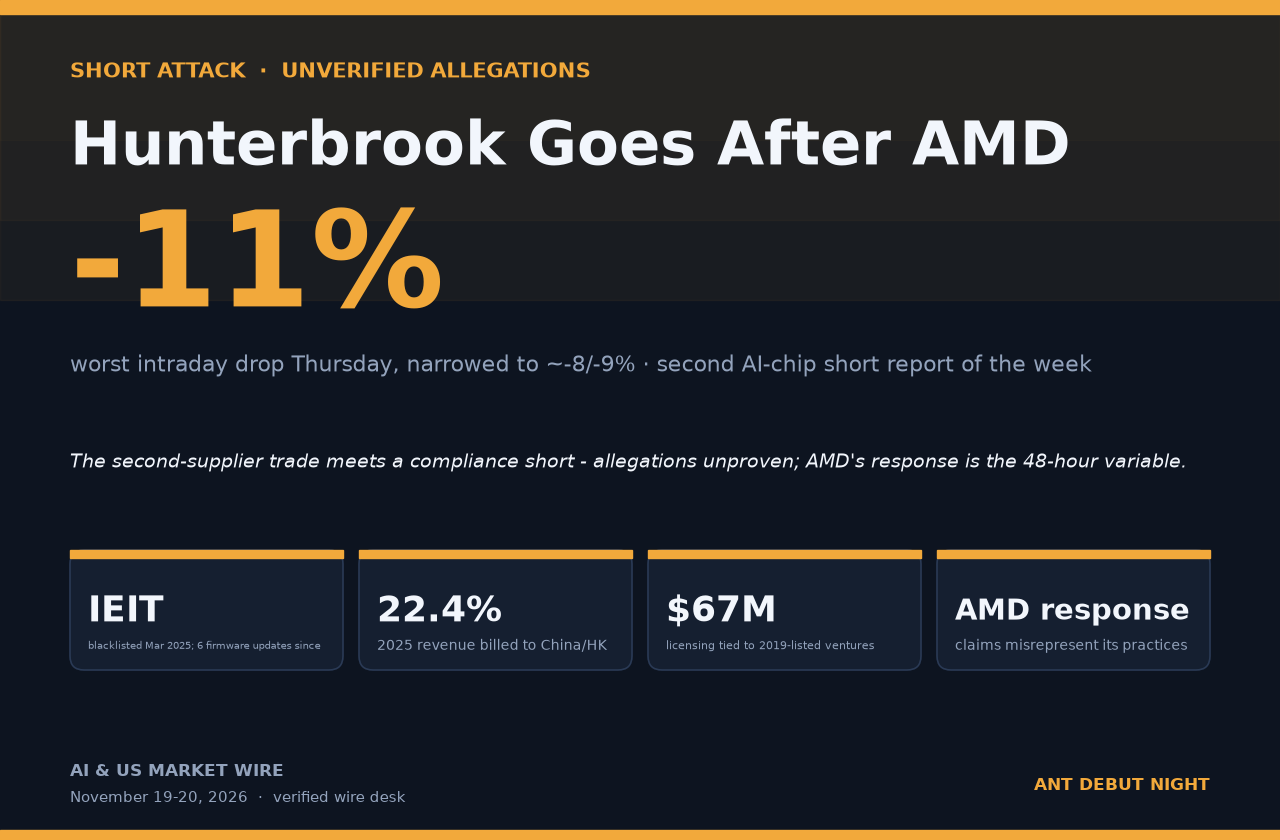
Hunterbrook Media published “AMD Has Its Own China Problem” on Thursday morning, November 19 (US time), with its affiliated capital arm disclosing a short position — the week’s second AI-chip short attack after the governance-focused report on Nvidia — alleging that IEIT Systems, the Chinese server maker blacklisted by Commerce in March 2025, incorporated at least six newer AMD firmware versions into its products after listing (most recently October 19), and that three IEIT-linked brands — Maginfra in China, Kaytus in Singapore and California’s Aivres, which AMD’s own website lists as an Instinct-chip server partner — sell servers running near-identical firmware. The report also flagged $67 million of 2025 licensing income traced to two ventures blacklisted in 2019, and the exposure math: 22.4% of AMD’s 2025 revenue billed to China/HK ($7.75B) plus 12.4% to Singapore ($4.28B) — ~35% inside newly tightening licensing regimes, with the 50%-ownership rule’s suspension expiring January 10, 2027. AMD fell as much as ~11% intraday before narrowing to roughly -8/-9% (the “15% flash crash” in early summaries is not supported by verified wire data), and — contrary to the morning wire — AMD has responded, telling Bloomberg the claims “misrepresent” its business practices and that it follows US export rules; Reuters and CNBC could not independently verify the allegations, Hunterbrook itself could not confirm how IEIT obtained the firmware or whether licenses covered it, and the 48-hour variables are AMD’s fuller rebuttal and any Commerce interest. The strategic sting: the “second supplier” that Microsoft’s multi-vendor pivot and last week’s $11 billion acquisition spree anointed now carries its own compliance question mark.