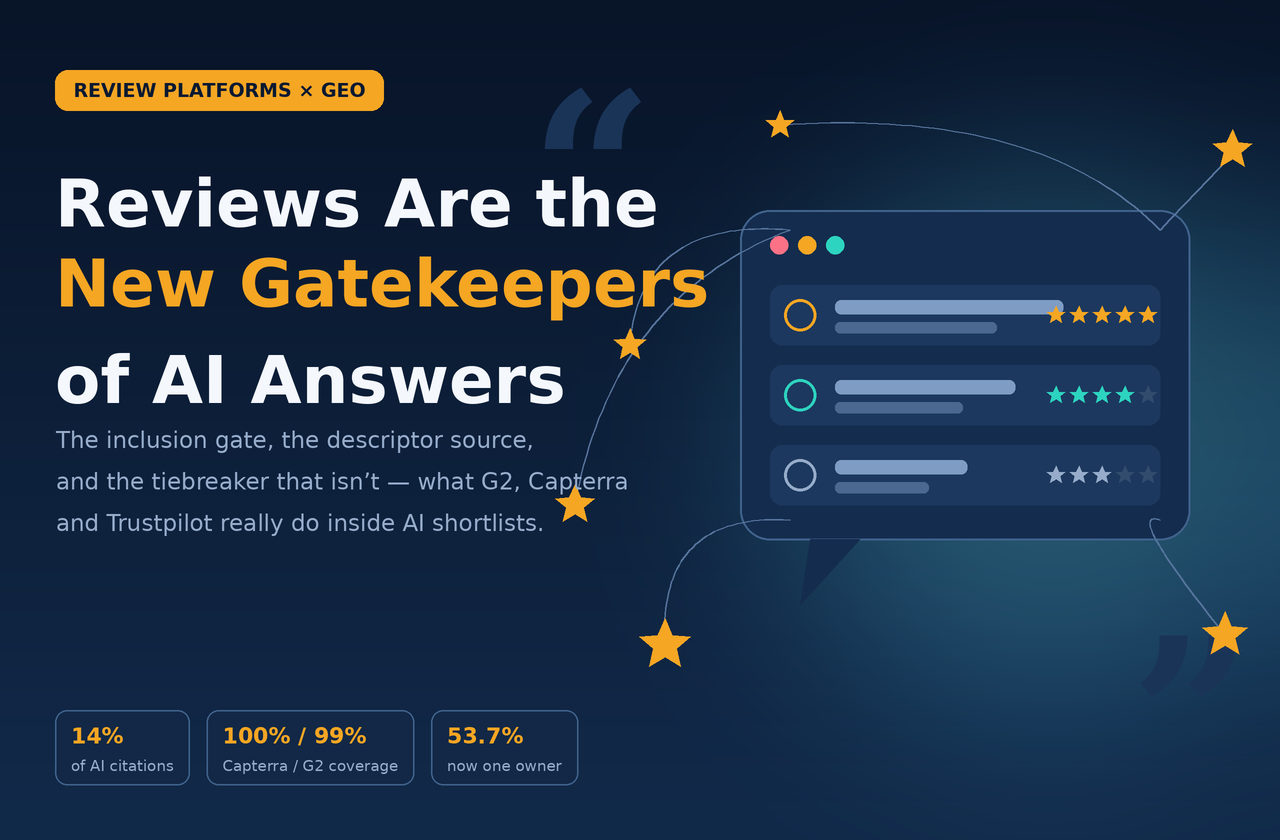
Review platforms stopped being reputation housekeeping and became distribution infrastructure. In research Seer Interactive ran for Trustpilot across more than 800,000 AI answers, review and trust sites were the second most-cited source category at 14%, behind only the general web. Yet the same evidence keeps embarrassing the obvious strategy: in a study of ChatGPT software recommendations, review count and star rating showed near-zero correlation with ranking position. Reviews get you into the answer. They rarely decide your seat at the table. This piece separates the three jobs review sites actually do — inclusion gate, descriptor source, weak tiebreaker — and shows where the money should go.
Why 14% of AI Citations Changes the Budget Conversation
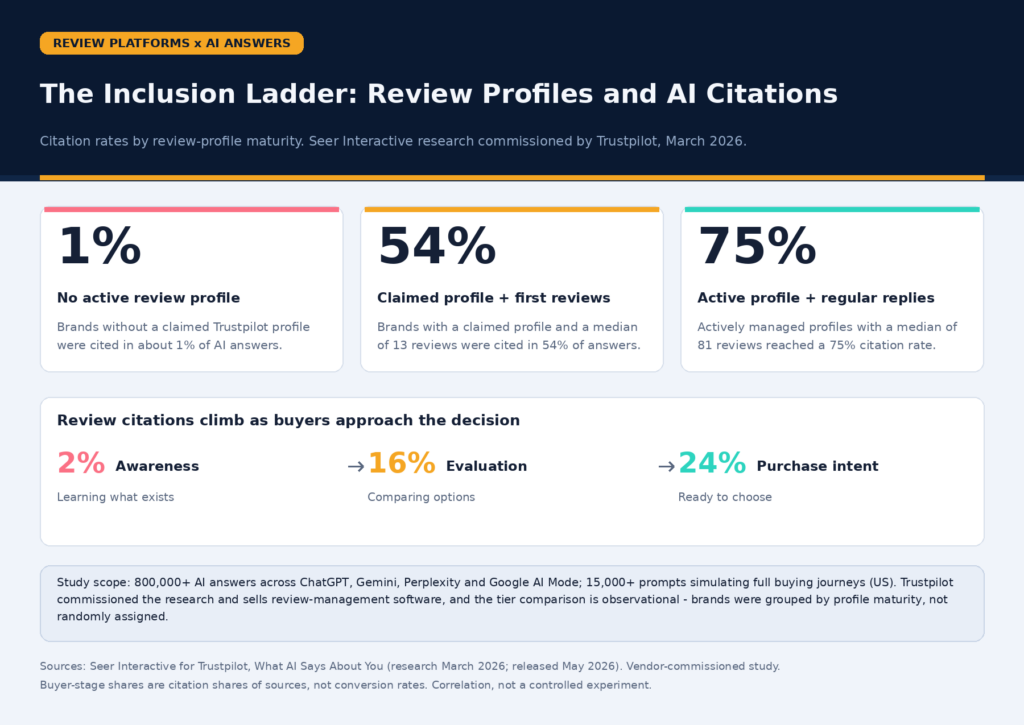
Start with the number that should retire the phrase “review management is just PR cleanup.” Trustpilot commissioned Seer Interactive to replicate full buying journeys with more than 15,000 prompts across ChatGPT, Gemini, Perplexity and Google AI Mode in March 2026. Review and trust sites accounted for 14% of cited sources — second only to general web and brand sites at roughly 76%.
Two caveats before you forward this to your CFO. Trustpilot paid for the study and sells review-management software, so read it as strong vendor-commissioned evidence, not neutral scripture. And the share moves with intent: review sources made up just 2% of citations at awareness, 16% during evaluation and 24% at purchase intent. The closer a buyer gets to choosing, the more the machine leans on what your customers said. That is exactly the slice of the funnel where deals are won.
The Inclusion Ladder: 1%, 54%, 75%
The same study sorted brands by profile maturity. Brands with no active Trustpilot profile were cited in about 1% of answers. A claimed profile with a median of 13 reviews reached 54%. Actively managed profiles — median 81 reviews, regular responses — reached 75%. The steepest climb happens at the very first rung: going from absent to present, not from present to popular. Notice what this is not: nobody randomly assigned profiles to brands, so mature-review brands may simply be better businesses. It is a ladder of correlation, and a compelling one.
A 2.5–3.5× Multiplier, With the Honest Label Attached
Independent corroboration comes from SE Ranking’s analysis of 129,000 domains and 216,524 pages. Domains listed across multiple review platforms averaged 4.6–6.3 ChatGPT citations versus 1.8 for domains absent from them — a 2.5–3.5× spread. Same caveat, different dataset: brands with deep review histories also tend to have more backlinks, more coverage and more brand demand. The multiplier tells you where established brands live. It does not promise that minting profiles will mint citations.
Job One: The Inclusion Gate
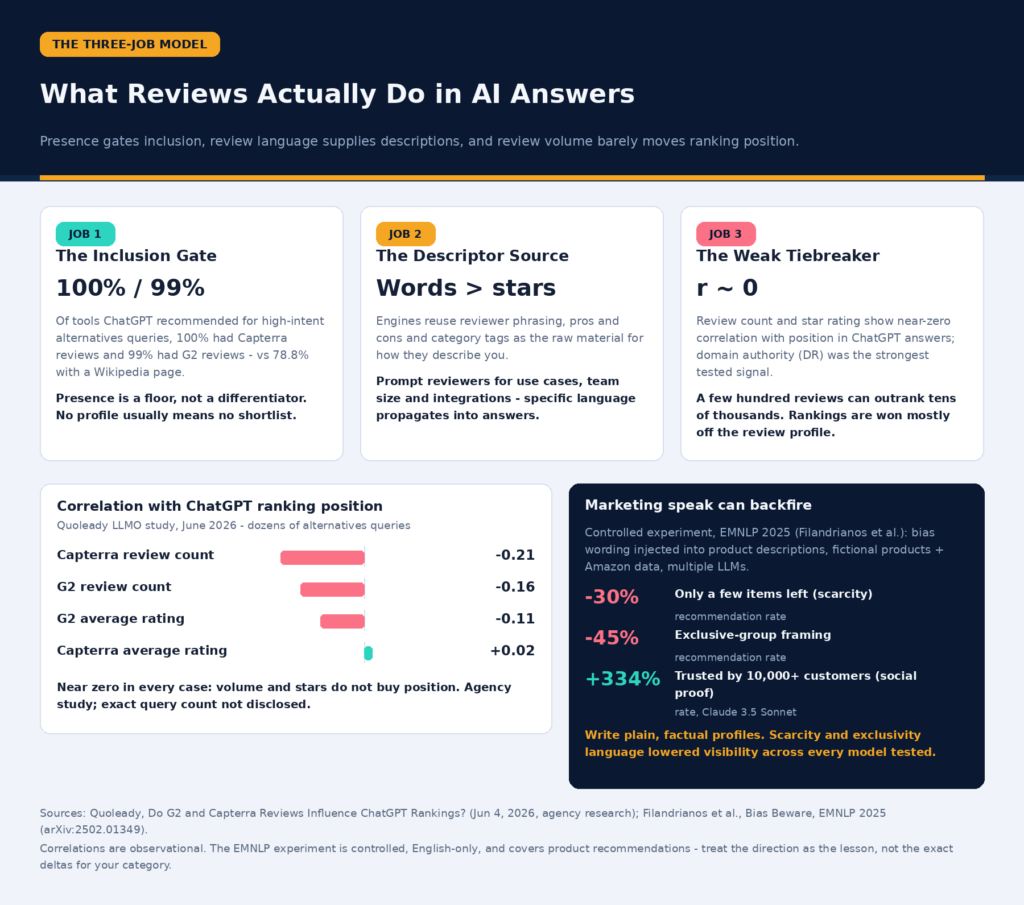
Here is the finding that should end the “we’ll get to G2 next quarter” conversation. Quoleady, an agency that sells LLM optimization, examined the tools ChatGPT recommended across dozens of high-intent “alternatives” queries — Trello alternatives, Zapier alternatives, that genre. Every recommended tool had Capterra reviews: 100%. G2 coverage was 99%. Wikipedia presence, that supposed prerequisite for machine legitimacy, trailed at 78.8%.
Read that as a threshold, not a trophy. When a signal is nearly universal among winners, it cannot differentiate them — but its absence can quietly disqualify you. The engine maps a buyer’s question to a category, retrieves the vendors that category sources associate with it, and corroborates. A missing profile removes you from the candidate set before any ranking contest begins. The exact query count was not disclosed, so treat the percentages as directional; the direction is loud enough.
Job Two: The Descriptor Source
If presence is binary, language is not. When an assistant says a tool is “easy to implement for non-technical teams” or “strong onboarding, weak reporting,” that phrasing frequently traces back to aggregated review text, pros-and-cons fields and category tags. Trustpilot’s report makes the same point from the consumer side: engines summarize recurring themes — service quality, delivery, refunds — rather than merely reading the score.
This is the most underused lever in the whole category. You cannot write your reviews, but you can shape what reviewers have occasion to say. Ask for reviews at moments when a specific outcome just happened, and prompt for specifics: team size, use case, integrations, the alternative they switched from. “Migrated our 12-person sales team off spreadsheets in a week” is retrievable evidence for a buyer’s oddly specific question. “Great product, love it!” is confetti.
Job Three: The Tiebreaker That Isn’t
Now the part the review-industrial complex prefers you skip. Quoleady correlated review metrics with position in ChatGPT answers and found almost nothing: Capterra review count −0.21, G2 count −0.16, Capterra rating +0.02, G2 rating −0.11. Squint at those numbers and they vanish. The strongest position signal in the dataset was domain authority — backlinks — not anything on the profile itself.
The anecdotes make it visceral. OnlyOffice, with 325 Capterra reviews and 64 on G2, ranked third for “Google Workspace alternatives,” above Slack’s tens of thousands of reviews at eighth. Coda, with 97 Capterra reviews, outranked ClickUp’s 4,490 for “Notion alternatives.” Whatever ordering logic the model used, raw review volume was not it.
What This Means for Your Review Budget
Stop buying volume. A campaign to add 500 four-point-eight-star reviews attacks the one metric with no measurable relationship to position. Redirect that spend toward correct category placement, complete profiles, current product facts and reviews rich in the language you want the machine to reuse. Those inputs feed jobs one and two, which is where the evidence actually points.
The Platform Map: Five Names, 88% of Citations
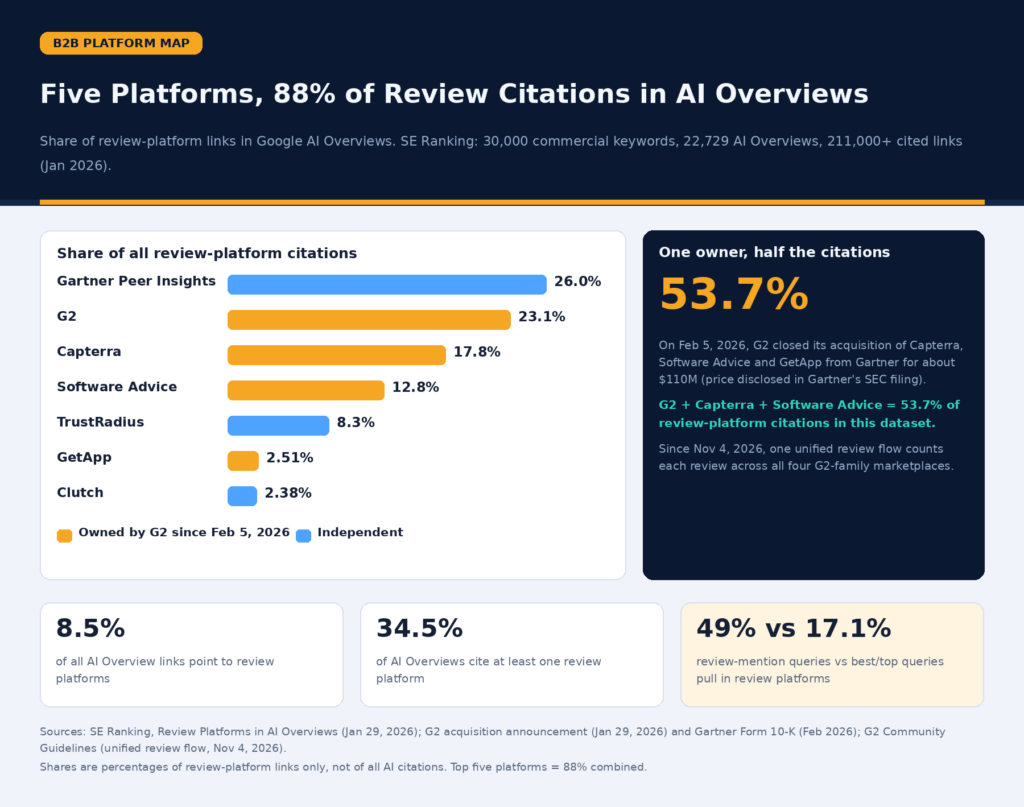
For B2B, the citation economy is oligopolistic. SE Ranking tracked 30,000 commercial keywords and 211,000-plus cited links in Google AI Overviews in January 2026. Five platforms took 88% of review-platform citations: Gartner Peer Insights 26.0%, G2 23.1%, Capterra 17.8%, Software Advice 12.8%, TrustRadius 8.3%. Review platforms overall were just 8.5% of all links but appeared in 34.5% of AI Overviews — scarce, yet disproportionately trusted.
Query wording swings the door open or shut. Explicit “reviews” and “ratings” queries pulled a review platform into 49% of AI Overviews; “best” and “top” queries only 17.1%, because list-style answers prefer editorial roundups. If your buyers ask “best X,” your review profiles compete alongside — and sometimes behind — the listicles you should also be earning placement in.
One Owner Now Holds 53.7% — and One Review Counts Four Times
The map redrew itself in one transaction. G2 announced on January 29, 2026 that it was buying Capterra, Software Advice and GetApp from Gartner; the deal closed February 5 for roughly $110 million, a price disclosed in Gartner’s SEC filing. Add the shares: G2, Capterra and Software Advice together account for 53.7% of review-platform citations in that dataset.
The operational change matters more than the headline. Since November 4, 2026, a single unified review flow counts each submitted review toward the product’s ratings on every G2-family marketplace where it is listed, with full text displayed publicly on one marketplace chosen by G2. Maintaining G2 and Capterra is no longer two parallel grinds; it is one review engine feeding four storefronts. Concentrate your asks there rather than spreading thin across six platforms.
Consumer and Local: Trustpilot’s Turf, With a French Accent
On the B2C side, Trustpilot held about 1.5% mention share in Ahrefs’ September 2026 ranking of ChatGPT’s most-cited sites — top-ten territory, though that share is measured against the top-50 source pool, not all citations. A longer view comes from Sorank’s panel of 301,025 answers across five assistants: Trustpilot was the most-cited review platform overall at 2.7%, spiking to 11.51% in fashion, while TripAdvisor looked modest at 1.08% overall but dominant at 14.27% in restaurant queries.
The asterisk is big: 79% of Sorank’s questions were asked in French, which inflates French directories and depresses Yelp (0.08%). G2’s 0.27% in that panel is a floor, not a verdict — B2B software is under-represented in consumer-heavy prompts. The transferable lesson is structural: categories have their own citation maps. Test your buyers’ questions in your market before copying anyone’s platform list.
The Buyer Side: Half the Market Starts With a Chatbot
G2’s Answer Economy report, based on a March 2026 survey of 1,076 B2B software buyers, found 51% now start research with an AI chatbot more often than with Google — up from 29% a year earlier. Eighty-five percent think more highly of a vendor when AI includes it. Sixty-nine percent chose a different vendor than initially planned because of a chatbot recommendation, and one in three bought from a vendor they had never heard of.
The trust detail deserves its own line: when buyers were asked what most increases confidence in an AI answer, citations from a software review site were the top trust signal. AI assembles the shortlist; reviews validate it. Disclosure, though — G2 sells AI-visibility analytics and answer-engine tooling, so it is both referee and coach. The survey is real; the vendor’s interest in its conclusions is also real.
Write Like a Spec Sheet, Not a Sales Page
There is now controlled evidence that marketing tone can backfire inside machine recommendations. Researchers at EMNLP 2025 (Filandrianos and colleagues) injected cognitive-bias language into product descriptions and measured recommendation behavior across multiple LLMs, using fictional product sets plus Amazon data. Social proof worked — “trusted by 10,000+ customers” lifted one model’s recommendation rate by 334%. But scarcity framing cut recommendation rates by 30%, and exclusivity framing by 45%, consistently across models.
Humans hear “only a few left” and lean in. Models appear to read urgency as noise, or worse, as a reliability discount. The practical rule for profiles, review prompts and product descriptions feeding AI: plain, factual, specific. Save the countdown timers for channels where humans are doing the buying.
The Compliance Playbook: Rules That Actually Bind
The FTC’s fake-reviews rule, effective October 21, 2024, prohibits fake or AI-fabricated reviews, undisclosed insider reviews, review suppression through threats, and — read carefully — incentives conditioned on sentiment, whether stated or implied. Neutral, honestly disclosed incentives are not banned by the rule itself; “tell us you loved it and get 10% off” is. Knowing violators face civil penalties per violation.
Platform rules can be stricter, and G2’s are specific: incentives capped at $100 in any form, including swag and credits; no sentiment-conditioned or selectively positive solicitation; business-partner and guest reviews labeled and excluded from the G2 Score; experiences older than two years rejected; employees and direct competitors barred. On Trustpilot, misuse earns a Consumer Warning banner at the top of your profile — and practitioners report that assistants read that banner straight into reputation summaries. No study has measured how often, but consider the mechanism: the penalty for gaming reviews is publishable text the machine quotes about you.
Operationally, ask at real moments — onboarding completed, first measurable win, renewal — send one follow-up a week later, then stop. Forecast review volume from your own funnel events, not from a “50 reviews in 60 days” wish. And never let an incentivized program drift into sentiment targeting; that is where platform enforcement and federal penalties overlap.
Measuring Whether Any of This Worked
Screenshots are anecdotes. The IAB’s August 2026 guidance, “Measuring Visibility in the AI Era,” organizes measurement into four Ps: Presence (are you mentioned), Prominence (where and how substantively), Portrayal (sentiment and factual accuracy), Persuasion (does the citation drive action). It also draws a hard line most dashboards ignore: fewer than 50 queries is exploratory, and only decision-grade data should move budgets.
A workable protocol: write five to ten real buyer questions, run each in two or three phrasings on at least two engines weekly, and record who was mentioned, who was cited and which sources carried the answer — competitors included. Establish that baseline before touching your profiles. After changes, compare distributions across weeks, not single runs; AI answers are noisy enough that a one-prompt before-and-after is a coin flip wearing a lab coat. If review pages never appear among the sources for your questions, spend elsewhere.
The Honest Boundaries
Three admissions this article owes you. First, nearly everything above is correlation: mature brands accumulate reviews and citations together, and no public controlled experiment has isolated the effect of adding a review profile on recommendation rates. Second, several key studies are vendor-commissioned — Trustpilot’s and G2’s especially — which makes them useful, not neutral. Third, citation shares are volatile: engines rewire retrieval monthly, and a leaderboard is a snapshot, never a deed of ownership. Build the presence, shape the language, respect the rules — and keep measuring, because the ground moves.
Summary
Review platforms now do three distinct jobs in AI answers. They gate inclusion: virtually every ChatGPT-recommended tool has G2 and Capterra reviews, and citation rates climb from 1% to 75% with profile maturity. They supply descriptions: reviewer language becomes the vocabulary machines reuse. They barely break ties: volume and stars correlate near zero with position, while domain authority does the heavy lifting. The market consolidated — one company now owns platforms holding 53.7% of B2B review citations, and one review counts across four marketplaces. So claim the profiles, fix the categories, engineer specific reviewer language, write factually, follow the FTC and platform rules, and measure against a baseline. Buy presence and words, not stars.