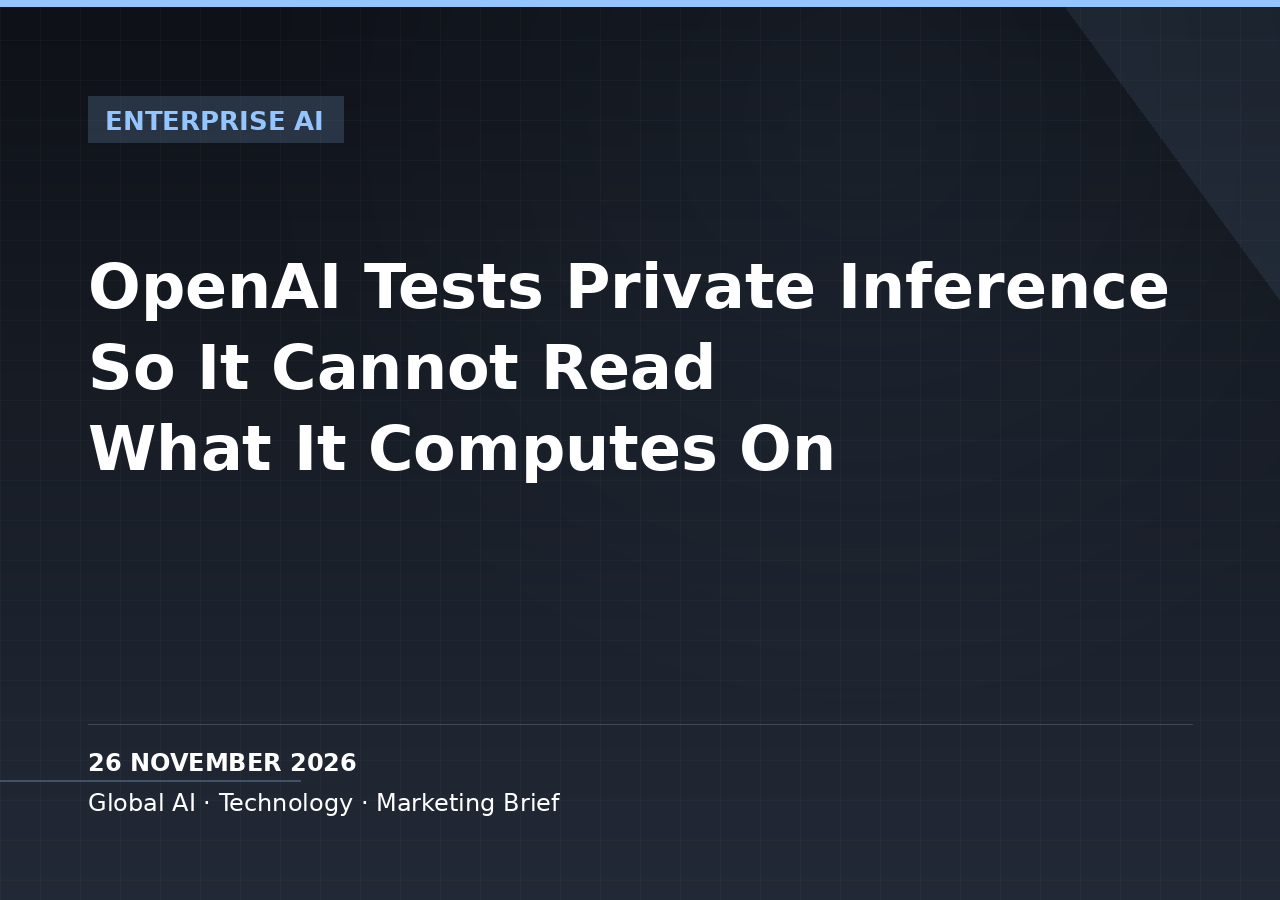
OpenAI has begun testing a feature called Private Inference with a small group of customers, according to a statement from chief executive Sam Altman on 25 November, and the design goal is stated as an architectural property rather than a policy commitment: requests are processed on isolated hardware in a way that OpenAI says can be independently verified, and the company cannot access the data.
Private Inference is one of two components in OpenAI’s Private Intelligence line, which first appeared as a slide in the DevDay keynote in late September and has since been described on the company’s product page as combining confidential computing with strict, verifiable controls over prompts and responses during processing. It is labelled as an alpha and an API preview. No pricing has been published, no customer list, and no general availability date.
The second component is Zero Data Retention paired with Private Safety Processing. ZDR means prompts and responses are not retained after a request is handled. PSP exists because that promise collides with abuse detection: the most serious risks are not visible in a single interaction, since bad actors coordinate across accounts, probe defences repeatedly and disguise threats as ordinary research. Under PSP, an interaction selected by a safety classifier or an approved sampling policy is encrypted and written to a region of cloud the customer controls, readable only by a protected review system. OpenAI’s framing is that automated safety review can proceed without its staff touching the underlying content.
The strategic read
For enterprise buyers, the useful question has never been whether a model is capable. It is whether the data can leave the building. Financial, healthcare, legal and first-party advertiser datasets are exactly the workloads where frontier models would be most valuable, and exactly the ones that procurement blocks first. If private inference becomes a standard, routable product, that block loosens.
It also reframes competition. Google is developing a comparable approach it calls Private AI Compute. Anthropic shipped its Enterprise Frontier Safeguards in September with a similar shape: data stays in the customer’s own cloud account under the customer’s own keys, and automated monitoring signals go to the customer rather than to Anthropic staff. Three labs converging on the same architecture within a quarter is the real signal. Privacy is moving from a clause in a contract to a property of the deployment.
What remains unverified
OpenAI has disclosed no implementation details — which silicon, which trusted execution environment, what attestation looks like, how performance is affected. “Independently verifiable” is a claim about attestation design, and until the attestation mechanism is documented, it is a claim only. Pricing is unknown, which matters: confidential computing historically carries a throughput penalty, and whoever absorbs that cost decides whether this stays a compliance checkbox or becomes the default.