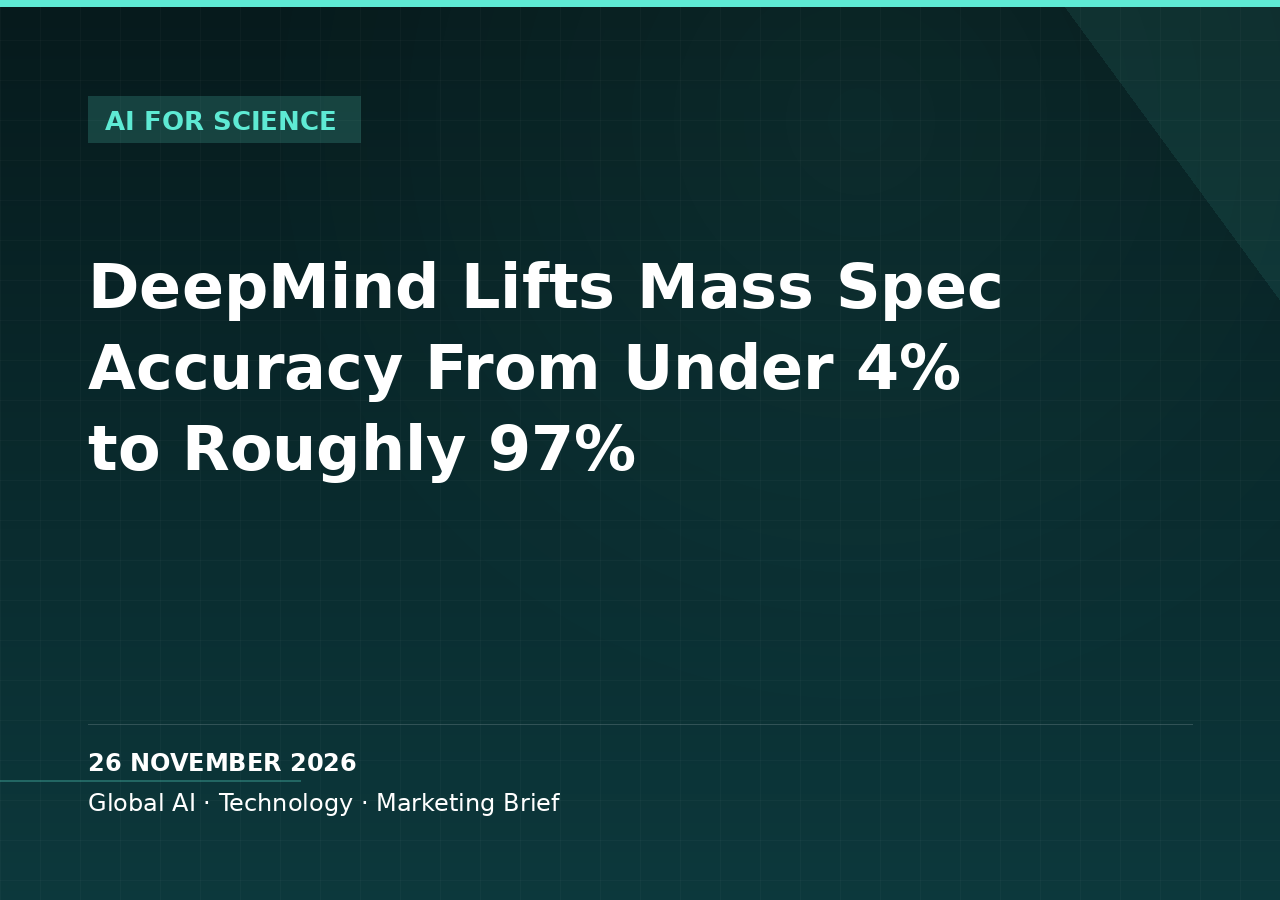
Google DeepMind published a set of domain skills on 25 November that let its Antigravity agent interpret tandem mass spectra end to end, and the evaluation numbers make an unusually blunt argument about how specialised work should be delegated to models.
The setup: 100 compounds drawn from the Enamine REAL MS/MS collection in MassBank of North America, filtered to remove under-fragmented recordings such as intact precursors or dimers that barely broke apart. Three configurations were compared — Antigravity with no internet access and no skills; Antigravity with user-permitted internet access to query public libraries; and that same access plus Mass Spec Skills. Each was run across three models: Gemini 3.8 Flash, Gemini 4 Argon and Gemini 4 Carbon.
With no access and no skills, accuracy stayed below 4% for all three. The models could not reliably deduce a structure from a peak list alone. Adding internet access helped only partially: writing search scripts from scratch proved brittle around precursor windows, adducts and noisy peaks, so the frontier models missed a quarter to a third of the spectra, and the lightweight model missed more than three-quarters.
With the skills installed, all three models identified and verified the exact molecule in roughly 97% of attempts. Gemini 3.8 Flash matched the frontier models.
The token bill fell too
The cost side is the part practitioners will actually feel. Without tools, the models burned the most tokens per attempt trying to reason from raw peak lists. With internet alone, they still spent heavily improvising API calls and debugging one-off scripts. With validated skills, generated tokens per attempt dropped by nearly four times on Flash, by half on Argon and by nearly a fifth on Carbon.
That combination — equal or better accuracy, from a cheaper model, at lower token cost — is the strongest published case yet for a specific architectural claim: on narrow scientific tasks, a small model wired to curated tools beats a large model reasoning from general knowledge.
Where it stops
DeepMind is explicit about the limits. The skills cannot separate enantiomers, or some closely related isomers, from an LC-MS/MS spectrum alone; those need retention time, ion mobility or NMR. For molecules absent from every database, Antigravity cannot confirm a structure, though it can propose a molecular formula, annotate peaks and hand over an evidence table as a starting point.
The context for all of this is what chemists call the dark matter of mass spectrometry: a modern instrument can detect tens of thousands of molecular signals in a single sample extract, yet reference libraries annotate only about 5% of spectra on average, and roughly 10% for human samples. The bottleneck was never instrument sensitivity. It was the cost of interpreting what came off the instrument.
One caveat belongs in any honest account: DeepMind’s launch post carries no independent replication of the 97% figure. The benchmark is the company’s own, on a curated set.