Every playbook about Amazon tells you to move faster. Almost none tell you why speed became the winning trait in the first place — or who benefits from the race. Look at the incentive structure instead of the tactics, and the famous upset stops being a mystery.
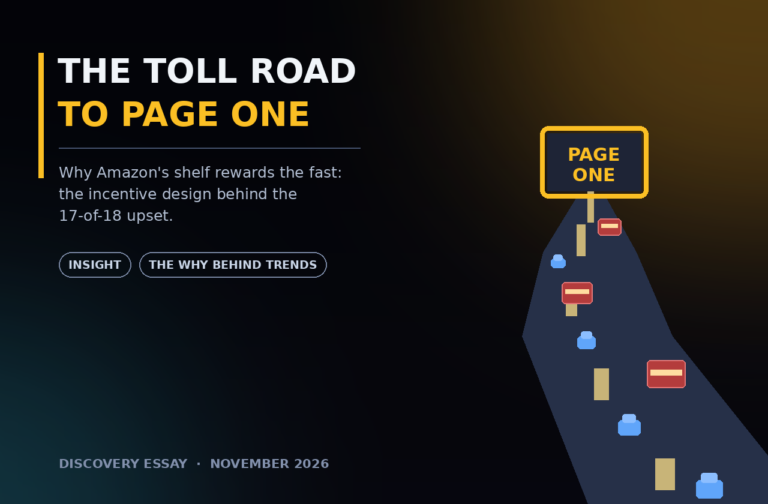
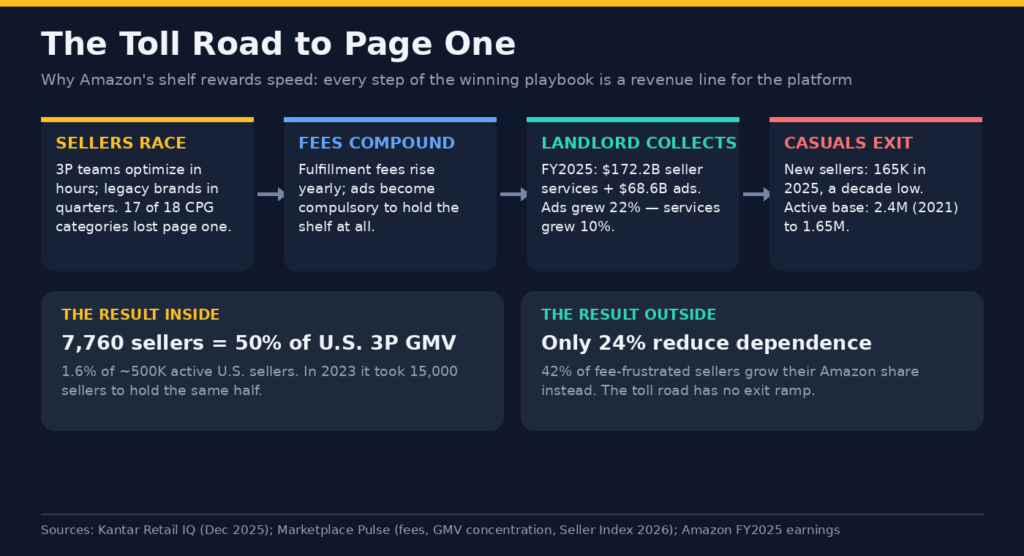
When Kantar Retail IQ analyzed research covering more than 1,000 top Amazon searches, third-party sellers out-placed big CPG brands on page one in 17 of 18 categories. The standard reading is Darwinian: nimble operators beat slow incumbents. The structural reading is stranger. Amazon designed a shelf where the only reliable way to hold visibility is to keep paying — and speed is simply the metabolism of a business built to pay continuously.
Follow the money. Fulfillment fees rise almost every year. Advertising drifted from optional to compulsory as the best-converting screen space became ad inventory. A typical seller now hands over more than 50% of revenue, up from about 40% five years ago. In FY2025 Amazon booked $172.2 billion in third-party seller services and $68.6 billion in advertising — and ads grew 22% while services grew 10%. The race up the shelf is the fastest-growing revenue line the landlord has.
This reframes what the “emergent brand economy” actually is. Third-party sellers dominate page one partly because they are the platform’s best customers: they buy fulfillment, ads and every new service, on every SKU, every week. Amazon’s private labels don’t pay that toll. A heritage brand resists it. The 3P operator metabolizes it. The algorithm isn’t neutral between these business models — the economics behind the algorithm aren’t.
Then watch the second-order effect. Higher tolls squeeze out casual operators: new sellers launching on Amazon.com fell to a decade-low 165,000 in 2025, and the active base shrank from 2.4 million to 1.65 million in four years. You might expect the survivors to relax. Instead, concentration doubled down — 7,760 sellers now hold half of U.S. third-party GMV, versus 15,000 three years earlier — because visibility is rented, not owned. Stop paying, stop appearing. The treadmill doesn’t slow when competitors exit; it just raises the speed needed to stay on.
The most revealing number sits in Marketplace Pulse’s 2026 Seller Index: among sellers most frustrated by fees, only 24% are reducing their Amazon dependence — 42% are increasing it. That isn’t irrationality. It’s the toll road having no exit ramp: Amazon is roughly 36% of U.S. e-commerce, so leaving means leaving the customers. Sellers complain about the toll and drive faster.
Which explains why the insurance layer matters more than the speed layer. The platform’s incentives will never align with yours — its best year is your most expensive one. Speed wins the shelf you rent. Owned demand, clean documentation and second channels are how you stop the landlord from pricing your entire business. The upset wasn’t luck, and it wasn’t virtue. It was design. Play accordingly.