Four years ago, if you wanted to advertise on Netflix, you needed roughly $10 million in annual commitments, a tolerance for a $65 CPM ask, and patience for an ad product built in six months. Today you can buy Netflix through the same DSP seat you already use for the rest of your CTV plan — and the audience on the other side of that transaction has grown to more than 250 million monthly viewers.
That is one of the fastest transformations in modern media buying. It is also, if you read the fine print, a story with a catch: the measurement still doesn’t work like Meta or Google, the pricing has no public rate card, and Netflix just trimmed its own ad revenue forecast by $300 million. Let’s walk through what a buyer actually gets — and what to watch out for.
The Scale: A New Premium Video Pool
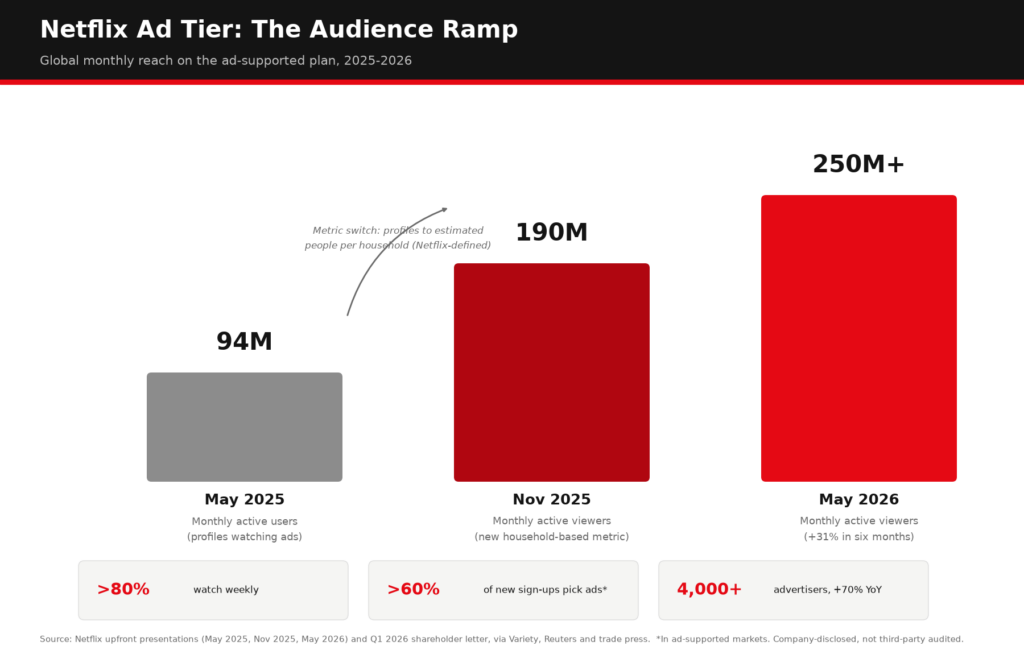
Start with the number everyone quotes. At its May 2026 upfront, Netflix said its ad-supported plan reaches more than 250 million global monthly active viewers — up 31% from the 190 million it reported in November 2025, which itself replaced a 94 million figure from May 2025. In twelve months, the reported reach nearly tripled.
But here’s the first thing a disciplined buyer should notice: those three numbers don’t measure the same thing.
Read the Metric Before You Buy It
In November 2025, Netflix retired its old “monthly active users” count (profiles watching ads) and introduced “monthly active viewers”: members who watch at least one minute of ad-supported content per month, multiplied by the estimated average number of people in the household, based on Netflix’s own first-party research.
That’s a reach estimate, not a subscriber count — and not a third-party-audited one either. It’s a reasonable way to count people on a couch, but it means part of the jump from 94 million to 190 million is definitional, not organic. Netflix has also stopped routine quarterly subscriber reporting; it disclosed more than 325 million paid memberships at the end of 2025 as a milestone update, and otherwise asks investors to judge it on revenue and engagement. When someone waves the 250 million figure at you in a pitch, your first question should be: viewers, users, or households?
Who’s Actually Watching
The engagement signals are more useful than the headline reach. Netflix says more than 80% of its ad-plan members actively watch every week. In its Q1 2026 shareholder letter, the company said over 60% of new sign-ups in ad-supported markets chose the ads plan, and that it worked with more than 4,000 advertisers, up 70% year over year.
On demographics, be careful with the folklore. You’ll see blog posts claiming “70% of the ad tier is 18–34.” That figure doesn’t trace to any Netflix disclosure. What Netflix actually claimed, at its May 2025 upfront, is that its ad tier reaches more 18–34-year-olds in the US than any single broadcast or cable network — a comparative claim, not a composition claim. In France, Netflix’s own ad sales team put 18–34s at just over a third of the ad audience. Translation: this is a broad, mainstream audience with genuinely strong young-adult reach, not a Gen Z-only pool.
The Revenue Story — and the $300 Million Haircut
Netflix’s ad revenue exceeded $1.5 billion in 2025, growing more than 2.5x year over year — impressive, but only about 3.3% of its $45.2 billion total revenue. Management spent the first half of 2026 promising a rough doubling to about $3 billion.
Then came the October surprise. In its Q3 2026 shareholder letter, Netflix cut the full-year ad outlook to roughly $2.7 billion, citing a slower-than-expected rollout of ad product capabilities. Read that carefully: the company blamed execution, not demand. US upfront commitments for 2026–27 nearly doubled, per Netflix’s August announcement. The money is willing; the plumbing is late.
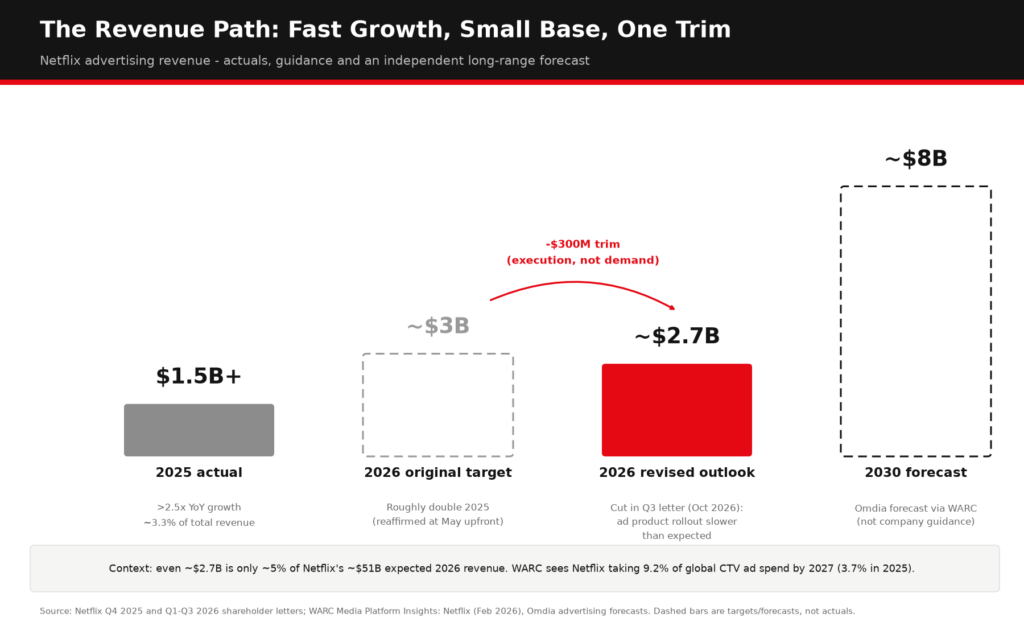
For buyers, the trim matters less as a financial event than as a planning signal: features and markets will slip. The expansion into 15 additional countries — including nine European markets — moved to 2027, with the European launch set for March 1. Podcast and vertical-video ad inventory also lands in 2027. If your international plan assumed those markets in 2026, redraw it.
The independent view is still bullish. WARC Media forecasts Netflix will take 9.2% of global CTV ad spend in 2027, up from 3.7% in 2025, and Omdia projects roughly $8 billion in ad revenue by 2030. Those are third-party forecasts, not company guidance — label them accordingly in your decks.
From $10 Million IOs to Four DSP Doors
The buying model’s evolution is the real story for planners.
At launch in November 2022, Netflix sold through Microsoft, asked a reported “soft $65 CPM,” and sought roughly $10 million in annual commitments from agencies, per WSJ and Variety reporting at the time. Targeting was rudimentary: top-10 titles and genres, no demographic or behavioral buying.
Through 2024–25, programmatic doors opened — Amazon DSP first, then Yahoo — and Netflix shipped its in-house ad tech platform, the Netflix Ads Suite, in spring 2025, live across all 12 ad-supported countries by November.
By August 2026, Netflix confirmed you can transact through Google Display & Video 360, Amazon, Yahoo and The Trade Desk via its CTV Marketplace and DSP-initiated deals. Pause ads became programmatically buyable across all four DSPs, interactive formats expanded to include Send to Phone and Frame Ads, and Conversion, Reach and Audience APIs went live.
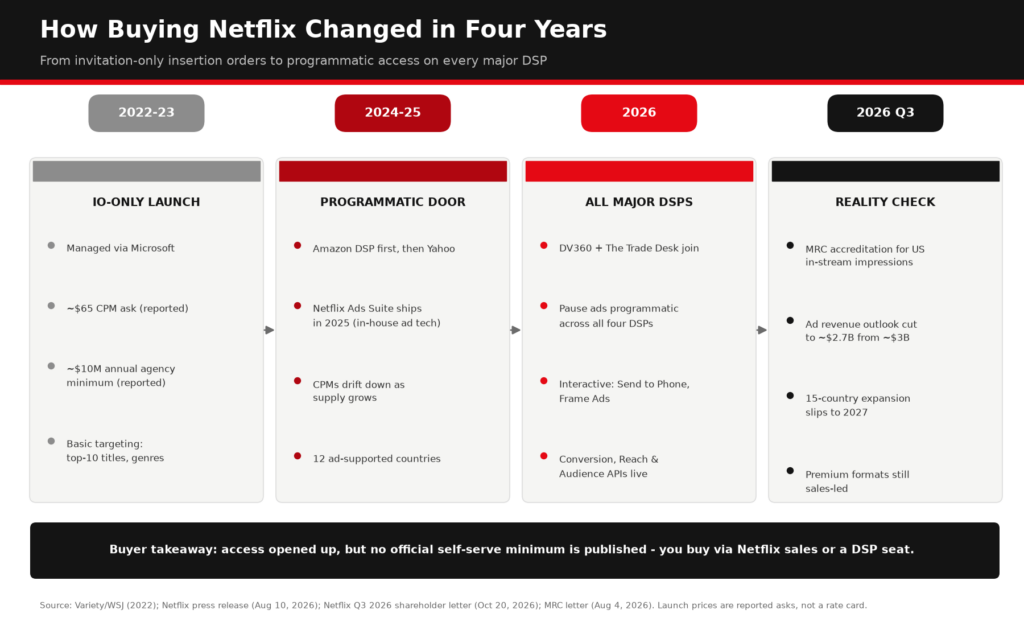
One myth to kill: there is no verified, officially published self-serve Netflix console with a $500 minimum. Claims floating around SEO blogs range from $50 to $500,000, and none trace to Netflix. In practice, you buy through Netflix’s sales team or a DSP partner, and Netflix publishes no minimum spend. If a reseller quotes you a floor, that’s their floor — ask what inventory it actually guarantees.
What It Costs: Pricing Without a Rate Card
Netflix has never published a rate card, so treat every CPM number as reported or estimated. The verified trajectory: launch asks around $65 (2022), buyer complaints about a still-too-high $55 by March 2023 (Digiday), and roughly half the launch price by late 2024 (VideoWeek), as Amazon Prime Video’s ad launch added supply pressure.
Where are we now? Tinuiti’s Q1 2026 Digital Ads Benchmark data shows Netflix CPMs running at about 141% of traditional streaming averages — a ~41% premium, the highest among major streamers. Trade reporting around the 2026 upfront put direct and upfront deals in a $25–65+ range, with NFL inventory at the top and hit shows in the middle. Programmatic broad-reach buys clear lower.
The planning implication: Netflix is a premium-priced environment, and the premium is the point. If your KPI is the cheapest completed view, cheaper CTV inventory exists. If your KPI is attention and brand outcomes per impression, the premium may be justified — but you’ll need the measurement discipline below to prove it.
The Inventory: Formats, Scarcity and Live Sports
Netflix keeps its ad load deliberately light — roughly four minutes per hour at launch, with frequency caps and no ads on Kids profiles. Standard pre/mid-roll video is the workhorse. Pause ads have become a signature format (now programmatic, with AI tooling that generates pause creative from existing assets). Interactive units — Send to Phone, Frame Ads — push engagement beyond the spot itself. Premium sponsorships and integrations remain sales-led.
Live sports is the scarcity engine. Netflix’s 2026 NFL package includes the first regular-season game from Australia (Rams–49ers, Melbourne, September 10), the inaugural Thanksgiving Eve game (Packers at Rams, November 25), two Christmas Day games and a Week 18 game. Add weekly WWE, MLB coverage, and reportedly strong upfront demand for the 2027 FIFA Women’s World Cup. Appointment viewing means unskippable moments and premium CPMs — book early or pay up.
But keep the ROI honest. Co-CEO Ted Sarandos admitted at Bloomberg’s Screentime event in September 2026 that live programming consumes about 5% of Netflix’s ~$20 billion content budget while producing only about 1% of viewing. Netflix buys live for sign-ups, churn reduction and ad dollars — not raw hours. As a buyer, you’re paying for the moment, not the minutes.
Targeting: First-Party Signals, No Cookie Crutches
Netflix targets on its own viewing data: genre and title affinity, demographics (now expanding to household income and composition), device, geography, and in-market audience segments. There are no third-party cookies here. First-party audience activation runs through partners like LiveRamp, and data collaboration through Snowflake and InfoSum integrations.
For planners, this is closer to buying premium TV with digital rails than to buying social. You get context and household-level signals; you don’t get click-level intent. Match your creative to the genre environment — a pause ad during a true-crime documentary reads differently than one during a comedy — and cap frequency aggressively, because a light ad load means over-serving one household burns goodwill fast.
Measurement: MRC Accreditation and the Attribution Catch
Here’s what genuinely improved in 2026: the Media Rating Council granted the Netflix Ads Suite its first accreditation, covering the processing and reporting of US in-stream video impressions across connected TV, mobile app and desktop web. That’s independent verification that the impression counts are real. Note the scope limits: live video and pause ads were excluded from that first accreditation.
Around it sits a partner stack — Kantar for brand lift, iSpot for reach and attribution, Nielsen, DoubleVerify, IAS, attention vendors — more than 50 measurement partnerships in total. The Conversion API now lets you tie campaigns to site actions, and Netflix offers brand-lift, conversion-lift and attribution tooling of its own.
And yet: this is still not a last-click channel. CTV attribution remains triangulated — brand-lift studies, geo-holdout incrementality tests, web-visit correlation where permitted. If your dashboard judges every channel by ROAS, Netflix will look like a failure even when it’s working. Decide your measurement framework before you spend, not after.
Does It Work? The Effectiveness Evidence
The evidence is promising but mostly Netflix-commissioned, so weight it accordingly. WARC’s Platform Insights report (February 2026), drawing on Kantar, ranks Netflix the fourth most “trustworthy” global ad platform — behind YouTube, Instagram and Google, and the only strictly curated one. Gen Z respondents were 70% more likely to trust brands that understand their favorite fandom shows, and 74% more likely to buy from fandom-aligned brands.
In France, Netflix cites an Ekimetrics study finding €1 of Netflix ad investment generates €7.20 in incremental sales — up to four times the average across TV, online video, social and search. Impressive, and vendor-commissioned: treat it as a hypothesis your own incrementality test should confirm.
The most credible engagement fact is also the most sober. Sarandos disclosed that total Netflix viewership grew only about 2% in the first half of 2026. The ad business is growing by monetizing a roughly flat pool of hours more effectively — not by watching time exploding. Meanwhile, co-CEO Greg Peters said on the Q2 earnings call that the revenue gap between ad-tier and ad-free memberships is narrowing. Netflix is squeezing more per viewer. That’s good for its P&L; for buyers, it means inventory scarcity is structural, not temporary.
The Buyer’s Decision Framework
Four questions decide whether Netflix belongs in your plan:
- Need premium, brand-safe video reach with strong young-adult coverage? Netflix earns a line item. Low ad load, curated environment, verified impressions.
- Need last-click performance and tight ROAS? Wrong tool. Meta and Google still own that job; Netflix is an upper-funnel instrument.
- Want live-sports adjacency? Book early, expect top-of-range CPMs, and tie the buy to a brand objective — not a conversions target.
- SMB with a small test budget? Enter through a DSP or reseller with honest minimums, or test on cheaper self-serve CTV first and graduate proven creative to Netflix.
Whichever door you use, pair the buy with brand-lift or geo-holdout incrementality from day one, and treat every audience figure as management-disclosed unless a third party verified it.
Risks and Failure Modes
The ways buyers lose money here are predictable. Judging Netflix by last-click ROAS kills a working brand channel. Assuming programmatic access equals full inventory disappoints — premium formats and integrations stay sales-led. Treating the 250 million viewer estimate as an audited subscriber count inflates your reach math. Overpaying for NFL scarcity without a brand objective buys expensive minutes you can’t evaluate. And planning 2026 campaigns around 2027 markets — the 15-country expansion, podcasts, vertical video — sets you up for a replan in January.
None of these are reasons to avoid Netflix. They’re reasons to buy it deliberately.
The Bottom Line
Netflix’s ad tier has become a genuine third force in premium video: 250 million+ monthly viewers, four major DSP doors, MRC-accredited impressions, and an ad business growing toward ~$2.7 billion this year — trimmed from $3 billion because the tech shipped late, not because advertisers said no. Buy it for attention, trust and incremental reach; measure it with lift and holdouts, not last clicks; price it as the premium environment it is; and read every disclosed number with its definition attached. The door that once required $10 million now opens through your existing DSP. Whether it deserves your budget depends on whether you bring the right ruler.