Here is an uncomfortable question for anyone who buys social ads: when was the last time your video ad got more than a passing glance?
Most feed ads get a flicker of attention, then the thumb moves on. You paid for the impression. You did not pay for anyone to actually look. And for Gen Z — the cohort every consumer brand claims to chase — the gap is widest. In an eye-tracking study of 3,200 Indian users aged 16 to 35 run by Lumen and WPP Media in 2025, Gen Z gave ads on conventional social platforms up to 34% less attention than millennials did. That is not a creative problem you can fix with a punchier hook. That is a structural mismatch between the format and the audience.
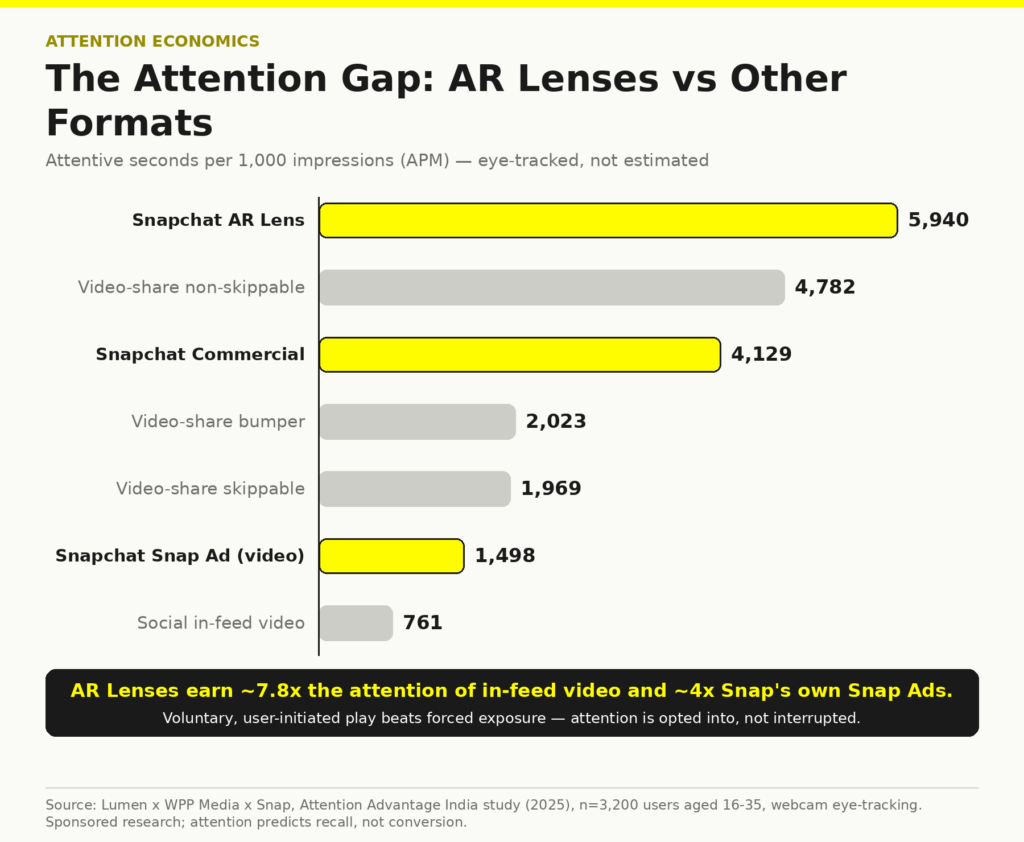
Now the twist. The same study measured Snapchat’s AR Lenses pulling 5,940 attentive seconds per thousand impressions — roughly 7.8 times what standard social in-feed video managed. Not because Snap users are more patient. Because a Lens is not something you watch. It is something you play with. The user opens the camera, picks your brand’s experience, and turns their own face into the ad. Nobody scrolls past themselves.
This field guide walks through the formats, the evidence (with honest labels on who paid for it), the build process, and the measurement traps. If you are planning Gen Z spend for 2027, this is the format you should at least pilot — and the caveats you should not skip.
Why This Channel Is Gen Z Territory
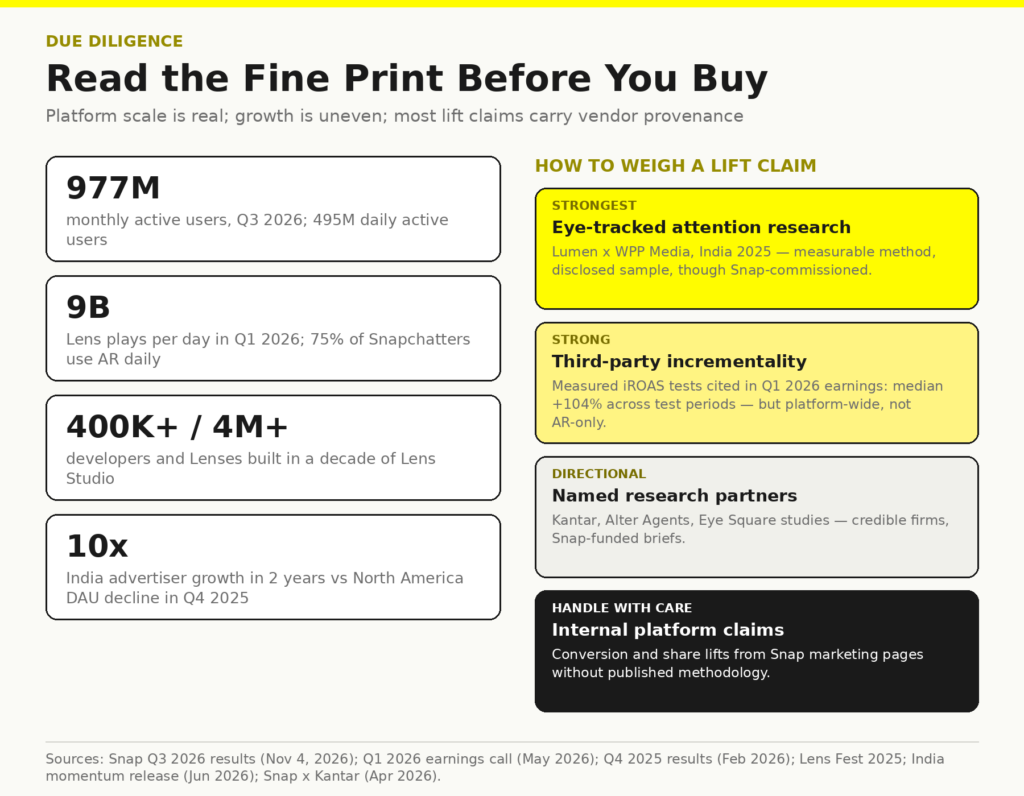
Snapchat is not the biggest platform, and it stopped pretending to be. What it is: concentrated. As of Q3 2026, Snap reported 977 million monthly active users and 495 million daily ones, with revenue up 14% year over year to $1.72 billion. The company has said it reaches more than 75% of 13-to-34-year-olds in over 25 countries, a claim from its 2024 investor materials that still anchors its pitch.
The engagement pattern matters more than the headcount. US Snapchatters open the app more than 30 times a day — a habit Snap has cited for years and reconfirmed in 2026. It opens to the camera, not a feed. And AR is not a side feature there: in Q1 2026, Snap said more than 75% of Snapchatters engage with AR daily and the community plays with Lenses around 9 billion times a day. Over 400,000 developers have built more than 4 million Lenses in the decade since the format launched.
Read those numbers together and the picture is clear. This is a camera-first messaging app where branded AR rides an existing daily behaviour, rather than interrupting one.
The Attention Evidence, Read Properly
The Lumen study deserves a careful read because it is both the strongest asset in Snap’s sales deck and easy to over-quote.
What it actually found: measured attention predicted brand recall eight times better than view-through rate, and brand favourability four times better. Snapchat captured roughly twice the attention of conventional digital platforms overall. Within Snap, Lenses ranked first — 5,940 APM against 4,129 for non-skippable Commercials and 1,498 for standard Snap Ads. Even Snap’s own ordinary video ad lost to a good non-skippable placement elsewhere. The lesson is not just AR beats video. It is that voluntary, immersive formats beat everything, and skippable feed video is the weakest inventory in the test.
Two nuances most coverage skips. First, attention has a ceiling: the study found gains flattening after about nine seconds, so a longer Lens is not automatically a better one. Second, adding Snap to an existing media mix lifted modelled Gen Z attention by up to 22% — a mix effect, not a reason to abandon other platforms.
And the honesty label: Snap co-commissioned this research. The method — webcam eye-tracking, disclosed sample, single-campaign sandbox across categories — is more rigorous than a typical vendor survey, and Lumen is an established attention-measurement firm. But directionally flattering results for the sponsor are exactly what you would expect. Treat the ranking of formats as robust and the exact multiples as indicative.
The Format Menu: What You Can Actually Buy
The AR lineup has grown past the classic face filter. Here is the working taxonomy.
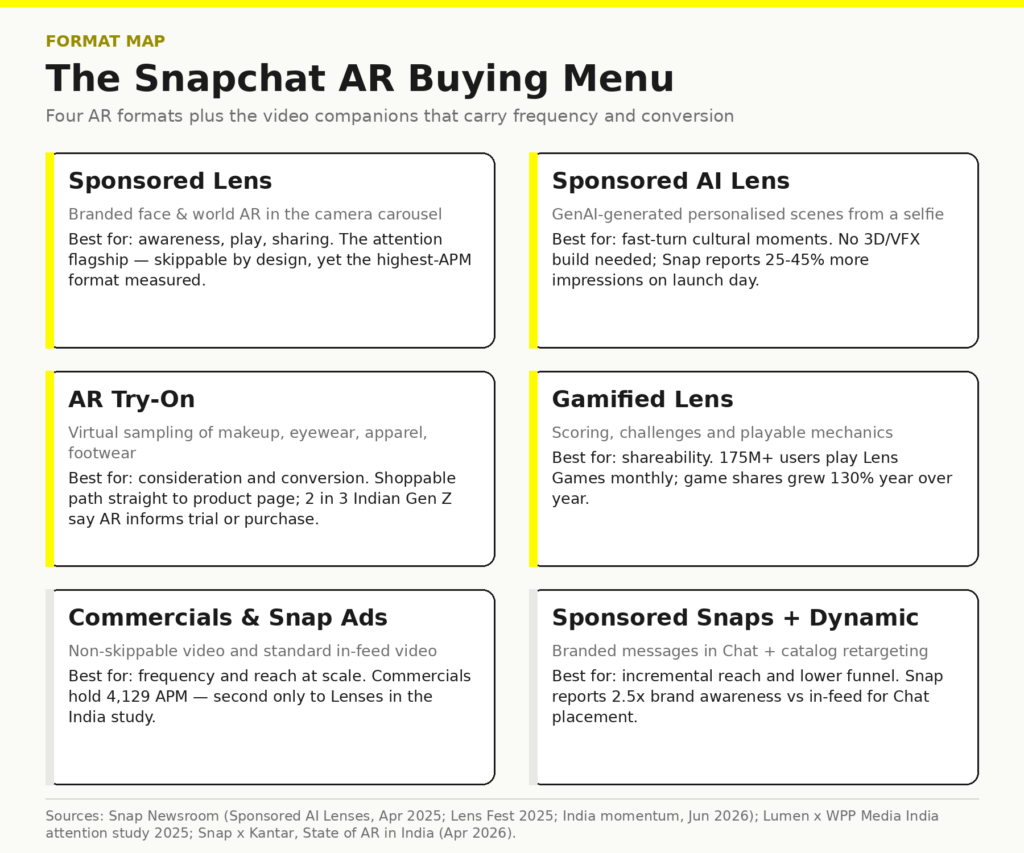
Sponsored Lens. The flagship: a branded face or world AR experience in the camera carousel. Users opt in, play, and share. This is the 5,940-APM format. Best for awareness moments where you want the brand inside the user’s own content.
Sponsored AI Lens. Launched in April 2025, this format generates personalised scenes from a selfie using Snap’s generative AI — no 3D modelling or VFX pipeline required. Uber, Tinder and Coldplay were early adopters. Snap claims brands using it can access 25–45% more impressions on launch day by sitting at the front of the camera; that figure is Snap’s internal data, so hold it loosely. The strategic point stands: production time collapses from weeks to days.
AR Try-On. Virtual sampling for beauty, eyewear, apparel and footwear, with a shoppable path to the product page. This is the conversion-oriented sibling. In Snap’s April 2026 research with Kantar in India — commissioned work, again — two in three Gen Z respondents said AR helps them decide whether to try or buy a product. Try-on turns curiosity into evaluation without a store visit.
Gamified Lens. Scoring, challenges, playable mechanics. At Lens Fest 2025, Snap said more than 175 million people play Lens Games monthly and game sharing grew 130% year over year. If your goal is organic spread, design a game, not a billboard.
Around these sit the companions: non-skippable Commercials and standard Snap Ads for frequency, Sponsored Snaps for branded messages inside Chat, and Dynamic Product Ads for catalog retargeting. You will use them together — more on that below.
The GenAI Twist That Changes the Math
Something quietly changed in the AR cost structure over the past two years, and most media plans have not caught up.
The old objection to Lenses was production: you needed a 3D artist, weeks of build time, and a budget that made AR a big-moment-only format. Snap has been dismantling that objection piece by piece. Lens Web Builder has offered free templates since 2020. Sponsored AI Lenses removed the 3D requirement entirely for selfie-transformation experiences. And in November 2026, Snap shipped Easy Lens CLI, which lets creators describe a Lens in plain language and have an AI coding assistant build, test and publish it — a playable game can go from idea to published Lens in a single day. Lens submissions in Q1 2026 were already up more than 150% year over year, driven by these tools.
For buyers, the implication is timing arbitrage. Cultural moments — a festival, a product drop, a viral meme — have short half-lives. When a Lens takes six weeks, you plan around predictable calendar events. When it takes days, you can ride news. That shifts AR from a tentpole format toward something closer to moment marketing, and the teams that reorganise their creative ops around that speed will get the compounding advantage.
The Purchase Evidence, With Its Provenance Labels
Attention is the headline, but you are paid on outcomes, so what happens downstream?
The most independent anchor is incrementality. In its Q1 2026 earnings, Snap cited tests by the third-party measurement firm Measured showing median incremental ROAS on the platform grew 104% between the April–September 2025 and October 2025–March 2026 test periods. Real caveat: that is platform-wide performance across formats, not an AR-only result. It tells you Snap’s measurement infrastructure improved; it does not prove your Lens will double sales.
The AR-specific commerce evidence comes mostly from research Snap commissioned with credible partners. Work with Tinuiti and Alter Agents, covering 741 coded branded Lenses and a survey of 5,000-plus social users across five markets, found Snapchatters 2.4 times more likely to buy packaged food and beverages after engaging with branded AR, with smaller lifts for entertainment, apparel and beauty. The Kantar India study pointed the same direction on trial and purchase decisions. These are consistent, plausible, methodologically described — and all funded by the platform that benefits from the answer.
So the working rule: believe the mechanism (trying a product virtually reduces purchase uncertainty), trust the direction of the lift, and refuse to bank a specific multiple until your own brand-lift or incrementality test confirms it. Every number above carries a provenance label for a reason. Budget like a sceptic; test like a scientist.
Building a Lens: Timelines You Can Plan Around
Three production tiers, with verified anchors for each.
Template route — days. Lens Web Builder produces a branded Lens from templates in minutes, free of creative fees. Add the review buffer: Snap’s own guidance says upload at least five business days before launch, covering automated technical review, manual technical review and ad review. So a template pilot realistically goes live within one to two weeks of a decision.
AI-assisted route — days. Sponsored AI Lenses and Easy Lens tooling compress custom-looking experiences into a fraction of traditional timelines. You still need brand review and the same five-business-day approval window, but the creative bottleneck largely disappears.
Custom craft route — weeks. A fully bespoke Lens with original 3D assets and interaction design is still a production project. The canonical reference point remains Taco Bell’s taco-head Lens, which took six weeks of direct collaboration with Snap back in 2016. Modern tooling has shortened this, but treat multi-week planning as the honest default for original world-AR builds, and never promise a cultural-moment launch without the review buffer.
One scheduling rule regardless of tier: anchor the Lens to a moment — a launch, a season, a festival — so the experience feels timely rather than promotional.
Stack, Don’t Choose
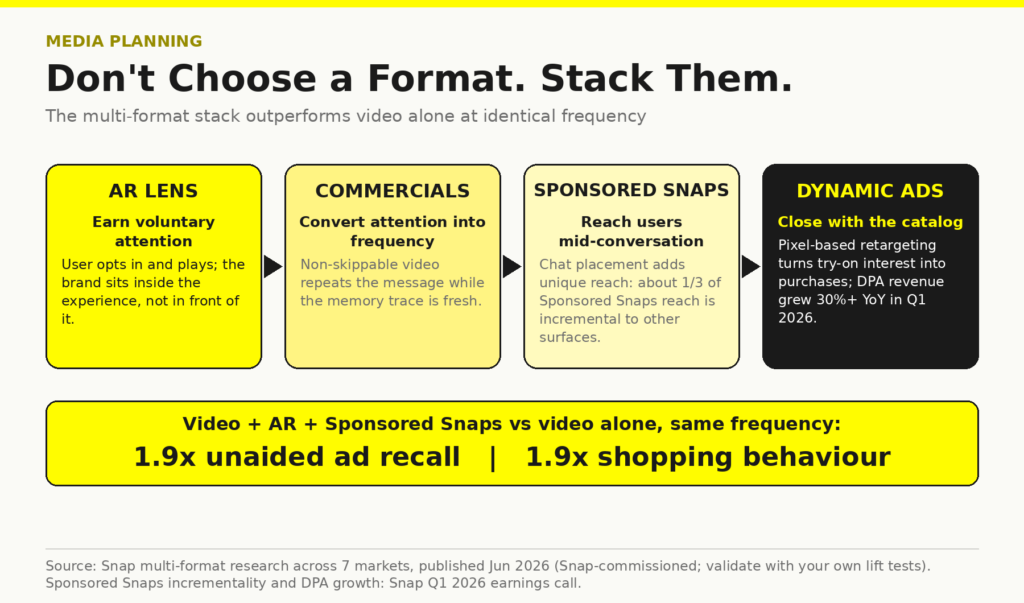
The most actionable finding in Snap’s June 2026 research announcement — global work across seven markets, Snap-commissioned — is that formats compound. Campaigns combining video, AR Lenses and Sponsored Snaps delivered 1.9 times the unaided ad recall and 1.9 times the shopping behaviour of video-only campaigns at identical frequency.
Unaided recall is the demanding metric: respondents naming your brand with no prompt. Doubling it at the same frequency suggests multi-format exposure builds a more durable memory trace than repetition of one format.
The logic of the stack: the Lens earns deep voluntary attention and creates the memory; Commercials repeat the message while it is fresh; Sponsored Snaps catch users mid-conversation — Snap says roughly a third of Sponsored Snaps reach in US Chat is unique to that surface; Dynamic ads close the loop on people who tried the product virtually. Q3 2026 showed Sponsored Snaps revenue growing 56% quarter over quarter, so the chat surface is scaling fast.
Same honesty label as before: this is Snap’s own research, and the company sells the stack. Validate the compounding effect with your own holdout test before shifting your whole mix.
Creative Discipline: Design the Experience, Not the Ad
The case every Snapchat deck still opens with is nearly a decade old, and it endures because the lesson is structural.
On Cinco de Mayo 2016, Taco Bell turned users’ heads into giant taco shells. The Lens drew 224 million views in 24 hours, with users playing for an average of 24 seconds — about three times the platform’s typical engagement — and roughly half of them sharing it. Trade press at the time reported peak-day Lens placements around $750,000, a historical anecdote rather than today’s rate card, but the engagement economics were the story even then: users voluntarily spent half a minute inside a brand experience and then distributed it for free.
What made it work translates directly to 2026 briefs. The user is the hero, not the product. The mechanic is dead simple — one idea, executed well. Sharing is the distribution engine, so the output has to be something a person wants to send to a friend. Branding stays visible but light: the Lumen and Dentsu work both found clear top-of-screen branding, sound-on design and a selfie option lift attention and recall, while heavy-handed branding kills the share.
AR punishes the repurposed TV spot. If your Lens is just your video ad with a face filter stapled on, you paid premium prices for a gimmick. Design the play first; let the brand ride along.
Measurement: Attention Is Not Conversion
The measurement trap is comparing AR engagement seconds to feed-video seconds and declaring victory. They are different intent states. A user playing with your Lens is exploring; a user watching your Commercial is receiving. Both matter, but they sit at different funnel stages and deserve different KPIs.
A workable framework: judge the Lens on attention metrics — play time, share rate, and the APM-style attentive-seconds view — plus brand-lift studies for recall and favourability. Judge the try-on and Dynamic layer on pixel-tracked conversions with sensible attribution windows; the Tinuiti-linked research found AR drives slower, more deliberate decision-making, so a same-session last-click view will systematically undervalue it. And judge the whole stack on incrementality: a geo holdout or a Measured-style iROAS test tells you what the spend added, which is the only number your CFO actually cares about.
One forward-looking wrinkle: Snap has announced it will shift its primary reported audience metric from DAU to MAU starting Q1 2027 and stop reporting regional DAU and ARPU. If your dashboards benchmark against Snap’s regional disclosures, plan for that data to disappear.
Budget and Market Reality: Read the Fine Print
Two truths coexist. Snap’s ad business is improving — Q1 2026 saw SMBs account for more than 30% of global ad revenue, and third-party iROAS trending up. And Snap’s map is shifting under your feet.
North American daily users declined to 94 million in Q4 2025, while the Rest of World segment keeps growing; India alone now has over 250 million users and saw its advertiser base grow tenfold in two years, per Snap’s June 2026 announcement and its India managing director’s on-record comments. Q3 2026 added another caution: upper-funnel brand advertising declined year over year as consumer-goods brands pulled back, even while direct response grew. The premium brand budgets that historically funded big Lens moments are exactly the budgets under pressure.
Practically: self-serve Ads Manager makes a template-Lens pilot accessible without an enterprise relationship — start small, validate attention and lift, then scale into custom builds and takeovers. And plan by market. A Gen Z strategy in India or the Gulf rides a growing user base; the same strategy in North America fishes in a shrinking, more expensive pond.
Failure Modes to Avoid
Four ways teams waste money here, in rough order of frequency. First, treating AR as display: no play mechanic, no share value, premium price. Second, banking vendor multiples: planning ROI around a commissioned 2.4x without your own test. Third, expecting AR to repair a broken mix: a Lens cannot compensate for the wrong audience or a weak product page downstream of the try-on. Fourth, timeline arrogance: a custom build that misses its cultural moment is just an expensive filter nobody asked for. The five-business-day review buffer alone has killed more launch dates than any creative disagreement.
A 30-Day Pilot You Can Actually Run
Week one: pick the moment and the SKU. Choose one cultural anchor in the next 60 days and one try-on-friendly product. Build a template Lens and set up the pixel and a brand-lift baseline. Week two: submit creative early — the review window is real — and configure the companion layer: Commercials for frequency, a Dynamic catalog for retargeting. Week three: launch the Lens with Commercials stacking behind it; watch play time, share rate and try-on swipe-through daily. Week four: read the results against baseline — attention metrics for the Lens, conversions for the lower funnel — and set up a holdout for an incrementality read. Scale to custom only when both attention and lift validate. Total exposure: a template build, a modest media budget, and four weeks of discipline.
The Bottom Line
Snapchat AR is the rare ad format the audience chooses to touch. The eye-tracked evidence says voluntary play out-attentions every conventional format tested; the commerce evidence — mostly Snap-funded, consistently directional — says trying products virtually moves people toward buying; and the new AI tooling has collapsed the production cost that used to keep this format locked to big budgets. Buy it for attention and try-on conversion, stack it with video and chat for recall, measure it with lift and incrementality rather than last-click, and label every vendor number until your own data replaces it. The two-second problem is not going away. This is one of the few formats built to sidestep it.