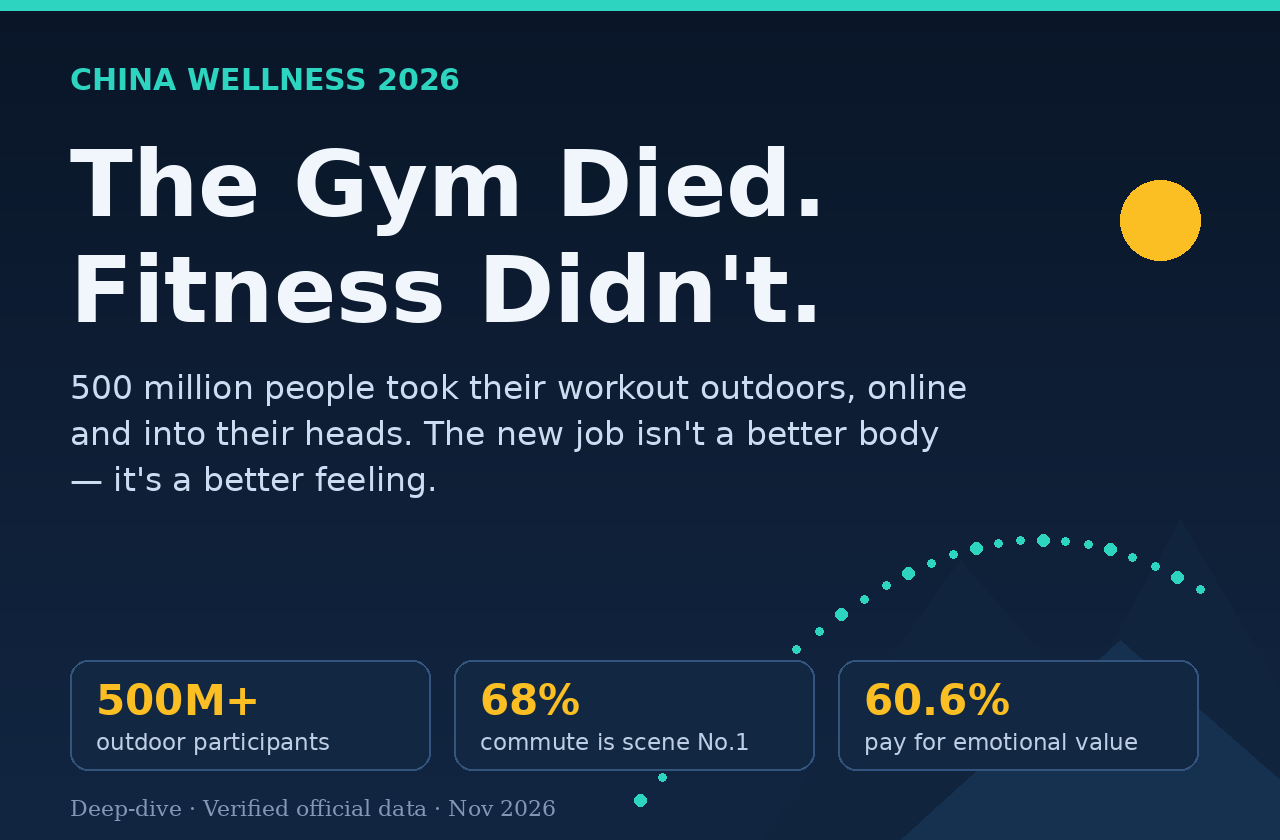
The gym died. Fitness didn’t. Here’s where 500 million people went instead — and what they’re actually buying.
Executive Summary
China’s post-pandemic fitness story is usually told as a gym recovery. The data tells a different story: a category redefinition. Outdoor participation passed 500 million by the end of 2025, the No.1 outdoor consumption scene is the urban commute (68%), and nearly half of Chinese adults report sleep trouble while six in ten online shoppers willingly pay extra for emotional value. Meanwhile the old machinery — gym memberships, fitness apps, annual contracts — is shrinking. The job consumers hire fitness for has changed: less body-sculpting, more feeling-management. Brands still selling six-packs are answering a question this cohort stopped asking.
Fitness Left the Building
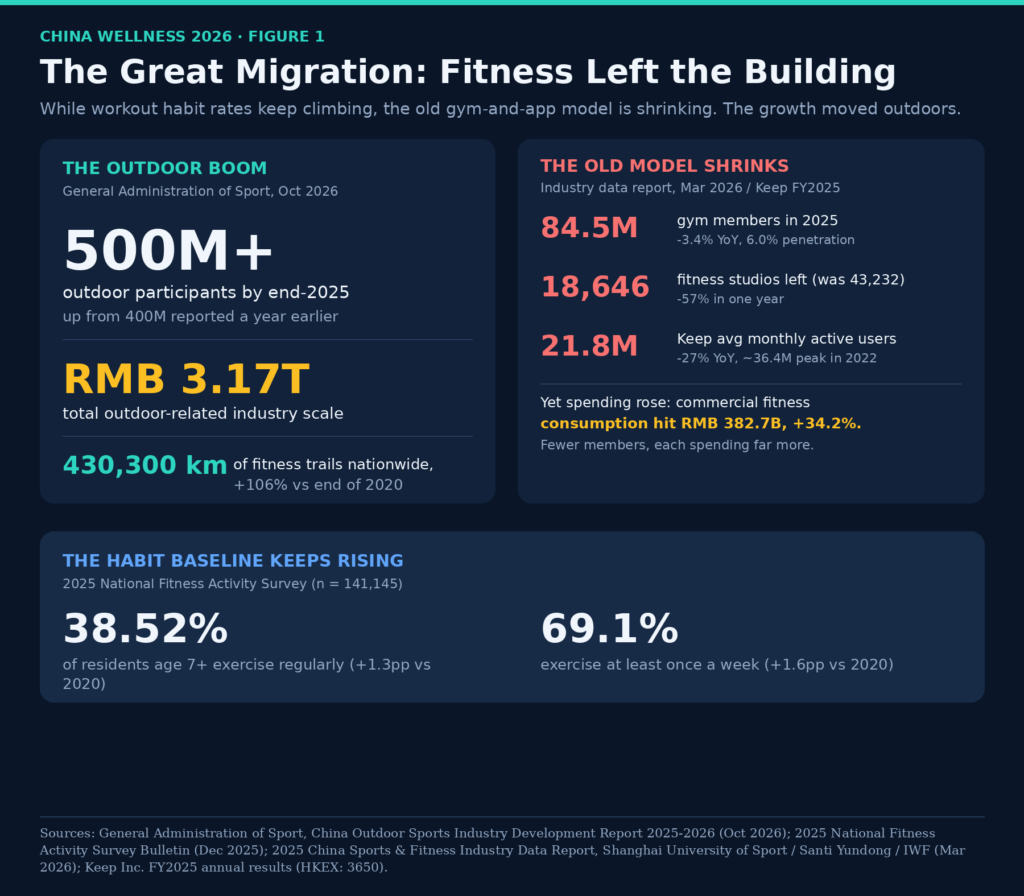
Start with the number that reframes everything. In October 2026, the General Administration of Sport released its China Outdoor Sports Industry Development Report 2025–2026: more than 500 million people now participate in outdoor sports, up from 400 million reported just a year earlier, and the outdoor-related industry has reached roughly 3.17 trillion yuan. That is a quarter more participants in twelve months, in a category most marketers still file under “niche adventure travel.”
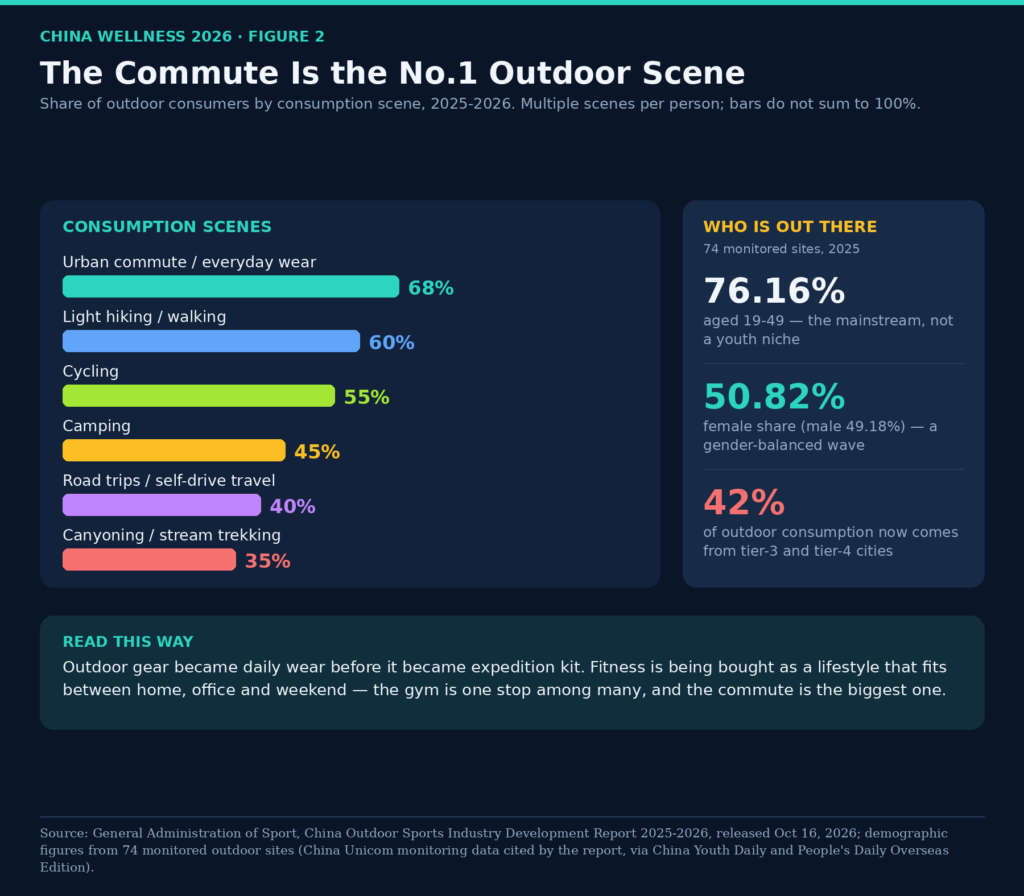
Now look at what those people are actually doing. The report’s consumption-scene data contains the single most revealing statistic in Chinese fitness today: urban commuting and everyday wear rank first, at 68%. Light hiking follows at 60%, cycling at 55%, camping at 45%. The shell jacket on the subway outranks the summit push. Fitness didn’t collapse after the pandemic. It dissolved into daily life — into the commute, the weekend walk, the ride to work — and stopped requiring a building with a turnstile.
The Gym’s K-Shaped Split: Fewer Members, More Money
Here’s where the “gym recovery” narrative breaks. According to the 2025 China Sports & Fitness Industry Data Report — compiled by Shanghai University of Sport, Santi Yundong and the IWF fitness expo under the China Bodybuilding Association’s guidance — total gym membership fell 3.44% to 84.5 million, a penetration rate of just 6%. Fitness studios, the boutique darlings of the late 2010s, collapsed from 43,232 to 18,646 in a single year. Nearly six in ten vanished.
And yet commercial fitness consumption grew 34.2% to 382.7 billion yuan. How? The members who stayed got serious. Active members now visit 7.56 times a month, up 42.1%. The average annual card price hit 3,838.5 yuan — 2.3 times the 2024 level. Short-term memberships dominate: 97.1% of studio contracts and 85.3% of club contracts now run a year or less. Traditional clubs, ironically, grew 34% in count while studios died, and 24-hour gyms and bare-bones iron gyms exploded.
Read that split carefully. The casual, guilt-driven, New-Year’s-resolution member left the building — probably for a trail or a run club. The committed core stayed, paid more, and demanded flexibility instead of lock-in. The gym isn’t dead. The gym as a mass-market subscription business is.
The App That Proved the Point
Keep, the HKEX-listed fitness app that once symbolized China’s home-workout boom, delivered its first-ever adjusted annual profit in FY2025 — 25.2 million yuan. Cause for celebration? Read the rest of the release. Revenue fell 20.7% to 1.637 billion yuan. Average monthly active users dropped 27% to 21.8 million, roughly 14.6 million below the 2022 peak. Subscriber penetration actually rose to 12.6%, and remaining users trained more.
Same K-shape, different surface. Keep got profitable by shrinking into its core — much like the gym industry. The mass audience that joined during lockdown livestreams didn’t stay home. It went outside.
The Livestream Wave That Receded — and What It Left Behind
Remember April 2022? Will Liu — Liu Genghong — the celebrity trainer who turned his living room into China’s largest aerobics class, set to a Jay Chou track. He gained over 40 million Douyin followers in twelve days and passed 70 million by the end of May. Peak sessions drew more than 48 million views, with over 4 million people watching simultaneously. By December his follower count had slipped, and media interviews found former followers who hadn’t followed along since summer.
The obituaries wrote themselves: home fitness was a fad. But that misses what the wave deposited. Tens of millions of people learned that exercise can happen anywhere, in twenty-minute doses, without equipment or etiquette. The livestream room was a training camp for a habit that graduated outdoors. The format died; the permission it granted — fitness doesn’t need a facility — survived.
The Feeling-First Job: Four Reasons People Actually Pay
If the body-transformation job is fading, what replaced it? The evidence points to four jobs, all about feelings rather than physiques.
Job 1: Stress Relief — The Antidote to Involution
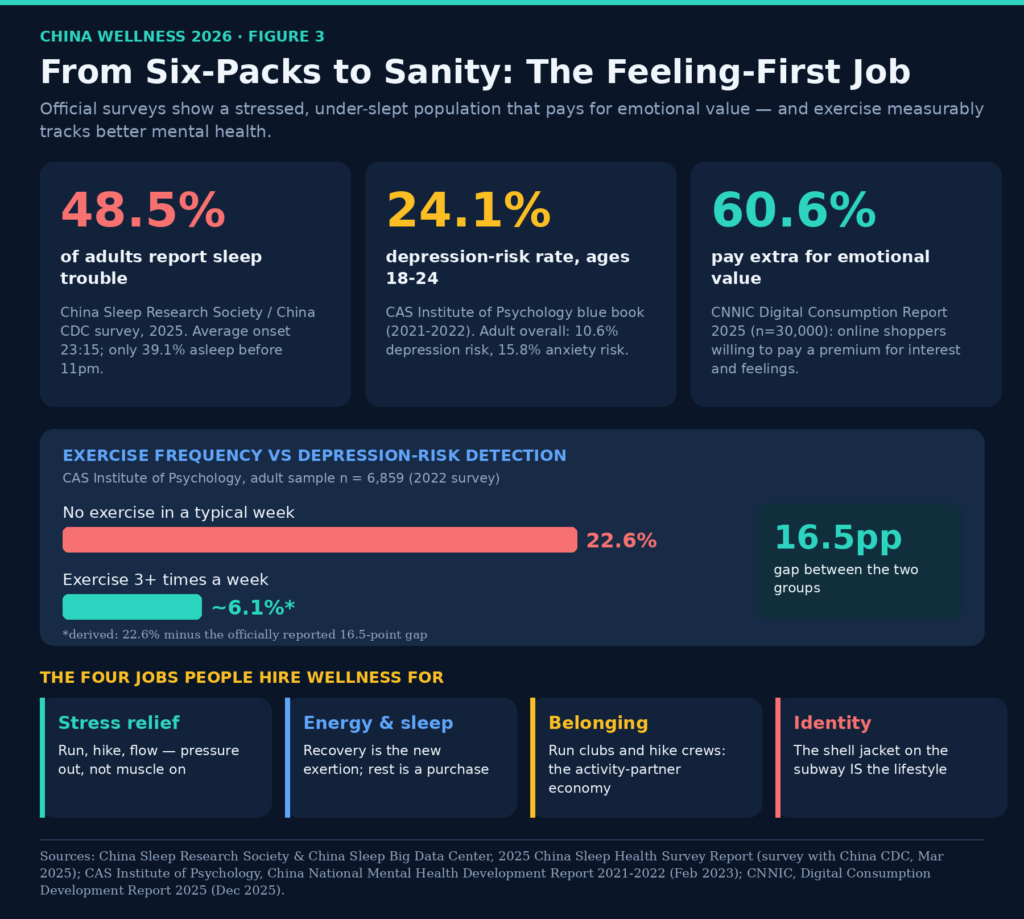
The Chinese Academy of Sciences’ Institute of Psychology found depression-risk detection at 10.6% among adults and 15.8% for anxiety in its 2021–2022 national blue book — and a striking 24.1% depression-risk rate among 18–24-year-olds. In the same survey, adults who did no weekly exercise showed a 22.6% depression-risk rate, 16.5 percentage points above those exercising three or more times a week. Correlation, not causation — but a population under this much pressure doesn’t wait for randomized trials. It runs, it hikes, it flows. The workout is self-medication with better side effects.
Job 2: Energy and Sleep — Recovery Is the New Exertion
The China Sleep Research Society’s 2025 national survey, conducted with the China CDC across 46,452 valid respondents, found 48.5% of adults reporting sleep trouble. Average sleep onset: 23:15. Only 39.1% fall asleep before 11pm. China News Weekly, drawing on the same research, counts over 300 million people with sleep disorders, roughly 150 million needing active intervention. When half the market is exhausted, “get shredded” is tone-deaf. “Sleep better, wake up human” is a value proposition. Notice that the wellness purchase here is recovery — pillows, wearables, wind-down rituals, gentle movement — not exertion.
Job 3: Belonging — The Activity-Partner Economy
Run clubs, hiking crews, cycling groups: fitness became the socially acceptable way to make friends as an adult. China’s cycling association counts roughly 40 million riders, about 10 million of them active. Meituan’s research institute reports over 10 million consumers buying outdoor-experience services on its platform in a year, across some 46,000 listed service venues — skills classes and guided experiences, not gear shops. People are paying for the group, not just the activity. The dazi — the activity partner — is the retention engine gyms never cracked.
Job 4: Identity — The Commute Is the Category
Back to that 68%. When the top outdoor consumption scene is commuting and everyday wear, fitness apparel is identity wear. The demographic data confirms the breadth: 76.16% of monitored outdoor participants are aged 19–49, women are 50.82% — a hair more than men — and tier-3 and tier-4 cities now generate 42% of outdoor consumption. This is not a coastal yoga-girl niche. It is a mass, gender-balanced, lower-tier-inclusive lifestyle. The trail-to-subway pipeline is the category.
What Everyone Misunderstands
Three misreadings keep costing brands money.
“The gym is bouncing back.” Membership fell; spending rose among a committed core. If you benchmark against 2019 mass-membership economics, you’re modeling a customer who left.
“Transformation sells.” Before-and-after photos address the appearance job. The growth jobs are stress, sleep, belonging and identity. A cohort with a 48.5% sleep-trouble rate is not shopping for abs; it’s shopping for relief.
“Wellness is young, female and tier-1.” The outdoor data says balanced gender, mainstream working age, and 42% of consumption from smaller cities. The stereotype costs you the majority of the market.
The Money Follows the Feeling
Skeptics will say emotional value is soft, unmeasurable spend. Two official data points disagree. CNNIC’s Digital Consumption Development Report 2025, based on 30,000 residents across 31 provinces, found 60.6% of online shoppers willing to pay a premium for interests and emotional value. And in January 2026, the State Council General Office’s work plan on new service-consumption growth points named emotion-based and experience-based services as one of three potential domains to cultivate — alongside performances and sports events — with support for new consumption scenes and formal recognition of related occupations. When the state’s consumption playbook lists feelings as an industry, the feeling-first job isn’t a trend piece. It’s policy-backed demand.
The Playbook for Brands
Sell the feeling, keep the proof. Lead with sleep, stress, energy and belonging — but back it with specifics. The CAS exercise-and-mood data is correlational; claim direction, not cure. China’s ad law punishes absolute promises, and this cohort punishes vibes without substance.
Meet consumers at the nodes, not the temple. The wellness life is distributed: trails, living rooms, commute routes, sleep rituals. A brand present only at the gym misses most of the job. Home equipment still sells — AVC monitored 590 million yuan of online treadmill sales in Q1 2026 alone, with knee-friendly cushioning and incline features leading the upgrade cycle — but it sells as one node of a hybrid life, not a lockdown substitute.
Build the dazi layer. Community is the retention mechanism. Sponsor run clubs, host beginner hikes, make your product the ticket into a group. Meituan’s 46,000 experience venues prove people pay for structured belonging.
Dress the commute. With 68% citing everyday wear as their top outdoor scene, the design brief is trail-capable, office-presentable. And take the tier-3/4 signal seriously: 42% of consumption is already there.
The Counterargument, and Its Limit
Fair pushback: gyms still matter, hiking isn’t exercise, and post-pandemic spikes fade. All partly true. Strength training and class communities persist — the gym survives as a node for the committed, which is exactly what the K-split shows. Leisure-as-feeling counts precisely because the job is feeling; the category boundary expanded, and that expansion is the story. And while intensity normalizes — Keep’s arc proves it — the structural deposits remain: 430,300 kilometers of fitness trails, a policy framework for emotion-based services, and a generation that learned to work out anywhere. Cycles fade; infrastructure and habits compound.
Conclusion
The post-pandemic wellness wave was never a gym recovery. It was a category redefinition: fitness migrated outdoors, hybrid and mental, and the job shifted from sculpting a body to managing a feeling — stress, sleep, belonging, identity. The commute outranks the mountain, half the country sleeps badly, six in ten shoppers pay for emotional value, and the state plans for it. The wellness consumer doesn’t want a body. They want a feeling. The brands that inherit this market will be the ones that stopped selling the before-and-after and started selling the after-feeling.