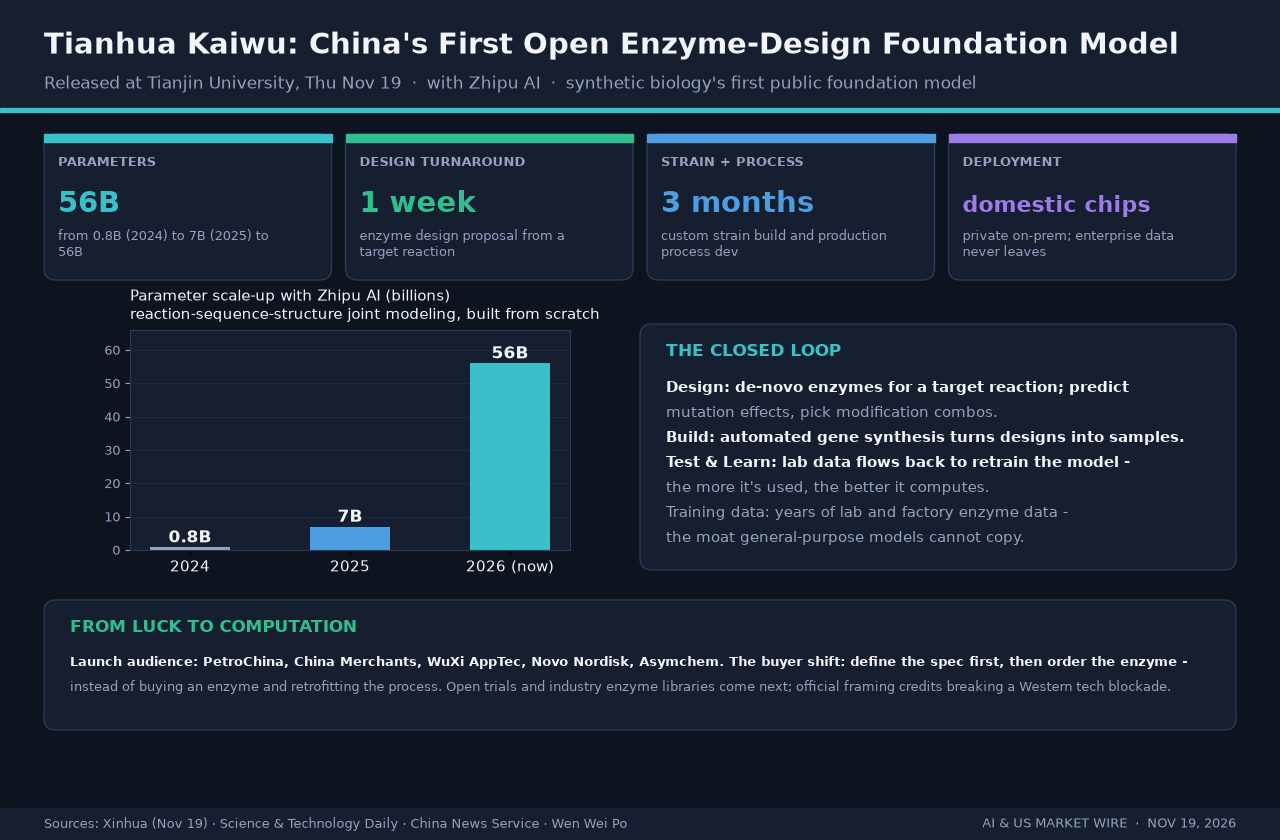
Tianjin University released “Tianhua Kaiwu” on Thursday, November 19 — synthetic biology’s first publicly released foundation model, co-developed with Zhipu AI and scaled from 0.8 billion parameters (2024) through 7 billion (2025) to 56 billion today — pairing reaction–sequence–structure joint modeling with the university’s automated synthesis equipment to close the design–build–test–learn loop: enzyme design proposals within one week of a target reaction, custom strain construction and production-process development within three months, with lab data flowing back to retrain the model so it computes better the more it’s used. The moat is data, not architecture: years of enzyme sequence, structure, reaction and process data from labs and factory floors that general-purpose models cannot replicate, with domestic-chip compatibility and private on-prem deployment so enterprise data never leaves the plant. Launch-day industry attendance — PetroChina, China Merchants, WuXi AppTec, Novo Nordisk, Asymchem — signals the buyer-side shift executives described: from “buy an enzyme, retrofit the process” to “define the spec, order the enzyme”; open trials for research and industry plus shared enzyme libraries and application standards come next, with official framing crediting the model with breaking a long-standing Western technology blockade in biomanufacturing’s core catalyst layer.